PUBLISHER: Mordor Intelligence | PRODUCT CODE: 2185112

PUBLISHER: Mordor Intelligence | PRODUCT CODE: 2185112
LPDDR5 For IoT Edge and Industrial AI - Market Share Analysis, Industry Trends & Statistics, Growth Forecasts (2026 - 2031)
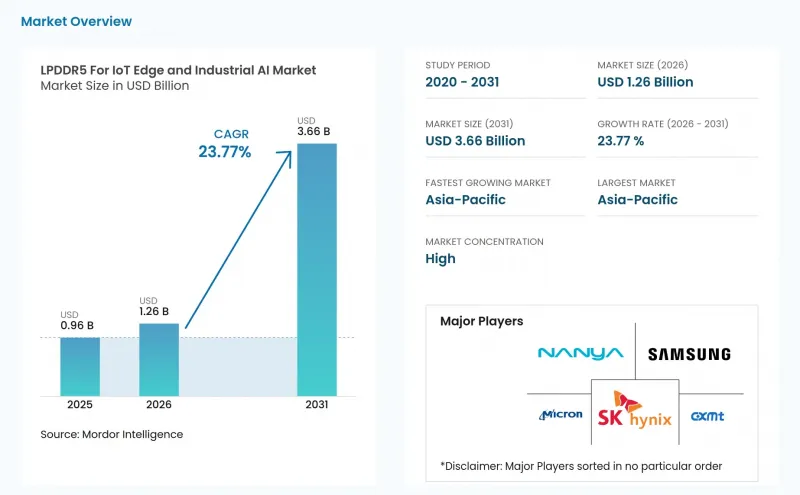
According to Mordor Intelligence, the LPDDR5 for IoT Edge and Industrial AI market size is expected to increase from USD 0.96 billion in 2025 to USD 1.26 billion in 2026 and reach USD 3.66 billion by 2031, growing at a CAGR of 23.8% over 2026-2031.
Global LPDDR5 For IoT Edge and Industrial AI Market Trends and Insights
Rising On-Device AI Memory Demand Across Industrial Platforms
On-device AI inference has moved from pilot activity to routine deployment across factories, logistics hubs, and industrial infrastructure. The LPDDR5 market for IoT Edge and Industrial AI is benefiting as these deployments increasingly run multiple models on the same edge device. DEEPX positioned its DX-M1 processor with Rambus LPDDR5 and LPDDR5X controller IP for factory automation, edge servers, smart cameras, and robotics, showing how validated memory interfaces are becoming part of the industrial AI stack. Advantech launched the AIR-055 with 36 GB of LPDDR5 memory and up to 100 TOPS at under 60 W, underscoring how much memory current vision AI systems already carry in compact industrial form factors. These systems are increasingly limited by data delivery rather than raw compute, so memory bandwidth has become a direct factor in usable inference performance. The sharpest demand increase in 2026 comes from multi-model workloads in quality inspection, anomaly detection, and predictive maintenance, which is raising memory content per deployed node across the LPDDR5 for IoT Edge and Industrial AI market.
Power-Efficiency Requirements for Battery-Powered and Fanless Industrial Deployments
Battery-powered and fanless industrial nodes have tight thermal budgets, making power efficiency a primary criterion for memory selection. The IoT Edge and Industrial AI market is seeing faster adoption of LPDDR5X because LPDDR4X cannot meet the same inference performance envelope in many compact systems. Micron states that LPDDR5X can reduce power consumption by 20% to 25% compared to LPDDR5 through a dual-domain voltage architecture and dynamic voltage and frequency scaling. Samsung also began mass production of 0.65 mm LPDDR5X packages with improved heat resistance and a lower profile, which helps dense robotic controllers and compact AI modules. Thinner packages reduce thermal bottlenecks in co-packaged designs, which supports the rise of embedded and system-in-package memory layouts in the LPDDR5 for IoT Edge and Industrial AI market. Mobile robot and industrial gateway OEMs that need 8 to 15 hours of duty cycle are among the clearest beneficiaries of these efficiency gains.
High Vendor Concentration And Supply Chain Dependency
The LPDDR5 for IoT Edge and Industrial AI markets still depend on a very small group of suppliers for advanced LPDDR5X volume. This creates purchasing risk for industrial OEMs that lack the scale to secure preferred allocation. SK hynix started mass production of the 192 GB SOCAMM2 in April 2026 for NVIDIA's Vera Rubin platform, underscoring how aggressively advanced low-power memory capacity is being pulled toward larger AI programs. Micron also shipped 256 GB SOCAMM2 customer samples in March 2026, indicating the same upstream focus on very high-capacity AI memory formats. When industrial buyers enter qualification cycles during this kind of supply redirection, price discipline weakens and lead times become harder to manage. CXMT is beginning to offer a partial offset, but qualification depth and industrial temperature support still matter before it can serve as a full substitute across the LPDDR5 for IoT Edge and Industrial AI market.
Other drivers and restraints analyzed in the detailed report include:
- Higher Memory Bandwidth Requirements for Edge Inference Workloads
- Accelerated Shift Toward LPDDR5X Across Industrial And IoT Platforms
- Design-In Complexity And Extended Qualification Lead Times
For complete list of drivers and restraints, kindly check the Table Of Contents.
Segment Analysis
LPDDR5 held 58.16% of generation demand in 2025, while LPDDR5X is projected to grow at a 25.12% CAGR through 2031. That split shows a market where the installed base remains large, but the momentum in new design has already shifted. LPDDR5 became the practical baseline for platforms that completed qualification between 2022 and 2024, especially in industrial gateways and early AI-enabled controllers. The LPDDR5 for IoT Edge and Industrial AI market, therefore, entered 2026 with a strong legacy position for LPDDR5, but not with lasting insulation from a newer standard. LPDDR5X is gaining traction because it improves both power efficiency and thermal performance within the same design envelope.
Micron's description of dual-domain voltage control helps explain why LPDDR5X is more attractive in fanless and battery-aware systems that already run close to thermal limits. Samsung's 0.65 mm LPDDR5X package adds another push, as improved heat resistance enables smaller industrial modules and denser board layouts. The LPDDR5 for IoT Edge and Industrial AI industries is also seeing faster adoption as developers increasingly refresh older LPDDR4X-based platforms with AI-capable hardware. LPDDR6 remains visible on the roadmap, but it is not yet the qualified volume option for near-term industrial deployment. That leaves LPDDR5X as the most practical upgrade target across the LPDDR5 for IoT Edge and Industrial AI market during the current design cycle.
The 8 GB to 16 GB tier led with 43.77% of capacity demand in 2025, while above 16 GB is expected to expand at a 25.81% CAGR through 2031. This range remains the current balance point for many factory automation and industrial gateway systems. It is large enough for meaningful local inference, but still manageable within common thermal and power budgets. The LPDDR5 for IoT Edge and Industrial AI market is now moving upward because advanced robotics and machine vision systems need more working memory for continuous model execution. Connect Tech's 2026 launch note on the Jetson T3000, with 32 GB of LPDDR5X and 273 GB/s of bandwidth, shows how memory floors are rising for autonomous systems.
The Up to 8 GB tier still serves legacy gateways, safety controllers, and lower-complexity edge nodes, but its role is increasingly tied to older architectures. Above 16 GB is expanding faster because robotics, industrial edge servers, and multi-stream vision systems push beyond the practical working set of 16 GB. Rambus also highlighted ongoing work toward LPDDR6-PIM with DEEPX, which signals a future where extra memory capacity also carries stronger compute value for certain edge AI workloads. Safety-sensitive energy and utility use cases are adding interest in higher-capacity memory because error tolerance and continuous monitoring need more robust platform configurations. That pattern keeps the LPDDR5 for IoT Edge and Industrial AI market tilted toward denser configurations as industrial AI models become more persistent and more local.
Complete Report Scope:
- By Generation
- LPDDR5
- LPDDR5X
- By Capacity
- Up to 8 GB
- 8 GB to 16 GB
- Above 16 GB
- By Package Configuration
- Discrete LPDDR Packages
- Package-on-Package (PoP)
- Multichip Packages (MCP/uMCP)
- Embedded / SiP-Based Solutions
- By Application
- Industrial Edge AI Computers and Box PCs
- High-Performance IoT Gateways
- Industrial Controllers and HMIs
- Machine Vision and Smart Cameras
- Robotics, Cobots, AMRs and AGVs
- By End Use Environment
- Factory Automation and Manufacturing
- Energy and Utilities
- Transportation, Warehousing and Logistics
- Smart Infrastructure
- Other Industrial IoT Applications
- By Geography
- North America
- Europe
- Asia Pacific
- China
- Japan
- South Korea
- Taiwan
- Rest of Asia Pacific
- Rest of the World
Geography Analysis
Asia Pacific held 54.92% of the LPDDR5 market share in the IoT Edge and Industrial AI markets in 2025 and is projected to grow at a 24.96% CAGR through 2031. This combination of scale and growth reflects the region's rare balance of supply strength and end-use demand. South Korea remains a major supply anchor because Samsung and SK hynix continue to define performance, packaging, and advanced-node execution across low-power DRAM programs. Taiwan adds a different advantage through packaging, integration, and platform-level memory design for compact AI form factors. Japan supports the regional position through industrial OEM demand that values extended-temperature qualification and strict quality testing for automation equipment.
China is becoming the main variable in the Asia Pacific. CXMT entered mass production of LPDDR5X and later filed for a USD 4.3 billion IPO to fund a much larger facility, which shows that domestic Chinese supply is moving toward meaningful scale. This matters because Chinese industrial OEMs can increasingly specify a domestic source in addition to global leaders. That shift can change pricing behavior in China-first procurement channels and gradually affect neighboring APAC markets.
North America holds an important role through industrial OEM demand and Micron's strategic position in advanced low-power memory development. Micron's 256 GB SOCAMM2 sample shipment in March 2026 showed how the region stays relevant in high-capacity low-power memory innovation, even when industrial qualification follows a slower path. Europe remains a qualification-heavy market tied to automotive-adjacent automation, precision manufacturing, rail systems, and energy infrastructure. Buyers there often favor established suppliers with long lifecycle support and strong certification depth. Rest of the World is still in an earlier adoption stage, with growth driven more by global platform rollouts than by local memory design activity.
- Samsung Electronics Co., Ltd.
- SK hynix Inc.
- Micron Technology, Inc.
- ChangXin Memory Technologies, Inc.
- Nanya Technology Corporation
- Winbond Electronics Corporation
- Elite Semiconductor Microelectronics Technology Inc.
- Integrated Silicon Solution, Inc.
- AP Memory Technology Corporation
- Etron Technology, Inc.
- Longsys Electronics Co., Ltd.
- BIWIN Storage Technology Co., Ltd.
- Kingston Technology Company, Inc.
- ADATA Technology Co., Ltd.
- Dosilicon Co., Ltd.
- Rambus Inc.
- Qualcomm Technologies, Inc.
- MediaTek Inc.
- Infineon Technologies AG
- STMicroelectronics N.V.
Additional Benefits:
- The market estimate (ME) sheet in Excel format
- 3 months of analyst support
TABLE OF CONTENTS
1 INTRODUCTION
- 1.1 Study Assumptions and Market Definition
- 1.2 Scope of the Study
2 RESEARCH METHODOLOGY
3 EXECUTIVE SUMMARY
4 MARKET LANDSCAPE
- 4.1 Market Overview
- 4.2 Market Drivers
- 4.2.1 Rising On-Device AI Inference in Industrial Edge Systems
- 4.2.2 Higher Memory Bandwidth Demand from High-Performance IoT Gateways
- 4.2.3 Power-Efficiency Requirements in Battery-Backed and Thermally Constrained Edge Nodes
- 4.2.4 Shift Toward LPDDR5X in Compact System Designs
- 4.2.5 Longer Product Lifecycles in Industrial Electronics Favor Low-Power DRAM
- 4.2.6 Qualification Pull From Automotive-Grade and Ruggedized Edge Platforms
- 4.3 Market Restraints
- 4.3.1 High Vendor Concentration and Supply Allocation Risk
- 4.3.2 Design-In Complexity for LPDDR5 Controller and PHY Integration
- 4.3.3 Cost Premium Versus Legacy DRAM Standards
- 4.3.4 Limited Compatibility Across Installed Industrial Embedded Platforms
- 4.4 Industry Value Chain Analysis
- 4.5 Regulatory Landscape
- 4.6 Porter's Five Forces Analysis
- 4.6.1 Bargaining Power of Suppliers
- 4.6.2 Bargaining Power of Buyers
- 4.6.3 Threat of New Entrants
- 4.6.4 Threat of Substitutes
- 4.6.5 Competitive Rivalry
- 4.7 Technological Outlook
- 4.7.1 LPDDR5X to LPDDR6 Transition Path
- 4.7.2 Advanced Packaging and SiP Integration
- 4.7.3 Thermal Management and Power Scaling Innovations
5 MARKET SIZE AND GROWTH FORECASTS
- 5.1 By Generation
- 5.1.1 LPDDR5
- 5.1.2 LPDDR5X
- 5.2 By Capacity
- 5.2.1 Up to 8 GB
- 5.2.2 8 GB to 16 GB
- 5.2.3 Above 16 GB
- 5.3 By Package Configuration
- 5.3.1 Discrete LPDDR Packages
- 5.3.2 Package-on-Package (PoP)
- 5.3.3 Multichip Packages (MCP/uMCP)
- 5.3.4 Embedded / SiP-Based Solutions
- 5.4 By Application
- 5.4.1 Industrial Edge AI Computers and Box PCs
- 5.4.2 High-Performance IoT Gateways
- 5.4.3 Industrial Controllers and HMIs
- 5.4.4 Machine Vision and Smart Cameras
- 5.4.5 Robotics, Cobots, AMRs and AGVs
- 5.5 By End Use Environment
- 5.5.1 Factory Automation and Manufacturing
- 5.5.2 Energy and Utilities
- 5.5.3 Transportation, Warehousing and Logistics
- 5.5.4 Smart Infrastructure
- 5.5.5 Other Industrial IoT Applications
- 5.6 By Geography
- 5.6.1 North America
- 5.6.2 Europe
- 5.6.3 Asia Pacific
- 5.6.3.1 China
- 5.6.3.2 Japan
- 5.6.3.3 South Korea
- 5.6.3.4 Taiwan
- 5.6.3.5 Rest of Asia Pacific
- 5.6.4 Rest of the World
6 COMPETITIVE LANDSCAPE
- 6.1 Market Concentration
- 6.2 Strategic Moves
- 6.3 Market Share Analysis
- 6.4 Company Profiles (includes Global Level Overview, Market Level Overview, Core Segments, Financials as available, Strategic Information, Market Rank/Share, Products and Services, Recent Developments)
- 6.4.1 Samsung Electronics Co., Ltd.
- 6.4.2 SK hynix Inc.
- 6.4.3 Micron Technology, Inc.
- 6.4.4 ChangXin Memory Technologies, Inc.
- 6.4.5 Nanya Technology Corporation
- 6.4.6 Winbond Electronics Corporation
- 6.4.7 Elite Semiconductor Microelectronics Technology Inc.
- 6.4.8 Integrated Silicon Solution, Inc.
- 6.4.9 AP Memory Technology Corporation
- 6.4.10 Etron Technology, Inc.
- 6.4.11 Longsys Electronics Co., Ltd.
- 6.4.12 BIWIN Storage Technology Co., Ltd.
- 6.4.13 Kingston Technology Company, Inc.
- 6.4.14 ADATA Technology Co., Ltd.
- 6.4.15 Dosilicon Co., Ltd.
- 6.4.16 Rambus Inc.
- 6.4.17 Qualcomm Technologies, Inc.
- 6.4.18 MediaTek Inc.
- 6.4.19 Infineon Technologies AG
- 6.4.20 STMicroelectronics N.V.
7 MARKET OPPORTUNITIES AND FUTURE OUTLOOK
- 7.1 White-space and Unmet-Need Assessment

