PUBLISHER: Mordor Intelligence | PRODUCT CODE: 2185123

PUBLISHER: Mordor Intelligence | PRODUCT CODE: 2185123
Semiconductor Epoxy Molding Compounds - Market Share Analysis, Industry Trends & Statistics, Growth Forecasts (2027 - 2032)
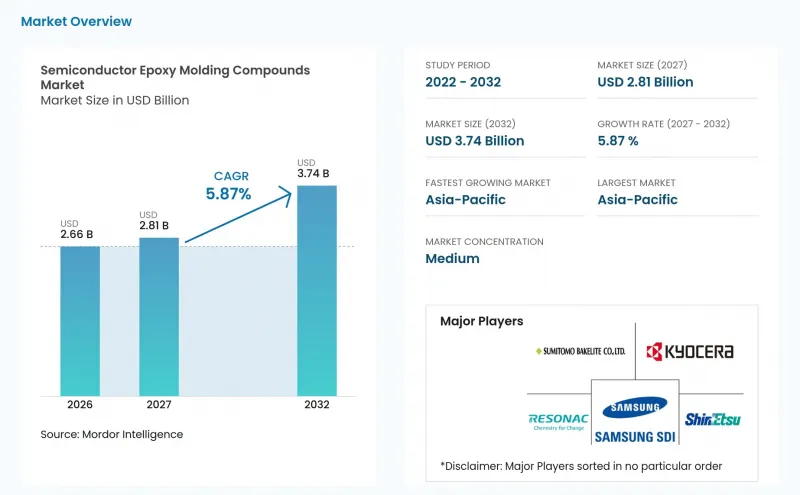
According to Mordor Intelligence, the semiconductor epoxy molding compounds market size was valued at USD 2.66 billion in 2026 and is estimated to grow from USD 2.81 billion in 2027 to reach USD 3.74 billion by 2032, at a CAGR of 5.87% during the forecast period (2027-2032).
Global Semiconductor Epoxy Molding Compounds Market Trends and Insights
Advanced Packaging and Heterogeneous Integration
The shift from monolithic chips to chiplet designs is changing the material requirements for the semiconductor epoxy molding compounds market. Fan-out redistribution layers embedded in molded substrates need compounds with coefficient of thermal expansion (CTE) values that closely match silicon. They also need flow behavior and curing characteristics suitable for much denser vertical interconnect structures. Samsung Semiconductor described how its heterogeneous integration platform used hybrid copper bonding for chiplet dies at a 9-10 µm pitch, a format that requires low-CTE encapsulation materials and balanced elastic properties. Every added die creates more interfaces exposed to thermal stress, making long-term reliability a central selection factor for advanced packages.
AI Accelerators, HPC and Data-Center Packaging
Artificial intelligence accelerators and high-performance computing (HPC) packages are increasing the technical demands placed on the semiconductor epoxy molding compounds market. These packages combine multiple logic dies and high-bandwidth memory in a larger footprint, increasing heat generation, stress across the package, and the need for dimensional stability during assembly and operation. Advanced packaging has become a significant capacity constraint for artificial intelligence chips, rather than a secondary manufacturing step. The resulting demand supports compounds that maintain low warpage, controlled thermal expansion, reliable curing, and consistent performance under high thermal loads, particularly when packaging processes place fine-pitch structures close to sensitive interfaces. It also favors liquid compression mold compounds and other specialized formulations that can meet tighter dimensional tolerances than standard granular products. Suppliers with experience in low-stress material systems can strengthen their position by working with package makers on the compound, mold process, and reliability requirements together.
Long Qualification Cycles and Switching Costs
Qualification cycles can slow the adoption of new materials in the semiconductor epoxy molding compounds market. Automotive and other high-reliability applications often require months of testing before a compound can be used in production. A material revision can require the customer to repeat qualification work, even if the change comes from the existing supplier. This makes customers cautious about moving to a new formulation or approving an additional supplier. It also means that material performance alone does not determine adoption speed. The first supplier to qualify a compound for a specific application can hold a strong position throughout the production life of that package.
Other drivers and restraints analyzed in the detailed report include:
- Automotive Electrification and Power-Semiconductor Reliability
- Low-Warpage Materials for Fan-Out and Panel-Level Packaging
- CTE, Moisture and Warpage Trade-Offs
For complete list of drivers and restraints, kindly check the Table Of Contents.
Segment Analysis
High-temperature epoxy held 61.65% of the semiconductor epoxy molding compounds market size in 2026. Its broad use across established package formats supported that leading position. Conventional quad flat packages and ball grid array packages can use high-temperature epoxy, as can thicker mold layers for discrete power devices. Existing transfer-mold equipment across the Asia-Pacific Outsourced Semiconductor Assembly and Test (OSAT) infrastructure also supports the continued use of this grade. Suppliers and package makers can rely on known processing windows and reliability behavior. This makes a shift to another material less attractive unless a new package requirement creates a clear advantage.
Low-temperature epoxy is projected to expand at a 6.74% CAGR through 2032. The growth reflects wider use of thermally sensitive components in heterogeneous packages, including embedded passive devices, optical interconnects, and organic interposers. These components may not tolerate standard 170-180 °C cure temperatures. Other materials, including liquid mold compounds and film-based encapsulants, are gaining use in fan-out wafer-level packaging and system-in-package designs. These alternatives can provide flow characteristics that granular compounds may not achieve in fine-pitch die arrays. The semiconductor epoxy molding compounds market is consequently serving both high-volume conventional packages and more specialized low-temperature or liquid applications.
Complete Report Scope:
- By Type
- High-Temperature Epoxy
- Low-Temperature Epoxy
- Others
- By End-Use Industry
- Consumer Electronics
- Automotive Electronics
- Industrial Electronics
- Data Centers and High-Performance Computing
- Others
- By Geography
- Asia-Pacific
- China
- India
- Japan
- South Korea
- Rest of Asia-Pacific
- North America
- United States
- Canada
- Mexico
- Europe
- Germany
- United Kingdom
- France
- Italy
- Rest of Europe
- South America
- Brazil
- Argentina
- Rest of South America
- Middle East and Africa
- Saudi Arabia
- South Africa
- Rest of Middle East and Africa
- Asia-Pacific
Geography Analysis
Asia-Pacific held 54.22% of the semiconductor epoxy molding compounds market size in 2026 and is projected to advance at a 6.81% CAGR through 2032. The region has a dense base of semiconductor assembly and testing activity in China, Japan, South Korea, and Taiwan. China is a major consumption center because it serves domestic artificial intelligence-chip packaging needs and supply-chain localization initiatives. Its capacity for commodity-grade compounds has expanded, while specialty grades still rely on suppliers with advanced formulation experience. Japan has a deep technical base in specialty epoxy molding compounds and high-purity silica fillers. This supplier network supports the broader global value chain as well as regional package makers.
South Korea's position is linked to its advanced packaging-material base and downstream integration. Samsung SDI and KCC Corporation are among the regional companies active in semiconductor materials. Samsung SDI's 2026 Materials Business performance reflected its push to broaden packaging-material relationships beyond mobile and memory applications. India remains a smaller consumer, but its announced semiconductor assembly investments make it a developing point of interest. Its present demand is still weighted toward lower-complexity package types. The semiconductor epoxy molding compounds market in Asia-Pacific remains closely connected to where large-scale assembly capacity and higher-value packaging development take place.
In North America, the United States drives demand for artificial intelligence accelerators, high-performance computing, hyperscale data centers, and defense electronics, even when assembly occurs in the Asia-Pacific. European demand is concentrated in Germany, France, and the United Kingdom, where automotive electronics producers need reliable power semiconductor modules. Henkel AG & Co. KGaA serves underfill and specialty encapsulant applications for European automotive and industrial original equipment manufacturers. South America and the Middle East and Africa remain smaller developing markets. Brazil's electronics assembly activity in Manaus supports conventional package demand, while Saudi Arabia's electronics manufacturing ambitions could create a longer-term pull for advanced packaging materials.
- Chang Chun Group
- Eternal Materials Co., Ltd.
- Henkel AG and Co. KGaA
- Jiangsu Zhongpeng New Material Co., Ltd.
- KCC Corporation
- KYOCERA Corporation
- Nagase ChemteX Corporation
- NAMICS CORPORATION
- Nitto Denko Corporation
- Panasonic Industry
- PhiChem Corporation
- Resonac Holdings Corporation
- SAMSUNG SDI
- Shin-Etsu Chemical Co., Ltd.
- Sumitomo Bakelite Co., Ltd.
Additional Benefits:
- The market estimate (ME) sheet in Excel format
- 3 months of analyst support
TABLE OF CONTENTS
1 Introduction
- 1.1 Study Assumptions and Market Definition
- 1.2 Scope of the Study
2 Research Methodology
3 Executive Summary
4 Market Landscape
- 4.1 Market Overview
- 4.2 Market Drivers
- 4.2.1 Advanced Packaging and Heterogeneous Integration
- 4.2.2 AI Accelerators, HPC and Data-Center Packaging
- 4.2.3 Automotive Electrification and Power-Semiconductor Reliability
- 4.2.4 Low-Warpage Materials for Fan-Out and Panel-Level Packaging
- 4.2.5 Halogen-Free and Low-Alpha Encapsulation Requirements
- 4.3 Market Restraints
- 4.3.1 Long Qualification Cycles and Switching Costs
- 4.3.2 CTE, Moisture and Warpage Trade-Offs
- 4.3.3 Volatility in Epoxy Resin and High-Purity Filler Costs
- 4.4 Value Chain Analysis
- 4.5 Porter's Five Forces Analysis
- 4.5.1 Bargaining Power of Suppliers
- 4.5.2 Bargaining Power of Buyers
- 4.5.3 Threat of New Entrants
- 4.5.4 Threat of Substitutes
- 4.5.5 Competitive Rivalry
- 4.6 Technological Outlook
5 Market Size and Growth Forecasts (Value)
- 5.1 By Type
- 5.1.1 High-Temperature Epoxy
- 5.1.2 Low-Temperature Epoxy
- 5.1.3 Others
- 5.2 By End-Use Industry
- 5.2.1 Consumer Electronics
- 5.2.2 Automotive Electronics
- 5.2.3 Industrial Electronics
- 5.2.4 Data Centers and High-Performance Computing
- 5.2.5 Others
- 5.3 By Geography
- 5.3.1 Asia-Pacific
- 5.3.1.1 China
- 5.3.1.2 India
- 5.3.1.3 Japan
- 5.3.1.4 South Korea
- 5.3.1.5 Rest of Asia-Pacific
- 5.3.2 North America
- 5.3.2.1 United States
- 5.3.2.2 Canada
- 5.3.2.3 Mexico
- 5.3.3 Europe
- 5.3.3.1 Germany
- 5.3.3.2 United Kingdom
- 5.3.3.3 France
- 5.3.3.4 Italy
- 5.3.3.5 Rest of Europe
- 5.3.4 South America
- 5.3.4.1 Brazil
- 5.3.4.2 Argentina
- 5.3.4.3 Rest of South America
- 5.3.5 Middle East and Africa
- 5.3.5.1 Saudi Arabia
- 5.3.5.2 South Africa
- 5.3.5.3 Rest of Middle East and Africa
- 5.3.1 Asia-Pacific
6 Competitive Landscape
- 6.1 Market Concentration
- 6.2 Strategic Moves
- 6.3 Market Share (%)/Ranking Analysis
- 6.4 Company Profiles (includes Global Overview, Market Overview, Core Segments, Financials as available, Strategic Information, Products and Services, and Recent Developments)
- 6.4.1 Chang Chun Group
- 6.4.2 Eternal Materials Co., Ltd.
- 6.4.3 Henkel AG and Co. KGaA
- 6.4.4 Jiangsu Zhongpeng New Material Co., Ltd.
- 6.4.5 KCC Corporation
- 6.4.6 KYOCERA Corporation
- 6.4.7 Nagase ChemteX Corporation
- 6.4.8 NAMICS CORPORATION
- 6.4.9 Nitto Denko Corporation
- 6.4.10 Panasonic Industry
- 6.4.11 PhiChem Corporation
- 6.4.12 Resonac Holdings Corporation
- 6.4.13 SAMSUNG SDI
- 6.4.14 Shin-Etsu Chemical Co., Ltd.
- 6.4.15 Sumitomo Bakelite Co., Ltd.
7 Market Opportunities and Future Outlook
- 7.1 White-Space and Unmet-Need Assessment

