PUBLISHER: Mordor Intelligence | PRODUCT CODE: 2185168

PUBLISHER: Mordor Intelligence | PRODUCT CODE: 2185168
Dyes and Organic Pigment Dispersions For Paper, Packaging and Tissue Industry - Market Share Analysis, Industry Trends & Statistics, Growth Forecasts (2027 - 2032)
According to Mordor Intelligence, the dyes and organic pigment dispersions market for the paper, packaging, and tissue industry was valued at USD 1.44 billion in 2026 and is estimated to grow from USD 1.51 billion in 2027 to USD 1.93 billion by 2032, at a CAGR of 5.03% during the forecast period (2027-2032).
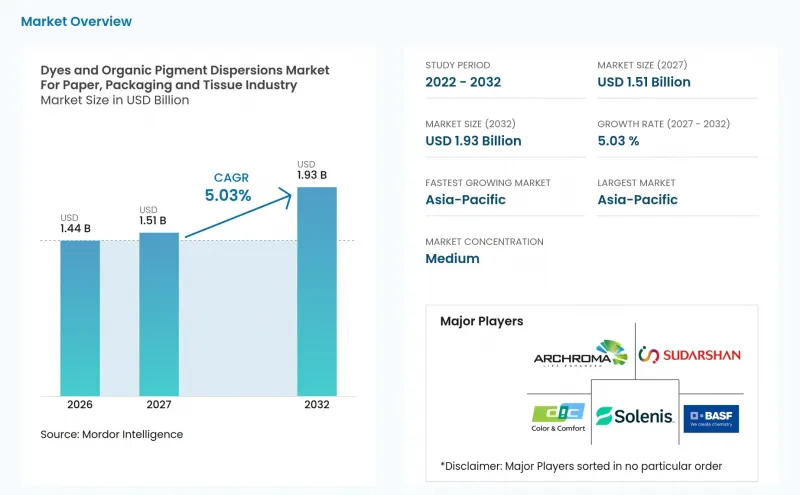
Insights and Trends of Dyes and Organic Pigment Dispersions Market For Paper, Packaging and Tissue Industry
Migration From Plastic to Fiber-Based Packaging
Regulation (EU) 2025/40 entered into force on February 11, 2025, and applies broadly from August 2026. It increases the importance of recyclable packaging formats across the European Union. Fiber-based packaging requires colorants designed for pulp or paper surfaces rather than plastic substrates. A shift from plastic to fiber can therefore require a new qualification cycle for wet-end dyes, pigment dispersions, coatings, and related application systems. The dyes and organic pigment dispersions market for the paper, packaging, and tissue industries benefits when converters require color consistency, recyclability, and suitable performance on new substrates. Paper and board packaging achieved an 82% recycling rate in Europe, supporting the commercial case for fiber formats. Sun Chemical's September 2026 partnership with Archipelago Technology Group links liquid barrier and resistant coatings with paper-based substrates as brands seek alternatives to plastic and composite structures.
E-Commerce Corrugated and Mailer Demand
E-commerce is increasing demand for corrugated liners, mailers, and printed delivery packaging. These applications require stable performance through fulfillment handling, varying humidity, and exposure during delivery. The requirements differ from retail shelf packaging because the package may experience more abrasion and handling before reaching the customer. The dyes and organic pigment dispersions market for the paper, packaging, and tissue industry can benefit from these performance requirements when mills and converters specify colorants for corrugated grades. Canon introduced the corrPRESS iB17 in October 2025 for industrial-scale printing of corrugated packaging using water-based pigment inks. The press is designed for direct printing on corrugated board and reflects a broader need for pigment systems compatible with industrial digital printing equipment. This development also increases the importance of printhead compatibility, color stability, and water-based formulation capability for suppliers.
Digital Substitution of Graphic Paper
Digital communication has continued to reduce paper use for printing and writing in offices, schools, and publishing. This affects demand for direct and acid dyes that have historically served these grades. The decline is difficult for suppliers with dedicated manufacturing assets built around standardized, high-volume graphic paper chemistry. Redirecting capacity into packaging, corrugated, or tissue grades often requires new product development and food-contact compliance work. The dyes and organic pigment dispersions market for the paper, packaging, and tissue industries offers stronger opportunities in packaging than in graphic paper, but capacity cannot be redirected without incurring costs. The decline is structural, as it is tied to changes in how documents are created and used. Suppliers must manage utilization pressure while building more specialized application portfolios.
Other drivers and restraints analyzed in the detailed report include:
- Food-Contact-Safe and Recyclable Coloration Requirements
- Recycled-Fiber Variability Increasing Demand for Retention-Controlled Dispersions
- Restricted-Substance Compliance and Migration Testing Costs
For complete list of drivers and restraints, kindly check the Table Of Contents.
Segment Analysis
Dyes accounted for 76.67% of the dyes and organic pigment dispersions market for the paper, packaging, and tissue industry in 2026. Their position reflects established use in wet-end papermaking, where direct, acid, and basic dye chemistries color cellulose fiber without a separate coating process. This route remains relevant for tissue, hygiene paper, and other consumer-facing paper products that require stable shade control. Dyes are also familiar to mills because they fit existing process equipment and operating practices. DyStar reported progress in its Levacel liquid direct dye range for tissue and packaging, with a focus on migration control and compatibility with modern retention systems. Liquid dyes can integrate with automated dosing systems and support more consistent color application. The shift from powders to liquids also reflects customer interest in lower material-handling complexity and reduced process variability.
Organic pigment dispersions are forecast to grow at a CAGR of 5.45% from 2027 to 2032. They are used where food-contact certification, lightfastness, surface application, or digital-print compatibility is important, requirements that are more difficult to meet with direct dyes alone. Their value proposition is strongest in coated board, premium packaging, and printing systems that require consistent performance on the paper surface. The market has room for dispersions that meet technical and compliance requirements in a single formulation. Water-based systems also align with the shift toward lower-emission processing and paper-based packaging formats. This demand supports more specialized product development and increases competition among suppliers capable of delivering qualified water-based technologies.
Complete Report Scope:
- By Product Type
- Dyes
- Organic Pigment Dispersions
- By Color Type
- Black
- White
- Blue
- Others
- By Paper and Packaging Type
- Printing and Writing Paper
- Packaging Paper and Paperboard
- Corrugated Board
- Flexible Paper Packaging
- Tissue and Hygiene Paper
- Others
- By Geography
- Asia-Pacific
- China
- India
- Japan
- South Korea
- ASEAN Countries
- Rest of Asia-Pacific
- North America
- United States
- Canada
- Mexico
- Europe
- Germany
- United Kingdom
- France
- Italy
- NORDIC Countries
- Rest of Europe
- South America
- Brazil
- Argentina
- Rest of South America
- Middle East and Africa
- Saudi Arabia
- South Africa
- Rest of Middle East and Africa
- Asia-Pacific
Geography Analysis
Asia-Pacific held 42.77% of the dyes and organic pigment dispersions market share for the paper, packaging, and tissue industry in 2026 and is forecast to grow at a CAGR of 5.77% through 2032. China's scale in organic pigment production gives the region a strong manufacturing base for colorant supply. Its shift toward water-based formulations reflects tighter emissions requirements and export standards. India is expanding packaging board capacity for FMCG and pharmaceutical applications. Sudarshan Chemical Industries completed its acquisition of Heubach Group in March 2025, creating a company with 19 manufacturing sites across 4 continents. This gives an Indian-headquartered company broader pigment technology capabilities and global manufacturing reach.
North America holds the second-largest regional position, supported by U.S. e-commerce growth, FMCG packaging demand, and food-contact requirements. Canon's corrPRESS iB17 indicates that industrial digital corrugated printing is advancing in the region. Canada and Mexico contribute additional demand for folding carton and corrugated grades. Europe continues to be shaped by the use of premium-coated paperboard and by recycling requirements. The European Commission's food-contact materials regulations influence product selection for packaging applications. Germany's Printing Ink Ordinance further raises compliance requirements for suppliers serving German packaging converters. These conditions favor suppliers that can document formulation suitability and provide technical support across multiple paper grades.
South America is supported by Brazil's eucalyptus-based pulp and paper industry and its exports to European converters. These exports expose Brazilian mills to European colorant requirements ahead of the wider implementation of the Packaging and Packaging Waste Regulation (PPWR). Argentina and other South American markets remain more cost-sensitive and rely more heavily on locally available direct dyes. The Middle East and Africa represent an emerging demand base for colorant-qualified packaging. Food-processing investment in Saudi Arabia is generating additional demand for packaging materials, while South Africa serves as a distribution hub for regional converters.
- Archroma
- Atul Ltd.
- BASF
- Cabot Corporation
- CLARIANT
- DIC Corporation
- DyStar Singapore Pte Ltd
- Heubach GmbH
- LANXESS
- Penn Color Inc.
- Pidilite Pigment
- Solenis
- Sudarshan Chemical Industries Limited
- Vibrantz
- Vipul Organics Ltd.
Additional Benefits:
- The market estimate (ME) sheet in Excel format
- 3 months of analyst support
TABLE OF CONTENTS
1 Introduction
- 1.1 Study Assumptions and Market Definition
- 1.2 Scope of the Study
2 Research Methodology
3 Executive Summary
4 Market Landscape
- 4.1 Market Overview
- 4.2 Market Drivers
- 4.2.1 Migration From Plastic to Fiber-Based Packaging
- 4.2.2 E-Commerce Corrugated and Mailer Demand
- 4.2.3 Food-Contact-Safe and Recyclable Coloration Requirements
- 4.2.4 Recycled-Fiber Variability Increasing Demand for Retention-Controlled Dispersions
- 4.2.5 Inline Digital Printing and Variable-Data Packaging
- 4.3 Market Restraints
- 4.3.1 Digital Substitution of Graphic Paper
- 4.3.2 Restricted-Substance Compliance and Migration Testing Costs
- 4.3.3 Pigment and Dye Raw-Material Price Volatility
- 4.4 Value Chain Analysis
- 4.5 Porter's Five Forces Analysis
- 4.5.1 Threat of New Entrants
- 4.5.2 Bargaining Power of Suppliers
- 4.5.3 Bargaining Power of Buyers
- 4.5.4 Threat of Substitutes
- 4.5.5 Competitive Rivalry
5 Market Size and Growth Forecasts (Value)
- 5.1 By Product Type
- 5.1.1 Dyes
- 5.1.2 Organic Pigment Dispersions
- 5.2 By Color Type
- 5.2.1 Black
- 5.2.2 White
- 5.2.3 Blue
- 5.2.4 Others
- 5.3 By Paper and Packaging Type
- 5.3.1 Printing and Writing Paper
- 5.3.2 Packaging Paper and Paperboard
- 5.3.3 Corrugated Board
- 5.3.4 Flexible Paper Packaging
- 5.3.5 Tissue and Hygiene Paper
- 5.3.6 Others
- 5.4 By Geography
- 5.4.1 Asia-Pacific
- 5.4.1.1 China
- 5.4.1.2 India
- 5.4.1.3 Japan
- 5.4.1.4 South Korea
- 5.4.1.5 ASEAN Countries
- 5.4.1.6 Rest of Asia-Pacific
- 5.4.2 North America
- 5.4.2.1 United States
- 5.4.2.2 Canada
- 5.4.2.3 Mexico
- 5.4.3 Europe
- 5.4.3.1 Germany
- 5.4.3.2 United Kingdom
- 5.4.3.3 France
- 5.4.3.4 Italy
- 5.4.3.5 NORDIC Countries
- 5.4.3.6 Rest of Europe
- 5.4.4 South America
- 5.4.4.1 Brazil
- 5.4.4.2 Argentina
- 5.4.4.3 Rest of South America
- 5.4.5 Middle East and Africa
- 5.4.5.1 Saudi Arabia
- 5.4.5.2 South Africa
- 5.4.5.3 Rest of Middle East and Africa
- 5.4.1 Asia-Pacific
6 Competitive Landscape
- 6.1 Market Concentration
- 6.2 Strategic Moves
- 6.3 Market Share (%)/Ranking Analysis
- 6.4 Company Profiles (includes Global Overview, Market Overview, Core Segments, Financials as available, Strategic Information, Products and Services, and Recent Developments)
- 6.4.1 Archroma
- 6.4.2 Atul Ltd.
- 6.4.3 BASF
- 6.4.4 Cabot Corporation
- 6.4.5 CLARIANT
- 6.4.6 DIC Corporation
- 6.4.7 DyStar Singapore Pte Ltd
- 6.4.8 Heubach GmbH
- 6.4.9 LANXESS
- 6.4.10 Penn Color Inc.
- 6.4.11 Pidilite Pigment
- 6.4.12 Solenis
- 6.4.13 Sudarshan Chemical Industries Limited
- 6.4.14 Vibrantz
- 6.4.15 Vipul Organics Ltd.
7 Market Opportunities and Future Outlook
- 7.1 White-Space and Unmet-Need Assessment

