PUBLISHER: Mordor Intelligence | PRODUCT CODE: 2185181

PUBLISHER: Mordor Intelligence | PRODUCT CODE: 2185181
Modular Flooring - Market Share Analysis, Industry Trends & Statistics, Growth Forecasts (2027 - 2032)
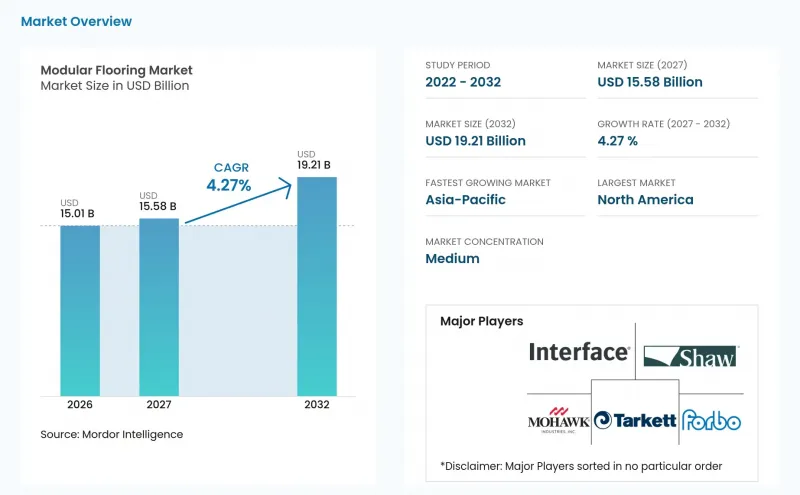
According to Mordor Intelligence, the modular flooring market size was valued at USD 15.01 billion in 2026 and is estimated to grow from USD 15.58 billion in 2027 to reach USD 19.21 billion by 2032, at a CAGR of 4.27% during the forecast period (2027-2032).
Global Modular Flooring Market Trends and Insights
Commercial Renovation and Retrofit Cycles
Renovation work is a central source of demand for the modular flooring market in North America and Europe because most occupied facilities cannot pause services for a full floor replacement. Facility managers can replace a defined area without closing an entire building or removing a complete floor, which makes the approach useful where occupants, patients, students, guests, or customers remain on site. Healthcare, education, senior living, retail, and office properties need phased work that keeps services available and allows each work area to return to use quickly. This requirement favors formats that can be installed in stages, replaced later without broad disruption, and specified for a mixture of high-use and lower-use spaces. The renovation focus also makes demand less dependent on new building permits and financing activity, since existing assets still require maintenance and interior upgrades. Owners can direct available capital toward refurbishment when they delay larger construction projects, which maintains a source of work for flooring suppliers and installers.
Low-Disruption Installation and Selective Replacement
Selective replacement changes how building owners compare flooring costs over a product's service life because they can assess disruption, labor, and future repair needs alongside the material price. A damaged tile can be removed and replaced without taking out adjacent flooring, which helps occupied hospitals, airports, retail stores, offices, and other locations where access must be carefully managed. Click-lock products remove adhesive curing time and allow faster use of the finished area, while loose lay products provide similar flexibility where contractors need to complete work during a short closure window. The modular flooring market benefits when reduced downtime carries a higher cost than the initial material price, particularly for facilities with fixed operating hours or high foot traffic. Large suppliers can strengthen customer retention when replacement tiles, warranties, design support, and installation guidance are available through the same channel. This can turn a single installation into a longer relationship based on maintenance, replacement, and future refurbishment work.
Subfloor Moisture, Flatness and Preparation Sensitivity
Subfloor preparation remains a lasting constraint for the modular flooring market. Moisture is identified as a leading reason for flooring failure, which makes testing and remediation important before installation. Existing buildings can require grinding, moisture barriers, and repeat testing before installers can begin. These steps add cost and can lengthen a retrofit project in facilities that have limited downtime. Magnetic systems can reduce some flatness concerns in specialist settings, although the system cost restricts broader use. Buyers that focus mainly on the first installation price may select conventional options when remediation expenses are not known at tender stage.
Other drivers and restraints analyzed in the detailed report include:
- Acoustic and Well-Being Requirements in Modern Interiors
- Circular Procurement and Green-Building Certification
- Petrochemical Input Exposure and Raw-Material Volatility
For complete list of drivers and restraints, kindly check the Table Of Contents.
Segment Analysis
Luxury vinyl tiles accounted for 53.67% of the modular flooring market size in 2026 and are projected to advance at a 4.89% CAGR through 2032. The segment benefits from click-lock rigid-core formats that reduce adhesive use, shorten installation work, and support occupied-building renovation where work needs to be completed in defined stages. Stone plastic composite products improve stability, dent resistance, and performance under changing indoor conditions, which broadens their use in homes, retail settings, offices, and public interiors. Digital printing gives suppliers more options for wood, stone, and other surface designs while allowing product ranges to serve several aesthetic preferences. These features support demand in residential renovation as well as commercial replacement projects, where users want a balance of durability, visual choice, and simple upkeep.
Manufacturers are directing product development toward lower-impact materials, improved acoustic performance, easier recovery at end of life, and improved surface performance for heavily used spaces. Shaw Industries Group, Inc. introduced EcoWorx Resilient as a closed-loop recyclable commercial resilient flooring platform in 2025. Ceramic modular tiles remain relevant in wet areas and institutional settings that need durability, chemical resistance, and a surface suited to regular cleaning. Rubber formats have roles in healthcare and education where slip resistance, comfort underfoot, acoustic performance, and long service life are important. Polyolefin products support specialized industrial and clean room needs, which ties their performance requirements to controlled environments, equipment traffic, and hygiene requirements rather than general refurbishment.
Complete Report Scope:
- By Product Type
- Luxury Vinyl Tiles (LVT)
- Ceramic
- Rubber
- Polyolefin
- Other Product Types
- By Installation Technique
- Interlocking
- Loose Lay
- Magnetic Systems
- Other Installation Techniques
- By End-Use
- Residential
- Commercial
- Industrial
- By Geography
- Asia-Pacific
- China
- India
- Japan
- South Korea
- ASEAN Countries
- Rest of Asia-Pacific
- North America
- United States
- Canada
- Mexico
- Europe
- Germany
- United Kingdom
- France
- Italy
- NORDIC Countries
- Russia
- Rest of Europe
- South America
- Brazil
- Argentina
- Rest of South America
- Middle East and Africa
- Saudi Arabia
- South Africa
- Rest of Middle East and Africa
- Asia-Pacific
Geography Analysis
North America held 48.14% of the modular flooring market share in 2026, supported by a large installed base of commercial properties entering regular renovation cycles. Corporate offices, healthcare facilities, schools, warehouses, and data centers support demand for durable products that can be installed with limited disruption to daily operations. The United States represents the largest part of regional demand because project teams often use specification-led purchasing and consider service continuity when planning interior upgrades. Mexico is developing as an important growth location as manufacturing investment adds industrial and commercial floor space that requires rapidly installed, durable flooring products.
Asia-Pacific is projected to advance at a 5.38% CAGR through 2032. Urbanization, household formation, and rising interior standards support demand in China, India, and Southeast Asian economies. Education, healthcare, retail, hospitality, and mixed-use projects are expanding the use of products selected through formal design and procurement processes. India is seeing greater adoption of luxury vinyl tiles in organized retail, hospitality, and mid-range housing, where buyers are moving toward rigid-core designs with wood and stone visuals. China remains important for regional demand, while Vietnam, Indonesia, and Thailand are both production locations and consumer markets as household incomes support higher expectations for interior finishes.
South America and the Middle East and Africa are earlier-stage markets where use of modular formats is expanding from a lower base. Brazil supports South American demand through multifamily housing renovation, corporate real estate, and growing retail networks in Sao Paulo and Rio de Janeiro. Saudi Arabia creates opportunities through hospitality, education, and commercial development connected with Vision 2030, while South Africa provides a secondary source of commercial renovation demand. Higher initial costs can limit broader adoption in both regions, especially where conventional vinyl sheet and ceramic tile remain less expensive and total-cost-of-ownership analysis is not routinely used.
- AHF, LLC
- Beaulieu International Group
- CFL Holding Limited
- DH Floors
- Forbo Holding AG
- Gerflor
- Interface, Inc.
- James Halstead PLC
- LX Hausys
- Mannington
- Milliken
- MOHAWK INDUSTRIES, INC.
- Shaw Industries Group, Inc.
- Tarkett
- Toli Floor
Additional Benefits:
- The market estimate (ME) sheet in Excel format
- 3 months of analyst support
TABLE OF CONTENTS
1 Introduction
- 1.1 Study Assumptions and Market Definition
- 1.2 Scope of the Study
2 Research Methodology
3 Executive Summary
4 Market Landscape
- 4.1 Market Overview
- 4.2 Market Drivers
- 4.2.1 Commercial Renovation and Retrofit Cycles
- 4.2.2 Low-Disruption Installation and Selective Replacement
- 4.2.3 Acoustic and Well-being Requirements in Modern Interiors
- 4.2.4 Circular Procurement and Green-Building Certification
- 4.2.5 Interoperable Carpet Tile, LVT and Rubber Flooring Systems
- 4.3 Market Restraints
- 4.3.1 Subfloor Moisture, Flatness and Preparation Sensitivity
- 4.3.2 Petrochemical Input Exposure and Raw-Material Volatility
- 4.3.3 Higher Upfront Cost Versus Conventional Flooring
- 4.4 Value Chain Analysis
- 4.5 Porter's Five Forces Analysis
- 4.5.1 Bargaining Power of Suppliers
- 4.5.2 Bargaining Power of Buyers
- 4.5.3 Threat of New Entrants
- 4.5.4 Threat of Substitutes
- 4.5.5 Competitive Rivalry
5 Market Size and Growth Forecasts (Value)
- 5.1 By Product Type
- 5.1.1 Luxury Vinyl Tiles (LVT)
- 5.1.2 Ceramic
- 5.1.3 Rubber
- 5.1.4 Polyolefin
- 5.1.5 Other Product Types
- 5.2 By Installation Technique
- 5.2.1 Interlocking
- 5.2.2 Loose Lay
- 5.2.3 Magnetic Systems
- 5.2.4 Other Installation Techniques
- 5.3 By End-Use
- 5.3.1 Residential
- 5.3.2 Commercial
- 5.3.3 Industrial
- 5.4 By Geography
- 5.4.1 Asia-Pacific
- 5.4.1.1 China
- 5.4.1.2 India
- 5.4.1.3 Japan
- 5.4.1.4 South Korea
- 5.4.1.5 ASEAN Countries
- 5.4.1.6 Rest of Asia-Pacific
- 5.4.2 North America
- 5.4.2.1 United States
- 5.4.2.2 Canada
- 5.4.2.3 Mexico
- 5.4.3 Europe
- 5.4.3.1 Germany
- 5.4.3.2 United Kingdom
- 5.4.3.3 France
- 5.4.3.4 Italy
- 5.4.3.5 NORDIC Countries
- 5.4.3.6 Russia
- 5.4.3.7 Rest of Europe
- 5.4.4 South America
- 5.4.4.1 Brazil
- 5.4.4.2 Argentina
- 5.4.4.3 Rest of South America
- 5.4.5 Middle East and Africa
- 5.4.5.1 Saudi Arabia
- 5.4.5.2 South Africa
- 5.4.5.3 Rest of Middle East and Africa
- 5.4.1 Asia-Pacific
6 Competitive Landscape
- 6.1 Market Concentration
- 6.2 Strategic Moves
- 6.3 Market Share (%)/Ranking Analysis
- 6.4 Company Profiles (includes Global Overview, Market Overview, Core Segments, Financials as available, Strategic Information, Products and Services, and Recent Developments)
- 6.4.1 AHF, LLC
- 6.4.2 Beaulieu International Group
- 6.4.3 CFL Holding Limited
- 6.4.4 DH Floors
- 6.4.5 Forbo Holding AG
- 6.4.6 Gerflor
- 6.4.7 Interface, Inc.
- 6.4.8 James Halstead PLC
- 6.4.9 LX Hausys
- 6.4.10 Mannington
- 6.4.11 Milliken
- 6.4.12 MOHAWK INDUSTRIES, INC.
- 6.4.13 Shaw Industries Group, Inc.
- 6.4.14 Tarkett
- 6.4.15 Toli Floor
7 Market Opportunities and Future Outlook
- 7.1 White-space and Unmet-need Assessment

