PUBLISHER: Mordor Intelligence | PRODUCT CODE: 2185207

PUBLISHER: Mordor Intelligence | PRODUCT CODE: 2185207
OT Attack Surface Management - Market Share Analysis, Industry Trends & Statistics, Growth Forecasts (2027 - 2032)
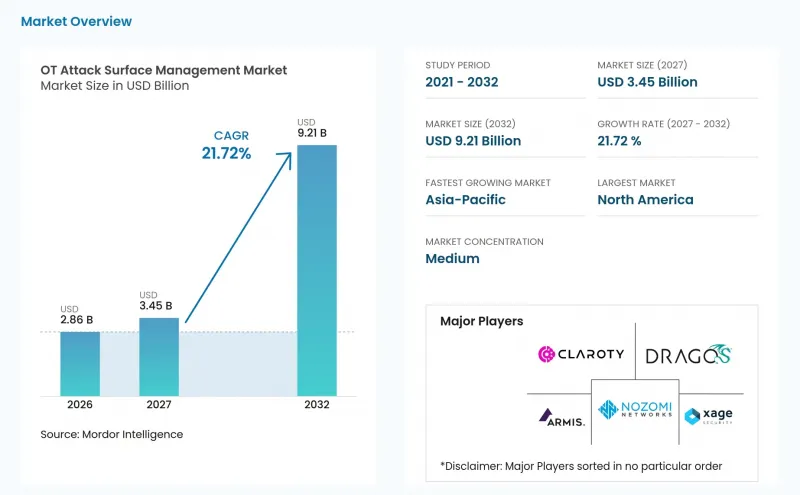
According to Mordor Intelligence, the OT attack surface management market size is valued at USD 2.86 billion in 2026 and is forecast to reach USD 9.21 billion by 2032, expanding at a CAGR of 21.72% from 2027 to 2032.
Global OT Attack Surface Management Market Trends and Insights
IT-OT Convergence Expanding Unmanaged Asset Exposure
IT and OT convergence has reduced the separation that once limited access to plant systems. The OT attack surface management market benefits when operators need to identify links among remote access tools, cloud services, engineering workstations, and controllers. TXOne Networks reported that 96% of OT security incidents in 2025 began with an IT-level compromise, which highlights the importance of securing the pathway into operations. Claroty reported that more than 12% of industrial organizations had OT assets communicating with malicious domains. ISACA noted that connected environments inherit risks from remote access, cloud use, and diverse IoT protocols that many legacy systems were not designed to handle. CISA also warned in May 2025 that exposed assets and default credentials can allow less sophisticated actors to target OT systems.
Critical-Infrastructure Regulation Mandating Continuous OT Visibility
Regulation is shifting from perimeter controls toward ongoing internal visibility and evidence that controls are operating. This supports the OT attack surface management market because asset records, network monitoring, and audit trails are required together. FERC approved NERC CIP-015-1 in June 2025, and the standard requires internal network security monitoring for specified bulk electric system cyber systems. The standard took effect on September 2, 2025, with compliance dates of October 1, 2028, and October 1, 2030. FERC approved CIP-015-2 in August 2026 to extend monitoring to electronic and physical access control systems outside the security perimeter. Japan's Ministry of Economy, Trade, and Industry also issued OT security guidelines for semiconductor device factories in June 2025, connecting plant practices with NIST CSF 2.0 and related frameworks.
Legacy Protocol and Safety Constraints Limiting Active Discovery
Legacy protocols such as Modbus, DNP3, PROFIBUS, and proprietary vendor protocols were not designed for active security scanning. A probe can cause device hangs, communication disruption, or unexpected state changes in a safety-critical setting. NIST's NCCoE stated that OT estates include proprietary protocols that do not apply to standard IT asset management approaches. The same project description noted that legacy configuration collection can require manual physical inspection. Passive monitoring does not identify equipment that generates no traffic, which leaves dark assets, air-gapped equipment, and infrequently communicating controllers less visible. This constraint makes physical walk-downs necessary in some energy, chemical, and water installations, extending deployment time and cost.
Other drivers and restraints analyzed in the detailed report include:
- Industrial Digitalization Increasing Connected Asset Density
- Insurance and Audit Requirements Requiring Evidence-Grade Asset Inventories
- Incomplete Asset Ownership Data Slowing Exposure Remediation
For complete list of drivers and restraints, kindly check the Table Of Contents.
Segment Analysis
Asset discovery and inventory accounted for 57.05% of the OT attack surface management market share in 2026. It is the first capability required before operators can map vulnerabilities, communication paths, and system ownership. CISA identified gaps in asset inventory as a material weakness in OT environments and published guidance on building a complete, usable inventory. Exposure and vulnerability management, along with network and communication monitoring, become more important once an organization has a stable asset record. These functions allow operators to move from a device list toward prioritization and continuous oversight. Other capabilities, such as reporting modules and integration middleware, support the workflow but are often incorporated into broader platforms.
Attack-path analysis and visualization are projected to grow at a 23.56% CAGR from 2027 to 2032. The OT attack surface management market size for this capability is driven by users who need to understand whether a group of connected weaknesses could impact a physical process. Peer-reviewed research published in 2026 found that attack-graph-based OT risk assessment improved the prediction of adversary paths compared with assessments based solely on vulnerability scores. Claroty introduced its CPS Library in August 2025 and launched Claroty Claire in May 2026 to add asset context to vulnerability and exposure data. Dragos introduced EmberAI in 2026 to help analysts query assets and translate advisories into site-specific assessments. As ISA/IEC 62443-based risk assessment practices mature, documented path analysis can serve security, engineering, and compliance teams together.
On-premises deployment represented 66.81% of revenue in 2026. Many OT environments prioritize deterministic performance, air-gap separation, and restricted data movement, which limits the use of cloud connectivity in sensitive sites. Nuclear, defense-related, and classified industrial facilities may require local processing due to data-sovereignty rules. Local platforms can therefore remain necessary even when enterprise security programs use cloud tools elsewhere. Hybrid models provide an intermediate option through plant-level collectors and centrally managed analytics. This approach can preserve local operational controls while allowing multi-site oversight.
Cloud deployment is projected to grow at a 23.89% CAGR from 2027 to 2032. The OT attack surface management market benefits from cloud delivery, where hardware costs, specialist staffing requirements, and software update delays create barriers for smaller teams. CISA issued 2,155 CVEs across 508 ICS advisories in 2025, which shows the operational value of timely intelligence and platform updates. Claroty's xDome and TXOne management platforms show how local data collection can be combined with centrally available risk analytics. Cloud options are particularly relevant to logistics, food and beverage, and mid-market manufacturing sites where continuity requirements are less restrictive than in core utility operations. Small and medium-sized enterprises can use the model to obtain capabilities that would be difficult to maintain entirely on-site.
Complete Report Scope:
- By Solution Capability
- Asset Discovery and Inventory
- Exposure and Vulnerability Management
- Network and Communication Monitoring
- Attack-Path Analysis and Visualization
- Other Solution Capabilities
- By Deployment Mode
- Cloud
- On-Premises
- Hybrid
- By Asset Type
- Industrial Control Systems
- Supervisory Control and Data Acquisition Systems
- Programmable Logic Controllers and Remote Terminal Units
- Distributed Control Systems
- Industrial IoT and Sensors
- Other Asset Types
- By Organization Size
- Large Enterprises
- Small and Medium-Sized Enterprises
- By End-Use Industry
- Energy and Utilities
- Oil and Gas
- Industrial Manufacturing
- Chemicals and Petrochemicals
- Water and Wastewater
- Transportation and Logistics
- Government and Public Administration
- Other End-Use Industries
- By Geography
- North America
- United States
- Canada
- South America
- Brazil
- Argentina
- Mexico
- Rest of South America
- Europe
- Germany
- United Kingdom
- France
- Italy
- Russia
- Rest of Europe
- Asia-Pacific
- China
- Japan
- India
- South Korea
- Rest of Asia-Pacific
- Middle East
- Saudi Arabia
- United Arab Emirates
- Rest of Middle East
- Africa
- South Africa
- Nigeria
- Rest of Africa
- North America
Geography Analysis
North America accounted for 36.19% of revenue in 2026, the largest share of the OT attack surface management market among regions. FERC's approval of CIP-015-1 created a procurement cycle for internal network monitoring at relevant bulk electric system entities. CIP-015-2, approved in 2026, broadened that effort to access-control systems outside the electronic security perimeter. The TSA Pipeline-2021-02F Security Directive added a related requirement for liquid and gas pipeline operators in 2025. The United States leads regional demand, while Canada is adopting aligned practices.
Europe is an important OT attack surface management market, as NIS2 requirements have led many industrial operators to establish asset inventories in 2025 and 2026. Germany, the United Kingdom, and France are the main demand centers due to their industrial bases, energy infrastructure, and enforcement bodies. The United Kingdom's Cyber Security and Resilience Bill adds accountability and incident-reporting expectations for infrastructure service providers. South America is earlier in adoption, and multinational manufacturers are applying common OT security practices at sites in Brazil and Argentina.
Asia-Pacific is projected to grow at a 22.81% CAGR from 2027 to 2032. This OT attack surface management market combines rapid digitalization, a large manufacturing base, and increasingly formal security requirements. Japan's 2025 semiconductor factory guidelines provide procurement and audit direction for a broad supply chain. China, India, and South Korea are adding connected industrial devices faster than security tooling is deployed. The Middle East and Africa are at earlier stages, with Saudi Arabia, the UAE, South Africa, and Nigeria serving as key entry points.
- Armis Security, Ltd.
- Claroty Ltd.
- Dragos, Inc.
- Nozomi Networks Inc.
- runZero, Inc.
- TXOne Networks Inc.
- Xage Security, Inc.
- Radiflow Ltd.
- Industrial Defender, Inc.
- Otorio Ltd.
- SCADAfence Ltd.
- Sepio Systems Ltd.
- Mission Secure, Inc.
- Verve Industrial Protection, Inc.
- OTbase GmbH
- Armexa, Inc.
- Shift5, Inc.
- Applied Risk B.V.
- SecurityMatters B.V.
- Cogniteam Ltd.
Additional Benefits:
- The market estimate (ME) sheet in Excel format
- 3 months of analyst support
TABLE OF CONTENTS
1 INTRODUCTION
- 1.1 Study Assumptions and Market Definition
- 1.2 Scope of the Study
2 RESEARCH METHODOLOGY
3 EXECUTIVE SUMMARY
4 MARKET LANDSCAPE
- 4.1 Market Overview
- 4.2 Market Drivers
- 4.2.1 IT-OT Convergence Expanding Unmanaged Asset Exposure
- 4.2.2 Critical-Infrastructure Regulation Mandating Continuous OT Visibility
- 4.2.3 Industrial Digitalization Increasing Connected Asset Density
- 4.2.4 Insurance and Audit Requirements Requiring Evidence-Grade Asset Inventories
- 4.2.5 Safe Active Discovery Improving Coverage Beyond Passive Monitoring
- 4.2.6 AI-Assisted Asset Contextualization Reducing OT Exposure-Management Workload
- 4.3 Market Restraints
- 4.3.1 Legacy Protocol and Safety Constraints Limiting Active Discovery
- 4.3.2 Incomplete Asset Ownership Data Slowing Exposure Remediation
- 4.3.3 Operational Downtime Sensitivity Extending Deployment Cycles
- 4.3.4 Shortage of OT-Cybersecurity Specialists Increasing Total Cost of Ownership
- 4.4 Industry Value Chain Analysis
- 4.5 Regulatory Landscape
- 4.6 Technological Outlook
- 4.7 Porter's Five Forces Analysis
- 4.7.1 Threat of New Entrants
- 4.7.2 Bargaining Power of Suppliers
- 4.7.3 Bargaining Power of Buyers
- 4.7.4 Threat of Substitutes
- 4.7.5 Competitive Rivalry
- 4.8 Impact of Macroeconomic Factors on the Market
5 MARKET SIZE AND GROWTH FORECASTS (VALUE)
- 5.1 By Solution Capability
- 5.1.1 Asset Discovery and Inventory
- 5.1.2 Exposure and Vulnerability Management
- 5.1.3 Network and Communication Monitoring
- 5.1.4 Attack-Path Analysis and Visualization
- 5.1.5 Other Solution Capabilities
- 5.2 By Deployment Mode
- 5.2.1 Cloud
- 5.2.2 On-Premises
- 5.2.3 Hybrid
- 5.3 By Asset Type
- 5.3.1 Industrial Control Systems
- 5.3.2 Supervisory Control and Data Acquisition Systems
- 5.3.3 Programmable Logic Controllers and Remote Terminal Units
- 5.3.4 Distributed Control Systems
- 5.3.5 Industrial IoT and Sensors
- 5.3.6 Other Asset Types
- 5.4 By Organization Size
- 5.4.1 Large Enterprises
- 5.4.2 Small and Medium-Sized Enterprises
- 5.5 By End-Use Industry
- 5.5.1 Energy and Utilities
- 5.5.2 Oil and Gas
- 5.5.3 Industrial Manufacturing
- 5.5.4 Chemicals and Petrochemicals
- 5.5.5 Water and Wastewater
- 5.5.6 Transportation and Logistics
- 5.5.7 Government and Public Administration
- 5.5.8 Other End-Use Industries
- 5.6 By Geography
- 5.6.1 North America
- 5.6.1.1 United States
- 5.6.1.2 Canada
- 5.6.2 South America
- 5.6.2.1 Brazil
- 5.6.2.2 Argentina
- 5.6.2.3 Mexico
- 5.6.2.4 Rest of South America
- 5.6.3 Europe
- 5.6.3.1 Germany
- 5.6.3.2 United Kingdom
- 5.6.3.3 France
- 5.6.3.4 Italy
- 5.6.3.5 Russia
- 5.6.3.6 Rest of Europe
- 5.6.4 Asia-Pacific
- 5.6.4.1 China
- 5.6.4.2 Japan
- 5.6.4.3 India
- 5.6.4.4 South Korea
- 5.6.4.5 Rest of Asia-Pacific
- 5.6.5 Middle East
- 5.6.5.1 Saudi Arabia
- 5.6.5.2 United Arab Emirates
- 5.6.5.3 Rest of Middle East
- 5.6.6 Africa
- 5.6.6.1 South Africa
- 5.6.6.2 Nigeria
- 5.6.6.3 Rest of Africa
- 5.6.1 North America
6 COMPETITIVE LANDSCAPE
- 6.1 Market Concentration
- 6.2 Strategic Moves
- 6.3 Market Share Analysis
- 6.4 Company Profiles (includes Global Level Overview, Market Level Overview, Core Segments, Financials as available, Strategic Information, Market Rank/Share, Products and Services, Recent Developments)
- 6.4.1 Armis Security, Ltd.
- 6.4.2 Claroty Ltd.
- 6.4.3 Dragos, Inc.
- 6.4.4 Nozomi Networks Inc.
- 6.4.5 runZero, Inc.
- 6.4.6 TXOne Networks Inc.
- 6.4.7 Xage Security, Inc.
- 6.4.8 Radiflow Ltd.
- 6.4.9 Industrial Defender, Inc.
- 6.4.10 Otorio Ltd.
- 6.4.11 SCADAfence Ltd.
- 6.4.12 Sepio Systems Ltd.
- 6.4.13 Mission Secure, Inc.
- 6.4.14 Verve Industrial Protection, Inc.
- 6.4.15 OTbase GmbH
- 6.4.16 Armexa, Inc.
- 6.4.17 Shift5, Inc.
- 6.4.18 Applied Risk B.V.
- 6.4.19 SecurityMatters B.V.
- 6.4.20 Cogniteam Ltd.
7 MARKET OPPORTUNITIES AND FUTURE OUTLOOK
- 7.1 White-Space and Unmet-Need Assessment

