PUBLISHER: Mordor Intelligence | PRODUCT CODE: 2185223

PUBLISHER: Mordor Intelligence | PRODUCT CODE: 2185223
United States Industrial Asset Inspection Services - Market Share Analysis, Industry Trends & Statistics, Growth Forecasts (2027 - 2032)
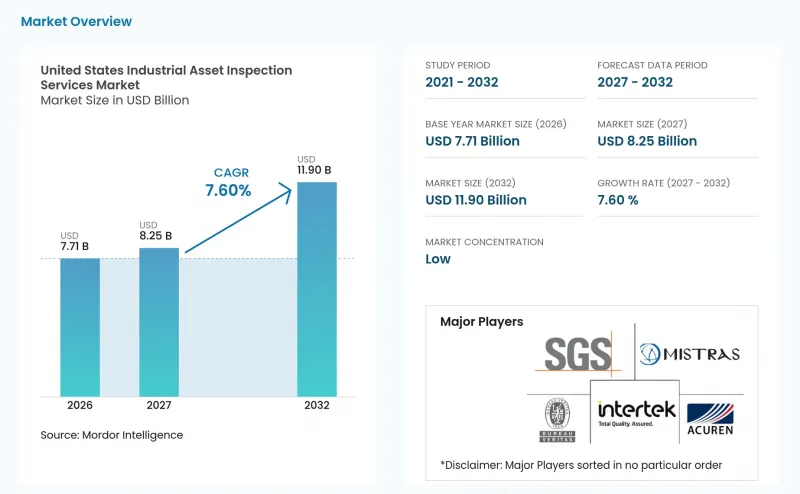
According to Mordor Intelligence, the United States industrial asset inspection services market size is projected to be USD 7.71 billion in 2026, USD 8.25 billion in 2027, and reach USD 11.90 billion by 2032, growing at a CAGR of 7.60% from 2027 to 2032.
United States Industrial Asset Inspection Services Market Trends and Insights
Aging Industrial, Energy, and Infrastructure Assets
A large base of aging industrial and civil assets supports the United States industrial asset inspection services market. The American Society of Civil Engineers (ASCE) identified a USD 3.7 trillion infrastructure investment gap in 2025, including energy, water, and industrial-adjacent systems. This gap was USD 1.1 trillion higher than the figure cited four years earlier, highlighting the continuing need for infrastructure rehabilitation, modernization, and maintenance. Assets operating beyond their original design life can face stress-corrosion cracking, hydrogen attack, flow-accelerated corrosion, and fatigue-related deterioration. These conditions can shorten inspection intervals as risk profiles deteriorate and increase the need for non-destructive testing, thickness measurements, structural assessments, and remaining-life evaluations. Gulf Coast refining units and Midwest steam systems are important examples because their operating histories, exposure to demanding process conditions, and changing duty cycles can increase inspection requirements. Operators are increasingly prioritizing risk-based inspection programs to identify high-consequence defects, allocate maintenance budgets more effectively, and reduce the likelihood of unexpected equipment failures.
Mandatory Mechanical Integrity and Industry Code Compliance
The United States industrial asset inspection services market has a recurring revenue base because many inspections are required by law or code. OSHA requires covered facilities to establish written inspection procedures, document inspections, and correct deficiencies before equipment returns to service. OSHA's 2024 enforcement directive identified mechanical integrity inspection and testing as the most frequently cited PSM element at covered petroleum and chemical facilities. PHMSA's July 2025 rule allowed UAS and satellite methods for pipeline right-of-way patrols, resolving a barrier to drone use without reducing inspection obligations. API 510 and API 653 also support recurring programs for pressure vessels and tanks. These requirements help providers maintain contracted work through periods of lower operator capital spending.
Shortage and Retirement of Qualified Level II and Level III Inspectors
The United States industrial asset inspection services market faces a structural constraint in the availability of certified labor. The United States non-destructive testing (NDT) workforce numbers approximately 89,800 professionals, and 30% are over 55 years old, creating concerns about knowledge transfer and replacement hiring as experienced technicians approach retirement. Level II technicians represent 55% of the active workforce, yet demand for personnel qualified to perform inspections, interpret results, and document findings can exceed available capacity in specialized applications. Achieving Level III certification requires substantial field experience, technical examinations, and ongoing professional qualification, limiting the speed at which providers can develop senior-level expertise. New entrants are not keeping pace with retirements and rising demand from energy infrastructure, refining, power generation, and industrial maintenance projects. Consequently, turnaround periods can face scheduling constraints, reduced inspection scope, higher labor costs, and increased competition for experienced contractors.
Other drivers and restraints analyzed in the detailed report include:
- Federal Infrastructure, Energy-Transition, and Grid-Modernization Investment
- Reshoring, Semiconductor, and Advanced-Manufacturing Capacity Expansion
- High Capital and Qualification Cost of Advanced Inspection Systems
For complete list of drivers and restraints, kindly check the Table Of Contents.
Segment Analysis
Pipelines and piping systems held 22% of the United States industrial asset inspection services market share in 2026. This segment is supported by the density of transmission and process piping that falls under PHMSA and API integrity programs. Oil, gas, and industrial transmission pipelines generate work through inline inspection, external corrosion direct assessment, and cathodic protection surveys. PHMSA reassessment requirements under 49 CFR Parts 192 and 195 provide a recurring inspection base. The 2025 remote-sensing rule broadens the available patrol methods while retaining the underlying inspection requirement. Pressure vessels, boilers, heat exchangers, tanks, and containment systems add large volumes of plant work. Industrial structures include steelwork, offshore platforms, and towers, while offshore wind foundations extend this asset class.
Electrical and power equipment has the fastest projected growth at an 8.5% CAGR from 2027 to 2032. The United States industrial asset inspection services market size for this asset type grows with grid spending and new generating capacity. Transformers, switchgear, and distribution equipment require thermography, power-factor testing, and dissolved-gas analysis. Generators and electrical installations require combined visual, mechanical, and electrical testing. Transmission assets increasingly use drone surveys and LiDAR measurements under reliability standards. Rotating machinery creates demand through vibration monitoring and condition assessment. This supports recurring data services alongside periodic field inspections.
Complete Report Scope:
- By Asset Type
- Pipelines and Piping Systems
- Oil, Gas and Industrial Transmission Pipelines
- Process Piping and Industrial Utility Piping
- Offshore Pipelines, Risers and Flowlines
- Pressure Vessels, Boilers and Heat Exchangers
- Pressure Vessels and Process Reactors
- Industrial Boilers and Steam Systems
- Heat Exchangers and Pressurized Thermal Equipment
- Storage Tanks and Containment Systems
- Aboveground and Underground Industrial Storage Tanks
- Industrial Containment and Bulk Storage Systems
- Rotating and Mechanical Equipment
- Pumps, Compressors and Industrial Turbines
- Conveyors, Drives and Fixed Production Machinery
- Other Installed Mechanical Equipment
- Electrical and Power Equipment
- Transformers, Switchgear and Power Distribution Equipment
- Generators and Electrical Installations
- Power Transmission and Electrical Utility Assets
- Industrial Structures and Fixed Installations
- Industrial Structural Steel and Equipment Supports
- Offshore Platforms and Fixed Energy Installations
- Industrial Towers, Stacks and Supporting Structures
- Other Fixed Industrial Assets
- Process Furnaces and Refractory Systems
- Industrial Instrumentation and Control Installations
- Other Specialized Installed Industrial Assets
- Pipelines and Piping Systems
- By End-Use Industry
- Oil and Gas, Refining and Petrochemicals
- Power Generation, Renewable Energy and Electrical Utilities
- Chemical Manufacturing (Excluding Petrochemicals)
- Metals and Other Industrial Manufacturing
- Mining and Mineral Processing
- Water and Wastewater Utilities
- Food and Beverage Processing
- Pharmaceuticals and Bioprocessing
- Transportation, Logistics and Port Operations
- Other Industrial End Users
List of Companies Covered in this Report:
- SGS SA
- Bureau Veritas SA
- Intertek Group plc
- MISTRAS Group, Inc.
- Acuren
- Applus+
- TEAM, Inc.
- Applied Technical Services, Inc.
- DNV AS
- Element Materials Technology
- TUV SUD AG
- TUV Rheinland AG
- UL Solutions Inc.
- Baker Hughes Company
- Evident Corporation
- Eddyfi Technologies
- Zetec, Inc.
- Waygate Technologies
- Nikon Corporation
- Sonatest Ltd.
Additional Benefits:
- The market estimate (ME) sheet in Excel format
- 3 months of analyst support
TABLE OF CONTENTS
1 Introduction
- 1.1 Study Assumptions and Market Definition
- 1.2 Scope of the Study
2 Research Methodology
3 Executive Summary
4 Market Landscape
- 4.1 Market Overview
- 4.2 Market Drivers
- 4.2.1 Aging Industrial, Energy, and Infrastructure Assets
- 4.2.2 Mandatory Mechanical Integrity and Industry Code Compliance
- 4.2.3 Federal Infrastructure, Energy-Transition, and Grid-Modernization Investment
- 4.2.4 Reshoring, Semiconductor, and Advanced-Manufacturing Capacity Expansion
- 4.2.5 Robotics, Remote Visual Inspection, and AI-Assisted NDT Adoption
- 4.2.6 Inspection-Data Interoperability as a Condition for Predictive Maintenance
- 4.3 Market Restraints
- 4.3.1 Shortage and Retirement of Qualified Level II and Level III Inspectors
- 4.3.2 High Capital and Qualification Cost of Advanced Inspection Systems
- 4.3.3 Inconsistent Acceptance Criteria for AI-Generated Inspection Findings
- 4.3.4 Fragmented Asset Records and Poor Data Lineage Across Brownfield Sites
- 4.4 Value / Supply-Chain Analysis
- 4.4.1 Asset Owners and Operators
- 4.4.2 EPC Contractors and Original Equipment Manufacturers
- 4.4.3 Inspection, Engineering, and Certification Providers
- 4.4.4 Technology, Equipment, and Software Suppliers
- 4.4.5 Accreditation, Standards, and Workforce-Certification Bodies
- 4.4.6 Repair, Maintenance, and Turnaround Contractors
- 4.5 Regulatory Landscape
- 4.5.1 OSHA Process Safety Management and Mechanical Integrity Requirements
- 4.5.2 PHMSA Pipeline Integrity Management Requirements
- 4.5.3 API 510, API 570, API 653, API 580, and API 1169 Frameworks
- 4.5.4 ASME Boiler and Pressure Vessel Code and Section V Nondestructive Examination
- 4.5.5 ASTM, ASNT, ISO 9712, and Employer-Based Qualification Practices
- 4.5.6 State Boiler, Pressure Vessel, Environmental, and Building-Code Requirements
- 4.6 Technological Outlook
- 4.6.1 Conventional Ultrasonic, Radiographic, Magnetic Particle, Liquid Penetrant, and Visual Testing
- 4.6.2 Phased-Array Ultrasonic Testing, TOFD, Guided-Wave, and Eddy-Current Array
- 4.6.3 Digital Radiography, Computed Tomography, and 3D Imaging
- 4.6.4 Drones, Crawlers, Rope Access, and Non-Entry Inspection
- 4.6.5 AI-Assisted Defect Classification and Human-in-the-Loop Review
- 4.6.6 Cloud Inspection Data Management, Digital Twins, and Predictive Analytics
- 4.7 Inspection Service Procurement and Commercial Models
- 4.7.1 Periodic Inspection versus Risk-Based Inspection Programs
- 4.7.2 In-Service versus Shutdown and Turnaround Inspection
- 4.7.3 Project-Based versus Long-Term Inspection Contracts
- 4.7.4 Inspection Pricing and Contract Structures
- 4.7.5 Multi-Site and Integrated Inspection Service Agreements
- 4.7.6 Inspection Frequency and Contract Renewal Dynamics
- 4.8 Macroeconomic and Industrial Capital-Cycle Impact
- 4.8.1 Impact of Industrial Capital Expenditure and Capacity Expansion
- 4.8.2 Impact of Oil and Gas Investment and Energy Price Cycles
- 4.8.3 Impact of Industrial Asset Aging and Maintenance Expenditure
- 4.8.4 Impact of Energy Transition and Infrastructure Modernization
5 Market Size and Growth Forecasts
- 5.1 By Asset Type
- 5.1.1 Pipelines and Piping Systems
- 5.1.1.1 Oil, Gas and Industrial Transmission Pipelines
- 5.1.1.2 Process Piping and Industrial Utility Piping
- 5.1.1.3 Offshore Pipelines, Risers and Flowlines
- 5.1.2 Pressure Vessels, Boilers and Heat Exchangers
- 5.1.2.1 Pressure Vessels and Process Reactors
- 5.1.2.2 Industrial Boilers and Steam Systems
- 5.1.2.3 Heat Exchangers and Pressurized Thermal Equipment
- 5.1.3 Storage Tanks and Containment Systems
- 5.1.3.1 Aboveground and Underground Industrial Storage Tanks
- 5.1.3.2 Industrial Containment and Bulk Storage Systems
- 5.1.4 Rotating and Mechanical Equipment
- 5.1.4.1 Pumps, Compressors and Industrial Turbines
- 5.1.4.2 Conveyors, Drives and Fixed Production Machinery
- 5.1.4.3 Other Installed Mechanical Equipment
- 5.1.5 Electrical and Power Equipment
- 5.1.5.1 Transformers, Switchgear and Power Distribution Equipment
- 5.1.5.2 Generators and Electrical Installations
- 5.1.5.3 Power Transmission and Electrical Utility Assets
- 5.1.6 Industrial Structures and Fixed Installations
- 5.1.6.1 Industrial Structural Steel and Equipment Supports
- 5.1.6.2 Offshore Platforms and Fixed Energy Installations
- 5.1.6.3 Industrial Towers, Stacks and Supporting Structures
- 5.1.7 Other Fixed Industrial Assets
- 5.1.7.1 Process Furnaces and Refractory Systems
- 5.1.7.2 Industrial Instrumentation and Control Installations
- 5.1.7.3 Other Specialized Installed Industrial Assets
- 5.1.1 Pipelines and Piping Systems
- 5.2 By End-Use Industry
- 5.2.1 Oil and Gas, Refining and Petrochemicals
- 5.2.2 Power Generation, Renewable Energy and Electrical Utilities
- 5.2.3 Chemical Manufacturing (Excluding Petrochemicals)
- 5.2.4 Metals and Other Industrial Manufacturing
- 5.2.5 Mining and Mineral Processing
- 5.2.6 Water and Wastewater Utilities
- 5.2.7 Food and Beverage Processing
- 5.2.8 Pharmaceuticals and Bioprocessing
- 5.2.9 Transportation, Logistics and Port Operations
- 5.2.10 Other Industrial End Users
6 Competitive Landscape
- 6.1 Market Concentration
- 6.2 Market Share Analysis
- 6.3 Strategic Developments (Mergers/ Acquisitions, Expansion and Service Portfolio Diversification, Investments in Advanced NDT and Robotic Inspection)
- 6.4 Company Profiles (Includes Global Level Overview, Market Level Overview, Core Segments, Financials as available, Strategic Information, Products and Services, Recent Developments)
- 6.4.1 SGS SA
- 6.4.2 Bureau Veritas SA
- 6.4.3 Intertek Group plc
- 6.4.4 MISTRAS Group, Inc.
- 6.4.5 Acuren
- 6.4.6 Applus+
- 6.4.7 TEAM, Inc.
- 6.4.8 Applied Technical Services, Inc.
- 6.4.9 DNV AS
- 6.4.10 Element Materials Technology
- 6.4.11 TUV SUD AG
- 6.4.12 TUV Rheinland AG
- 6.4.13 UL Solutions Inc.
- 6.4.14 Baker Hughes Company
- 6.4.15 Evident Corporation
- 6.4.16 Eddyfi Technologies
- 6.4.17 Zetec, Inc.
- 6.4.18 Waygate Technologies
- 6.4.19 Nikon Corporation
- 6.4.20 Sonatest Ltd.
7 Market Opportunities and Future Outlook
- 7.1 White-Space and Unmet-Need Assessment
- 7.1.1 National Inspection-Data Interoperability and Digital-Thread Services
- 7.1.2 AI Validation, Explainability, and Human-Review Assurance
- 7.1.3 Rural and Distributed-Asset Inspection Capacity
- 7.1.4 Inspection-as-a-Service for Energy-Transition Assets
- 7.1.5 Non-Entry and Low-Emission Inspection Programs

