PUBLISHER: Mordor Intelligence | PRODUCT CODE: 2185236

PUBLISHER: Mordor Intelligence | PRODUCT CODE: 2185236
Aluminum Rolled Products - Market Share Analysis, Industry Trends & Statistics, Growth Forecasts (2027 - 2032)
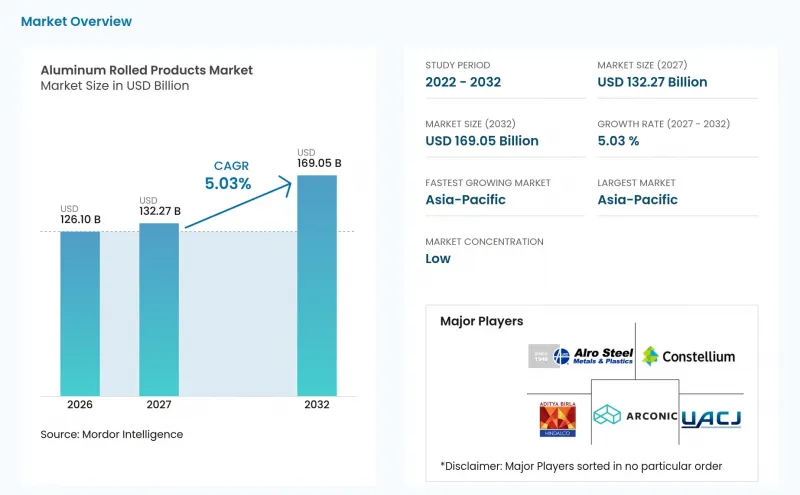
According to Mordor Intelligence, the aluminum rolled products market size was valued at USD 126.10 billion in 2026 and is estimated to grow from USD 132.27 billion in 2027 to USD 169.05 billion by 2032, at a CAGR of 5.03% during the forecast period (2027-2032).
Global Aluminum Rolled Products Market Trends and Insights
Automotive Lightweighting and EV Range Requirements
Battery enclosures have become an important application in the aluminum rolled products market for electric vehicle designs. Aluminum is used in 80% of battery pack enclosures worldwide. Replacing 400 kg of steel with 240 kg of aluminum reduces vehicle weight by 160 kg directly and can reduce the weight of related parts by an additional 40-60 kg. This makes 6xxx Series rolled sheet a strategic material for structural battery trays rather than a standard input. Hindalco delivered its first 10,000 aluminum battery enclosures for Mahindra BE 6 and XEV 9e vehicles from its Chakan facility, which has an INR 5 billion (~USD 0.05 billion) investment and can scale to 160,000 units annually. Within the aluminum rolled products market, suppliers that offer crash-tested alloy development and nearby enclosure fabrication can secure supply positions before vehicle production reaches full scale.
Construction, Facade, and Infrastructure Modernization
Urban density and building energy regulations are sustaining demand for aluminum-intensive facade systems. Construction accounted for 13% of aluminum consumption in the United States in 2025. The Global Status Report for Buildings and Construction identifies material choices at the design stage as important for reducing building-sector emissions. Aluminum cladding remains relevant for projects pursuing Leadership in Energy and Environmental Design (LEED) or Building Research Establishment Environmental Assessment Method (BREEAM) certification due to its recyclability and use in durable facade systems. Architectural aluminum specified during design development often converts into mill orders 18-36 months later, giving specialist mills earlier visibility of future demand. India's National Infrastructure Pipeline targets USD 1.5 trillion in investment, and ASEAN infrastructure investment is projected at USD 3 trillion by 2030.
Aluminum, Alumina, and Electricity Price Volatility
The London Metal Exchange (LME) aluminum price stood at USD 2,632 per ton in 2025, with Q4 2025 prices ranging from USD 2,800 to USD 2,900 per ton. These price movements directly affect input costs for aluminum rolled products manufacturers. Alumina price movements were shaped by refinery disruptions and new capacity additions in Indonesia and India. Bauxite supply concerns, particularly in Guinea, added further uncertainty before the metal reached rolling mills. Pass-through pricing offers some margin protection, but fixed-price and delayed-adjustment contracts compress margins when metal prices rise faster than contractual mechanisms allow. Price volatility in metal, alumina, and electricity costs can contribute to market concentration, as smaller rolling mills may defer investment when they cannot absorb these cost increases.
Other drivers and restraints analyzed in the detailed report include:
- Recyclable Packaging and Beverage-Can Demand
- Aerospace Fleet Renewal and Defense Localization
- Energy Intensity and Carbon-Compliance Costs
For complete list of drivers and restraints, kindly check the Table Of Contents.
Segment Analysis
The 6xxx Series held 31.78% of the aluminum rolled products market share in 2026, with a forecast CAGR of 5.67% through 2032. Its position reflects its age hardening, formability, corrosion resistance, and weldability across automotive, construction, and packaging applications. Grades 6016 and 6022 are used for automotive outer panels. Grade 6061 is used in structural construction and marine applications. Grade 6101 is used in electrical busbars and cable trays.
The 1xxx series is used for packaging foil and electrical applications where conductivity and formability are more important than strength. The 3xxx series is used for heat exchangers and building sheets. The 5xxx series is used in marine, transit, and beverage-can body stock due to its corrosion resistance. Constellium's HSA6 and HCA6 alloys achieved weight savings of 12-35% compared with established designs in the ALIVE consortium project. The aluminum rolled products market is therefore moving toward alloy-processing expertise and joint development with original equipment manufacturers, rather than competition based solely on rolling output.
Complete Report Scope:
- By Grade
- 1xxx Series
- 3xxx Series
- 5xxx Series
- 6xxx Series
- Others
- By Product Form
- Hot-Rolled Thick Plates
- Hot-Rolled Medium-Thick Sheets
- Cold-Rolled Sheets
- Others
- By End-User Industry
- Automotive
- Aerospace and Defense
- Packaging
- Construction
- Other End-User Industries
- By Geography
- Asia-Pacific
- China
- India
- Japan
- South Korea
- ASEAN Countries
- Rest of Asia-Pacific
- North America
- United States
- Canada
- Mexico
- Europe
- Germany
- United Kingdom
- France
- Italy
- NORDIC Countries
- Rest of Europe
- South America
- Brazil
- Argentina
- Rest of South America
- Middle East and Africa
- Saudi Arabia
- South Africa
- Rest of Middle East and Africa
- Asia-Pacific
Geography Analysis
Asia-Pacific accounted for 46.85% of the aluminum rolled products market share in 2026 and is forecast to expand at a 5.78% CAGR through 2032. China remains the largest market in the region due to its extensive flat-rolled capacity and integration across the aluminum value chain. China's aluminum production rose 1.7% in 2025, with limited commissioning of new projects constraining further growth. India is a major source of regional demand, as infrastructure investment, logistics development, and electric vehicle adoption are driving flat-rolled demand. Hindalco commissioned a 170,000-ton-per-year flat-rolled products and battery-foil facility in Odisha in January 2026, which is expected to reduce India's flat-rolled import dependence to 40% of demand.
North America and Europe remain the second and third-largest geographic markets. In North America, Section 232 import duties rose to 50% in June 2025, contributing to higher domestic aluminum prices and tighter local supply. U.S. aluminum prices rose 39% year over year in 2025. Kaiser Aluminum completed a USD 25 million Phase 7 heat-treat expansion at Trentwood, one of three U.S. sites capable of producing aerospace-grade plate.
South America, the Middle East, and Africa contribute lower current output but present longer-term demand potential. Brazil maintained an aluminum can recycling rate above 97% for 15 consecutive years as of 2025, and its collection system supports domestic can-sheet recycling. Argentina could support demand for automotive assembly and packaging if macroeconomic stabilization continues. Saudi Arabia's Vision 2030, South Africa's construction modernization pipeline, and early GCC interest in downstream conversion capacity are driving demand for architectural and industrial products. However, logistics constraints and limited local capacity are restricting near-term orders.
- ALRO
- Aluminium Duffel
- AMAG Austria Metall AG
- Arconic
- Constellium
- ElvalHalcor
- Granges
- Henan Mingtai AL.Industrial Co., Ltd
- Hindalco Industries Ltd.
- Kaiser Aluminum
- Kibar Holding A.S.
- Norsk Hydro ASA
- Speira GmbH
- UACJ Corporation
Additional Benefits:
- The market estimate (ME) sheet in Excel format
- 3 months of analyst support
TABLE OF CONTENTS
1 Introduction
- 1.1 Study Assumptions and Market Definition
- 1.2 Scope of the Study
2 Research Methodology
3 Executive Summary
4 Market Landscape
- 4.1 Market Overview
- 4.2 Market Drivers
- 4.2.1 Automotive Lightweighting and EV Range Requirements
- 4.2.2 Construction, Facade and Infrastructure Modernization
- 4.2.3 Recyclable Packaging and Beverage-Can Demand
- 4.2.4 Aerospace Fleet Renewal and Defense Localization
- 4.2.5 Closed-Loop Scrap Availability as a Competitive Differentiator
- 4.3 Market Restraints
- 4.3.1 Aluminum, Alumina and Electricity Price Volatility
- 4.3.2 Energy Intensity and Carbon-Compliance Costs
- 4.3.3 Qualification Cycles for Automotive and Aerospace Grades
- 4.4 Value Chain Analysis
- 4.5 Porter's Five Forces Analysis
- 4.5.1 Bargaining Power of Suppliers
- 4.5.2 Bargaining Power of Buyers
- 4.5.3 Threat of New Entrants
- 4.5.4 Threat of Substitutes
- 4.5.5 Competitive Rivalry
5 Market Size and Growth Forecasts (Value and Volume)
- 5.1 By Grade
- 5.1.1 1xxx Series
- 5.1.2 3xxx Series
- 5.1.3 5xxx Series
- 5.1.4 6xxx Series
- 5.1.5 Others
- 5.2 By Product Form
- 5.2.1 Hot-Rolled Thick Plates
- 5.2.2 Hot-Rolled Medium-Thick Sheets
- 5.2.3 Cold-Rolled Sheets
- 5.2.4 Others
- 5.3 By End-User Industry
- 5.3.1 Automotive
- 5.3.2 Aerospace and Defense
- 5.3.3 Packaging
- 5.3.4 Construction
- 5.3.5 Other End-User Industries
- 5.4 By Geography
- 5.4.1 Asia-Pacific
- 5.4.1.1 China
- 5.4.1.2 India
- 5.4.1.3 Japan
- 5.4.1.4 South Korea
- 5.4.1.5 ASEAN Countries
- 5.4.1.6 Rest of Asia-Pacific
- 5.4.2 North America
- 5.4.2.1 United States
- 5.4.2.2 Canada
- 5.4.2.3 Mexico
- 5.4.3 Europe
- 5.4.3.1 Germany
- 5.4.3.2 United Kingdom
- 5.4.3.3 France
- 5.4.3.4 Italy
- 5.4.3.5 NORDIC Countries
- 5.4.3.6 Rest of Europe
- 5.4.4 South America
- 5.4.4.1 Brazil
- 5.4.4.2 Argentina
- 5.4.4.3 Rest of South America
- 5.4.5 Middle East and Africa
- 5.4.5.1 Saudi Arabia
- 5.4.5.2 South Africa
- 5.4.5.3 Rest of Middle East and Africa
- 5.4.1 Asia-Pacific
6 Competitive Landscape
- 6.1 Market Concentration
- 6.2 Strategic Moves
- 6.3 Market Share (%)/Ranking Analysis
- 6.4 Company Profiles (includes Global Overview, Market Overview, Core Segments, Financials as available, Strategic Information, Products and Services, and Recent Developments)
- 6.4.1 ALRO
- 6.4.2 Aluminium Duffel
- 6.4.3 AMAG Austria Metall AG
- 6.4.4 Arconic
- 6.4.5 Constellium
- 6.4.6 ElvalHalcor
- 6.4.7 Granges
- 6.4.8 Henan Mingtai AL.Industrial Co., Ltd
- 6.4.9 Hindalco Industries Ltd.
- 6.4.10 Kaiser Aluminum
- 6.4.11 Kibar Holding A.S.
- 6.4.12 Norsk Hydro ASA
- 6.4.13 Speira GmbH
- 6.4.14 UACJ Corporation
7 Market Opportunities and Future Outlook
- 7.1 White-Space and Unmet-Need Assessment

