PUBLISHER: Mordor Intelligence | PRODUCT CODE: 2185237

PUBLISHER: Mordor Intelligence | PRODUCT CODE: 2185237
Ammonium Metatungstate - Market Share Analysis, Industry Trends & Statistics, Growth Forecasts (2027 - 2032)
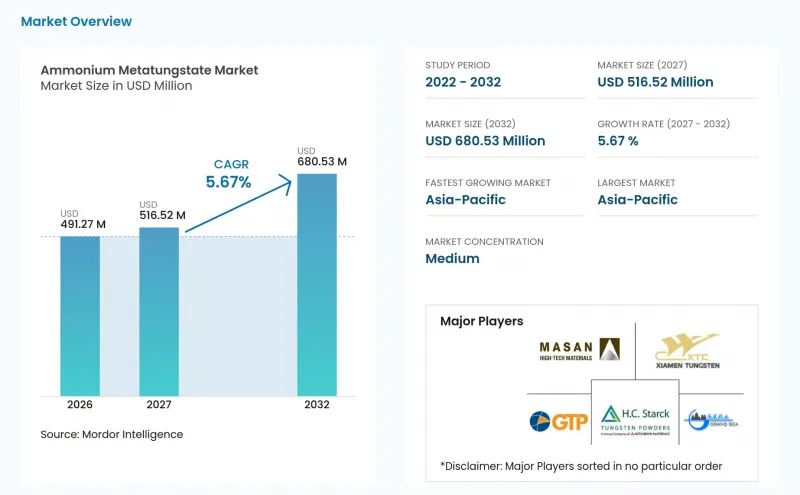
According to Mordor Intelligence, the ammonium metatungstate market size was valued at USD 491.27 million in 2026 and is estimated to grow from USD 516.52 million in 2027 to reach USD 680.53 million by 2032, at a CAGR of 5.67% during the forecast period (2027-2032).
Global Ammonium Metatungstate Market Trends and Insights
Cleaner-Fuel and Emissions-Control Catalyst Demand
Ultra-low-sulfur fuel requirements support the largest source of demand for the ammonium metatungstate market. China's National VI standard, the European Union's Euro 7 requirements, and the United States Environmental Protection Agency Tier 3 rules require very low sulfur levels in transportation fuels. Refiners use tungsten-molybdenum sulfide catalysts to remove sulfur, and ammonium metatungstate is an important tungsten precursor in these catalyst systems. New fuel-quality programs in India, Vietnam, and Nigeria create additional catalyst demand as refineries prepare for stricter product specifications. The International Energy Agency expects global refinery throughput to remain above 95 million barrels per day through 2030, which supports replacement demand for hydrodesulfurization catalysts.
Semiconductor, Electronics, and Advanced Materials Expansion
The ammonium metatungstate market is gaining from the move toward smaller semiconductor device geometries. High-purity material can be processed into tungsten-containing inputs used for chemical vapor deposition contacts, vias, and barrier layers. These uses require consistent batches and very low trace-metal contamination, which differentiates electronics-grade material from catalyst-grade product. Advanced logic, memory, and display manufacturing in China, Japan, and South Korea support this demand base. High-purity material also supports electrochromic tungsten oxide systems that can be used in smart glazing and automotive displays. A peer-reviewed study reported transmittance modulation above 74% for an ammonium-metatungstate-based electrochromic device.
APT and Tungsten Price Volatility
Ammonium paratungstate (APT) price changes create an immediate cost risk for the ammonium metatungstate market. Ammonium paratungstate is a key tungsten intermediate so that higher costs can pass into ammonium metatungstate production. Producers outside China can face greater cost pressure when seaborne supply becomes constrained. Downstream catalyst and specialty chemical customers may resist full price pass-through because they also compete in price-sensitive markets. This can compress margins for producers that have limited feedstock integration. The difference between domestic Chinese pricing and seaborne pricing can also reduce the competitiveness of non-Chinese producers. Supply-chain diversification and recycling can reduce this risk, but neither option removes exposure to tungsten price movements.
Other drivers and restraints analyzed in the detailed report include:
- Growth of Specialty Chemical and Metallurgy Applications
- Circular Tungsten Recovery and Recycled Feedstock Adoption
- Technical Complexity and High Barriers to New Production
For complete list of drivers and restraints, kindly check the Table Of Contents.
Segment Analysis
The virgin ore route held a 64.56% share in the ammonium metatungstate market in 2026. This route remains important because primary ore processing is connected to established mine, smelter, and chemical production networks. China's role in tungsten mining and intermediate processing supports the availability of primary feedstock for domestic producers. Long-standing relationships among mines, ammonium paratungstate producers, and chemical manufacturers also make supplier changes difficult for many buyers. The route is particularly suited to producers that operate close to upstream tungsten assets. Mine output, concentrate conversion, and chemical production can be coordinated within the same supply network. That coordination can improve delivery reliability for buyers who use material in continuous catalyst manufacturing processes. Its leading position reflects the scale of existing infrastructure rather than a lack of interest in recycling. Primary supply remains important where long-term mine contracts and processing capacity are already in place.
The secondary/recycled route is projected to advance at a 6.13% CAGR through 2032. Recycling gives non-Chinese producers an alternative source of tungsten-containing material and can improve supply traceability. H.C. Starck Tungsten GmbH's Goslar project shows the scale of investment entering this route, with capacity planned to reach 7,000 metric tons per year by 2028. Xiamen Tungsten Co., Ltd. reported that its operations recovered more than 10,000 metric tons of ammonium-paratungstate-equivalent material from scrap each year. It also reported a South Korean facility with 1,500 metric tons per year of tungsten oxide capacity from scrap. This route does not replace primary production in the near term, but it expands choices for the ammonium metatungstate market. It also supports buyers who want verified recycled content in their tungsten supply chains.
Aqueous solution held a 43.12% share in the ammonium metatungstate market in 2026. This form fits wet-impregnation processes used in industrial catalyst manufacturing. Buyers can add the solution to the catalyst preparation steps without first dissolving a powder. This can simplify plant operations and help maintain consistent solution chemistry. The form remains useful where consistent delivery of active tungsten matters more than the compact shipping profile of a dry material. Its position reflects its fit with established refinery catalyst production methods. Suppliers can tailor concentration, packaging, and quality records to the needs of individual catalyst plants. These service requirements favor producers who understand the operating conditions of established refinery customers.
Powder is projected to advance at a 6.57% CAGR through 2032. Powder supports solid-state catalyst preparation and tungsten carbide sintering applications that need controlled particle characteristics. It can also serve high-purity tungsten chemical production where processors require a dry input. Crystalline material serves laboratory and reagent-grade customers who place value on consistent documentation and controlled batch properties. The different forms allow suppliers to meet process requirements across catalyst, laboratory, metallurgy, and electronics uses. Aqueous, crystalline, and powder products, therefore, address distinct operational needs rather than serving as direct substitutes in every application. The ammonium metatungstate market can support each form because customers select material according to their processing equipment and purity requirements.
Complete Report Scope:
- By Raw Material Route
- Virgin Ore Route
- Secondary/Recycled Route
- By Form
- Aqueous Solution
- Crystalline
- Powder
- By Grade
- Standard Grade
- High-Purity Grade
- Reagent Grade
- By Application
- Catalysts
- Metal Finishing
- Pigments
- X-Ray Shielding
- Analytical Chemistry
- Glass and Ceramic Production
- Other Applications
- By End-Use Industry
- Chemical and Petrochemical
- Electronics
- Metallurgy
- Medical
- Aerospace and Defense
- Other End-Use Industries
- By Geography
- Asia-Pacific
- China
- India
- Japan
- South Korea
- ASEAN Countries
- Rest of Asia-Pacific
- North America
- United States
- Canada
- Mexico
- Europe
- Germany
- United Kingdom
- France
- Italy
- NORDIC Countries
- Rest of Europe
- South America
- Brazil
- Argentina
- Rest of South America
- Middle East and Africa
- Saudi Arabia
- South Africa
- Rest of Middle East and Africa
- Asia-Pacific
Geography Analysis
Asia-Pacific held 45.39% share in the ammonium metatungstate market in 2026 and is projected to advance at a 6.56% CAGR through 2032. China is the region's central production base because of its integrated tungsten mining, intermediate-processing, and chemical manufacturing capacity. This structure supports domestic ammonium metatungstate output and provides supply to customers across the region. Japan and South Korea are important consumers of electronics-grade material because of their semiconductor and advanced-material manufacturing activities. Their procurement requirements place more focus on traceability and consistent quality documentation. India supports demand through refinery upgrades associated with its BS VI (Bharat Stage VI) program.
North America is supported by the United States refining sector and by semiconductor facilities that require high-purity inputs. The region has an incentive to secure traceable tungsten supply through domestic, allied-country, and recycled sources. Global Tungsten & Powders processes tungsten products in Towanda, Pennsylvania, and has expanded its interest in non-Chinese raw material supply. Europe is centered on Germany, where H.C. Starck Tungsten GmbH is increasing recycling capacity in Goslar. The project supports Europe's role in secondary-route tungsten processing and gives regional buyers an option outside the primary ore supply. France, the United Kingdom, and Nordic countries contribute to specialty chemical demand, but the European supply position is most closely linked to recycling capability.
South America has modest ammonium metatungstate demand that is mainly connected to refinery catalysts, with Brazil as the regional center. A 2025 peer-reviewed study on tungsten recovery from raw and secondary materials indicates continuing technical interest in regional tungsten processing. The Middle East and Africa rely largely on catalyst demand linked to refinery operations and capacity additions. Saudi Arabia, the United Arab Emirates, and South Africa provide the main refinery-related demand centers within this area. Marine fuel sulfur requirements can support the need for advanced hydrodesulfurization catalysts over the medium term. Regional demand is smaller than in Asia-Pacific, North America, and Europe, but it provides additional outlets for catalyst-grade products. The geographical structure of the ammonium metatungstate market remains anchored in Asian production and diversified by recycling, refinery, and electronics demand elsewhere.
- ATT Advanced elemental materials Co., Ltd.
- Ereztech LLC
- Ganzhou CF Tungsten Co.,Ltd
- Ganzhou Grand Sea Tungsten Co., Ltd.
- Global Tungsten & Powders
- H.C. Starck Tungsten GmbH
- Masan High-Tech Materials Corporation
- NINGBO INNO PHARMCHEM CO.,LTD.
- Nippon Inorganic Colour & Chemical Co., Ltd.
- Noah Chemicals
- North Metal & Chemical Co.
- ProChem, Inc.
- United Wolfram
- W&Q Metal Products Co., Ltd.
- Xiamen Tungsten Co., Ltd.
Additional Benefits:
- The market estimate (ME) sheet in Excel format
- 3 months of analyst support
TABLE OF CONTENTS
1 Introduction
- 1.1 Study Assumptions and Market Definition
- 1.2 Scope of the Study
2 Research Methodology
3 Executive Summary
4 Market Landscape
- 4.1 Market Overview
- 4.2 Market Drivers
- 4.2.1 Cleaner-Fuel and Emissions-Control Catalyst Demand
- 4.2.2 Semiconductor, Electronics, and Advanced Materials Expansion
- 4.2.3 Growth of Specialty Chemical and Metallurgy Applications
- 4.2.4 Circular Tungsten Recovery and Recycled Feedstock Adoption
- 4.2.5 Aqueous AMT Routes Enable Lower-Impurity Process Intensification
- 4.3 Market Restraints
- 4.3.1 APT and Tungsten Price Volatility
- 4.3.2 Technical Complexity and High Barriers to New Production
- 4.3.3 Batch-Qualification Bottlenecks for High-Purity AMT
- 4.4 Value Chain Analysis
- 4.5 Porter's Five Forces Analysis
- 4.5.1 Threat of New Entrants
- 4.5.2 Bargaining Power of Suppliers
- 4.5.3 Bargaining Power of Buyers
- 4.5.4 Threat of Substitutes
- 4.5.5 Competitive Rivalry
5 Market Size and Growth Forecasts (Value)
- 5.1 By Raw Material Route
- 5.1.1 Virgin Ore Route
- 5.1.2 Secondary/Recycled Route
- 5.2 By Form
- 5.2.1 Aqueous Solution
- 5.2.2 Crystalline
- 5.2.3 Powder
- 5.3 By Grade
- 5.3.1 Standard Grade
- 5.3.2 High-Purity Grade
- 5.3.3 Reagent Grade
- 5.4 By Application
- 5.4.1 Catalysts
- 5.4.2 Metal Finishing
- 5.4.3 Pigments
- 5.4.4 X-Ray Shielding
- 5.4.5 Analytical Chemistry
- 5.4.6 Glass and Ceramic Production
- 5.4.7 Other Applications
- 5.5 By End-Use Industry
- 5.5.1 Chemical and Petrochemical
- 5.5.2 Electronics
- 5.5.3 Metallurgy
- 5.5.4 Medical
- 5.5.5 Aerospace and Defense
- 5.5.6 Other End-Use Industries
- 5.6 By Geography
- 5.6.1 Asia-Pacific
- 5.6.1.1 China
- 5.6.1.2 India
- 5.6.1.3 Japan
- 5.6.1.4 South Korea
- 5.6.1.5 ASEAN Countries
- 5.6.1.6 Rest of Asia-Pacific
- 5.6.2 North America
- 5.6.2.1 United States
- 5.6.2.2 Canada
- 5.6.2.3 Mexico
- 5.6.3 Europe
- 5.6.3.1 Germany
- 5.6.3.2 United Kingdom
- 5.6.3.3 France
- 5.6.3.4 Italy
- 5.6.3.5 NORDIC Countries
- 5.6.3.6 Rest of Europe
- 5.6.4 South America
- 5.6.4.1 Brazil
- 5.6.4.2 Argentina
- 5.6.4.3 Rest of South America
- 5.6.5 Middle East and Africa
- 5.6.5.1 Saudi Arabia
- 5.6.5.2 South Africa
- 5.6.5.3 Rest of Middle East and Africa
- 5.6.1 Asia-Pacific
6 Competitive Landscape
- 6.1 Market Concentration
- 6.2 Strategic Moves
- 6.3 Market Share (%)/Ranking Analysis
- 6.4 Company Profiles (includes Global Overview, Market Overview, Core Segments, Financials as available, Strategic Information, Products and Services, and Recent Developments)
- 6.4.1 ATT Advanced elemental materials Co., Ltd.
- 6.4.2 Ereztech LLC
- 6.4.3 Ganzhou CF Tungsten Co.,Ltd
- 6.4.4 Ganzhou Grand Sea Tungsten Co., Ltd.
- 6.4.5 Global Tungsten & Powders
- 6.4.6 H.C. Starck Tungsten GmbH
- 6.4.7 Masan High-Tech Materials Corporation
- 6.4.8 NINGBO INNO PHARMCHEM CO.,LTD.
- 6.4.9 Nippon Inorganic Colour & Chemical Co., Ltd.
- 6.4.10 Noah Chemicals
- 6.4.11 North Metal & Chemical Co.
- 6.4.12 ProChem, Inc.
- 6.4.13 United Wolfram
- 6.4.14 W&Q Metal Products Co., Ltd.
- 6.4.15 Xiamen Tungsten Co., Ltd.
7 Market Opportunities and Future Outlook
- 7.1 White-Space and Unmet-Need Assessment

