PUBLISHER: Mordor Intelligence | PRODUCT CODE: 2185243

PUBLISHER: Mordor Intelligence | PRODUCT CODE: 2185243
Middle East and Africa Precision Agriculture - Market Share Analysis, Industry Trends & Statistics, Growth Forecasts (2026 - 2031)
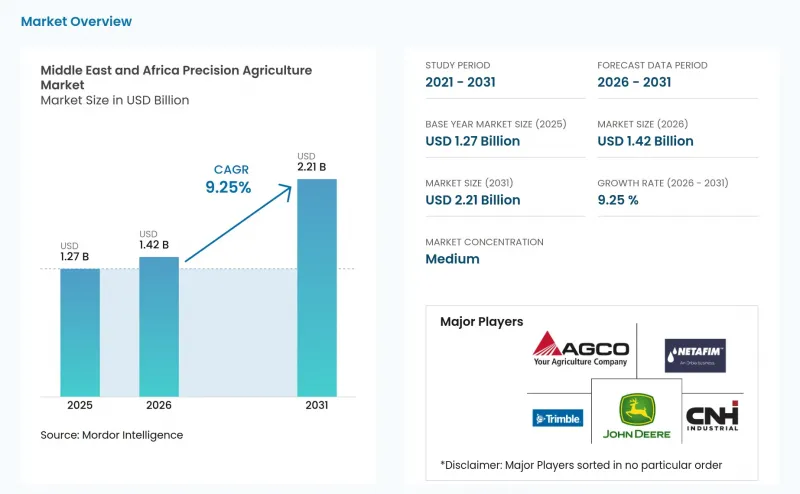
According to Mordor Intelligence, the Middle East and Africa precision agriculture market size is projected to expand from USD 1.27 billion in 2025 and USD 1.42 billion in 2026 to USD 2.21 billion by 2031, registering a CAGR of 9.25% between 2026 and 2031.
Middle East and Africa Precision Agriculture Market Trends and Insights
Expanding Water Stress and Irrigation Efficiency Needs
Water scarcity remains the clearest commercial trigger for the Middle East and Africa precision agriculture market because irrigation efficiency directly affects farm viability in arid and semi-arid production systems. The World Economic Forum reported in 2025 that 14 Middle East and North Africa (MENA) countries face extreme freshwater stress, highlighting the urgent need for more efficient agricultural water management. The Forum also noted that smart irrigation systems have the potential to reduce water usage by up to 50% compared with traditional irrigation methods, strengthening the business case for precision agriculture across the region. In January 2026, National Agricultural Development Company (NADEC) and EF Polymer began large-scale field trials that targeted a 40% reduction in irrigation water use through artificial intelligence (AI)-driven irrigation systems and satellite-based crop monitoring. These conditions keep irrigation management at the center of the Middle East and Africa precision agriculture market because water savings can be measured quickly and tied to operating costs. As water allocation rules tighten, precision irrigation is moving closer to a requirement in some production zones, making the demand in the Middle East and Africa precision agriculture market more durable than a simple replacement cycle.
Government and Donor Support for Climate-Smart Agriculture
Public policy and sovereign-backed investment continue to accelerate adoption in the Middle East and Africa precision agriculture market as food security objectives are increasingly translated into long-term agricultural modernization initiatives. Saudi Agricultural and Livestock Investment Company (SALIC) signed a letter of intent with Syngenta in October 2025 to explore collaboration in digital agriculture, soil health, and crop protection, demonstrating how sovereign-backed organizations are expanding access to advanced agricultural technologies. This approach supports the simultaneous deployment of precision equipment, digital platforms, and agronomic services rather than investing in a single layer of the agricultural value chain. It also benefits technology providers capable of integrating hardware, software, and ongoing technical support with national food and water security priorities, making execution as important as product offerings. Government and donor-backed programs further reduce adoption risks for commercial growers while accelerating the integration of digital farming solutions into routine agricultural operations. As a result, policy support remains one of the strongest long-term growth drivers for the Middle East and Africa precision agriculture market throughout the forecast period.
High Upfront Hardware and Integration Costs
Upfront equipment costs remain one of the strongest barriers to wider adoption in the Middle East and Africa precision agriculture market because many growers continue to face limited access to financing and constrained investment capacity. The 2025 study, "Digitalization of Precision Fertilization in East Africa: Adoption, Benefits and Losses," highlighted that variable-rate application systems require significant purchase and calibration investments, making adoption challenging for many smallholder farmers. Research published in the journal Drones in 2025 also found that although unmanned aerial vehicle (UAV)-based precision agriculture solutions deliver strong field performance, their ownership costs remain difficult for individual smallholders across much of Sub-Saharan Africa. Although the cost of sensors and digital technologies has declined over time, access to affordable financing continues to lag behind technological advancements, slowing commercial adoption. Service-based business models and cooperative ownership structures are helping improve accessibility, but their success still depends on reliable technical support networks and sustainable dealer ecosystems. Until financing mechanisms become more accessible, high hardware costs will continue to limit precision agriculture adoption among smaller farm operators across the Middle East and Africa.
Other drivers and restraints analyzed in the detailed report include:
- Export Crop Yield Optimization Pressure
- Rising Adoption of Data-Driven Precision Irrigation in Horticulture
- Fragmented Farm Connectivity and Digital Infrastructure
For complete list of drivers and restraints, kindly check the Table Of Contents.
Segment Analysis
Hardware accounted for 49.6% of the Middle East and Africa precision agriculture market size in 2025, reflecting substantial investments in smart irrigation systems, Global Positioning System (GPS) guidance technologies, and field sensors across major agricultural markets such as Saudi Arabia, Egypt, and South Africa. This demonstrates that physical equipment remains the foundation of the region's precision agriculture ecosystem, particularly where governments and large commercial farms prioritize irrigation control, field positioning, and real-time data collection. Software sits in the middle layer of the component landscape and continues to expand as farm management platforms and satellite-based analytics move beyond pilot projects into routine commercial use. This keeps the Middle East and Africa precision agriculture industry anchored in equipment-led adoption while steadily building a broader digital ecosystem around installed hardware.
Services are projected to grow at a CAGR of 14.2% from 2026 to 2031, making them the strongest indicator of the market's evolving revenue mix. In December 2025, Lindsay Corporation signed an agreement to supply USD 80 million worth of Zimmatic irrigation systems integrated with FieldNET remote management technology across the Middle East and North Africa (MENA), illustrating the growing demand for bundled hardware and digital services. This trend reflects a broader shift toward integrated precision agriculture solutions, where software, remote monitoring, and advisory services are becoming increasingly important alongside physical equipment. As a result, the Middle East and Africa precision agriculture industry is projected to generate a growing share of revenue from software integration, advisory services, and managed support rather than equipment sales alone.
Complete Report Scope:
- By Component
- Hardware
- Software
- Services
- By Technology
- Guidance Systems
- Remote Sensing
- Variable Rate Technology
- By Application
- Yield Monitoring
- Field Mapping
- Crop Scouting
- Weather Tracking and Forecasting
- Irrigation Management
- Inventory Management
- Farm Labor Management
- Other Applications
- By Geography
- Middle East
- Saudi Arabia
- United Arab Emirates
- Turkey
- Rest of Middle East
- Africa
- South Africa
- Egypt
- Rest of Africa
- Middle East
List of Companies Covered in this Report:
- Deere and Company
- Trimble Inc.
- CNH Industrial N.V.
- AGCO Corporation
- Topcon Corporation
- Valmont Industries, Inc.
- Lindsay Corporation
- Hexagon AB
- ST Engineering
- Netafim Ltd.
- The Toro Company
- Jain Irrigation Systems Ltd.
- Siemens AG
- Kubota Corporation
- DICKEY-john Corporation
Additional Benefits:
- The market estimate (ME) sheet in Excel format
- 3 months of analyst support
TABLE OF CONTENTS
1 INTRODUCTION
- 1.1 Study Assumptions and Market Definition
- 1.2 Scope of the Study
2 RESEARCH METHODOLOGY
3 EXECUTIVE SUMMARY
4 MARKET LANDSCAPE
- 4.1 Market Overview
- 4.2 Market Drivers
- 4.2.1 Expanding Water Stress and Irrigation Efficiency Needs
- 4.2.2 Export Crop Yield Optimization Pressure
- 4.2.3 Labor Shortage and Mechanization Gap in Commercial Farms
- 4.2.4 Government and Donor Support for Climate-Smart Agriculture
- 4.2.5 Growth of Satellite-Based Farm Advisory and Remote Monitoring
- 4.2.6 Rising Adoption of Data-Driven Precision Irrigation in Horticulture
- 4.3 Market Restraints
- 4.3.1 High Upfront Hardware and Integration Costs
- 4.3.2 Fragmented Farm Connectivity and Digital Infrastructure
- 4.3.3 Fragmented Farm Sizes and Input Standardization Limits
- 4.3.4 Limited Local Technical Support and After-Sales Service
- 4.4 Value and Supply Chain Analysis
- 4.5 Regulatory Landscape
- 4.6 Technological Outlook
- 4.7 Porter's Five Forces Analysis
- 4.7.1 Threat of New Entrants
- 4.7.2 Bargaining Power of Buyers
- 4.7.3 Bargaining Power of Suppliers
- 4.7.4 Threat of Substitutes
- 4.7.5 Intensity of Competitive Rivalry
5 MARKET SIZE AND GROWTH FORECASTS
- 5.1 By Component
- 5.1.1 Hardware
- 5.1.2 Software
- 5.1.3 Services
- 5.2 By Technology
- 5.2.1 Guidance Systems
- 5.2.2 Remote Sensing
- 5.2.3 Variable Rate Technology
- 5.3 By Application
- 5.3.1 Yield Monitoring
- 5.3.2 Field Mapping
- 5.3.3 Crop Scouting
- 5.3.4 Weather Tracking and Forecasting
- 5.3.5 Irrigation Management
- 5.3.6 Inventory Management
- 5.3.7 Farm Labor Management
- 5.3.8 Other Applications
- 5.4 By Geography
- 5.4.1 Middle East
- 5.4.1.1 Saudi Arabia
- 5.4.1.2 United Arab Emirates
- 5.4.1.3 Turkey
- 5.4.1.4 Rest of Middle East
- 5.4.2 Africa
- 5.4.2.1 South Africa
- 5.4.2.2 Egypt
- 5.4.2.3 Rest of Africa
- 5.4.1 Middle East
6 COMPETITIVE LANDSCAPE
- 6.1 Market Concentration
- 6.2 Strategic Moves
- 6.3 Market Share Analysis
- 6.4 Company Profiles (Includes Global Level Overview, Market Level Overview, Core Segments, Financials as available, Strategic Information, Market Rank/Share, Products and Services, Recent Developments)
- 6.4.1 Deere and Company
- 6.4.2 Trimble Inc.
- 6.4.3 CNH Industrial N.V.
- 6.4.4 AGCO Corporation
- 6.4.5 Topcon Corporation
- 6.4.6 Valmont Industries, Inc.
- 6.4.7 Lindsay Corporation
- 6.4.8 Hexagon AB
- 6.4.9 ST Engineering
- 6.4.10 Netafim Ltd.
- 6.4.11 The Toro Company
- 6.4.12 Jain Irrigation Systems Ltd.
- 6.4.13 Siemens AG
- 6.4.14 Kubota Corporation
- 6.4.15 DICKEY-john Corporation
7 MARKET OPPORTUNITIES AND FUTURE OUTLOOK

