PUBLISHER: Mordor Intelligence | PRODUCT CODE: 2185892

PUBLISHER: Mordor Intelligence | PRODUCT CODE: 2185892
Cocoa Butter Alternatives - Market Share Analysis, Industry Trends & Statistics, Growth Forecasts (2027 - 2032)
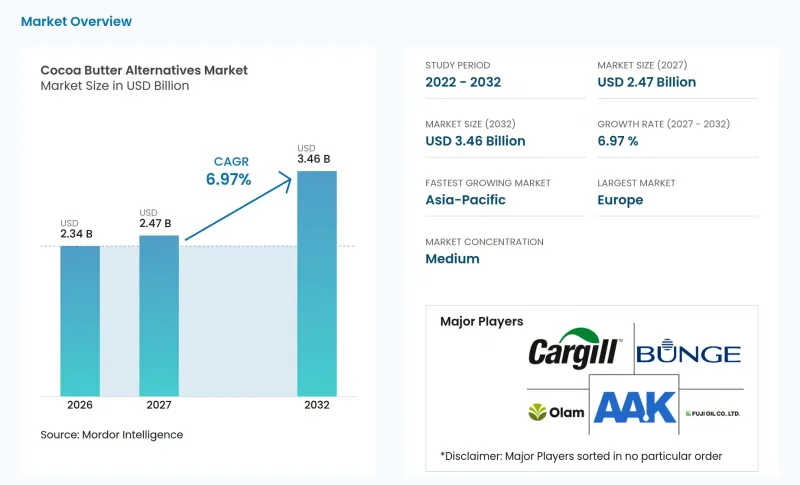
According to Mordor Intelligence, the cocoa butter alternatives market size is expected to grow from USD 2.34 billion in 2026 to USD 2.47 billion in 2027 and is forecast to reach USD 3.46 billion by 2032 at 6.97% CAGR over 2027-2032.
Global Cocoa Butter Alternatives Market Trends and Insights
Increasing Demand for Cost-Effective Fat Alternatives in Chocolate Manufacturing
Cocoa costs have encouraged food manufacturers to assess specialty fats that can reduce exposure to cocoa butter pricing. The cocoa butter alternatives market benefits when recipe changes are adopted across existing production lines. Cargill stated that it expanded specialty-fat capacity in Port Klang, Malaysia, to serve chocolate, bakery, dairy, and filling applications. The company identified cocoa butter equivalents and low-trans cocoa butter replacers among the products supported by the expansion. Reformulation can remain in place once manufacturers have completed line validation, supplier approval, and packaging updates. The resulting demand favors fats that offer predictable processing performance while lowering formulation costs.
Growing Demand for Compound Chocolate and Fat-Based Confectionery Coatings
Compound coatings use vegetable fats instead of cocoa butter and can serve bakery, snack, and confectionery products. This route is important to the cocoa butter alternatives market because it allows broader use of cocoa butter substitutes and replacers where a chocolate designation is not required. AAK introduced its Cebes 2900 NH range for compound coatings using palm kernel and palm oils. The company described the range as non-hydrogenated and designed for bloom resistance, quick crystallization, and processing without tempering. These operating characteristics can improve throughput for producers making high-volume coated products. Compound systems also help suppliers address demand for accessible confectionery formats in price-sensitive markets.
Functional Compatibility Challenges Between Cocoa Butter and Certain Alternative Fats
Not all alternative fats can reproduce cocoa butter's melting behavior, gloss, snap, and crystallization profile. This limits their use in applications that require close sensory and functional similarity to conventional chocolate. The cocoa butter alternatives market must therefore match product selection with the processing and performance requirements of each application. The systematic review of chocolate couverture formulations found that cocoa butter alternatives create challenges related to crystallization and sensory characteristics. Cocoa butter equivalents are more suitable where greater compatibility is needed. Cocoa butter substitutes and replacers are more often used where compound coatings, fillings, or other formats allow more formulation flexibility.
Other drivers and restraints analyzed in the detailed report include:
- Expanding Applications of Cocoa Butter Alternatives in Confectionery and Bakery Products
- Expanding Use of Specialty Vegetable Fats in Cosmetics and Personal Care
- Price Volatility and Supply Uncertainty in Alternative-Fat Raw Materials
For complete list of drivers and restraints, kindly check the Table Of Contents.
Segment Analysis
Cocoa butter equivalents held 43.15% of the cocoa butter alternatives market share in 2026. Their position reflects their compatibility with cocoa butter's triacylglycerol profile and crystallization behavior. Cocoa butter equivalents can be made from shea, illipe, mango kernel, sal fat, and palm mid-fractions. This compatibility supports products that need a fat system closer to cocoa butter. Standards addressing cocoa butter equivalents remain relevant to product development and quality control. The cocoa butter alternatives market continues to use these products where formulation performance and chocolate-related requirements are especially important.
Cocoa butter substitutes are forecast to grow at a 7.81% CAGR through 2032. Their advantage comes from use in compound systems that do not require tempering. Cocoa butter replacers occupy a middle position because they provide partial compatibility and flexibility for selected recipes. Non-hydrogenated products are becoming more important as manufacturers seek acceptable labels and functional performance. AAK's Cebes 2900 NH was introduced as a non-hydrogenated compound coating fat with quick crystallization and bloom resistance. The product category therefore combines cost management with processing efficiency in compound chocolate applications.
Complete Report Scope:
- By Product Type
- Cocoa Butter Equivalents (CBEs)
- Cocoa Butter Replacers (CBRs)
- Cocoa Butter Substitutes (CBSs)
- By Application
- Food and Beverages
- Confectionery
- Bakery Products
- Dairy and Frozen Desserts
- Functional Foods and Beverages
- Cosmetics and Personal Care
- Pharmaceuticals
- Other Applications
- Food and Beverages
- By Functionality
- Chocolate-Compatible Fats
- Compound Coating Fats
- Filling and Cream Fats
- Bakery and Biscuit Fats
- By Geography
- North America
- United States
- Canada
- Mexico
- Rest of North America
- Europe
- United Kingdom
- Germany
- France
- Italy
- Spain
- Netherlands
- Poland
- Rest of Europe
- Asia-Pacific
- China
- India
- Japan
- Australia
- South Korea
- Rest of Asia-Pacific
- South America
- Brazil
- Argentina
- Colombia
- Rest of South America
- Middle East and Africa
- South Africa
- Saudi Arabia
- United Arab Emirates
- Egypt
- Turkiye
- Rest of Middle East and Africa
- North America
Geography Analysis
Europe held 33.76% of the cocoa butter alternatives market share in 2026. The region combines a large confectionery manufacturing base with established standards that shape cocoa butter equivalent formulation. Germany, France, the Netherlands, and the United Kingdom are important demand centers for specialty fats. Their manufacturers use vertically integrated supply chains and technical product specifications. The cocoa butter alternatives market in Europe is shaped by the need to balance product performance, traceability, and regulatory compliance. CEN-CENELEC identifies chocolate standards as part of the regional framework for cocoa butter equivalent use.
Asia-Pacific is forecast to grow at an 8.03% CAGR through 2032. Indonesia and Malaysia are central to palm oil and palm kernel oil processing. Their processing base supports fractionation and supply of specialty-fat inputs. Regional demand also benefits from the growth of affordable confectionery and compound coating formats. Cargill selected Port Klang for a specialty-fat expansion that will serve customers across chocolate, bakery, dairy, and filling uses. The cocoa butter alternatives market in the region benefits from proximity to feedstocks and investment in value-added processing.
North America is a stable demand area for compound and chocolate-flavored products. Product labels affect how manufacturers present products containing non-cocoa fats. South America is an emerging demand region where local confectionery production uses cost-efficient, no-temper fat systems. The Middle East and Africa have distinct roles in demand and supply. The Gulf Cooperation Council is a premium chocolate import area, while West Africa remains important to shea supply used in cocoa butter equivalents. These regional patterns give the cocoa butter alternatives market both sourcing and end-use opportunities.
- AAK AB
- Cargill, Incorporated
- Bunge Global SA
- Fuji Oil Holdings Inc.
- Barry Callebaut AG
- Wilmar International Limited
- Olam International Limited
- Musim Mas Group
- Manorama Industries Limited
- Mewah International Inc.
- The Nisshin OilliO Group, Ltd.
- Archer Daniels Midland Company
- 3F Industries Ltd.
- Kuala Lumpur Kepong Berhad
- Intercontinental Specialty Fats Sdn. Bhd.
- Louis Dreyfus Company B.V.
- Sime Darby Plantation Berhad
- United Plantations Berhad
- GrainCorp Limited
- Ariyan International Inc.
Additional Benefits:
- The market estimate (ME) sheet in Excel format
- 3 months of analyst support
TABLE OF CONTENTS
1 INTRODUCTION
- 1.1 Study Assumptions and Market Definition
- 1.2 Scope of the Study
2 RESEARCH METHODOLOGY
3 EXECUTIVE SUMMARY
4 MARKET LANDSCAPE
- 4.1 Market Overview
- 4.2 Market Drivers
- 4.2.1 Increasing Demand for Cost-Effective Fat Alternatives in Chocolate Manufacturing
- 4.2.2 Growing Demand for Compound Chocolate and Fat-Based Confectionery Coatings
- 4.2.3 Expanding Applications of Cocoa Butter Alternatives in Confectionery and Bakery Products
- 4.2.4 Expanding Use of Specialty Vegetable Fats in Cosmetics and Personal Care
- 4.2.5 Advances in Fat Modification and Blending Technologies
- 4.2.6 Growing Focus on Sustainable and Diversified Alternative-Fat Sourcing
- 4.3 Market Restraints
- 4.3.1 Regulatory Restrictions on Cocoa Butter Alternatives in Chocolate Products
- 4.3.2 Consumer Preference for Authentic Cocoa Butter-based Chocolate
- 4.3.3 Functional Compatibility Challenges Between Cocoa Butter and Certain Alternative Fats
- 4.3.4 Price Volatility and Supply Uncertainty in Alternative-Fat Raw Materials
- 4.4 Value Chain Analysis
- 4.5 Regulatory Landscape
- 4.6 Technological Outlook
- 4.7 Porter's Five Forces Analysis
- 4.7.1 Bargaining Power of Suppliers
- 4.7.2 Bargaining Power of Buyers
- 4.7.3 Threat of New Entrants
- 4.7.4 Threat of Substitutes
- 4.7.5 Intensity of Competitive Rivalry
5 MARKET SIZE & GROWTH FORECASTS (VALUE )
- 5.1 By Product Type
- 5.1.1 Cocoa Butter Equivalents (CBEs)
- 5.1.2 Cocoa Butter Replacers (CBRs)
- 5.1.3 Cocoa Butter Substitutes (CBSs)
- 5.2 By Application
- 5.2.1 Food and Beverages
- 5.2.1.1 Confectionery
- 5.2.1.2 Bakery Products
- 5.2.1.3 Dairy and Frozen Desserts
- 5.2.1.4 Functional Foods and Beverages
- 5.2.2 Cosmetics and Personal Care
- 5.2.3 Pharmaceuticals
- 5.2.4 Other Applications
- 5.2.1 Food and Beverages
- 5.3 By Functionality
- 5.3.1 Chocolate-Compatible Fats
- 5.3.2 Compound Coating Fats
- 5.3.3 Filling and Cream Fats
- 5.3.4 Bakery and Biscuit Fats
- 5.4 By Geography
- 5.4.1 North America
- 5.4.1.1 United States
- 5.4.1.2 Canada
- 5.4.1.3 Mexico
- 5.4.1.4 Rest of North America
- 5.4.2 Europe
- 5.4.2.1 United Kingdom
- 5.4.2.2 Germany
- 5.4.2.3 France
- 5.4.2.4 Italy
- 5.4.2.5 Spain
- 5.4.2.6 Netherlands
- 5.4.2.7 Poland
- 5.4.2.8 Rest of Europe
- 5.4.3 Asia-Pacific
- 5.4.3.1 China
- 5.4.3.2 India
- 5.4.3.3 Japan
- 5.4.3.4 Australia
- 5.4.3.5 South Korea
- 5.4.3.6 Rest of Asia-Pacific
- 5.4.4 South America
- 5.4.4.1 Brazil
- 5.4.4.2 Argentina
- 5.4.4.3 Colombia
- 5.4.4.4 Rest of South America
- 5.4.5 Middle East and Africa
- 5.4.5.1 South Africa
- 5.4.5.2 Saudi Arabia
- 5.4.5.3 United Arab Emirates
- 5.4.5.4 Egypt
- 5.4.5.5 Turkiye
- 5.4.5.6 Rest of Middle East and Africa
- 5.4.1 North America
6 COMPETITIVE LANDSCAPE
- 6.1 Market Concentration
- 6.2 Strategic Moves
- 6.3 Market Positioning Analysis
- 6.4 Company Profiles (Includes Company Highlights, Strategic Information, Core Segments, Financials, Products & Services, Recent Developments)
- 6.4.1 AAK AB
- 6.4.2 Cargill, Incorporated
- 6.4.3 Bunge Global SA
- 6.4.4 Fuji Oil Holdings Inc.
- 6.4.5 Barry Callebaut AG
- 6.4.6 Wilmar International Limited
- 6.4.7 Olam International Limited
- 6.4.8 Musim Mas Group
- 6.4.9 Manorama Industries Limited
- 6.4.10 Mewah International Inc.
- 6.4.11 The Nisshin OilliO Group, Ltd.
- 6.4.12 Archer Daniels Midland Company
- 6.4.13 3F Industries Ltd.
- 6.4.14 Kuala Lumpur Kepong Berhad
- 6.4.15 Intercontinental Specialty Fats Sdn. Bhd.
- 6.4.16 Louis Dreyfus Company B.V.
- 6.4.17 Sime Darby Plantation Berhad
- 6.4.18 United Plantations Berhad
- 6.4.19 GrainCorp Limited
- 6.4.20 Ariyan International Inc.
7 MARKET OPPORTUNITIES AND FUTURE OUTLOOK

