PUBLISHER: Mordor Intelligence | PRODUCT CODE: 2185896

PUBLISHER: Mordor Intelligence | PRODUCT CODE: 2185896
Pension Finance - Market Share Analysis, Industry Trends & Statistics, Growth Forecasts (2026 - 2031)
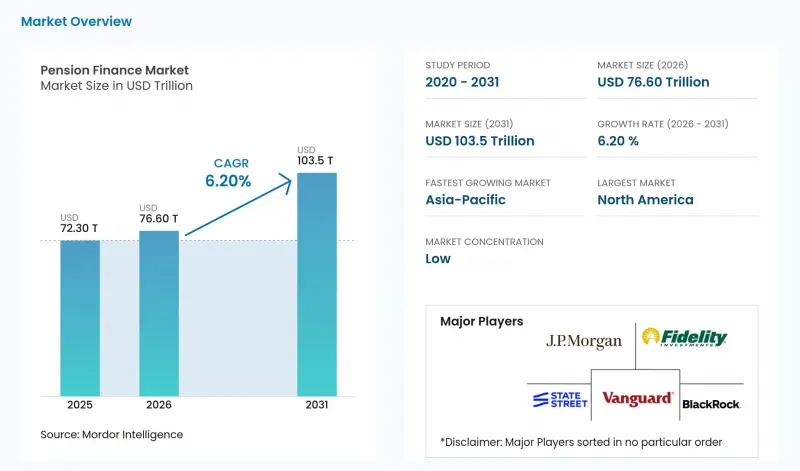
According to Mordor Intelligence, the pension finance market size was valued at USD 72.30 trillion in 2025 and is estimated to grow from USD 76.60 trillion in 2026 to reach USD 103.5 trillion by 2031, at a CAGR of 6.20% during the forecast period (2026-2031).
Global Pension Finance Market Trends and Insights
Aging Populations and Longer Retirement Periods
Population aging is extending pension liabilities while increasing the number of people who need retirement savings. China, Indonesia, Thailand, and Vietnam are projected to have 485 million people aged over 65 by 2050. HelpAge International reported that 1 in 4 people in the Asia-Pacific region will be over 60 by 2050. Governments are responding by expanding funded retirement systems and reassessing social pension arrangements. Longer life expectancy can also expose gaps in mortality assumptions and in the reserves that support pension commitments. These conditions support the pension finance market because retirement assets may need to grow faster than replacement-rate targets alone would suggest.
Shift from Defined Benefit to Defined Contribution Pension Plans
The move from defined benefit plans to defined contribution plans transfers more retirement risk from sponsors to individuals. Occupational defined contribution assets grew by 11.4% in 2024, compared with 4% growth in occupational defined benefit assets. Defined benefit plans accounted for 31.9% of total pension assets in 2024. The Netherlands requires defined benefit plans to transition to defined contribution structures by 2028, providing a regulatory example for other European systems. The United Kingdom's Value for Money framework also increases pressure on smaller defined contribution providers to demonstrate performance and scale. This transition expands opportunities in the pension finance market for asset managers, recordkeepers, advisors, and digital platforms.
Pension Funding Gaps and Liability-Market Volatility
Funded-status improvements can lead sponsors to reduce risk, which may limit the asset growth of defined benefit plans. Milliman estimated that the average United States discount rate fell by 12 basis points in 2025, increasing pension liabilities by 7% on an economic basis. The average funded ratio for the 200 largest United States corporate plans reached 107.7% at December 31, 2025, and 112.8% by August 2026. Sponsors responding to surpluses often follow liability-driven investment paths and lower equity exposure. The Pension Benefit Guaranty Corporation framework in the United States and supervisory requirements in the United Kingdom reinforce careful funding and de-risking practices. A sustained decline in rates without offsetting asset returns could reduce funding surpluses and constrain the pension finance market.
Other drivers and restraints analyzed in the detailed report include:
- Mandatory Contributions and Auto-Enrollment Expansion
- Alternative Assets and Infrastructure Allocations
- Low Investment Returns and Interest-Rate Uncertainty
For complete list of drivers and restraints, kindly check the Table Of Contents.
Segment Analysis
Defined contribution plans held 56.3% of the pension finance market in 2025 and are forecast to expand at a 7.1% CAGR through 2031. Occupational defined contribution assets grew 11.4% in 2024, while occupational defined benefit assets grew 4%. Defined benefit plans remain important where legacy systems are large. Canada retained 57.4% of assets in defined benefit arrangements, and the Netherlands retained 97.5%. The Netherlands is moving all defined benefit plans toward defined contribution structures by 2028. Hybrid and mixed arrangements remain relevant for sponsors seeking predictable contributions alongside some income-guarantee features.
Collective defined contribution schemes provide one example of this hybrid approach, including the first such scheme opened in the United Kingdom in 2024. The United Kingdom's Value for Money requirements favor larger multi-employer trusts and provider platforms. This may increase consolidation among smaller plan providers. Leading defined contribution organizations identified retirement income as their main challenge for the next decade. Deferred-income annuities within target-date funds can improve late-life consumption security for longer-lived members. The pension finance industry is therefore developing both accumulation and decumulation capabilities.
Equities held 42.6% of the pension finance market in 2025. This allocation supports long-term return objectives, especially in defined contribution systems where members bear more investment risk. The average pension fund equity allocation reached a high in 2026. Equity exposure is higher in several systems, including Australian lifecycle defaults and many United States public plans. Bills and bonds remain central to liability matching in defined benefit arrangements and capital preservation for older defined contribution members. Cash, deposits, real estate, and other assets balance liquidity, return, and inflation-management needs.
Private equity and other alternatives are projected to grow at a 7.7% CAGR through 2031. CalPERS increased its net asset value in infrastructure by USD 4.6 billion in 2025 and committed USD 1 billion each to traditional and digital infrastructure in one quarter. Infrastructure has drawn new interest because of the capital needed for data centers and energy-transition assets. Private equity and infrastructure have also been identified as stronger expected-return sources across several macroeconomic scenarios. France's AIFMD II implementation in April 2026 creates another regulated path for private-credit activity. These investments require robust due diligence, liquidity planning, and information management.
Complete Report Scope:
- By Plan Type
- Defined Contribution (DC) Plans
- Defined Benefit (DB) Plans
- Hybrid and Mixed Plans
- By Access Type
- Occupational Pension Plans
- Personal Pension Plans
- By Asset Allocation
- Equities
- Bills and Bonds
- Cash and Deposits
- Real Estate
- Private Equity and Other Alternatives
- Other Investments
- By Financing Vehicle
- Pension Funds
- Pension Insurance Contracts
- Bank/Investment-Managed Retirement Products
- Book-Reserve Arrangements
- By Participation Rule
- Mandatory and Quasi-Mandatory
- Voluntary
- By Worker / Sponsor Sector
- Private-Sector Workers
- Public-Sector Workers
- By Geography
- North America
- United States
- Canada
- Mexico
- South America
- Brazil
- Argentina
- Rest of South America
- Europe
- United Kingdom
- Germany
- France
- Italy
- Spain
- Rest of Europe
- Asia-Pacific
- China
- Japan
- India
- South Korea
- Australia
- Indonesia
- Thailand
- Malaysia
- Singapore
- Vietnam
- Rest of Asia-Pacific
- Middle East and Africa
- Saudi Arabia
- United Arab Emirates
- Turkey
- South Africa
- Egypt
- Rest of Middle East and Africa
- North America
Geography Analysis
North America held 67.2% of the pension finance market share in 2025. The United States managed USD 44.8 trillion through pension providers at the end of 2024, representing 71% of the OECD total and 153.3% of gross domestic product. Canada became the second-largest global pension market in 2025 after 12% year-on-year growth. United States corporate defined benefit plans entered 2026 with funded ratios near 108%. CalPERS committed more than USD 14 billion to private markets in late 2025. The Department of Labor's January 2026 guidance on pension risk transfer is changing how United States sponsors assess annuity buyout decisions.
Asia-Pacific is projected to grow at an 8.2% CAGR through 2031. Japan and Australia were among the five largest global pension markets in 2025, while South Korea ranked eighth and China ranked ninth. Asia-Pacific retirement assets grew by 9% to USD 1.7 trillion in 2025 and are expected to reach USD 2.5 trillion by 2029. Population aging strengthens the case for wider funded coverage in China. India introduced the Balanced Life Cycle Fund within the National Pension System in October 2024 for more than 70 million subscribers. Asia-Pacific represented 45.5% of the 300 largest pension funds in 2025, compared with 22.5% previously.
Europe, South America, the Middle East, and Africa have distinct conditions in the pension finance market. Gulf Cooperation Council states are formalizing occupational systems as part of economic diversification efforts. Formal pension coverage in Sub-Saharan Africa remains limited by low formal employment and shallow capital markets.
- BlackRock, Inc.
- The Vanguard Group, Inc.
- Fidelity Investments
- State Street Corporation
- JPMorgan Chase & Co.
- Legal & General Group plc
- Allianz SE
- Prudential Financial, Inc.
- AXA Group
- UBS Group AG
- Goldman Sachs Group, Inc.
- The Bank of New York Mellon Corporation
- Northern Trust Corporation
- Capital Group
- Aon plc
- Mercer LLC
- WTW
- T. Rowe Price Group, Inc.
- Principal Financial Group, Inc.
- Manulife Financial Corporation
Additional Benefits:
- The market estimate (ME) sheet in Excel format
- 3 months of analyst support
TABLE OF CONTENTS
1 INTRODUCTION
- 1.1 Study Assumptions and Market Definition
- 1.2 Scope of the Study
2 RESEARCH METHODOLOGY
3 EXECUTIVE SUMMARY
4 MARKET LANDSCAPE
- 4.1 Market Overview
- 4.2 Market Drivers
- 4.2.1 Ageing Populations and Longer Retirement Periods
- 4.2.2 Shift from Defined Benefit to Defined Contribution Pension Plans
- 4.2.3 Expansion of Mandatory Contributions and Auto-Enrolment
- 4.2.4 Growing Pension-Fund Allocation to Alternative Assets and Infrastructure
- 4.2.5 Rising Demand for Retirement-Income and Decumulation Solutions
- 4.2.6 Digitalization of Pension Administration and Investment Management
- 4.3 Market Restraints
- 4.3.1 Pension Funding Gaps and Liability-Market Volatility
- 4.3.2 Low Investment Returns and Interest-Rate Uncertainty
- 4.3.3 Limited Domestic Investment Opportunities for Large Pension Portfolios
- 4.3.4 Longevity, Decumulation, and Retirement-Income Sustainability Risk
- 4.4 Value Chain Analysis
- 4.4.1 Contribution Collection and Pension Administration
- 4.4.2 Investment Management and Portfolio Construction
- 4.4.3 Custody, Valuation, Actuarial and Pension-Risk Management
- 4.4.4 Member Engagement, Advice and Retirement-Income Solutions
- 4.5 Regulatory Landscape
- 4.5.1 Fiduciary Duty, Prudential Supervision and Pension-Fund Governance
- 4.5.2 Defined Contribution Disclosure, Investment Governance and Value-for-Money Requirements
- 4.5.3 Pension-Risk Transfer, Buy-In, Buy-Out and Longevity-Risk Regulation
- 4.5.4 ESG, Cross-Border Investment and Sustainable-Finance Requirements
- 4.6 Technological Outlook
- 4.6.1 Cloud-Based Pension Administration and Recordkeeping
- 4.6.2 AI-Enabled Investment, Actuarial and Pension Operations
- 4.6.3 Pension Data Interoperability and Open Data Standards
- 4.6.4 Digital Identity, Automated Advice and Retirement-Income Platforms
- 4.7 Porter's Five Forces Analysis
- 4.7.1 Bargaining Power of Suppliers
- 4.7.2 Bargaining Power of Buyers
- 4.7.3 Threat of New Entrants
- 4.7.4 Threat of Substitutes
- 4.7.5 Competitive Rivalry
5 MARKET SIZE AND GROWTH FORECASTS
- 5.1 By Plan Type
- 5.1.1 Defined Contribution (DC) Plans
- 5.1.2 Defined Benefit (DB) Plans
- 5.1.3 Hybrid and Mixed Plans
- 5.2 By Access Type
- 5.2.1 Occupational Pension Plans
- 5.2.2 Personal Pension Plans
- 5.3 By Asset Allocation
- 5.3.1 Equities
- 5.3.2 Bills and Bonds
- 5.3.3 Cash and Deposits
- 5.3.4 Real Estate
- 5.3.5 Private Equity and Other Alternatives
- 5.3.6 Other Investments
- 5.4 By Financing Vehicle
- 5.4.1 Pension Funds
- 5.4.2 Pension Insurance Contracts
- 5.4.3 Bank/Investment-Managed Retirement Products
- 5.4.4 Book-Reserve Arrangements
- 5.5 By Participation Rule
- 5.5.1 Mandatory and Quasi-Mandatory
- 5.5.2 Voluntary
- 5.6 By Worker / Sponsor Sector
- 5.6.1 Private-Sector Workers
- 5.6.2 Public-Sector Workers
- 5.7 By Geography
- 5.7.1 North America
- 5.7.1.1 United States
- 5.7.1.2 Canada
- 5.7.1.3 Mexico
- 5.7.2 South America
- 5.7.2.1 Brazil
- 5.7.2.2 Argentina
- 5.7.2.3 Rest of South America
- 5.7.3 Europe
- 5.7.3.1 United Kingdom
- 5.7.3.2 Germany
- 5.7.3.3 France
- 5.7.3.4 Italy
- 5.7.3.5 Spain
- 5.7.3.6 Rest of Europe
- 5.7.4 Asia-Pacific
- 5.7.4.1 China
- 5.7.4.2 Japan
- 5.7.4.3 India
- 5.7.4.4 South Korea
- 5.7.4.5 Australia
- 5.7.4.6 Indonesia
- 5.7.4.7 Thailand
- 5.7.4.8 Malaysia
- 5.7.4.9 Singapore
- 5.7.4.10 Vietnam
- 5.7.4.11 Rest of Asia-Pacific
- 5.7.5 Middle East and Africa
- 5.7.5.1 Saudi Arabia
- 5.7.5.2 United Arab Emirates
- 5.7.5.3 Turkey
- 5.7.5.4 South Africa
- 5.7.5.5 Egypt
- 5.7.5.6 Rest of Middle East and Africa
- 5.7.1 North America
6 COMPETITIVE LANDSCAPE
- 6.1 Market Concentration
- 6.2 Strategic Moves
- 6.3 Market Share Analysis (Top 5-6 players)
- 6.4 Company Profiles (includes Global Level Overview, Market Level Overview, Core Segments, Financials as available, Strategic Information, Market Rank/Share, Products and Services, Recent Developments)
- 6.4.1 BlackRock, Inc.
- 6.4.2 The Vanguard Group, Inc.
- 6.4.3 Fidelity Investments
- 6.4.4 State Street Corporation
- 6.4.5 JPMorgan Chase & Co.
- 6.4.6 Legal & General Group plc
- 6.4.7 Allianz SE
- 6.4.8 Prudential Financial, Inc.
- 6.4.9 AXA Group
- 6.4.10 UBS Group AG
- 6.4.11 Goldman Sachs Group, Inc.
- 6.4.12 The Bank of New York Mellon Corporation
- 6.4.13 Northern Trust Corporation
- 6.4.14 Capital Group
- 6.4.15 Aon plc
- 6.4.16 Mercer LLC
- 6.4.17 WTW
- 6.4.18 T. Rowe Price Group, Inc.
- 6.4.19 Principal Financial Group, Inc.
- 6.4.20 Manulife Financial Corporation
7 MARKET OPPORTUNITIES AND FUTURE OUTLOOK
- 7.1 White-Space and Unmet-Need Assessment
- 7.1.1 Retirement-Income Decumulation and Longevity-Pooling Solutions
- 7.1.2 Portable Pension Solutions for Gig, Self-Employed, and Informal Workers
- 7.1.3 Scalable Climate and Infrastructure Investment Vehicles for Pension Capital

