PUBLISHER: Mordor Intelligence | PRODUCT CODE: 2186032

PUBLISHER: Mordor Intelligence | PRODUCT CODE: 2186032
Managed DDoS and Threat Prevention Services - Market Share Analysis, Industry Trends & Statistics, Growth Forecasts (2027 - 2032)
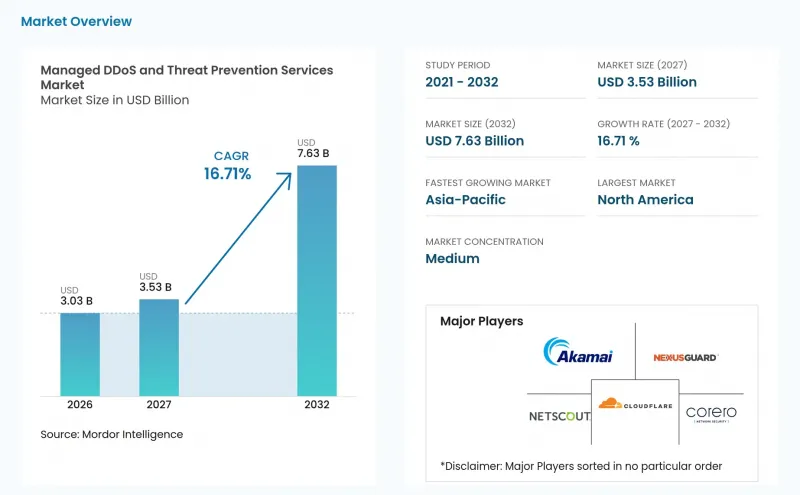
According to Mordor Intelligence, the managed DDoS and threat prevention services market size is projected to expand from USD 3.03 billion in 2026 to USD 3.53 billion in 2027, and to USD 7.63 billion by 2032, registering a CAGR of 16.71% between 2027 and 2032.
Global Managed DDoS and Threat Prevention Services Market Trends and Insights
Increasing Frequency and Sophistication of Multi-Vector Attacks
The managed DDoS and threat prevention services market is supported by a threat environment that is becoming more frequent and more difficult to contain with internal resources alone. NETSCOUT documented 9.1 million DDoS attacks across 209 countries in the first half of 2026. Attacks exceeding 1 Tbps or 1 Gpps increased by 1,286% year over year, placing pressure on organizations that rely on fixed capacity and scheduled appliance upgrades. NETSCOUT also reported that DDoS-for-hire operators used large language models as operational tools to coordinate campaigns across the DNS, application, and network layers. Cloudflare reported that the Aisuru-Kimwolf botnet generated a 31.4 Tbps attack in the fourth quarter of 2025, demonstrating the scale that always-on edge capacity may need to absorb. Direct-path and carpet-bombing methods accounted for nearly two-thirds of observed attacks in the first half of 2026, underscoring the need for continuous monitoring and prevention alongside traffic scrubbing.
Cloud Migration and Expansion of Internet-Facing Attack Surfaces
The managed DDoS and threat prevention services market is also benefiting from the growing number of public-facing components in cloud and hybrid environments. Distributed workloads expose APIs, cloud interconnects, and containerized applications that cannot be protected by one on-premises device at every network edge. Financial services data from Akamai showed that Layer 3 and Layer 4 DDoS attack duration increased 738% from 2024 to 2025, creating longer exposure periods for organizations with distributed architectures. Cloudflare identified generative AI service providers as one of the most targeted infrastructure categories in the fourth quarter of 2025, connecting the growth of AI workloads with a changing attack surface. The managed DDoS and threat prevention services industry benefits when a provider can manage traffic protection across cloud and on-premises environments under a single operating model. Cloud providers are also becoming distribution partners by incorporating DDoS coverage into network services, thereby extending access beyond enterprise direct sales channels.
High Cost of Global Scrubbing Capacity and Premium Service-Level Agreements
The cost of global scrubbing infrastructure and 24/7 security operations limits how quickly the managed DDoS and threat prevention services market can reach price-sensitive buyers. Premium service-level agreements require reserved capacity that providers cannot always share when several customers experience attacks at the same time. NETSCOUT recorded 8.09 million attacks during the second half of 2025, illustrating the scale of demand that providers may need to support during active periods. Providers can offer shared and dedicated capacity tiers, but the difference between entry-level coverage and enterprise commitments remains material for many smaller customers. This constraint is especially relevant in South America, Southeast Asia, and Africa, where budgets can be less able to absorb premium contracts. The managed DDoS and threat prevention services market must balance broad access with the investment needed to sustain high-capacity protection.
Other drivers and restraints analyzed in the detailed report include:
- Shortage of In-House Cybersecurity Skills
- Regulatory and Critical-Infrastructure Availability Requirements
- Complexity of Coordinating Protection Across Multi-Cloud and Hybrid Architectures
For complete list of drivers and restraints, kindly check the Table Of Contents.
Segment Analysis
Traffic Scrubbing Services commanded 52.68% of the managed DDoS and threat prevention services market share in 2026, reflecting the central role of redirecting malicious traffic before it reaches customer systems. The service relies on capacity, carrier relationships, and traffic-routing capabilities that established providers have developed over many years. It remains the foundation of many defense arrangements because volumetric attacks can require fast diversion of large traffic flows. DDoS Monitoring Services add visibility by identifying anomalies, documenting activity, and helping security teams assess whether a response is needed. Incident Response Services provide a structured process for activating mitigation, coordinating technical teams, and preserving records for compliance reviews. Other services include red-team exercises, configuration assessments, and service-level agreement validation for organizations that want to test the effectiveness of existing protection.
Threat Prevention Services is projected to record a 17.78% CAGR from 2027 to 2032, the highest rate within this service grouping. The managed DDoS and threat prevention services market size for prevention-led services is driven by demand for behavioral analysis to identify attacks before volumes reach disruptive levels. NETSCOUT reported that direct-path attacks accounted for nearly two-thirds of observed events in the first half of 2026, making upstream intelligence more important when link saturation is not the primary mechanism of disruption. Akamai added a machine-learning behavioral DDoS engine to App and API Protector in April 2025, reflecting the shift toward prevention capabilities inside broader security services. The distinction between prevention and monitoring is becoming less clear as correlation tools bring both functions under one managed agreement. This approach gives buyers a path to combine detection, analysis, and response without managing several separate providers.
On-Premises deployment accounted for 66.81% of 2026 revenue, driven by the requirements of service providers, financial institutions, and government agencies that need in-network traffic control. The managed DDoS and threat prevention services market share for this mode reflects buyer preference for data sovereignty and consistent response times. Routing traffic to a distant scrubbing center can introduce latency that is unacceptable for carrier operations and tightly controlled services. In-path equipment can therefore remain necessary where service-level commitments require local mitigation. Corero reported a 96% renewal rate for its multi-year, subscription-based DDoS Protection as-a-Service products through the first half of 2026. These renewals show that on-premises managed contracts can remain durable after they become part of a customer's network design.
Cloud deployment is projected to grow at an 18.07% CAGR from 2027 to 2032, driven by lower upfront infrastructure requirements and elastic capacity during high-volume events. This option aligns with organizations that run cloud-first applications and prefer recurring operating expenses to capital purchases. It also provides a simpler way for smaller organizations to access capacity that would be difficult to build internally. Corero enabled SmartWall ONE orchestration to operate on Akamai Compute in July 2025, allowing the control plane to run in the cloud while inline mitigation remains on-premises. This design reflects how hybrid deployments can retain local precision while using cloud-based management. As subscription models and cloud billing integrations develop, some revenue that is now counted as on-premises may shift toward cloud classifications.
Complete Report Scope:
- By Service Type
- Traffic Scrubbing Services
- DDoS Monitoring Services
- Threat Prevention Services
- Incident Response Services
- Other Service Types
- By Deployment Mode
- On-Premises
- Cloud
- By Organization Size
- Large Enterprises
- Small and Medium-Sized Enterprises
- By End-User Industry
- Banking, Financial Services, and Insurance (BFSI)
- Government and Public Administration
- Healthcare and Life Sciences
- IT and Telecommunication
- Industrial Manufacturing
- Retail and E-commerce
- Energy and Utilities
- Other End-User Industries
- By Geography
- North America
- United States
- Canada
- Mexico
- South America
- Brazil
- Argentina
- Rest of South America
- Europe
- Germany
- United Kingdom
- France
- Italy
- Russia
- Rest of Europe
- Asia-Pacific
- China
- Japan
- India
- South Korea
- Rest of Asia-Pacific
- Middle East
- Saudi Arabia
- United Arab Emirates
- Rest of Middle East
- Africa
- South Africa
- Nigeria
- Rest of Africa
- North America
Geography Analysis
North America held 36.44% of 2026 revenue, making it the largest regional contributor to the managed DDoS and threat prevention services market. The region combines regulated financial institutions, federal agencies, and large technology companies with demanding service-level commitments. The Federal Reserve's 36-hour notification requirement for material incidents increases the value of providers that can combine mitigation with reporting records. Cloudflare reported USD 2,167.9 million in 2025 revenue, up 30% year over year, while Radware reported USD 301.9 million in 2025 revenue. These results reflect the commercial maturity of security platforms serving enterprise and public-sector buyers.
Canada adds to regional demand as critical infrastructure requirements encourage utilities and financial institutions to maintain reliable service availability. The managed DDoS and threat prevention services market in North America includes global platform operators, specialist providers, and managed service providers focused on smaller healthcare and government customers. Europe has a divided profile, with mature Western economies responding to wider security obligations and Eastern markets experiencing persistent hacktivist activity. Corero secured a 5-year managed services contract with a U.K. Tier-1 telecommunications provider in September 2026, citing the customer's preparation for the Cyber Security and Resilience Bill. NETSCOUT recorded 3.33 million DDoS attacks in EMEA during the second half of 2025, the highest concentration of any region during that period.
Asia-Pacific is projected to grow at a 17.34% CAGR from 2027 to 2032, the fastest regional rate. NETSCOUT recorded 1.9 million attacks in Asia-Pacific during the second half of 2025. Cloudflare ranked Hong Kong as the second-most-targeted location globally in the fourth quarter of 2025, and India ninth. Singapore's network security requirements and the active expansion of digital infrastructure across the region support demand for managed mitigation. South America, the Middle East, and Africa remain earlier-stage areas, with Brazil, Saudi Arabia, the United Arab Emirates, Nigeria, and South Africa showing government or enterprise activity that can support future adoption.
- Akamai Technologies, Inc.
- Cloudflare, Inc.
- NETSCOUT Systems, Inc.
- Radware Ltd.
- Corero Network Security plc
- Nexusguard Limited
- Link11 GmbH
- NSFOCUS Technologies Group Co., Ltd.
- StormWall s. r. o.
- IQWeb FZ-LLC (DDoS-Guard)
- Qrator Labs
- Haltdos Private Limited
- MazeBolt Technologies Ltd.
- Indusface Private Limited
- Mlytics Inc.
- RioRey, Incorporated
- Redge Technologies sp. z o.o.
- FastNetMon LTD
- ThreatX (A10 Networks, Inc.)
- DOSarrest Internet Security Limited
Additional Benefits:
- The market estimate (ME) sheet in Excel format
- 3 months of analyst support
TABLE OF CONTENTS
1 INTRODUCTION
- 1.1 Study Assumptions and Market Definition
- 1.2 Scope of the Study
2 RESEARCH METHODOLOGY
3 EXECUTIVE SUMMARY
4 MARKET LANDSCAPE
- 4.1 Market Overview
- 4.2 Market Drivers
- 4.2.1 Increasing Frequency and Sophistication of Multi-Vector Attacks
- 4.2.2 Cloud Migration and Expansion of Internet-Facing Attack Surfaces
- 4.2.3 Shortage of In-House Cybersecurity Skills
- 4.2.4 Regulatory and Critical-Infrastructure Availability Requirements
- 4.2.5 Subscription-Based Access to Terabit-Scale Mitigation Capacity
- 4.2.6 Carrier and Hosting Provider Monetization of Managed DDoS Services
- 4.3 Market Restraints
- 4.3.1 High Cost of Global Scrubbing Capacity and Premium Service-Level Agreements
- 4.3.2 Complexity of Coordinating Protection Across Multi-Cloud and Hybrid Architectures
- 4.3.3 False Positives and Latency Risk in Application-Layer Mitigation
- 4.3.4 Customer Reluctance to Share Traffic Telemetry and Route Traffic Through Third Parties
- 4.4 Industry Value Chain Analysis
- 4.5 Regulatory Landscape
- 4.6 Technological Outlook
- 4.7 Porter's Five Forces Analysis
- 4.7.1 Threat of New Entrants
- 4.7.2 Bargaining Power of Suppliers
- 4.7.3 Bargaining Power of Buyers
- 4.7.4 Threat of Substitutes
- 4.7.5 Competitive Rivalry
- 4.8 Impact of Macroeconomic Factors on the Market
5 MARKET SIZE AND GROWTH FORECASTS (VALUE)
- 5.1 By Service Type
- 5.1.1 Traffic Scrubbing Services
- 5.1.2 DDoS Monitoring Services
- 5.1.3 Threat Prevention Services
- 5.1.4 Incident Response Services
- 5.1.5 Other Service Types
- 5.2 By Deployment Mode
- 5.2.1 On-Premises
- 5.2.2 Cloud
- 5.3 By Organization Size
- 5.3.1 Large Enterprises
- 5.3.2 Small and Medium-Sized Enterprises
- 5.4 By End-User Industry
- 5.4.1 Banking, Financial Services, and Insurance (BFSI)
- 5.4.2 Government and Public Administration
- 5.4.3 Healthcare and Life Sciences
- 5.4.4 IT and Telecommunication
- 5.4.5 Industrial Manufacturing
- 5.4.6 Retail and E-commerce
- 5.4.7 Energy and Utilities
- 5.4.8 Other End-User Industries
- 5.5 By Geography
- 5.5.1 North America
- 5.5.1.1 United States
- 5.5.1.2 Canada
- 5.5.1.3 Mexico
- 5.5.2 South America
- 5.5.2.1 Brazil
- 5.5.2.2 Argentina
- 5.5.2.3 Rest of South America
- 5.5.3 Europe
- 5.5.3.1 Germany
- 5.5.3.2 United Kingdom
- 5.5.3.3 France
- 5.5.3.4 Italy
- 5.5.3.5 Russia
- 5.5.3.6 Rest of Europe
- 5.5.4 Asia-Pacific
- 5.5.4.1 China
- 5.5.4.2 Japan
- 5.5.4.3 India
- 5.5.4.4 South Korea
- 5.5.4.5 Rest of Asia-Pacific
- 5.5.5 Middle East
- 5.5.5.1 Saudi Arabia
- 5.5.5.2 United Arab Emirates
- 5.5.5.3 Rest of Middle East
- 5.5.6 Africa
- 5.5.6.1 South Africa
- 5.5.6.2 Nigeria
- 5.5.6.3 Rest of Africa
- 5.5.1 North America
6 COMPETITIVE LANDSCAPE
- 6.1 Market Concentration
- 6.2 Strategic Moves
- 6.3 Market Share Analysis
- 6.4 Company Profiles (includes Global Level Overview, Market Level Overview, Core Segments, Financials as available, Strategic Information, Market Rank/Share, Products and Services, Recent Developments)
- 6.4.1 Akamai Technologies, Inc.
- 6.4.2 Cloudflare, Inc.
- 6.4.3 NETSCOUT Systems, Inc.
- 6.4.4 Radware Ltd.
- 6.4.5 Corero Network Security plc
- 6.4.6 Nexusguard Limited
- 6.4.7 Link11 GmbH
- 6.4.8 NSFOCUS Technologies Group Co., Ltd.
- 6.4.9 StormWall s. r. o.
- 6.4.10 IQWeb FZ-LLC (DDoS-Guard)
- 6.4.11 Qrator Labs
- 6.4.12 Haltdos Private Limited
- 6.4.13 MazeBolt Technologies Ltd.
- 6.4.14 Indusface Private Limited
- 6.4.15 Mlytics Inc.
- 6.4.16 RioRey, Incorporated
- 6.4.17 Redge Technologies sp. z o.o.
- 6.4.18 FastNetMon LTD
- 6.4.19 ThreatX (A10 Networks, Inc.)
- 6.4.20 DOSarrest Internet Security Limited
7 MARKET OPPORTUNITIES AND FUTURE OUTLOOK
- 7.1 White-Space and Unmet-Need Assessment

