PUBLISHER: Mordor Intelligence | PRODUCT CODE: 2186075

PUBLISHER: Mordor Intelligence | PRODUCT CODE: 2186075
Artisan Bakery - Market Share Analysis, Industry Trends & Statistics, Growth Forecasts (2027 - 2032)
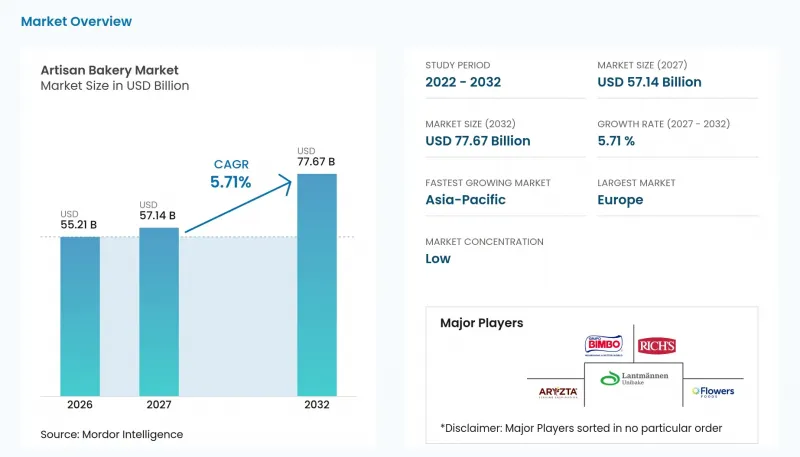
According to Mordor Intelligence, the artisan bakery market was valued at USD 55.21 billion in 2026 and is estimated to grow from USD 57.14 billion in 2027 to USD 77.67 billion by 2032, at a CAGR of 5.71% during the forecast period from 2027 to 2032.
Global Artisan Bakery Market Trends and Insights
Growing Consumer Interest in Premium Ingredients and Distinctive Bakery Flavors
Growing consumer interest in distinctive flavors, ingredient transparency, and whole-grain products is encouraging bakeries to diversify their product offerings. For instance, in June 2025, according to the Oldways Whole Grains Council's Whole Grain Consumer Insights Survey, consumers chose whole-grain options for bread, rolls, and buns 42% of the time. Additionally, 77% of surveyed U.S. consumers wanted product packaging to display whole-grain content, up from 70% in 2021. Furthermore, 84% of respondents trusted the Whole Grain Stamp, underscoring the importance of ingredient transparency in purchasing decisions .
Increasing Popularity of Artisan Bread and Experiential Bakery Offerings
Increasing consumer interest in artisan bread, sourdough, and distinctive bakery products is creating opportunities for artisan bakeries to expand their product offerings and enhance the customer experience. For instance, in August 2026, according to the Grain Foods Foundation's Consumer Perspectives on Bread research, conducted by Ipsos among 1,043 U.S. adults, sourdough registered the highest net consumption gain among all bread types over the previous year. It was also the preferred bread for the "ideal sandwich," selected by 20% of respondents. The study identified an "Artisan Advocate" consumer group driven by interest in gut health and premium experiences .
Shortage of Skilled Bakers and Employee Retention Challenges
Skilled labor shortages and employee retention challenges can constrain artisan bakeries' ability to extend operating hours, expand product portfolios, and increase wholesale production. Traditional baking requires hands-on expertise in dough preparation, fermentation, shaping, and baking, making experienced workers essential for maintaining consistent product quality. Smaller bakeries may face additional challenges in competing with larger food manufacturers for skilled employees due to limited training resources and career advancement opportunities. High workloads and demanding schedules can further reduce employee satisfaction and retention.
Other drivers and restraints analyzed in the detailed report include:
- Rising Demand for Diverse Flavors, International Bakery Styles, and Seasonal Offerings
- Growing Consumer Demand for Freshly Baked and Small-Batch Products
- Volatility in Flour, Energy, and Specialty Ingredient Costs
For complete list of drivers and restraints, kindly check the Table Of Contents.
Segment Analysis
Bread and rolls accounted for 47.11% of the artisan bakery market in 2026, reflecting their role as everyday bakery staples across major regions. Regular household consumption, broad availability, and suitability for breakfast, sandwiches, and meal accompaniments drive demand for this segment. Consumers can choose from a wide range of formats, including loaves, buns, baguettes, and specialty rolls, which cater to varying taste preferences and consumption occasions. Artisan bakeries can leverage a core range of fresh bread and rolls to generate consistent sales while differentiating their offerings through traditional baking methods, high-quality ingredients, freshness, and distinctive textures.
Sourdough bread is projected to grow at a CAGR of 7.40% through 2032. Traditional fermentation methods, distinctive flavor and texture, and premium positioning drive this growth. Increasing consumer interest in naturally fermented, artisanal bread has expanded sourdough consumption beyond specialty bakeries to a broader household consumer base. Consumers increasingly value sourdough for its perceived quality, authentic production methods, and versatile use across everyday meals and premium food occasions. Artisan bakers can capitalize on this trend by incorporating sourdough loaves and variations into their core bread offerings, including flavored, seeded, and whole-grain options, to attract consumers seeking distinctive, higher-value bakery products.
Conventional products accounted for 76.21% of the artisan bakery market in 2026, driven by sustained consumer demand for familiar, accessible, and affordable bakery products. Their widespread availability across bakery outlets and retail channels, established recipes, and suitability for everyday bread purchases support their leading position. Artisan bakeries maintain a strong customer base through conventional breads, rolls, and pastries that cater to both regular household consumption and diverse consumer preferences. They further differentiate these offerings through freshness, craftsmanship, ingredient quality, and product variety.
Natural and organic is projected to grow at a 8.20% CAGR through 2032, making it the fastest-growing formulation segment in the artisan bakery market. This growth reflects growing consumer interest in transparent ingredient sourcing, organic certification, clean-label products, and offerings that align with specific dietary preferences, such as natural ingredients and fewer artificial additives. Consumers are increasingly seeking breads and pastries that provide perceived health, quality, and sustainability benefits while serving as alternatives to conventional bakery products. Artisan bakeries can capitalize on this trend by expanding their offerings of naturally formulated and, where applicable, certified organic breads and pastries.
Complete Report Scope:
- By Product Type
- Bread and Rolls
- Sourdough Bread
- Baguettes and Boules
- Ciabatta, Focaccia and Flatbreads
- Others
- By Ingredient and Claim
- Conventional
- Natural/Organic
- By Packaging Format
- Retail-Packaged Fresh
- Frozen and Par-Baked
- Bulk and Foodservice Packaging
- Others
- By End User
- Retail and Household Consumers
- Restaurants and Cafes
- Hotels, Catering and Events
- Institutional and Workplace Foodservice
- By Geography
- North America
- United States
- Canada
- Mexico
- Rest of North America
- Europe
- Germany
- United Kingdom
- Italy
- France
- Spain
- Netherlands
- Poland
- Belgium
- Sweden
- Rest of Europe
- Asia-Pacific
- India
- Japan
- Australia
- China
- Indonesia
- South Korea
- Thailand
- Singapore
- Rest of Asia-Pacific
- South America
- Brazil
- Argentina
- Colombia
- Chile
- Peru
- Rest of South America
- Middle East and Africa
- South Africa
- Saudi Arabia
- United Arab Emirates
- Nigeria
- Egypt
- Morocco
- Turkey
- Rest of Middle East and Africa
- North America
Geography Analysis
Europe is projected to account for 32.22% of the artisan bakery market in 2026. Europe's artisan bakery market is supported by well-established baking traditions, extensive bakery networks, and mature ingredient supply chains. France has a strong tradition of artisanal boulangeries and baguette production, while Germany benefits from a broad network of bakeries. Spain also has an established bakery and pastry industry. These markets are supported by longstanding craft practices, consumer familiarity with traditional baked goods, and developed production and distribution networks.
Asia-Pacific is projected to register a CAGR of 6.80% through 2032. Expanding bakery retail networks, evolving urban lifestyles, and shifting consumer preferences support growth in the Asia-Pacific artisan bakery market. China's bakery sector presents opportunities to increase bread consumption and diversify product offerings, while India's growing preference for healthier bakery products encourages innovation in formulations and ingredients. Across the region, demand for diverse bread varieties, pastries, and premium baked goods enables artisan bakeries to expand their product portfolios and reach new consumer segments.
North America's artisan bakery market benefits from a well-established retail bakery sector and strong consumer interest in premium breads, whole-grain ingredients, and organic products. In South America and the Middle East and Africa, opportunities vary based on local consumer preferences, retail development, and foodservice demand. The expansion of hospitality and catering services is creating opportunities for premium breads, pastries, and other specialty baked goods. Frozen and par-baked products also provide foodservice operators with greater preparation flexibility and consistent product availability. Across these regions, retail development and rising demand from commercial foodservice customers are enabling artisan bakery suppliers to expand their reach.
- Grupo Bimbo, S.A.B. de C.V.
- ARYZTA AG
- Lantmannen Unibake (Lantmannen)
- Flowers Foods, Inc.
- Rich Products Corporation (Rich's)
- Yamazaki Baking Co., Ltd.
- Finsbury Food Group Limited
- Vandemoortele
- Warburtons Limited
- Hovis Limited (Endless LLP)
- Bakers Delight Holdings Ltd
- Panera Bread (JAB Holding Company)
- Le Pain Quotidien
- Groupe LE DUFF
- BreadTalk Group Pte Ltd
- CJ Foodville Corporation (CJ Group affiliate)
- SPC Group (Paris Baguette)
- Groupe HOLDER (Boulangeries PAUL)
- Bread Holdings (GAIL's Bakery)
- Tartine Bakery
Additional Benefits:
- The market estimate (ME) sheet in Excel format
- 3 months of analyst support
TABLE OF CONTENTS
1 INTRODUCTION
- 1.1 Study Assumptions and Market Definition
- 1.2 Scope of the Study
2 RESEARCH METHODOLOGY
3 EXECUTIVE SUMMARY
4 MARKET LANDSCAPE
- 4.1 Market Overview
- 4.2 Market Drivers
- 4.2.1 Growing consumer interest in premium ingredients and distinctive bakery flavors
- 4.2.2 Increasing popularity of artisan bread and experiential bakery offerings
- 4.2.3 Growing demand for diverse flavors, international bakery styles, and seasonal offerings
- 4.2.4 Rising consumer demand for freshly baked and small-batch products
- 4.2.5 Increasing demand for customized cakes and made-to-order bakery products
- 4.2.6 Rising demand for organic, whole-grain and dietary-specific bakery products
- 4.3 Market Restraints
- 4.3.1 Shortage of skilled bakers and employee retention challenges
- 4.3.2 volatility in flour, energy and specialty ingredient costs
- 4.3.3 short shelf life, product waste and distribution constraints
- 4.3.4 high prices of artisan bakery products and consumer affordability challenges
- 4.4 Consumer Behavior Analysis
- 4.5 Regulatory Landscape
- 4.6 Technological Outlook
- 4.7 Porter's Five Forces Analysis
- 4.7.1 Bargaining Power of Suppliers
- 4.7.2 Bargaining Power of Buyers
- 4.7.3 Threat of New Entrants
- 4.7.4 Threat of Substitutes
- 4.7.5 Competitive Rivalry
5 MARKET SIZE AND GROWTH FORECASTS (VALUE)
- 5.1 By Product Type
- 5.1.1 Bread and Rolls
- 5.1.2 Sourdough Bread
- 5.1.3 Baguettes and Boules
- 5.1.4 Ciabatta, Focaccia and Flatbreads
- 5.1.5 Others
- 5.2 By Ingredient and Claim
- 5.2.1 Conventional
- 5.2.2 Natural/Organic
- 5.3 By Packaging Format
- 5.3.1 Retail-Packaged Fresh
- 5.3.2 Frozen and Par-Baked
- 5.3.3 Bulk and Foodservice Packaging
- 5.3.4 Others
- 5.4 By End User
- 5.4.1 Retail and Household Consumers
- 5.4.2 Restaurants and Cafes
- 5.4.3 Hotels, Catering and Events
- 5.4.4 Institutional and Workplace Foodservice
- 5.5 By Geography
- 5.5.1 North America
- 5.5.1.1 United States
- 5.5.1.2 Canada
- 5.5.1.3 Mexico
- 5.5.1.4 Rest of North America
- 5.5.2 Europe
- 5.5.2.1 Germany
- 5.5.2.2 United Kingdom
- 5.5.2.3 Italy
- 5.5.2.4 France
- 5.5.2.5 Spain
- 5.5.2.6 Netherlands
- 5.5.2.7 Poland
- 5.5.2.8 Belgium
- 5.5.2.9 Sweden
- 5.5.2.10 Rest of Europe
- 5.5.3 Asia-Pacific
- 5.5.3.1 India
- 5.5.3.2 Japan
- 5.5.3.3 Australia
- 5.5.3.4 China
- 5.5.3.5 Indonesia
- 5.5.3.6 South Korea
- 5.5.3.7 Thailand
- 5.5.3.8 Singapore
- 5.5.3.9 Rest of Asia-Pacific
- 5.5.4 South America
- 5.5.4.1 Brazil
- 5.5.4.2 Argentina
- 5.5.4.3 Colombia
- 5.5.4.4 Chile
- 5.5.4.5 Peru
- 5.5.4.6 Rest of South America
- 5.5.5 Middle East and Africa
- 5.5.5.1 South Africa
- 5.5.5.2 Saudi Arabia
- 5.5.5.3 United Arab Emirates
- 5.5.5.4 Nigeria
- 5.5.5.5 Egypt
- 5.5.5.6 Morocco
- 5.5.5.7 Turkey
- 5.5.5.8 Rest of Middle East and Africa
- 5.5.1 North America
6 COMPETITIVE LANDSCAPE
- 6.1 Market Concentration
- 6.2 Strategic Moves
- 6.3 Market Share Analysis
- 6.4 Company Profiles (includes Global Level Overview, Market Level Overview, Core Segments, Financials as available, Strategic Information, Market Rank/Share, Products and Services, Recent Developments)
- 6.4.1 Grupo Bimbo, S.A.B. de C.V.
- 6.4.2 ARYZTA AG
- 6.4.3 Lantmannen Unibake (Lantmannen)
- 6.4.4 Flowers Foods, Inc.
- 6.4.5 Rich Products Corporation (Rich's)
- 6.4.6 Yamazaki Baking Co., Ltd.
- 6.4.7 Finsbury Food Group Limited
- 6.4.8 Vandemoortele
- 6.4.9 Warburtons Limited
- 6.4.10 Hovis Limited (Endless LLP)
- 6.4.11 Bakers Delight Holdings Ltd
- 6.4.12 Panera Bread (JAB Holding Company)
- 6.4.13 Le Pain Quotidien
- 6.4.14 Groupe LE DUFF
- 6.4.15 BreadTalk Group Pte Ltd
- 6.4.16 CJ Foodville Corporation (CJ Group affiliate)
- 6.4.17 SPC Group (Paris Baguette)
- 6.4.18 Groupe HOLDER (Boulangeries PAUL)
- 6.4.19 Bread Holdings (GAIL's Bakery)
- 6.4.20 Tartine Bakery
7 MARKET OPPORTUNITIES AND FUTURE OUTLOOK

