PUBLISHER: Mordor Intelligence | PRODUCT CODE: 2186077

PUBLISHER: Mordor Intelligence | PRODUCT CODE: 2186077
Lithium-ion Battery Binders - Market Share Analysis, Industry Trends & Statistics, Growth Forecasts (2027 - 2032)
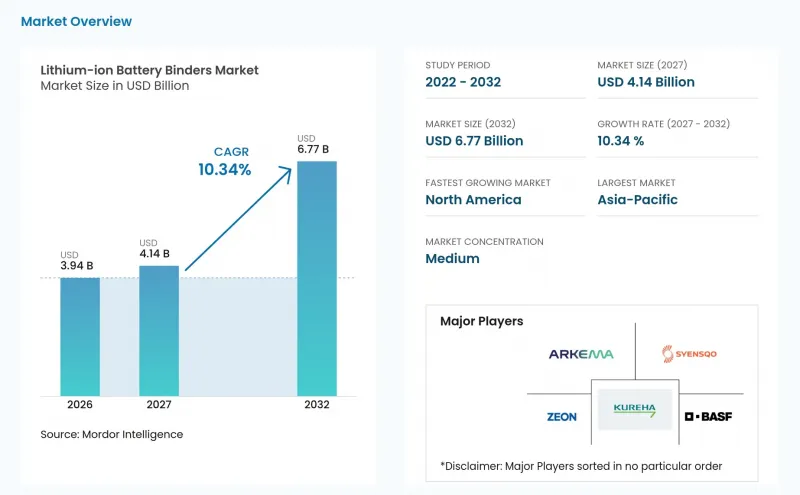
According to Mordor Intelligence, the lithium-ion battery binders market size is expected to increase from USD 3.94 billion in 2026 to USD 4.14 billion in 2027 and reach USD 6.77 billion by 2032, growing at a CAGR of 10.34% over 2027-2032.
Global Lithium-ion Battery Binders Market Trends and Insights
Electric Vehicle and Gigafactory Expansion
Gigafactory expansion remains the strongest demand driver for the lithium-ion battery binders market. New cell plants turn binder materials from specialized inputs into products needed at large industrial volumes. Global EV battery deployment reached 1.2 TWh in 2025 and rose by nearly 30% from 2024. Electric trucks more than doubled their battery demand in the same year, adding another route for electrode-material consumption. Suppliers that qualify materials during a plant's initial production stage can become part of a supply relationship that continues through later production programs. This makes early work with cell designers important because binder specification affects line performance, product quality, and validation schedules.
Grid-Scale Energy Storage Deployment
Grid-scale storage gives the lithium-ion battery binders market a source of demand that is separate from vehicle production cycles. The United States installed 57.6 GWh of new energy storage capacity in 2025, 4 times the level recorded 3 years earlier. Cumulative utility-scale storage in the country reached 137 GWh during 2025. LFP accounted for more than 90% of global stationary storage installations in 2025, which supports use of cost-focused SBR and Carboxymethyl Cellulose (CMC) binder systems. This demand base reduces dependence on automotive volumes for suppliers serving aqueous anode processing. It also supports SBR demand when EV adoption slows in an individual region.
High Qualification and Switching Costs
Binder qualifications can limit the pace of change in the lithium-ion battery binders market. Cell manufacturers test electrochemical cycling, thermal stability, line adhesion, and safety performance before approving a material. These activities take multiple years and involve more than a single laboratory test. Once material is approved, changing to another supplier can introduce new cost and production-schedule risk. This process protects suppliers with existing qualifications, especially in high-nickel NMC and NCA applications with few established alternatives. It can also slow commercial adoption of bio-derived, PFAS-free, or otherwise differentiated binder systems even when technical results are promising.
Other drivers and restraints analyzed in the detailed report include:
- Water-Based Electrode Processing Adoption
- Silicon-Rich Anode Qualification
- Fluoropolymer Feedstock and Supply Concentration
For complete list of drivers and restraints, kindly check the Table Of Contents.
Segment Analysis
PVDF held 46.5% of lithium-ion battery binders market share in 2026, supported by its long qualification history and stability in cathode formulations. Cathode manufacturing requires binder materials that remain reliable in oxidative environments. Arkema introduced Kynar HSV 1200 and HSV 1400 at Interbattery 2026 for LFP cathodes, with lower binder loading and higher active-material content as stated product objectives. CMC supports water-based anode slurry as a thickener and dispersant when used with SBR. The draft indicates that CMC and SBR are commonly used in a 1:3 weight ratio across anode coating lines. Polyacrylic Acid (PAA)-based binders are gaining relevance for silicon-rich anodes because their carboxyl groups can bond with silicon particles. This functional property responds to the adhesion demands created by cycling-related expansion.
SBR is forecast to grow at an 11.6% CAGR through 2032, making it the fastest-growing binder material. Growth is linked to aqueous anode processing and rising demand for silicon-compatible grades. Trinseo commercially launched VOLTABOND 211 in May 2026, reporting a 5% reduction in electrode surface resistivity and up to an 18% reduction in internal resistance compared with its earlier SBR generation. Polytetrafluoroethylene (PTFE) is used in dry-electrode processing to create self-supporting films, while PMMA is being evaluated for solid-state prototype cells. Sodium alginate is attracting research interest in aqueous LFP cathode applications. These materials widen the binder material set as cell makers pursue different processing routes and battery architectures.
Anode binders held 57.3% of revenue share in 2026 and are forecast to grow at a 10.6% CAGR through 2032. Their share reflects the broad use of aqueous SBR and CMC systems in graphite anodes across commercial cell chemistries. Rising silicon content in commercial anode blends supports demand for functional polymer grades. The anode side therefore includes both high-volume conventional applications and higher-performance materials for silicon-containing systems. The lithium-ion battery binders market size for anode materials benefits from the large installed base of graphite-based cell production. It also gains from a gradual shift toward materials that can withstand repeated changes in electrode volume.
Cathode binders held the remaining 42.7% share in 2026 and tended to command higher selling prices because PVDF is a specialty material. Cathode environments require resistance to oxidation and compatibility with active materials. Water-based NMC cathode routes are moving from pilot work toward pre-commercial evaluation. The 2026 RSC Sustainability review identified pH management and aluminum corrosion as key barriers to wider aqueous NMC cathode deployment. Broad adoption of aqueous cathode processing would change procurement toward aqueous latex suppliers. That shift could reduce margins for suppliers whose current position rests mainly on high-value PVDF cathode grades.
Complete Report Scope:
- By Binder Material
- Polyvinylidene Fluoride (PVDF)
- Styrene-Butadiene Rubber (SBR)
- Carboxymethyl Cellulose (CMC)
- Polyacrylic Acid (PAA)
- Polymethyl Methacrylate (PMMA)
- Polytetrafluoroethylene (PTFE)
- Sodium Alginate
- Other Binder Materials
- By Electrode Type
- Anode Binders
- Cathode Binders
- By Battery Chemistry
- Lithium Iron Phosphate (LFP)
- Lithium Nickel Manganese Cobalt Oxide (NMC)
- Lithium Cobalt Oxide (LCO)
- Lithium Nickel Cobalt Aluminum Oxide (NCA)
- Lithium Manganese Oxide (LMO)
- Lithium Titanate Oxide (LTO)
- Other Lithium-Ion Battery Chemistries
- By Formulation and Processing Technology
- Solvent-Based Binders
- Water-Based Binders
- Dry Electrode Binders
- Other Binder Formulations
- By End-Use Industry
- Automotive and Transportation
- Consumer Electronics
- Energy and Power
- Industrial and Manufacturing
- Other End-Use Industries
- By Geography
- North America
- United States
- Canada
- Mexico
- Europe
- Germany
- France
- Italy
- Spain
- United Kingdom
- Poland
- Russia
- Rest of Europe
- Asia-Pacific
- China
- India
- Japan
- South Korea
- Australia
- Indonesia
- Vietnam
- Thailand
- Rest of Asia-Pacific
- South America
- Brazil
- Argentina
- Chile
- Rest of South America
- Middle East and Africa
- Saudi Arabia
- United Arab Emirates
- Egypt
- South Africa
- Morocco
- Rest of Middle East and Africa
- North America
Geography Analysis
Asia-Pacific held 47.5% of revenue share in 2026, giving the region the largest position in the lithium-ion battery binders market. China held more than 80% of global lithium-ion battery nameplate capacity, and its battery-material supply chain includes highly concentrated LFP precursor production. This manufacturing base supports extensive demand for both cathode and anode binder materials. South Korea is another major regional demand center, supported by gigafactory programs run by LG Energy Solution, Samsung SDI, and SK On. Japan remains important as the home of Kureha and Zeon, as well as a base for silicon-anode and solid-state binder development.
North America is forecast to grow at a 12.4% CAGR through 2032, the fastest rate among geographic regions. Growth reflects the movement from announced plants toward operational electrode manufacturing. Syensqo is building a PVDF facility in Augusta, Georgia, backed by a USD 178 million Department of Energy grant, with capacity intended to serve more than 5 million EV batteries annually at full output. Arkema completed a 15% PVDF capacity expansion at its Calvert City, Kentucky, plant in June 2026. The Section 45X production tax credit supports localized battery-material output in the United States. These additions address a domestic supply gap while increasing the importance of local qualification and logistics.
Europe has a meaningful position through cell plants and binder facilities in Germany, France, the United Kingdom, and Poland. Arkema expanded its Global Battery R&D Center of Excellence in Lyon with a EUR 10 million investment in October 2026. Syensqo's Tavaux PVDF site further supports the region's binder production base. European cell manufacturing capacity rose by 50% in 2025, compared with 25% in China. The EU Battery Regulation raises documentation requirements on recycled content, carbon footprint, and due diligence. South America is still developing battery-material processing around lithium resources, while the Middle East and Africa see additional demand from grid-scale storage projects.
- Arkema S.A.
- Ashland Inc.
- BASF SE
- Daikin Industries, Ltd.
- Denka Company Limited
- Dow Inc.
- JSR Corporation
- Kureha Corporation
- LG Chem Ltd.
- Mitsubishi Chemical Group Corporation
- Mitsui Chemicals, Inc.
- Resonac Holdings Corporation
- Shanghai 3F New Materials Co., Ltd.
- Sumitomo Chemical Co., Ltd.
- Suzhou Crystal Clear Chemical Co., Ltd.
- Syensqo S.A.
- Synthomer plc
- Toray Industries, Inc.
- Trinseo PLC
- Zeon Corporation
Additional Benefits:
- The market estimate (ME) sheet in Excel format
- 3 months of analyst support
TABLE OF CONTENTS
1 INTRODUCTION
- 1.1 Study Assumptions and Market Definition
- 1.2 Scope of the Study
2 RESEARCH METHODOLOGY
3 EXECUTIVE SUMMARY
4 MARKET LANDSCAPE
- 4.1 Market Overview
- 4.2 Market Drivers
- 4.2.1 Electric Vehicle and Gigafactory Expansion
- 4.2.2 Grid-Scale Energy Storage Deployment
- 4.2.3 Water-Based Electrode Processing Adoption
- 4.2.4 Silicon-Rich Anode Qualification
- 4.2.5 Binder Qualification as a Process-Yield Differentiator
- 4.2.6 Localized Battery-Material Supply Strategies
- 4.3 Market Restraints
- 4.3.1 High Qualification and Switching Costs
- 4.3.2 Fluoropolymer Feedstock and Supply Concentration
- 4.3.3 Binder Performance Trade-Offs in Emerging Chemistries
- 4.3.4 Uncertain Scale-Up Timing for Dry-Electrode Processing
- 4.4 Supply-Chain Analysis
- 4.5 Porter's Five Forces Analysis
- 4.5.1 Bargaining Power of Suppliers
- 4.5.2 Bargaining Power of Buyers
- 4.5.3 Threat of New Entrants
- 4.5.4 Threat of Substitutes
- 4.5.5 Competitive Rivalry
- 4.6 Technology Outlook
- 4.7 Regulatory Landscape
- 4.8 Investment Analysis
5 MARKET SIZE AND GROWTH FORECASTS
- 5.1 By Binder Material
- 5.1.1 Polyvinylidene Fluoride (PVDF)
- 5.1.2 Styrene-Butadiene Rubber (SBR)
- 5.1.3 Carboxymethyl Cellulose (CMC)
- 5.1.4 Polyacrylic Acid (PAA)
- 5.1.5 Polymethyl Methacrylate (PMMA)
- 5.1.6 Polytetrafluoroethylene (PTFE)
- 5.1.7 Sodium Alginate
- 5.1.8 Other Binder Materials
- 5.2 By Electrode Type
- 5.2.1 Anode Binders
- 5.2.2 Cathode Binders
- 5.3 By Battery Chemistry
- 5.3.1 Lithium Iron Phosphate (LFP)
- 5.3.2 Lithium Nickel Manganese Cobalt Oxide (NMC)
- 5.3.3 Lithium Cobalt Oxide (LCO)
- 5.3.4 Lithium Nickel Cobalt Aluminum Oxide (NCA)
- 5.3.5 Lithium Manganese Oxide (LMO)
- 5.3.6 Lithium Titanate Oxide (LTO)
- 5.3.7 Other Lithium-Ion Battery Chemistries
- 5.4 By Formulation and Processing Technology
- 5.4.1 Solvent-Based Binders
- 5.4.2 Water-Based Binders
- 5.4.3 Dry Electrode Binders
- 5.4.4 Other Binder Formulations
- 5.5 By End-Use Industry
- 5.5.1 Automotive and Transportation
- 5.5.2 Consumer Electronics
- 5.5.3 Energy and Power
- 5.5.4 Industrial and Manufacturing
- 5.5.5 Other End-Use Industries
- 5.6 By Geography
- 5.6.1 North America
- 5.6.1.1 United States
- 5.6.1.2 Canada
- 5.6.1.3 Mexico
- 5.6.2 Europe
- 5.6.2.1 Germany
- 5.6.2.2 France
- 5.6.2.3 Italy
- 5.6.2.4 Spain
- 5.6.2.5 United Kingdom
- 5.6.2.6 Poland
- 5.6.2.7 Russia
- 5.6.2.8 Rest of Europe
- 5.6.3 Asia-Pacific
- 5.6.3.1 China
- 5.6.3.2 India
- 5.6.3.3 Japan
- 5.6.3.4 South Korea
- 5.6.3.5 Australia
- 5.6.3.6 Indonesia
- 5.6.3.7 Vietnam
- 5.6.3.8 Thailand
- 5.6.3.9 Rest of Asia-Pacific
- 5.6.4 South America
- 5.6.4.1 Brazil
- 5.6.4.2 Argentina
- 5.6.4.3 Chile
- 5.6.4.4 Rest of South America
- 5.6.5 Middle East and Africa
- 5.6.5.1 Saudi Arabia
- 5.6.5.2 United Arab Emirates
- 5.6.5.3 Egypt
- 5.6.5.4 South Africa
- 5.6.5.5 Morocco
- 5.6.5.6 Rest of Middle East and Africa
- 5.6.1 North America
6 COMPETITIVE LANDSCAPE
- 6.1 Market Concentration
- 6.2 Strategic Moves
- 6.3 Market Share Analysis
- 6.4 Company Profiles (includes Global Level Overview, Market Level Overview, Core Segments, Financials as available, Strategic Information, Market Rank/Share, Products and Services, Recent Developments)
- 6.4.1 Arkema S.A.
- 6.4.2 Ashland Inc.
- 6.4.3 BASF SE
- 6.4.4 Daikin Industries, Ltd.
- 6.4.5 Denka Company Limited
- 6.4.6 Dow Inc.
- 6.4.7 JSR Corporation
- 6.4.8 Kureha Corporation
- 6.4.9 LG Chem Ltd.
- 6.4.10 Mitsubishi Chemical Group Corporation
- 6.4.11 Mitsui Chemicals, Inc.
- 6.4.12 Resonac Holdings Corporation
- 6.4.13 Shanghai 3F New Materials Co., Ltd.
- 6.4.14 Sumitomo Chemical Co., Ltd.
- 6.4.15 Suzhou Crystal Clear Chemical Co., Ltd.
- 6.4.16 Syensqo S.A.
- 6.4.17 Synthomer plc
- 6.4.18 Toray Industries, Inc.
- 6.4.19 Trinseo PLC
- 6.4.20 Zeon Corporation
7 MARKET OPPORTUNITIES AND FUTURE OUTLOOK
- 7.1 White-Space and Unmet-Need Assessment

