PUBLISHER: Mordor Intelligence | PRODUCT CODE: 2186094

PUBLISHER: Mordor Intelligence | PRODUCT CODE: 2186094
Inspection Services - Market Share Analysis, Industry Trends & Statistics, Growth Forecasts (2027 - 2032)
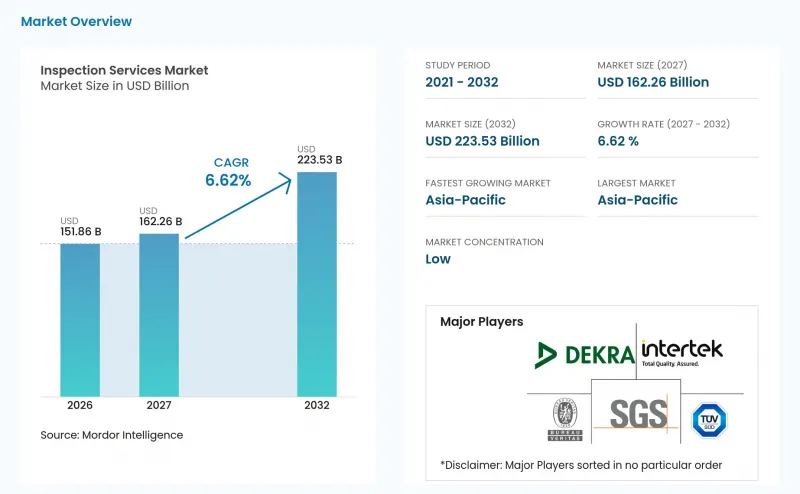
According to Mordor Intelligence, the inspection services market size is expected to increase from USD 151.86 billion in 2026 to USD 162.26 billion in 2027 and reach USD 223.53 billion by 2032, growing at a CAGR of 6.62% over 2027-2032.
Global Inspection Services Market Trends and Insights
Stringent Safety, Quality, and Regulatory Compliance Requirements
Safety, quality, and regulatory requirements are the largest source of recurring demand in the inspection services market. ISO/IEC 17020:2026 replaced the 2012 edition on March 27, 2026, and introduced changes to independence classification, impartiality governance, and complaints handling. UKAS states that accredited inspection bodies have a three-year transition period and must complete the change by March 2029. The new framework requires organizations to review procedures, train personnel, and maintain clearer evidence of competence. France expanded building-related obligations through Decree No. 2025-814, which requires structural diagnostic reports for collective residential buildings. Such rules make inspection spending less dependent on voluntary capital budgets because property owners and operators must demonstrate compliance.
Aging Infrastructure and Industrial Assets Driving Periodic and Condition-Based Inspections
Aging bridges, dams, levees, pipelines, and industrial plants increase the need for periodic and condition-based assessment. The American Society of Civil Engineers reported in 2025 that 6.8% of more than 623,000 United States bridges were in poor condition. The same assessment noted that nearly two-thirds of more than 24,000 levee miles in the national database had not received a formal risk assessment. More than 92,000 United States dams have an average age above 60 years, and 17,000 are classified as high-hazard-potential structures. Asset owners are therefore moving beyond fixed inspection intervals toward programs that use condition, risk, and operating data. This transition supports more frequent assessments and creates demand for specialists who can interpret asset condition and prioritize corrective work.
Shortage of Qualified and Accredited Inspection Professionals
The shortage of qualified personnel limits how quickly providers can add capacity in the inspection services market. The American Society for Nondestructive Testing identified a need for stronger skills, trust, and technology systems as the nondestructive evaluation workforce changes. Inspection work often requires documented industrial experience in addition to formal instruction and examination. This requirement extends the time needed to deploy technicians on critical assets. The ISO/IEC 17020:2026 transition adds training and competence-management work for organizations already facing staffing pressure. Different certification systems across regions can further limit the cross-border movement of experienced specialists. The constraint is most visible in advanced nondestructive testing, high-risk industrial assets, and inspection roles that require senior technical judgment.
Other drivers and restraints analyzed in the detailed report include:
- Infrastructure Development, Construction Activity, and Industrial Capital Investment
- Growing Outsourcing of Inspection Services and Demand for Independent Verification
- High Costs of Specialized Inspection Equipment and Technologies
For complete list of drivers and restraints, kindly check the Table Of Contents.
Segment Analysis
Building and Property Inspection Services held 23.9% of the inspection services market share in 2026. In the inspection services market, the segment serves residential, commercial, and institutional properties, where statutory obligations and property transactions both support inspection activity. Core work includes structural checks, mechanical, electrical, and plumbing assessments, fire-safety inspections, and pre-handover condition reports. These services respond to both scheduled compliance needs and time-sensitive events such as sales, leasing, renovation, and occupancy changes. Building owners also face wider expectations for documented condition and safety. France's 2025 structural diagnostic requirement for collective residential buildings illustrates how public policy can expand the scope of building assessment. This wide set of requirements gives the segment a stable demand base across different property types.
Civil Infrastructure Inspection Services is forecast to record a 7.9% CAGR through 2032. The inspection services market includes a segment that covers bridges, roads, tunnels, dams, rail assets, and related public structures that require recurring condition reviews. Aging assets and backlogs make detailed assessments more important, especially where owners need to prioritize repairs and maintain safe operation. The United States infrastructure condition data shows the scale of inspection needs across bridges, levees, and dams. Germany's 2025 nationwide structural-inspection framework also shows that public buyers are adopting multi-year procurement models. Industrial facilities, manufactured products, transportation assets, and commodities remain important adjacent domains. They extend demand across pressure equipment, pipelines, production processes, aircraft, vehicles, marine vessels, cargo, and trade flows.
Complete Report Scope:
- By Inspection Service Domain
- Building and Property Inspection Services
- Residential, Commercial, and Institutional Building Inspections
- Structural, Building Envelope, MEP, and Fire-Safety Inspections
- Property Condition, Construction, and Handover Inspections
- Civil Infrastructure Inspection Services
- Roads, Bridges, Tunnels, and Rail Track Infrastructure
- Dams, Civil Water Infrastructure, and Other Civil Engineering Structures
- Industrial Facilities and Fixed Asset Inspection Services
- Industrial Plants and Installed Process Equipment
- Pressure Vessels, Pipelines, and Storage Tanks
- Energy Generation and Utility Systems
- Other Stationary Industrial Equipment
- Manufactured Product and Production-Process Inspection Services
- Raw Material and Component Inspection
- In-Process Manufacturing Inspection
- Finished-Product and Production-Process Conformity Inspection
- Transportation Vehicle and Mobile Asset Inspection Services
- Road Vehicles and Commercial Fleets
- Rail Rolling Stock
- Aircraft and Aviation Assets
- Ships and Other Marine Vessels
- Other Mobile Transportation Assets
- Commodity, Cargo, and Trade Inspection Services
- Bulk and Containerized Cargo Inspection
- Traded Commodity Inspection
- Consignment Condition, Quantity, and Quality Verification
- Loading, Unloading, and Custody-Transfer Inspection
- Other Operational Site and Process Inspection Services
- Physical Hygiene and Workplace Safety Inspection
- Agricultural Site Inspection
- Other Operational Compliance Inspection
- Building and Property Inspection Services
- By End-Use Industry
- Oil and Gas, Including Petroleum Refining, and Petrochemicals
- Power Generation, Renewable Energy, and Utilities
- Manufacturing and Industrial Processing (Excluding Industries Separately Classified)
- Construction, Real Estate, and Civil Infrastructure
- Transportation and Logistics Operations
- Mining and Quarrying
- Agriculture, Food, and Beverage
- Wholesale, Retail, and Commodity Trading
- Healthcare, Pharmaceuticals, and Life Sciences
- Households and Individual Consumers
- Other Commercial Services and Public Institutions
- By Geography
- North America
- United States
- Canada
- Mexico
- Europe
- Germany
- United Kingdom
- France
- Italy
- Spain
- Netherlands
- Poland
- Turkey
- Russia
- Rest of Europe
- Asia-Pacific
- China
- Japan
- India
- South Korea
- Taiwan
- Australia
- ASEAN (Indonesia, Thailand, Vietnam, Malaysia, Singapore, Philippines, Myanmar, Cambodia, Laos, Brunei, Timor-Leste)
- Rest of Asia-Pacific (Taiwan, Hong Kong, New Zealand, Bangladesh, Pakistan, Sri Lanka, etc.)
- Middle East and Africa
- Saudi Arabia
- United Arab Emirates
- Qatar
- South Africa
- Egypt
- Nigeria
- Rest of Middle East
- Rest of Africa
- South America
- Brazil
- Argentina
- Rest of South America (Chile, Colombia, Peru, etc.)
- North America
Geography Analysis
Asia-Pacific held 37.1% of the inspection services market share in 2026 and is forecast to grow at a 7.49% CAGR through 2032. China supports substantial inspection demand through its manufacturing base, ports, logistics networks, and domestic regulatory activity. India adds demand through investment in roads, metro rail, airports, renewable energy, and other infrastructure. Vietnam, Indonesia, Thailand, and Malaysia are also gaining production capacity as companies diversify supply chains. New facilities require qualification of equipment, processes, and suppliers before production can scale. TUV Rheinland reported EUR 87.2 million (USD 102.6 million) of investments in 2025, including laboratory expansion in Taicang and Shenzhen, which indicates the priority placed on regional capacity. The inspection services market in the region combines large installed asset bases with new construction and manufacturing activity.
North America remains an important part of the inspection services market because of its aging public infrastructure and large base of industrial assets. ASCE identified a USD 3.7 trillion 10-year United States infrastructure funding gap in its 2025 report card. This gap points to persistent needs for condition assessment, maintenance planning, and oversight across civil assets. SGS signed an agreement in July 2025 to acquire Applied Technical Services, which operates 85 United States facilities with 2,100 specialists. The transaction is intended to extend SGS's scale across testing, inspection, calibration, and forensics. North American demand also includes aerospace, manufacturing, power generation, and insurance-related verification. These applications support continuing demand for specialist staff and accredited inspection capability.
Mature procurement systems, regular reinspection cycles, and tightening obligations for buildings and civil structures characterize Europe. The EUR 3.9 million (USD 4.6 million) German structural-inspection framework demonstrates how operators formalize recurring asset checks through national contracts. The Middle East and Africa depend on oil and gas, power, and diversification-linked construction spending, while South America is supported by Brazil's building, sanitation, and commodity-related activity. DNV's August 2025 quality-assurance contract for the Net Zero Teesside Power and Northern Endurance Partnership projects shows how carbon capture infrastructure is opening new inspection mandates. These projects require providers to apply inspection and quality methods to newer asset classes. Across these regions, the inspection services market benefits from a mix of established compliance work and opportunities tied to energy and infrastructure development.
- SGS SA
- Bureau Veritas SA
- Intertek Group plc
- DEKRA SE
- TUV SUD AG
- TUV Rheinland AG
- TUV NORD Group
- Applus+
- DNV
- RINA S.p.A.
- Lloyd's Register Group
- Kiwa Group
- SOCOTEC Group
- Apave Group
- OCA Global
- Acuren Corporation (Including NV5 Operations)
- MISTRAS Group, Inc.
- TEAM, Inc.
- Oceaneering International, Inc.
- ROSEN Group
- NDT Global
- QIMA
- Cotecna
- China Certification & Inspection Group (CCIC)
- Opus Inspection
Additional Benefits:
- The market estimate (ME) sheet in Excel format
- 3 months of analyst support
TABLE OF CONTENTS
1 Introduction
- 1.1 Study Assumptions and Market Definition
- 1.2 Scope of the Study
2 Research Methodology
3 Executive Summary
4 Market Landscape
- 4.1 Market Overview
- 4.1.1 Global Inspection Services Industry Structure
- 4.1.2 Role of Independent Inspection Providers and Regulatory Authorities
- 4.1.3 Demand Characteristics Across Major End-Use Industries
- 4.2 Value and Supply-Chain Analysis
- 4.2.1 Inspection Equipment, Instrumentation, and Software Providers
- 4.2.2 Independent Inspection Service Providers and Specialist Operators
- 4.2.3 Accreditation Bodies, Standards Organizations, and Regulators
- 4.2.4 Supporting Testing Laboratories and Technical Service Providers
- 4.2.5 End Users, Asset Owners, and Procurement Channels
- 4.3 Market Drivers
- 4.3.1 Stringent Safety, Quality, and Regulatory Compliance Requirements
- 4.3.2 Aging Infrastructure and Industrial Assets Driving Periodic and Condition-Based Inspections
- 4.3.3 Infrastructure Development, Construction Activity, and Industrial Capital Investments
- 4.3.4 Growing Outsourcing of Inspection Services and Demand for Independent Verification
- 4.3.5 Increasing Product Quality Requirements and Global Supply-Chain Complexity
- 4.3.6 Expansion of Renewable Energy, Electrification, and Other Emerging Asset Classes
- 4.4 Market Restraints
- 4.4.1 Shortage of Qualified and Accredited Inspection Professionals
- 4.4.2 High Costs of Specialized Inspection Equipment and Technologies
- 4.4.3 Pricing Pressure and Market Fragmentation Across Regional Providers
- 4.4.4 Operational Constraints, Safety Risks, and Restricted Asset Accessibility
- 4.4.5 Regulatory Fragmentation and Varying Recognition of Inspection Standards
- 4.5 Key Market Trends
- 4.5.1 Shift Toward Risk-Based and Condition-Based Inspection Programs
- 4.5.2 Growing Adoption of Remote, Automated, and Robotics-Assisted Inspections
- 4.5.3 Increasing Integration of Digital Inspection Records and Asset Management Platforms
- 4.5.4 Consolidation Among Inspection Service Providers and Expansion of Integrated Service Offerings
- 4.5.5 Growing Demand for Continuous Monitoring and Recurring Inspection Arrangements
- 4.6 Regulatory and Standards Landscape
- 4.6.1 International Inspection Accreditation Framework - ISO/IEC 17020:2026
- 4.6.2 Distinction Between Inspection Accreditation, Testing Accreditation, and Certification
- 4.6.3 Industrial Equipment, Pressure Systems, and Pipeline Inspection Requirements
- 4.6.4 Building, Construction, and Civil Infrastructure Inspection Regulations
- 4.6.5 Automotive, Aviation, Rail, and Maritime Inspection Requirements
- 4.6.6 Manufacturing, Product Quality, and Pre-Shipment Inspection Regulations
- 4.6.7 Occupational Safety, Environmental, and Operational Site Inspection Requirements
- 4.6.8 Regional Regulatory Differences and Cross-Border Recognition of Inspection Results
- 4.7 Technological Outlook
- 4.7.1 Conventional Visual and Manual Inspection Techniques
- 4.7.2 NDT-Based Inspection Techniques (Ultrasonic, Radiographic, Eddy Current, Magnetic Particle, Liquid Penetrant and Acoustic Methods)
- 4.7.3 Thermal Imaging, Laser Scanning, and 3D Inspection Technologies
- 4.7.4 Drone, ROV, Crawler, and Robotic Inspection Platforms
- 4.7.5 AI-Assisted Defect Detection and Computer Vision
- 4.7.6 IoT-Enabled Monitoring, Digital Twins, and Predictive Inspection Analytics
- 4.7.7 Digital Inspection Reporting, Traceability, and Data Interoperability
- 4.8 Inspection Service Procurement and Commercial Models
- 4.8.1 Statutory and Mandatory Inspection Demand versus Voluntary Inspection Demand
- 4.8.2 Project-Based versus Recurring Inspection Contracts
- 4.8.3 Pricing Structures - Per Inspection, Time-Based, Asset-Based, and Contract-Based Fees
- 4.8.4 Inspection Frequency, Asset Criticality, and Contract Renewal Dynamics
- 4.9 Macroeconomic and Industry Investment Cycle Impact
- 4.9.1 Impact of Industrial Capital Expenditure and Manufacturing Activity
- 4.9.2 Impact of Infrastructure Investment and Construction Cycles
- 4.9.3 Impact of Trade Activity and Global Supply-Chain Reconfiguration
5 Market Size And Growth Forecasts
- 5.1 By Inspection Service Domain
- 5.1.1 Building and Property Inspection Services
- 5.1.1.1 Residential, Commercial, and Institutional Building Inspections
- 5.1.1.2 Structural, Building Envelope, MEP, and Fire-Safety Inspections
- 5.1.1.3 Property Condition, Construction, and Handover Inspections
- 5.1.2 Civil Infrastructure Inspection Services
- 5.1.2.1 Roads, Bridges, Tunnels, and Rail Track Infrastructure
- 5.1.2.2 Dams, Civil Water Infrastructure, and Other Civil Engineering Structures
- 5.1.3 Industrial Facilities and Fixed Asset Inspection Services
- 5.1.3.1 Industrial Plants and Installed Process Equipment
- 5.1.3.2 Pressure Vessels, Pipelines, and Storage Tanks
- 5.1.3.3 Energy Generation and Utility Systems
- 5.1.3.4 Other Stationary Industrial Equipment
- 5.1.4 Manufactured Product and Production-Process Inspection Services
- 5.1.4.1 Raw Material and Component Inspection
- 5.1.4.2 In-Process Manufacturing Inspection
- 5.1.4.3 Finished-Product and Production-Process Conformity Inspection
- 5.1.5 Transportation Vehicle and Mobile Asset Inspection Services
- 5.1.5.1 Road Vehicles and Commercial Fleets
- 5.1.5.2 Rail Rolling Stock
- 5.1.5.3 Aircraft and Aviation Assets
- 5.1.5.4 Ships and Other Marine Vessels
- 5.1.5.5 Other Mobile Transportation Assets
- 5.1.6 Commodity, Cargo, and Trade Inspection Services
- 5.1.6.1 Bulk and Containerized Cargo Inspection
- 5.1.6.2 Traded Commodity Inspection
- 5.1.6.3 Consignment Condition, Quantity, and Quality Verification
- 5.1.6.4 Loading, Unloading, and Custody-Transfer Inspection
- 5.1.7 Other Operational Site and Process Inspection Services
- 5.1.7.1 Physical Hygiene and Workplace Safety Inspection
- 5.1.7.2 Agricultural Site Inspection
- 5.1.7.3 Other Operational Compliance Inspection
- 5.1.1 Building and Property Inspection Services
- 5.2 By End-Use Industry
- 5.2.1 Oil and Gas, Including Petroleum Refining, and Petrochemicals
- 5.2.2 Power Generation, Renewable Energy, and Utilities
- 5.2.3 Manufacturing and Industrial Processing (Excluding Industries Separately Classified)
- 5.2.4 Construction, Real Estate, and Civil Infrastructure
- 5.2.5 Transportation and Logistics Operations
- 5.2.6 Mining and Quarrying
- 5.2.7 Agriculture, Food, and Beverage
- 5.2.8 Wholesale, Retail, and Commodity Trading
- 5.2.9 Healthcare, Pharmaceuticals, and Life Sciences
- 5.2.10 Households and Individual Consumers
- 5.2.11 Other Commercial Services and Public Institutions
- 5.3 By Geography
- 5.3.1 North America
- 5.3.1.1 United States
- 5.3.1.2 Canada
- 5.3.1.3 Mexico
- 5.3.2 Europe
- 5.3.2.1 Germany
- 5.3.2.2 United Kingdom
- 5.3.2.3 France
- 5.3.2.4 Italy
- 5.3.2.5 Spain
- 5.3.2.6 Netherlands
- 5.3.2.7 Poland
- 5.3.2.8 Turkey
- 5.3.2.9 Russia
- 5.3.2.10 Rest of Europe
- 5.3.3 Asia-Pacific
- 5.3.3.1 China
- 5.3.3.2 Japan
- 5.3.3.3 India
- 5.3.3.4 South Korea
- 5.3.3.5 Taiwan
- 5.3.3.6 Australia
- 5.3.3.7 ASEAN (Indonesia, Thailand, Vietnam, Malaysia, Singapore, Philippines, Myanmar, Cambodia, Laos, Brunei, Timor-Leste)
- 5.3.3.8 Rest of Asia-Pacific (Taiwan, Hong Kong, New Zealand, Bangladesh, Pakistan, Sri Lanka, etc.)
- 5.3.4 Middle East and Africa
- 5.3.4.1 Saudi Arabia
- 5.3.4.2 United Arab Emirates
- 5.3.4.3 Qatar
- 5.3.4.4 South Africa
- 5.3.4.5 Egypt
- 5.3.4.6 Nigeria
- 5.3.4.7 Rest of Middle East
- 5.3.4.8 Rest of Africa
- 5.3.5 South America
- 5.3.5.1 Brazil
- 5.3.5.2 Argentina
- 5.3.5.3 Rest of South America (Chile, Colombia, Peru, etc.)
- 5.3.1 North America
6 Competitive Landscape
- 6.1 Market Concentration
- 6.2 Inspection-Attributable Market Share Analysis
- 6.3 Competitive Positioning by Inspection Service Domain and Geographic Presence
- 6.4 Strategic Developments (Mergers/ Acquisitions, Expansion and Service Portfolio Diversification, Investments in Digital Capabilities, Long-Term Inspection Contracts)
- 6.5 Company Profiles (Includes Global Level Overview, Market Level Overview, Core Segments, Financials as available, Strategic Information, Products and Services, Recent Developments)
- 6.5.1 SGS SA
- 6.5.2 Bureau Veritas SA
- 6.5.3 Intertek Group plc
- 6.5.4 DEKRA SE
- 6.5.5 TUV SUD AG
- 6.5.6 TUV Rheinland AG
- 6.5.7 TUV NORD Group
- 6.5.8 Applus+
- 6.5.9 DNV
- 6.5.10 RINA S.p.A.
- 6.5.11 Lloyd's Register Group
- 6.5.12 Kiwa Group
- 6.5.13 SOCOTEC Group
- 6.5.14 Apave Group
- 6.5.15 OCA Global
- 6.5.16 Acuren Corporation (Including NV5 Operations)
- 6.5.17 MISTRAS Group, Inc.
- 6.5.18 TEAM, Inc.
- 6.5.19 Oceaneering International, Inc.
- 6.5.20 ROSEN Group
- 6.5.21 NDT Global
- 6.5.22 QIMA
- 6.5.23 Cotecna
- 6.5.24 China Certification & Inspection Group (CCIC)
- 6.5.25 Opus Inspection
7 Market Opportunities and Future Outlook
- 7.1 Emerging Opportunities
- 7.1.1 Inspection Demand from Aging Infrastructure and Asset Life-Extension Programs
- 7.1.2 Inspection Requirements for Renewable Energy, Battery Manufacturing, Hydrogen and Electrified Infrastructure
- 7.1.3 Growing Product and Supplier Inspection Demand from Supply-Chain Diversification
- 7.1.4 Opportunities in Digital, Remote and Automated Inspection Services
- 7.2 White-Space and Unmet-Need Assessment
- 7.2.1 Underserved SMEs and Mid-Market Asset Owners Requiring Affordable, Recurring Inspection Services
- 7.2.2 Opportunities for Integrated, Multi-Asset and Multi-Site Inspection Service Contracts
- 7.2.3 Gaps in Inspection Service Availability Across Emerging and Underserved Geographic Markets
- 7.2.4 Unmet Need for Digital Inspection Records, Traceability and Cross-Platform Data Interoperability
- 7.3 Future Outlook
- 7.3.1 Expected Shift Toward Risk-Based, Predictive and Condition-Based Inspection Models
- 7.3.2 Increasing Adoption of AI, Robotics and Remote Inspection Technologies

