PUBLISHER: Mordor Intelligence | PRODUCT CODE: 2186110

PUBLISHER: Mordor Intelligence | PRODUCT CODE: 2186110
Aesthetic Wellness - Market Share Analysis, Industry Trends & Statistics, Growth Forecasts (2027 - 2032)
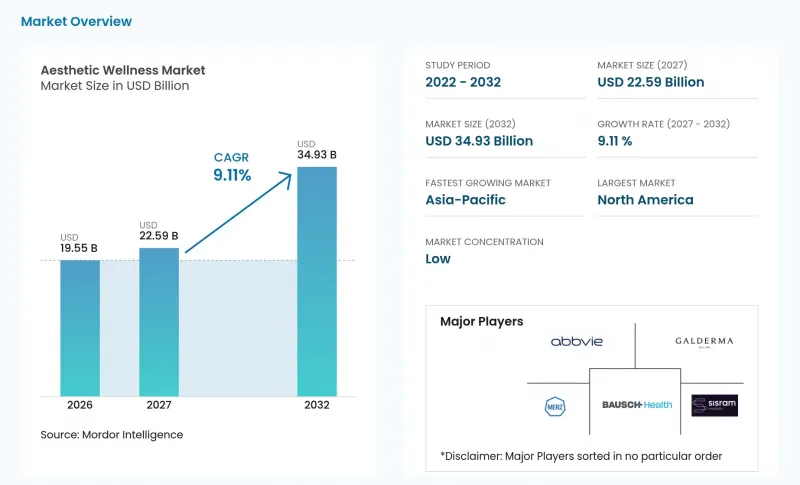
According to Mordor Intelligence, the global aesthetic wellness market was valued at USD 19.55 billion in 2026 and is estimated to grow from USD 22.59 billion in 2027 to reach USD 34.93 billion by 2032, at a CAGR of 9.11% during the forecast period (2027-2032).
Global Aesthetic Wellness Market Trends and Insights
Rising Preference for Non-Surgical and Minimally Invasive Treatments
Preference for non-surgical and minimally invasive care drives growth in the aesthetic wellness market. Plastic surgeons performed 7.3 million botulinum toxin procedures and 4.7 million hyaluronic acid filler procedures in 2025. These figures exclude procedures performed by dermatologists and other aesthetic practitioners. Lower upfront costs, limited downtime, and reversibility reduce barriers for first-time patients. These attributes appeal to urban consumers seeking procedures that fit work and personal commitments. Recurring maintenance visits, rather than a single corrective procedure, support market growth. When clinically appropriate, providers combine neurotoxins, fillers, laser procedures, and topical protocols. This approach supports continuity of care and adapts treatment plans to changing patient needs. It also highlights the importance of medical consultation, qualified administration, and clear communication of expected outcomes. Recurring care plans can strengthen medical spas and dermatology clinics with the capacity to manage repeat treatment cycles.
Mainstreaming of Preventive Aesthetic Care
Preventive aesthetic care shifts the focus from correcting visible signs of aging to maintaining skin quality earlier in adulthood. According to the AAFPRS 2023 Annual Member Survey, 77% of American Academy of Facial Plastic and Reconstructive Surgery (AAFPRS) members expected greater emphasis on preventive maintenance among individuals in their twenties and thirties. Minimally invasive treatments accounted for 83% of procedures performed by surveyed members in 2023. This shift creates opportunities for the Global Aesthetic Wellness Market through personalized assessments, conservative treatments, and ongoing skincare plans. However, prevention-led demand requires realistic outcome communication and clinical assessment rather than age-based promotion. Younger consumers' interest in skincare also supports education-led services. The American Academy of Dermatology's 2025 survey found that 73% of United States adults used products or procedures to prevent premature aging, while only 56% regularly used sunscreen. Clinics can differentiate through individualized consultations, documented treatment plans, and qualified practitioners while avoiding unnecessary interventions driven by social media trends.
Treatment Cost and Limited Reimbursement
Consumers pay for most aesthetic procedures directly, limiting access for price-sensitive patients. This constraint is significant in markets with uneven disposable income or where advanced care is concentrated in major cities. The aesthetic wellness market can expand through broader service access; however, providers cannot assume that all patients can afford repeated treatment cycles. Clear pricing and medically appropriate treatment plans help maintain patient trust. Membership and subscription models may spread the cost of recurring care but do not eliminate affordability constraints, particularly for procedures requiring licensed practitioners or regulated products. Small providers may face challenges in managing recurring payments and follow-up commitments. In emerging markets, cost sensitivity remains significant outside affluent urban groups despite growing awareness of aesthetic treatments.
Other drivers and restraints analyzed in the detailed report include:
- Social Media and Appearance-Led Wellness Spending
- Healthy Aging and Longevity-Oriented Demand
- Shortage of Skilled and Licensed Practitioners
For complete list of drivers and restraints, kindly check the Table Of Contents.
Segment Analysis
Non-Surgical Aesthetic Services segment accounted for 45.32% of the aesthetic wellness market size in 2026. The category includes neurotoxins, dermal fillers, laser skin resurfacing, chemical peels, and professional-grade topical treatments. Its breadth enables clinicians to tailor treatment plans to patient objectives. Limited-downtime procedures support demand among patients seeking non-surgical treatment. The segment reflects the importance of recurring skin-quality and maintenance care.
Minimally Invasive Aesthetic Services segment is forecast to grow at a CAGR of 10.82% through 2032. The category includes treatments between conventional non-surgical care and surgery. Biostimulants, polynucleotides, and neuromodulators are expanding provider options. Surgical Aesthetic Services segment remains relevant for patients requiring or preferring surgical outcomes. ISAPS reported that breast lifts among women showed the highest percentage increase, while eyelid surgery recorded the highest absolute increase globally.
Facial Aesthetics and Skin Rejuvenation accounted for 32.24% of the global aesthetic wellness market size in 2026. Demand for skin quality improvement and natural-looking results supports the category. It includes clinic-based treatments and professional skincare protocols for ongoing care. In 2025, Allergan Aesthetics expanded SKINVIVE by JUVEDERM to 35 additional markets, bringing its total to 57 markets. This reflects the expansion of injectable portfolios beyond traditional volumizing fillers.
Injectables and Biostimulatory Treatments are forecast to grow at a CAGR of 10.34% through 2032. Patients consider treatment longevity, skin quality, and expected results when selecting injectable procedures. During the first nine months of 2025, Galderma reported double-digit biostimulator growth, while its Injectable Aesthetics business grew 10.5% year over year. Treatment suitability, product selection, and outcomes vary by patient.
Complete Report Scope:
- By Service Type
- Non-Surgical Aesthetic Services
- Minimally Invasive Aesthetic Services
- Surgical Aesthetic Services
- Others
- By Treatment Category
- Facial Aesthetics and Skin Rejuvenation
- Injectables and Biostimulatory Treatments
- Body Contouring and Shaping
- Hair Removal and Hair Restoration
- Other Aesthetic Treatments
- By Service Provider
- Dermatology and Aesthetic Clinics
- Medical Spas
- Hospitals and Surgical Centers
- Others
- By End User
- Male
- Female
- By Geography
- North America
- United States
- Canada
- Mexico
- South America
- Brazil
- Peru
- Chile
- Argentina
- Rest of South America
- Europe
- United Kingdom
- Germany
- France
- Spain
- Italy
- BENELUX (Belgium, Netherlands, and Luxembourg)
- NORDICS (Denmark, Finland, Iceland, Norway, and Sweden)
- Rest of Europe
- Asia-Pacific
- India
- China
- Japan
- Australia
- South Korea
- South East Asia (Singapore, Malaysia, Thailand, Indonesia, Vietnam, and Philippines)
- Rest of Asia-Pacific
- Middle East and Africa
- United Arab Emirates
- Saudi Arabia
- South Africa
- Nigeria
- Rest of Middle East and Africa
- North America
Geography Analysis
North America accounted for 38.71% of the aesthetic wellness market in 2026. In 2025, plastic surgeons in the United States performed more than 5.4 million aesthetic procedures. The region has a mature provider base, high consumer awareness, and established infrastructure. Medical spas, dermatology clinics, and surgical practices provide different levels of care.
Asia-Pacific is forecast to grow at a CAGR of 10.50% through 2032. China, India, South Korea, Japan, and Southeast Asia support the regional demand outlook. Galderma identified China as the world's second-largest injectable aesthetics market and cited Sculptra's China launch as a contributor to its 2025 performance. South Korea remains a treatment destination and source of procedural innovation. Expanding dermatology clinic chains and a growing urban middle class in emerging Asian markets support long-term demand, while regulation and practitioner capacity remain material factors.
Europe remains significant, with the United Kingdom, Germany, France, Italy, and Spain contributing to demand. The United Kingdom is planning stricter regulations for cosmetic procedures. Spain investigated 24 clinics for using illegal aesthetic substances in early 2025. Brazil recorded 3.2 million aesthetic procedures in 2025 and ranked first globally in surgical procedures, with 2.3 million. The United Arab Emirates and Saudi Arabia are attracting medical aesthetics investment, while Nigeria and South Africa remain earlier-stage markets.
- AbbVie Inc.
- Galderma S.A.
- Merz Pharma GmbH & Co. KGaA
- Bausch Health Companies Inc.
- Sisram Medical Ltd.
- Candela Corporation
- Cutera, Inc.
- InMode Ltd.
- Fotona d.o.o.
- Evolus, Inc.
- Sinclair
- Medytox Inc.
- Hologic, Inc.
- Venus Concept Inc.
- Sciton, Inc.
- Quanta System S.p.A.
- BTL Industries Inc.
- Aerolase Corporation
- Lutronic, Inc.
- Sofwave Medical Ltd.
Additional Benefits:
- The market estimate (ME) sheet in Excel format
- 3 months of analyst support
TABLE OF CONTENTS
1 Introduction
- 1.1 Study Assumptions and Market Definition
- 1.2 Scope of the Study
2 Executive Summary
3 Market Landscape
- 3.1 Market Overview
- 3.2 Market Drivers
- 3.2.1 Rising Preference for Non-Surgical and Minimally Invasive Treatments
- 3.2.2 Mainstreaming of Preventive Aesthetic Care
- 3.2.3 Social Media and Appearance-Led Wellness Spending
- 3.2.4 Healthy Aging and Longevity-Oriented Demand
- 3.2.5 Personalization Through AI-Assisted Assessment and Treatment Planning
- 3.2.6 Expansion of Medical Spas and Integrated Wellness Clinics
- 3.3 Market Restraints
- 3.3.1 Treatment Cost and Limited Reimbursement
- 3.3.2 Shortage of Skilled and Licensed Practitioners
- 3.3.3 Safety Risks, Counterfeit Products, and Unqualified Providers
- 3.3.4 Regulatory Fragmentation and Compliance Burden
- 3.4 Regulatory Landscape
- 3.5 Technological Outlook
- 3.6 Porter's Five Forces Analysis
- 3.6.1 Threat of New Entrants
- 3.6.2 Bargaining Power of Suppliers
- 3.6.3 Bargaining Power of Buyers
- 3.6.4 Threat of Substitutes
- 3.6.5 Competitive Rivalry
4 Aesthetic Wellness Supply & Development Intelligence
- 4.1 Supply Landscape & Development Trends
- 4.2 Aesthetic Wellness Service Offerings
5 Aesthetic Wellness Performance Intelligence
- 5.1 Occupany Rates
- 5.2 Averages Daily Rates
6 Consumer Behavior Analysis
- 6.1 Consumer Preferences and Treatment Patterns
- 6.2 Booking Behavior and Service Preferences
- 6.3 Spending Patterns and Emerging Wellness Preferences
7 Market Size & Growth Forecasts (USD, Value)
- 7.1 By Service Type
- 7.1.1 Non-Surgical Aesthetic Services
- 7.1.2 Minimally Invasive Aesthetic Services
- 7.1.3 Surgical Aesthetic Services
- 7.1.4 Others
- 7.2 By Treatment Category
- 7.2.1 Facial Aesthetics and Skin Rejuvenation
- 7.2.2 Injectables and Biostimulatory Treatments
- 7.2.3 Body Contouring and Shaping
- 7.2.4 Hair Removal and Hair Restoration
- 7.2.5 Other Aesthetic Treatments
- 7.3 By Service Provider
- 7.3.1 Dermatology and Aesthetic Clinics
- 7.3.2 Medical Spas
- 7.3.3 Hospitals and Surgical Centers
- 7.3.4 Others
- 7.4 By End User
- 7.4.1 Male
- 7.4.2 Female
- 7.5 By Geography
- 7.5.1 North America
- 7.5.1.1 United States
- 7.5.1.2 Canada
- 7.5.1.3 Mexico
- 7.5.2 South America
- 7.5.2.1 Brazil
- 7.5.2.2 Peru
- 7.5.2.3 Chile
- 7.5.2.4 Argentina
- 7.5.2.5 Rest of South America
- 7.5.3 Europe
- 7.5.3.1 United Kingdom
- 7.5.3.2 Germany
- 7.5.3.3 France
- 7.5.3.4 Spain
- 7.5.3.5 Italy
- 7.5.3.6 BENELUX (Belgium, Netherlands, and Luxembourg)
- 7.5.3.7 NORDICS (Denmark, Finland, Iceland, Norway, and Sweden)
- 7.5.3.8 Rest of Europe
- 7.5.4 Asia-Pacific
- 7.5.4.1 India
- 7.5.4.2 China
- 7.5.4.3 Japan
- 7.5.4.4 Australia
- 7.5.4.5 South Korea
- 7.5.4.6 South East Asia (Singapore, Malaysia, Thailand, Indonesia, Vietnam, and Philippines)
- 7.5.4.7 Rest of Asia-Pacific
- 7.5.5 Middle East and Africa
- 7.5.5.1 United Arab Emirates
- 7.5.5.2 Saudi Arabia
- 7.5.5.3 South Africa
- 7.5.5.4 Nigeria
- 7.5.5.5 Rest of Middle East and Africa
- 7.5.1 North America
8 North America Market Size & Growth Forecasts (USD, Value) 2022- 2032
- 8.1 By Service Type
- 8.2 By Treatment Category
- 8.3 By Service Provider
- 8.4 By End User
- 8.5 By Country
9 South America Market Size & Growth Forecasts (USD, Value) 2022- 2032
- 9.1 By Service Type
- 9.2 By Treatment Category
- 9.3 By Service Provider
- 9.4 By End User
- 9.5 By Country
10 Europe Market Size & Growth Forecasts (USD, Value) 2022- 2032
- 10.1 By Service Type
- 10.2 By Treatment Category
- 10.3 By Service Provider
- 10.4 By End User
- 10.5 By Country
11 Asia-Pacific Market Size & Growth Forecasts (USD, Value) 2022- 2032
- 11.1 By Service Type
- 11.2 By Treatment Category
- 11.3 By Service Provider
- 11.4 By End User
- 11.5 By Country
12 Middle East and Africa Market Size & Growth Forecasts (USD, Value) 2022- 2032
- 12.1 By Service Type
- 12.2 By Treatment Category
- 12.3 By Service Provider
- 12.4 By End User
- 12.5 By Country
13 Competitive Landscape
- 13.1 Market Concentration
- 13.2 Strategic Moves
- 13.3 Market Share Analysis
- 13.4 Company Profiles (includes Global Level Overview, Market Level Overview, Core Segments, Financials as available, Strategic Information, Market Rank/Share, Products and Services, and Recent Developments)
- 13.4.1 AbbVie Inc.
- 13.4.2 Galderma S.A.
- 13.4.3 Merz Pharma GmbH & Co. KGaA
- 13.4.4 Bausch Health Companies Inc.
- 13.4.5 Sisram Medical Ltd.
- 13.4.6 Candela Corporation
- 13.4.7 Cutera, Inc.
- 13.4.8 InMode Ltd.
- 13.4.9 Fotona d.o.o.
- 13.4.10 Evolus, Inc.
- 13.4.11 Sinclair
- 13.4.12 Medytox Inc.
- 13.4.13 Hologic, Inc.
- 13.4.14 Venus Concept Inc.
- 13.4.15 Sciton, Inc.
- 13.4.16 Quanta System S.p.A.
- 13.4.17 BTL Industries Inc.
- 13.4.18 Aerolase Corporation
- 13.4.19 Lutronic, Inc.
- 13.4.20 Sofwave Medical Ltd.
14 Market Opportunities & Future Outlook
- 14.1 White-Space and Unmet-Need Assessment
- 14.2 Opportunities
- 14.2.1 Integrated Longevity, Nutrition, Weight Management, and Aesthetic Memberships
- 14.2.2 AI-Personalized, Regenerative, and At-Home Aesthetic Wellness Journeys
- 14.3 Future Outlook
15 Research Methodology

