PUBLISHER: Mordor Intelligence | PRODUCT CODE: 2186135

PUBLISHER: Mordor Intelligence | PRODUCT CODE: 2186135
Agricultural Technical Textile - Market Share Analysis, Industry Trends & Statistics, Growth Forecasts (2027 - 2032)
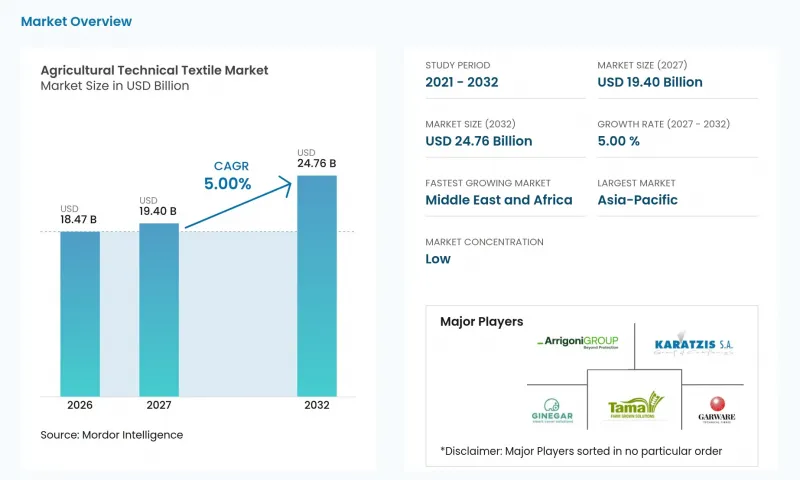
According to Mordor Intelligence, the agricultural technical textile market size is projected to expand from USD 18.47 billion in 2026 and USD 19.40 billion in 2027 to USD 24.76 billion by 2032, registering a CAGR of 5% between 2027 and 2032.
Global Agricultural Technical Textile Market Trends and Insights
Protected Cultivation and Commercial Horticulture
Protected cultivation is a central demand base for the agricultural technical textile market because net houses and greenhouses need screens, insect barriers, and covers. The agricultural technical textile market serves both basic structures and climate-controlled facilities, although product requirements differ by technology level. Plastic structures in Asia and Africa generally require large volumes of practical textile components, while advanced installations require better control of light and heat. Growers operating larger facilities also need screens that work with automated climate systems and drive equipment. This creates room for suppliers that can document performance and support installers in emerging protected-cultivation locations. Product selection also depends on crop value, local weather, and the operational capability of the farm.
Increasing Crop Losses from Extreme Weather and Pest Infestations
Crop losses from weather events and pests are strengthening the case for durable physical protection in the agricultural technical textile market. Food and Agriculture Organization reported in 2025 that disasters had caused USD 3.26 trillion in agricultural losses over three decades, with fruits and vegetables among the affected products. A 2025 scientific review found that warming can increase insect pest damage in wheat, rice, and maize by changing pest ranges and reproductive cycles. Anti-hail, windbreak, and insect-exclusion nets can protect high-value crops through several seasons when they are correctly specified and installed. The agricultural technical textile market therefore gains relevance where growers need protection that addresses weather exposure and invasive pest risk at the same time. Reliable installation is important because poorly fitted nets may not deliver the expected protection.
Polyethylene and Polypropylene Price Fluctuations
Polyethylene and polypropylene are important inputs for nets, mulch products, and covers, so changes in feedstock costs can quickly affect converter margins. The World Bank identified continued uncertainty in commodity markets in its 2025 outlook. The United States Energy Information Administration also reported ongoing uncertainty in energy and petrochemical market conditions during 2025. The agricultural technical textile market faces pressure when processors must absorb higher resin costs or pass them to price-sensitive farmers. This can delay purchasing decisions and reduce funding available for new capacity or material development. Price changes are especially difficult for suppliers serving farms with limited ability to absorb cost increases.
Other drivers and restraints analyzed in the detailed report include:
- Growing Adoption of Integrated Pest Management and Non-Chemical Crop Protection
- Protected Cultivation and Agricultural Modernization Incentives
- High Initial Cost and Smallholder Affordability Limits
For complete list of drivers and restraints, kindly check the Table Of Contents.
Segment Analysis
Crop protection nets held 24% of the agricultural technical textile market share in 2026. Their position reflects use across open-field vegetables, orchards, vineyards, and aquaculture ponds. Anti-insect, anti-hail, anti-bird, and windbreak variants protect crops against several forms of production risk. Demand is becoming more specification-led, where growers serve export markets or work under integrated pest-management programs. This keeps mesh precision and ultraviolet durability important in supplier selection.
Agricultural shade nets and greenhouse climate screens are the fastest-growing product category, registering a 7.2% CAGR through 2032. These products benefit from expansion in protected cultivation and interest in reflective and light-diffusing materials. Crop covers and plant protection fleece continue to support season extension and nonchemical production methods in temperate regions. Mulch mats, ground covers, nursery textiles, forestry textiles, and harvesting products serve field preparation and post-harvest tasks. Fishing and aquaculture textiles provide an additional product base in commercial aquaculture locations.
Complete Report Scope:
- By Product Type
- Crop Protection Nets
- Anti-Insect and Pest Protection Nets
- Anti-Hail and Weather Protection Nets
- Anti-Bird and Wildlife Protection Nets
- Agricultural Windbreak Nets
- Agricultural Shade Nets and Greenhouse Climate Screens
- Agricultural Shade Nets
- Thermo-Reflective and Light-Diffusion Screens
- Thermal and Energy-Saving Greenhouse Screens
- Greenhouse Blackout and Light-Control Screens
- Crop Covers and Plant Protection Fleece
- Nonwoven Floating Row Covers
- Frost and Thermal Protection Textiles
- Other Woven and Knitted Crop Covers
- Fishing and Aquaculture Textiles
- Commercial Fishing Nets
- Aquaculture Cage and Containment Nets
- Specialized Aquaculture Protection Nets
- Mulch Mats and Agricultural Ground Covers
- Nursery, Plant Support, and Forestry Textiles
- Harvesting and Forage Management Textiles
- Other Agricultural Technical Textiles
- Crop Protection Nets
- By End-Use Sector
- Field Crop Cultivation
- Vegetable, Floriculture and Nursery Cultivation
- Fruit Orchards and Viticulture
- Forestry and Landscape Cultivation
- Livestock and Forage Operations
- Fisheries and Aquaculture
- By Geography
- North America
- United States
- Canada
- Mexico
- Europe
- Germany
- United Kingdom
- France
- Italy
- Spain
- Netherlands
- Rest of Europe
- Asia-Pacific
- China
- Japan
- India
- South Korea
- Taiwan
- Australia
- Indonesia
- Vietnam
- Rest of Asia-Pacific
- Middle East and Africa
- Saudi Arabia
- United Arab Emirates
- Turkey
- South Africa
- Rest of Middle East and Africa
- South America
- Brazil
- Argentina
- Chile
- Rest of South and Central America
- North America
Geography Analysis
Asia-Pacific accounted for 46% of the global revenue share in 2026. China remains important because its plastic-covered greenhouse footprint is the largest globally. A 2025 satellite-based study estimated China's covered greenhouse area at 8,224.9 square kilometers, equal to 57.7% of the mapped global total. India is supported by programs that encourage shade-net and polyhouse adoption. Vietnam and Indonesia are expanding protected cultivation for export-oriented vegetables and aquaculture.
Europe is the second-largest regional market and has a strong role in premium greenhouse screens and certified recyclable materials. Producers in the region respond to crop-protection and environmental requirements through higher-performance nets, climate screens, and simpler material structures. EN 18109:2025 is raising attention to recycling and material selection across agricultural plastics. North America grows through mechanized forage operations in the United States and Canada and through protected-cultivation investment in Canada and Mexico.
The Middle East and Africa is projected to be the fastest-growing geography, at a 6.5% CAGR from 2027 to 2032. Water scarcity, food-security priorities, and protected-cultivation investments support demand in Saudi Arabia, the UAE, Morocco, and South Africa. Morocco's export-oriented greenhouse operations need insect-exclusion nets and ultraviolet-stabilized covers. Saudi Arabia and the UAE favor high-performance screens where heat and ultraviolet exposure are severe. South America also contributes through aquaculture textiles in Chile and forage-related net-wrap demand in Brazil, Chile, and Argentina.
- Arrigoni Group
- KARATZIS S.A.
- Ginegar Plastic Products Ltd.
- Tama Group
- Intermas Nets SAU
- Garware Technical Fibres Limited
- AB Ludvig Svensson
- Ridder
- MDB Texinov
- Diatex SAS
- RKW Group
- Freudenberg Performance Materials
- BTT SA (Beaulieu Technical Textiles)
- Don & Low Ltd. (Thrace Group)
- Cordex
- TENAX S.p.A.
- Novatex Italia S.p.A.
- Belton Industries Inc.
- Shakti Polyweave
- Shreeram Nets
- B&V Agro Irrigation Co.
- Hampiojan Group
- Nitto Seimo Co., Ltd.
Additional Benefits:
- The market estimate (ME) sheet in Excel format
- 3 months of analyst support
TABLE OF CONTENTS
1 INTRODUCTION
- 1.1 Study Assumptions and Market Definition
- 1.2 Scope of the Study
2 RESEARCH METHODOLOGY
3 EXECUTIVE SUMMARY
4 MARKET LANDSCAPE
- 4.1 Market Overview
- 4.2 Agrotech Value Chain and Supply Chain Analysis
- 4.2.1 Polymer and Specialty Fiber Supply Chain
- 4.2.2 Monofilament, Tape Yarn, and Technical Fiber Production
- 4.2.3 Weaving, Knitting, and Nonwoven Textile Manufacturing
- 4.2.4 Agricultural Textile Converting and Product Fabrication
- 4.2.5 Distribution through Agricultural Input Suppliers and Greenhouse System Integrators
- 4.3 Market Drivers
- 4.3.1 Protected Cultivation and Commercial Horticulture
- 4.3.2 Increasing Crop Losses from Extreme Weather and Pest Infestations
- 4.3.3 Growing Adoption of Integrated Pest Management and Non-Chemical Crop Protection
- 4.3.4 Protected Cultivation and Agricultural Modernization Incentives
- 4.3.5 Crop Protection and Yield Improvement in High-Value Agriculture
- 4.3.6 Mechanization of Forage Harvesting and Baling
- 4.4 Market Restraints
- 4.4.1 Fluctuations in Polyethylene and Polypropylene Raw Material Prices
- 4.4.2 High Initial Investment and Limited Affordability Among Smallholder Farmers
- 4.4.3 Agricultural Plastic Waste Management and Recycling Challenges
- 4.4.4 UV Degradation and Performance Limitations under Extreme Climatic Conditions
- 4.4.5 Limited Awareness and Technical Expertise in Emerging Agricultural Markets
- 4.5 Key Market Trends
- 4.5.1 Increasing Adoption of Multifunctional Agricultural Shade and Protection Nets
- 4.5.2 Development of Biodegradable and Bio-Based Agrotextile Materials
- 4.5.3 Growing Use of Thermo-Reflective and Energy-Saving Greenhouse Screens
- 4.5.4 Advancements in High-Strength and Lightweight Agricultural Netting
- 4.5.5 Shift Toward Reusable and Recyclable Crop Protection Textiles
- 4.5.6 Growing Demand for Customized Mesh Sizes and Light-Diffusion Properties
- 4.6 Regulatory and Standards Landscape
- 4.6.1 International Standards for Agricultural Textile Performance and Durability
- 4.6.2 Indian Agrotextile Standards for Shade Nets, Insect Nets, and Hail Protection Nets
- 4.6.3 Agricultural Input Subsidies and Protected Cultivation Support Programs
- 4.6.4 European Union Integrated Pest Management and Pesticide Reduction Policies
- 4.6.5 Agricultural Plastic Waste Collection, Recycling, and Disposal Requirements
- 4.7 Technological Outlook
- 4.7.1 Woven, Knitted and Nonwoven Agricultural Textile Technologies
- 4.7.2 Extruded and Oriented Agricultural Netting Technologies
- 4.7.3 UV-Stabilized and High-Tenacity Polymer Fibers
- 4.7.4 Light-Diffusing, Reflective and Thermal-Control Textile Structures
- 4.7.5 Biodegradable Mulch Textiles and Sustainable Fiber Technologies
- 4.7.6 Advances in Multifunctional Crop Protection and Controlled-Environment Textiles
- 4.8 Sustainability and Environmental Impact Assessment
- 4.8.1 Contribution of Agrotextiles to Water Conservation and Reduced Chemical Inputs
- 4.8.2 Environmental Impact of Synthetic Agricultural Textiles
- 4.8.3 Collection and Recycling of End-of-Life Agricultural Nets and Fabrics
- 4.8.4 Reusable, Recycled-Content and Biodegradable Material Alternatives
5 MARKET SIZE AND GROWTH FORECASTS
- 5.1 By Product Type
- 5.1.1 Crop Protection Nets
- 5.1.1.1 Anti-Insect and Pest Protection Nets
- 5.1.1.2 Anti-Hail and Weather Protection Nets
- 5.1.1.3 Anti-Bird and Wildlife Protection Nets
- 5.1.1.4 Agricultural Windbreak Nets
- 5.1.2 Agricultural Shade Nets and Greenhouse Climate Screens
- 5.1.2.1 Agricultural Shade Nets
- 5.1.2.2 Thermo-Reflective and Light-Diffusion Screens
- 5.1.2.3 Thermal and Energy-Saving Greenhouse Screens
- 5.1.2.4 Greenhouse Blackout and Light-Control Screens
- 5.1.3 Crop Covers and Plant Protection Fleece
- 5.1.3.1 Nonwoven Floating Row Covers
- 5.1.3.2 Frost and Thermal Protection Textiles
- 5.1.3.3 Other Woven and Knitted Crop Covers
- 5.1.4 Fishing and Aquaculture Textiles
- 5.1.4.1 Commercial Fishing Nets
- 5.1.4.2 Aquaculture Cage and Containment Nets
- 5.1.4.3 Specialized Aquaculture Protection Nets
- 5.1.5 Mulch Mats and Agricultural Ground Covers
- 5.1.6 Nursery, Plant Support, and Forestry Textiles
- 5.1.7 Harvesting and Forage Management Textiles
- 5.1.8 Other Agricultural Technical Textiles
- 5.1.1 Crop Protection Nets
- 5.2 By End-Use Sector
- 5.2.1 Field Crop Cultivation
- 5.2.2 Vegetable, Floriculture and Nursery Cultivation
- 5.2.3 Fruit Orchards and Viticulture
- 5.2.4 Forestry and Landscape Cultivation
- 5.2.5 Livestock and Forage Operations
- 5.2.6 Fisheries and Aquaculture
- 5.3 By Geography
- 5.3.1 North America
- 5.3.1.1 United States
- 5.3.1.2 Canada
- 5.3.1.3 Mexico
- 5.3.2 Europe
- 5.3.2.1 Germany
- 5.3.2.2 United Kingdom
- 5.3.2.3 France
- 5.3.2.4 Italy
- 5.3.2.5 Spain
- 5.3.2.6 Netherlands
- 5.3.2.7 Rest of Europe
- 5.3.3 Asia-Pacific
- 5.3.3.1 China
- 5.3.3.2 Japan
- 5.3.3.3 India
- 5.3.3.4 South Korea
- 5.3.3.5 Taiwan
- 5.3.3.6 Australia
- 5.3.3.7 Indonesia
- 5.3.3.8 Vietnam
- 5.3.3.9 Rest of Asia-Pacific
- 5.3.4 Middle East and Africa
- 5.3.4.1 Saudi Arabia
- 5.3.4.2 United Arab Emirates
- 5.3.4.3 Turkey
- 5.3.4.4 South Africa
- 5.3.4.5 Rest of Middle East and Africa
- 5.3.5 South America
- 5.3.5.1 Brazil
- 5.3.5.2 Argentina
- 5.3.5.3 Chile
- 5.3.5.4 Rest of South and Central America
- 5.3.1 North America
6 COMPETITIVE LANDSCAPE
- 6.1 Market Concentration
- 6.2 Market Share Analysis
- 6.3 Strategic Developments (Mergers/Acquisitions, New Product Developments, Strategic Partnerships and Distribution Agreements)
- 6.4 Competitive Positioning on Application Coverage & Sustainability Positioning
- 6.5 Company Profiles (includes Global Level Overview, Market Level Overview, Core Segments, Financials as available, Strategic Information, Products and Services, Recent Developments)
- 6.5.1 Arrigoni Group
- 6.5.2 KARATZIS S.A.
- 6.5.3 Ginegar Plastic Products Ltd.
- 6.5.4 Tama Group
- 6.5.5 Intermas Nets SAU
- 6.5.6 Garware Technical Fibres Limited
- 6.5.7 AB Ludvig Svensson
- 6.5.8 Ridder
- 6.5.9 MDB Texinov
- 6.5.10 Diatex SAS
- 6.5.11 RKW Group
- 6.5.12 Freudenberg Performance Materials
- 6.5.13 BTT SA (Beaulieu Technical Textiles)
- 6.5.14 Don & Low Ltd. (Thrace Group)
- 6.5.15 Cordex
- 6.5.16 TENAX S.p.A.
- 6.5.17 Novatex Italia S.p.A.
- 6.5.18 Belton Industries Inc.
- 6.5.19 Shakti Polyweave
- 6.5.20 Shreeram Nets
- 6.5.21 B&V Agro Irrigation Co.
- 6.5.22 Hampiojan Group
- 6.5.23 Nitto Seimo Co., Ltd.
7 MARKET OPPORTUNITIES AND FUTURE OUTLOOK
- 7.1 White-Space and Unmet-Need Assessment
- 7.1.1 Affordable Crop Protection Solutions for Smallholder Farmers
- 7.1.2 Climate-Resilient Agricultural Textiles for Extreme Weather
- 7.1.3 Biodegradable Mulch Textiles for Sustainable Farming
- 7.1.4 Advanced Agrotextiles for Protected Horticulture
- 7.2 Future Outlook
- 7.2.1 Expansion of Agrotech Adoption in Emerging Agricultural Economies
- 7.2.2 Evolution of Multifunctional Agricultural Textile Products
- 7.2.3 Recyclable Agricultural Netting and Circular Material Solutions
- 7.2.4 Growing Importance of Sustainable and Recyclable Agrotextiles

