PUBLISHER: Mordor Intelligence | PRODUCT CODE: 2186159

PUBLISHER: Mordor Intelligence | PRODUCT CODE: 2186159
Vegan - Market Share Analysis, Industry Trends & Statistics, Growth Forecasts (2026 - 2031)
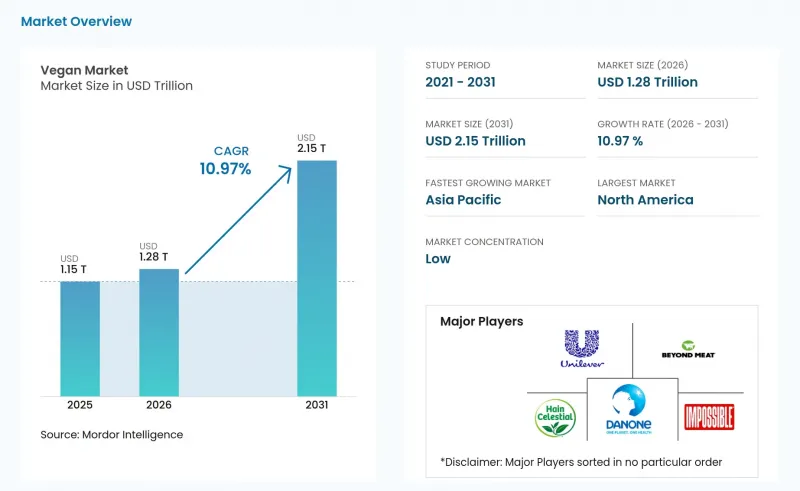
According to Mordor Intelligence, the vegan market size is expected to increase from USD 1.15 trillion in 2025 to USD 1.28 trillion in 2026 and reach USD 2.15 trillion by 2031, growing at a CAGR of 10.97% over 2026-2031.
Global Vegan Market Trends and Insights
Increasing Consumer Awareness of Animal Welfare and Ethical Consumption
Growing consumer awareness of animal welfare and ethical consumption is driving the vegan market by influencing purchasing decisions toward products that minimize animal exploitation and exclude animal-derived ingredients. Consumers are increasingly considering the ethical implications of product sourcing, manufacturing, and testing, leading to a preference for alternatives that align with cruelty-free and animal-conscious values. This shift is encouraging the adoption of vegan products across everyday consumption, as consumers seek consistency between their ethical beliefs and purchasing behavior. Growing scrutiny of ingredient origins and production practices is also increasing the importance of transparency, vegan certification, and credible cruelty-free claims, helping consumers identify products that meet their expectations.
Increasing Adoption of Plant-Based Diets and Flexitarian Eating Habits
The increasing adoption of plant-based diets and flexitarian eating habits is driving the vegan market, as consumers reduce their reliance on animal-based products and incorporate more plant-derived alternatives into their regular diets. The growing acceptance of flexitarian diets, which prioritize plant-based foods while allowing occasional consumption of animal products, broadens the potential consumer base beyond strict vegans and vegetarians. This gradual dietary shift supports market growth by making vegan products accessible to consumers who prefer to reduce, rather than eliminate, animal-based foods. According to ProVeg International, in 2025, 48% of meat eaters in the United Kingdom reported reducing their annual meat intake, while 38% identified as flexitarian, pescatarian, vegetarian, or vegan. These figures indicate a shift toward more plant-oriented eating habits and a growing willingness to modify conventional dietary patterns.
High Production Costs of Certain Vegan Alternatives
High production costs of certain vegan alternatives restrain market growth by limiting affordability and reducing adoption among price-sensitive consumers. Developing vegan products often requires specialized raw materials, alternative ingredients, formulation expertise, processing methods, and quality-control procedures to achieve the desired performance, taste, texture, durability, and stability. The use of plant-derived ingredients and animal-free materials can increase manufacturing costs, particularly when production volumes are low or sourcing options are limited. Manufacturers may also incur additional expenses when reformulating products to replace animal-derived components while maintaining comparable functionality and quality. These cost pressures can result in higher retail prices, making some vegan alternatives less competitive with conventional products and discouraging consumers from switching or making regular purchases.
Other drivers and restraints analyzed in the detailed report include:
- Rising Consumer Focus on Health, Wellness, and Preventive Nutrition
- Growing Influence of Social Media, Vegan Advocacy Campaigns, and Digital Communities
- Taste and Texture Limitations of Vegan Food Products
For complete list of drivers and restraints, kindly check the Table Of Contents.
Segment Analysis
Food and beverages accounted for a 36.92% share of the vegan market in 2025, supported by the growing integration of plant-based products into everyday diets and the increasing acceptance of vegan food among consumers who do not follow strict vegan lifestyles. The segment benefits from rising interest in dietary variety, animal welfare, ingredient transparency, and the environmental impact of conventional food production, encouraging consumers to explore alternatives that align with their personal preferences. Improvements in product formulation have strengthened demand by addressing traditional barriers related to taste, texture, aroma, and nutritional value, making plant-based foods more competitive with conventional options.
Personal care and beauty is projected to be the fastest-growing product type in the vegan market, registering a CAGR of 12.09% during 2026-2031. Growth is driven by increasing consumer preference for cruelty-free formulations, plant-derived ingredients, and beauty products developed without animal-derived components. Rising awareness of ingredient transparency and ethical sourcing is encouraging consumers to evaluate not only product performance but also the environmental and animal welfare implications of personal care purchases. Advances in vegan formulation technologies are helping manufacturers develop effective alternatives to conventional ingredients, including plant-based emollients, waxes, oils, and conditioning agents, while improving product stability, texture, fragrance, and skin compatibility.
Complete Report Scope:
- By Product Type
- Food and Beverages
- Personal Care and Beauty
- Apparel
- Footwear
- Accessories
- Household and Cleaning Products
- Other Product Types
- By Distribution Channel
- Off-line Retail Stores
- Online Retail Stores
- By Geography
- North America
- United States
- Canada
- Mexico
- Rest of North America
- Europe
- United Kingdom
- Germany
- France
- Italy
- Spain
- Netherlands
- Poland
- Belgium
- Sweden
- Rest of Europe
- Asia-Pacific
- China
- Japan
- India
- Australia
- Indonesia
- South Korea
- Thailand
- Singapore
- Rest of Asia-Pacific
- South America
- Brazil
- Argentina
- Colombia
- Chile
- Peru
- Rest of South America
- Middle East and Africa
- South Africa
- Saudi Arabia
- United Arab Emirates
- Nigeria
- Egypt
- Morocco
- Turkey
- Rest of Middle East and Africa
- North America
Geography Analysis
North America held the largest share of the vegan products market, accounting for 33.23% in 2025, supported by a mature retail ecosystem, established plant-based food categories, and growing consumer familiarity with vegan and cruelty-free products. The region benefits from broad product availability across supermarkets, specialty retailers, natural and organic stores, and e-commerce platforms, enabling consumers to access vegan alternatives across multiple product categories. The United States is a key contributor to regional market development, with plant-based foods gaining visibility through mainstream retail distribution and continued product innovation. According to the Plant Based Foods Association, 60% of the United States population purchased plant-based foods in 2025. Canada's established market for plant-based alternatives and Mexico's developing retail availability also contribute to regional demand.
Asia-Pacific is forecast to be the fastest-growing region in the vegan products market, registering a CAGR of 11.55% during 2026-2031. Growth is supported by increasing awareness of plant-based lifestyles, rising interest in cruelty-free products, and the gradual expansion of vegan alternatives across mainstream consumer markets. The region benefits from established familiarity with plant-derived ingredients and traditional plant-based diets, providing a foundation for broader acceptance of modern vegan products. Growing interest in ingredient transparency, environmental sustainability, and ethical consumption is extending demand beyond traditional dietary preferences. Improvements in product formulation, availability, and affordability are also helping overcome barriers related to taste, texture, and consumer familiarity.
Europe represents an established market for vegan products, supported by growing awareness of sustainability, animal welfare, and responsible consumption, alongside demand for transparent ingredients and ethically produced goods. Continued product innovation and the availability of vegan-certified options are helping sustain market development, although growth varies across countries based on consumer preferences, retail access, and purchasing habits. In South America, the market remains at an earlier stage of development, with opportunities arising from growing awareness of plant-based lifestyles, expanding product availability, and increasing consumer interest in sustainable consumption. The Middle East and Africa region is also developing, with growth potential linked to rising awareness of vegan and cruelty-free products, the gradual diversification of retail assortments, and increasing digital product discovery.
- Danone S.A.
- Unilever PLC
- The Hain Celestial Group, Inc.
- Beyond Meat, Inc.
- Impossible Foods Inc.
- Oatly Group AB
- Conagra Brands, Inc.
- General Mills, Inc.
- Tyson Foods, Inc.
- Maple Leaf Foods Inc.
- DAIYA FOODS INC.
- Amy's Kitchen, Inc.
- Vitasoy International Holdings Limited
- Califia Farms, LLC
- Roquette Freres
- Archer-Daniels-Midland Company
- Kerry Group plc
- Ingredion Incorporated
- e.l.f. Beauty, Inc.
- LVMH Moet Hennessy Louis Vuitton SE
Additional Benefits:
- The market estimate (ME) sheet in Excel format
- 3 months of analyst support
TABLE OF CONTENTS
1 INTRODUCTION
- 1.1 Study Assumptions and Market Definition
- 1.2 Scope of the Study
2 RESEARCH METHODOLOGY
3 EXECUTIVE SUMMARY
4 MARKET LANDSCAPE
- 4.1 Market Overview
- 4.2 Market Drivers
- 4.2.1 Increasing consumer awareness of animal welfare and ethical consumption
- 4.2.2 Increasing adoption of plant-based diets and flexitarian eating habits
- 4.2.3 Rising consumer focus on health, wellness, and preventive nutrition
- 4.2.4 Growing influence of social media, vegan advocacy campaigns, and digital communities
- 4.2.5 Adoption of vegan labeling, third-party certification, and ingredient transparency standards
- 4.2.6 Advancements in alternative protein technologies and fermentation-based ingredients
- 4.3 Market Restraints
- 4.3.1 High production costs of certain vegan alternatives
- 4.3.2 Taste and texture limitations of vegan food products
- 4.3.3 Limited nutritional equivalence of certain vegan alternatives
- 4.3.4 Limited availability of suitable plant-based raw materials
- 4.4 Technological Outlook
- 4.5 Regulatory Landscape
- 4.6 Supply-Chain Analysis
- 4.7 Porter's Five Forces Analysis
- 4.7.1 Threat of New Entrants
- 4.7.2 Bargaining Power of Buyers
- 4.7.3 Bargaining Power of Suppliers
- 4.7.4 Threat of Substitutes
- 4.7.5 Intensity of Competitive Rivalry
5 MARKET SIZE AND GROWTH FORECASTS (VALUE)
- 5.1 By Product Type
- 5.1.1 Food and Beverages
- 5.1.2 Personal Care and Beauty
- 5.1.3 Apparel
- 5.1.4 Footwear
- 5.1.5 Accessories
- 5.1.6 Household and Cleaning Products
- 5.1.7 Other Product Types
- 5.2 By Distribution Channel
- 5.2.1 Off-line Retail Stores
- 5.2.2 Online Retail Stores
- 5.3 By Geography
- 5.3.1 North America
- 5.3.1.1 United States
- 5.3.1.2 Canada
- 5.3.1.3 Mexico
- 5.3.1.4 Rest of North America
- 5.3.2 Europe
- 5.3.2.1 United Kingdom
- 5.3.2.2 Germany
- 5.3.2.3 France
- 5.3.2.4 Italy
- 5.3.2.5 Spain
- 5.3.2.6 Netherlands
- 5.3.2.7 Poland
- 5.3.2.8 Belgium
- 5.3.2.9 Sweden
- 5.3.2.10 Rest of Europe
- 5.3.3 Asia-Pacific
- 5.3.3.1 China
- 5.3.3.2 Japan
- 5.3.3.3 India
- 5.3.3.4 Australia
- 5.3.3.5 Indonesia
- 5.3.3.6 South Korea
- 5.3.3.7 Thailand
- 5.3.3.8 Singapore
- 5.3.3.9 Rest of Asia-Pacific
- 5.3.4 South America
- 5.3.4.1 Brazil
- 5.3.4.2 Argentina
- 5.3.4.3 Colombia
- 5.3.4.4 Chile
- 5.3.4.5 Peru
- 5.3.4.6 Rest of South America
- 5.3.5 Middle East and Africa
- 5.3.5.1 South Africa
- 5.3.5.2 Saudi Arabia
- 5.3.5.3 United Arab Emirates
- 5.3.5.4 Nigeria
- 5.3.5.5 Egypt
- 5.3.5.6 Morocco
- 5.3.5.7 Turkey
- 5.3.5.8 Rest of Middle East and Africa
- 5.3.1 North America
6 COMPETITIVE LANDSCAPE
- 6.1 Market Concentration
- 6.2 Strategic Moves
- 6.3 Market Ranking Analysis
- 6.4 Company Profiles (includes Global level Overview, Market level overview, Core Segments, Financials as available, Strategic Information, Market Rank/Share for key companies, Products and Services, and Recent Developments)
- 6.4.1 Danone S.A.
- 6.4.2 Unilever PLC
- 6.4.3 The Hain Celestial Group, Inc.
- 6.4.4 Beyond Meat, Inc.
- 6.4.5 Impossible Foods Inc.
- 6.4.6 Oatly Group AB
- 6.4.7 Conagra Brands, Inc.
- 6.4.8 General Mills, Inc.
- 6.4.9 Tyson Foods, Inc.
- 6.4.10 Maple Leaf Foods Inc.
- 6.4.11 DAIYA FOODS INC.
- 6.4.12 Amy's Kitchen, Inc.
- 6.4.13 Vitasoy International Holdings Limited
- 6.4.14 Califia Farms, LLC
- 6.4.15 Roquette Freres
- 6.4.16 Archer-Daniels-Midland Company
- 6.4.17 Kerry Group plc
- 6.4.18 Ingredion Incorporated
- 6.4.19 e.l.f. Beauty, Inc.
- 6.4.20 LVMH Moet Hennessy Louis Vuitton SE
7 MARKET OPPORTUNITIES AND FUTURE OUTLOOK

