PUBLISHER: Mordor Intelligence | PRODUCT CODE: 2187144

PUBLISHER: Mordor Intelligence | PRODUCT CODE: 2187144
India Energy Drinks - Market Share Analysis, Industry Trends & Statistics, Growth Forecasts (2027 - 2032)
According to Mordor Intelligence, the India energy drinks market size is expected to increase from USD 0.82 billion in 2026 to USD 0.84 billion in 2027 and reach USD 0.98 billion by 2032, growing at a CAGR of 3.15% over 2027-2032.
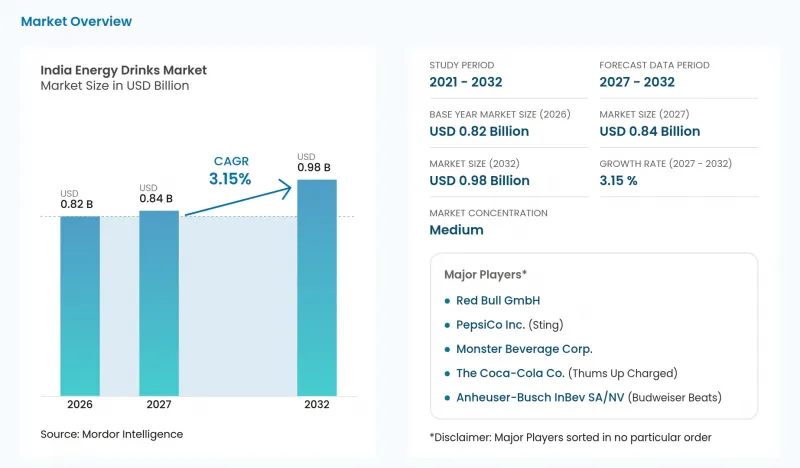
This report is segmented by Product Type (Traditional Energy Drinks, Sugar-Free/Low-Calorie Energy Drinks, Natural/Organic Energy Drinks, Other Energy Drinks, and Energy Shots), Packaging Type (PET Bottles, Metal Can, Glass Bottles, and Others), and Distribution Channel (Off-Trade and On-Trade). The market forecasts are provided in terms of value (USD), based on availability.
India Energy Drinks Market Trends and Insights
Rising on-the-go workforce and demand for convenient energy options
A larger mobile workforce creates more occasions for energy drinks that require little preparation or interruption to work. India's gig workforce, including delivery, ridesharing, and freelancing, grew 55% to 12 million workers from FY2021 to FY2025. In FY2025-26, Tata Consumer Products Ltd re-entered India's caffeine energy segment with Zip Zap, a still-based, noncarbonated energy drink in a cup format. Serving convenience gives suppliers a practical way to reach workers who travel between tasks, without relying on a performance claim alone. The still, noncarbonated format opens another way to compete for mobile work occasions, allowing a caffeine beverage to differ in both carbonation and container.
Expanding fitness and sports participation culture
Organized adult fitness participation gives energy-drink suppliers an audience whose consumption occasions can extend beyond commuting and desk work. India's 89th Fit India Sundays on Cycle edition brought together more than 5 million young people across over 25,000 locations on September 6, 2026, promoting a drug-free youth message and illustrating organized recreation's scale. At the January 18, 2026 Tata Mumbai Marathon, 70,065 participants took part, 60% of them aged 25 to 44. The marathon's adult age profile supplies a distinct audience for energy-drink servings around recreation, extending potential demand beyond work-related convenience.
Health concerns over high caffeine, sugar, and artificial additives
Caffeine-related health concerns limit how broadly suppliers can position an energy drink as an everyday refreshment. Medical guidance reported in India in July 2026 advised children and adolescents to avoid caffeinated energy drinks because of greater susceptibility to stimulant-related adverse effects. The advice creates a boundary around youth-oriented recruitment and makes a general refreshment message harder to reconcile with the product's stimulant character. In June 2026, HELL Energy launched its zero-sugar HELL ZERO range in India, providing a product option that addresses sugar content. Removing sugar leaves the caffeine-related barrier for younger consumers in place, limiting the audience that such reformulation can responsibly unlock.
Other drivers and restraints analyzed in the detailed report include:
- Surge in e-sports and gaming boosting caffeine beverages
- Cold-chain reach in Tier-2/3 cities enabling chilled RTD formats
- Stringent regulations on labeling and caffeine limits, alongside self-regulatory safeguards for advertising to children
For complete list of drivers and restraints, kindly check the Table Of Contents.
Segment Analysis
Traditional energy drinks accounted for a 32.3% share of the India energy drinks market size in 2026. Varun Beverages Ltd introduced Sting Classic in PET bottles in April 2026 and also launched the product in cans. In its May 2026 earnings call, the bottler reported favorable early performance for the PepsiCo product. A traditional offering can therefore compete through product renewal within the same product type, without requiring a different botanical or ingredient proposition to define the offer. In the same call, Varun's chairman reported demand above expectations while discussing the Sting Classic launch.
Natural/organic energy drinks are the fastest-growing segment, with a projected CAGR of 4.4% over 2027-2032. In March 2025, SAGE founder Archana Nagar reported cultivating hibiscus sabdariffa on about 25 acres in Harda and operating a small production unit for a flower-based energy drink. In that example, the product identity connects a distinctive botanical ingredient with its cultivation and production. For a supplier pursuing this model, scaling the proposition means connecting the agricultural and beverage operations while preserving the intended formulation. With about 25 acres and a small production unit in March 2025, this example had a modest supply base, so replicating its flower-based model requires other producers to secure comparable botanical supply.
Complete Report Scope:
- By Product Type
- Energy Shots
- Natural/Organic Energy Drinks
- Sugar-Free/Low-Calorie Energy Drinks
- Traditional Energy Drinks
- Other Energy Drinks
- By Packaging Type
- PET Bottles
- Glass Bottles
- Metal Can
- Others
- By Distribution Channel
- On-Trade
- Off-Trade
- Supermarket/Hypermarket
- Convenience Stores
- Specialty Stores
- Online Retail
- Other Distribution Channels
List of Companies Covered in this Report:
- Red Bull GmbH
- PepsiCo Inc. (Sting)
- Monster Beverage Corp.
- The Coca-Cola Co. (Thums Up Charged)
- Anheuser-Busch InBev SA/NV (Budweiser Beats)
- Goldwin Healthcare Pvt Ltd (Cloud 9)
- Hector Beverages Pvt Ltd (Tzinga)
- Ghodawat Consumer Ltd (Rider)
- Radiohead Brands Pvt Ltd (Hustle)
- Hell Energy Magyarorszag Kft.
- Tata Consumer Products Ltd (Himalayan Energy)
- Varun Beverages Ltd
- Bisleri International Pvt Ltd (Urzza)
- Power Horse Energy Drinks GmbH
- Taisho Pharmaceutical Co. Ltd (Lipovitan)
- Osotspa Co. Ltd (M-150)
- Ocean Drinks Pvt Ltd
- BPI Sports LLC
- Prime Hydration LLC
- Congo Brands (Predator)
Additional Benefits:
- The market estimate (ME) sheet in Excel format
- 3 months of analyst support
TABLE OF CONTENTS
1 INTRODUCTION
- 1.1 Study Assumptions and Market Definition
- 1.2 Scope of the Study
2 RESEARCH METHODOLOGY
3 EXECUTIVE SUMMARY
4 MARKET LANDSCAPE
- 4.1 Market Overview
- 4.2 Market Drivers
- 4.2.1 Rising on-the-go workforce and demand for convenient energy options
- 4.2.2 Expanding fitness and sports participation culture
- 4.2.3 Surge in e-sports and gaming boosting caffeine beverages
- 4.2.4 Cold-chain reach in Tier-2/3 cities enabling chilled RTD formats
- 4.2.5 Shift to natural, sugar-free, and functional variants
- 4.2.6 Rapid urbanization and rising disposable incomes among working professionals
- 4.3 Market Restraints
- 4.3.1 Health concerns over high caffeine, sugar, and artificial additives
- 4.3.2 Stringent regulations on labeling and caffeine limits, alongside self-regulatory safeguards for advertising to children
- 4.3.3 Raw-material price spikes for botanicals and vitamins
- 4.3.4 Rise of alternative functional beverages like kombucha or nootropics
- 4.4 Industry Value Chain Analysis
- 4.5 Regulatory Landscape
- 4.6 Technological Outlook
- 4.7 Porter's Five Forces Analysis
- 4.7.1 Threat of New Entrants
- 4.7.2 Bargaining Power of Suppliers
- 4.7.3 Bargaining Power of Buyers
- 4.7.4 Threat of Substitutes
- 4.7.5 Competitive Rivalry
5 MARKET SIZE AND GROWTH FORECASTS (VALUE)
- 5.1 By Product Type
- 5.1.1 Energy Shots
- 5.1.2 Natural/Organic Energy Drinks
- 5.1.3 Sugar-Free/Low-Calorie Energy Drinks
- 5.1.4 Traditional Energy Drinks
- 5.1.5 Other Energy Drinks
- 5.2 By Packaging Type
- 5.2.1 PET Bottles
- 5.2.2 Glass Bottles
- 5.2.3 Metal Can
- 5.2.4 Others
- 5.3 By Distribution Channel
- 5.3.1 On-Trade
- 5.3.2 Off-Trade
- 5.3.2.1 Supermarket/Hypermarket
- 5.3.2.2 Convenience Stores
- 5.3.2.3 Specialty Stores
- 5.3.2.4 Online Retail
- 5.3.2.5 Other Distribution Channels
6 COMPETITIVE LANDSCAPE
- 6.1 Market Concentration
- 6.2 Strategic Moves
- 6.3 Market Share Analysis
- 6.4 Company Profiles (includes Global level Overview, Market level overview, Core Segments, Financials as available, Strategic Information, Market Rank/Share for key companies, Products and Services, and Recent Developments)
- 6.4.1 Red Bull GmbH
- 6.4.2 PepsiCo Inc. (Sting)
- 6.4.3 Monster Beverage Corp.
- 6.4.4 The Coca-Cola Co. (Thums Up Charged)
- 6.4.5 Anheuser-Busch InBev SA/NV (Budweiser Beats)
- 6.4.6 Goldwin Healthcare Pvt Ltd (Cloud 9)
- 6.4.7 Hector Beverages Pvt Ltd (Tzinga)
- 6.4.8 Ghodawat Consumer Ltd (Rider)
- 6.4.9 Radiohead Brands Pvt Ltd (Hustle)
- 6.4.10 Hell Energy Magyarorszag Kft.
- 6.4.11 Tata Consumer Products Ltd (Himalayan Energy)
- 6.4.12 Varun Beverages Ltd
- 6.4.13 Bisleri International Pvt Ltd (Urzza)
- 6.4.14 Power Horse Energy Drinks GmbH
- 6.4.15 Taisho Pharmaceutical Co. Ltd (Lipovitan)
- 6.4.16 Osotspa Co. Ltd (M-150)
- 6.4.17 Ocean Drinks Pvt Ltd
- 6.4.18 BPI Sports LLC
- 6.4.19 Prime Hydration LLC
- 6.4.20 Congo Brands (Predator)
7 MARKET OPPORTUNITIES AND FUTURE OUTLOOK
- 7.1 White-Space and Unmet-Need Assessment

