PUBLISHER: Mordor Intelligence | PRODUCT CODE: 2187154

PUBLISHER: Mordor Intelligence | PRODUCT CODE: 2187154
Functional Beverage - Market Share Analysis, Industry Trends & Statistics, Growth Forecasts (2027 - 2032)
According to Mordor Intelligence, the functional beverage market size is expected to increase from USD 163.8 billion in 2026 to USD 176.8 billion in 2027 and reach USD 255.3 billion by 2032, growing at a CAGR of 7.62% over 2027-2032.
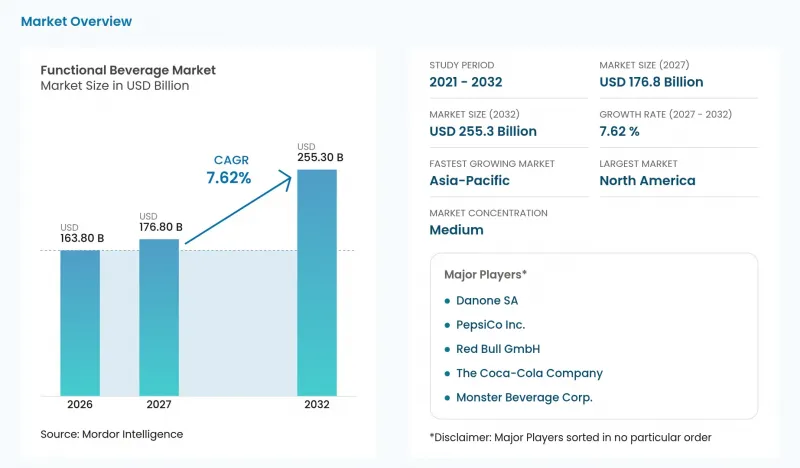
This report is segmented by Product Type (Energy Drinks, Sports Drinks, and more), Packaging Type (PET/Glass Bottles, Cans, and more), Distribution Channel (Off-Trade and On-Trade), and Geography (North America, Asia-Pacific, and more). The market forecasts are provided in terms of value (USD), based on availability.
Global Functional Beverage Market Trends and Insights
Increasing Consumer Focus on Health and Wellness
Health-oriented demand gives beverage suppliers 2 commercial openings, recurring consumption and the possibility of a premium for a relevant benefit. In EY's November 20 to December 11, 2025, survey, 65% of US respondents reported drinking functional beverages at least every 2 weeks. In the same survey, 52% said they were willing to pay more for drinks supporting health and wellness goals. Together, these findings support differentiation around the benefit a drink offers within an established consumption routine. A premium proposition consequently needs a recognizable health purpose, which gives suppliers a reason to state the benefit plainly.
Demand for Clean Label and Natural Ingredients
Ingredient naturalness can support demand by reassuring buyers about a health-positioned drink, while other attributes help determine its appeal. In a June to July 2025 online survey of 144 Moscow adults, 71% identified ingredients and naturalness as a leading choice factor for soft drinks positioned as healthy. Taste ranked higher at 80%, while functional effect was selected by 51%. The authors found that composition mainly removed consumer doubts rather than prompted a choice. Clearing ingredient doubts leaves taste and a recognizable functional benefit to secure the drink's appeal.
Stringent Regulatory and Labeling Requirements
Restrictions on a beverage's label can interrupt availability even when the formulation itself is not the disputed issue. In July 2026, a 90-day labeling deadline from the Food Safety and Standards Authority of India (FSSAI) prompted distributors nationwide to reject existing energy-drink stocks, contributing to retail shortages of dozens of brands. On October 15, PepsiCo told the Delhi High Court that its Indian energy drinks could run out nationwide within 2 months while new production under the "energy drink" label remained barred. The court had not ruled on the merits, with another hearing set for October 30, 2026. For affected suppliers, labeling therefore reaches beyond communication into the ability to replenish saleable stock. PepsiCo's unresolved manufacturing restriction left product availability exposed while the dispute continued.
Other drivers and restraints analyzed in the detailed report include:
- Growing Awareness of Gut Health and Microbiome
- Innovation in Ingredients and Formulations
- Packaging and Sustainability Challenges
For complete list of drivers and restraints, kindly check the Table Of Contents.
Segment Analysis
Energy drinks accounted for a 28.77% share of the functional beverage market size in 2026, making them the largest segment. Monster Beverage's Monster Energy Drinks segment reported USD 7.67 billion in net sales in 2025. That company segment primarily included Monster, Reign Total Body Fuel, Reign Storm and Bang Energy drinks. Reporting these franchises together in one segment shows a single owner building its energy-drink sales across several named lines.
Sports drinks are the fastest-growing segment, with a forecast CAGR of 8.11% over 2027-2032. Gatorade recorded North American volume growth in PepsiCo's Q3 2026 results, covering the 12 weeks ended September 5, 2026. Gatorade Lower Sugar and Gatorlyte each gained value and volume share during that period. Lower Sugar's formulation contained no artificial flavors, sweeteners or colors, giving the sports-drink proposition a specific ingredient profile alongside hydration. The gains by Lower Sugar and Gatorlyte show how formulation variants can contribute to expansion within an established sports-drink franchise.
Complete Report Scope:
- By Product Type
- Energy Drinks
- Sports Drinks
- Fortified Juice
- Dairy and Dairy Alternative Beverages
- Functional/Fortified Water
- Others
- By Packaging Type
- PET/Glass Bottles
- Cans
- Tetra Pak
- Other Types
- By Distribution Channel
- On-Trade
- Off-Trade
- Supermarkets/Hypermarkets
- Pharmacies and Health Stores
- Convenience Stores
- Online Retail Stores
- Other Retail Channels
- By Geography
- North America
- United States
- Canada
- Mexico
- Rest of North America
- South America
- Brazil
- Argentina
- Colombia
- Chile
- Rest of South America
- Europe
- United Kingdom
- Germany
- France
- Italy
- Spain
- Russia
- Sweden
- Belgium
- Poland
- Netherlands
- Rest of Europe
- Asia-Pacific
- China
- Japan
- India
- Thailand
- Singapore
- Indonesia
- South Korea
- Australia
- New Zealand
- Rest of Asia-Pacific
- Middle East and Africa
- United Arab Emirates
- South Africa
- Saudi Arabia
- Nigeria
- Egypt
- Morocco
- Turkey
- Rest of Middle East and Africa
- North America
Geography Analysis
North America held a 38.82% share of the functional beverage market size in 2026. Celsius Holdings reported USD 2.42 billion in North American company revenue in 2025. Alani Nu's sales in tracked US ready-to-drink energy retail channels rose 55.7% year over year in the 13 weeks ended June 28, 2026. Celsius, which owns Alani Nu, attributed that growth to innovation, expanded distribution and continued adoption by new consumers, showing retail access and new buyers adding demand for that brand.
Asia-Pacific is the fastest-growing region, with a forecast CAGR of 8.2% over 2027-2032. Otsuka Pharmaceutical launched POCARI SWEAT retail sales in India in July 2025 through Otsuka Nutraceutical India Private Limited, using products manufactured by its Indonesian subsidiary, PT Amerta Indah Otsuka. Otsuka linked Indian demand to extreme heatwaves and a growing need for beverages that support hydration and electrolyte replenishment. The Coca-Cola Company reported 8% unit case volume growth across its Asia Pacific portfolio in the second quarter of 2026. Otsuka's hydration launch entered a region where a major beverage system subsequently reported volume growth.
Europe, South America and Middle East and Africa show different commercial paths through individual bottlers' functional beverage portfolios. In Spain, Coca-Cola Europacific Partners linked its 2025 company-wide sports-drink volume growth to Aquarius, supported by the Red Peach variant launched at the start of the year. In Brazil, Coca-Cola FEMSA reported sustained 2025 demand for energy and sports drinks within its own portfolio. Coca-Cola HBC reported double-digit energy-drink volume growth in Nigeria in 2025, driven by Predator. A supplier serving these regions faces different entry tasks, from refreshing an established sports brand in Spain to securing a role in an energy-led bottler portfolio in Nigeria.
- PepsiCo Inc.
- The Coca-Cola Company
- Red Bull GmbH
- Monster Beverage Corp.
- Danone SA
- CENTR Brands Corporation (Centr)
- Nestle SA
- Otsuka Holdings Co. Ltd
- Blue Diamond Growers
- Oatly Group AB
- Keurig Dr Pepper Inc.
- Celsius Holdings Inc.
- Yakult Honsha Co. Ltd
- Vita Coco Company Inc.
- Hint Inc.
- Flow Beverage Corp. (Flow)
- Vitamin Well
- BioSteel Sports Inc.
- VOSS Water Global
- Glanbia Plc
Additional Benefits:
- The market estimate (ME) sheet in Excel format
- 3 months of analyst support
TABLE OF CONTENTS
1 INTRODUCTION
- 1.1 Study Assumptions and Market Definition
- 1.2 Scope of the Study
2 RESEARCH METHODOLOGY
3 EXECUTIVE SUMMARY
4 MARKET LANDSCAPE
- 4.1 Market Overview
- 4.2 Market Drivers
- 4.2.1 Increasing Consumer Focus on Health and Wellness
- 4.2.2 Demand for Clean Label and Natural Ingredients
- 4.2.3 Growing Awareness of Gut Health and Microbiome
- 4.2.4 Innovation in Ingredients and Formulations
- 4.2.5 Sustainability and Ethical Sourcing Focus
- 4.2.6 Personalization and Targeted Functional Benefits
- 4.3 Market Restraints
- 4.3.1 Stringent Regulatory and Labeling Requirements
- 4.3.2 Packaging and Sustainability Challenges
- 4.3.3 Taste and Consumer Palatability Challenges
- 4.3.4 High Production and Ingredient Costs
- 4.4 Industry Value Chain Analysis
- 4.5 Regulatory Landscape
- 4.6 Technological Outlook
- 4.7 Porter's Five Forces Analysis
- 4.7.1 Threat of New Entrants
- 4.7.2 Bargaining Power of Suppliers
- 4.7.3 Bargaining Power of Buyers
- 4.7.4 Threat of Substitutes
- 4.7.5 Competitive Rivalry
5 MARKET SIZE AND GROWTH FORECASTS (VALUE)
- 5.1 By Product Type
- 5.1.1 Energy Drinks
- 5.1.2 Sports Drinks
- 5.1.3 Fortified Juice
- 5.1.4 Dairy and Dairy Alternative Beverages
- 5.1.5 Functional/Fortified Water
- 5.1.6 Others
- 5.2 By Packaging Type
- 5.2.1 PET/Glass Bottles
- 5.2.2 Cans
- 5.2.3 Tetra Pak
- 5.2.4 Other Types
- 5.3 By Distribution Channel
- 5.3.1 On-Trade
- 5.3.2 Off-Trade
- 5.3.2.1 Supermarkets/Hypermarkets
- 5.3.2.2 Pharmacies and Health Stores
- 5.3.2.3 Convenience Stores
- 5.3.2.4 Online Retail Stores
- 5.3.2.5 Other Retail Channels
- 5.4 By Geography
- 5.4.1 North America
- 5.4.1.1 United States
- 5.4.1.2 Canada
- 5.4.1.3 Mexico
- 5.4.1.4 Rest of North America
- 5.4.2 South America
- 5.4.2.1 Brazil
- 5.4.2.2 Argentina
- 5.4.2.3 Colombia
- 5.4.2.4 Chile
- 5.4.2.5 Rest of South America
- 5.4.3 Europe
- 5.4.3.1 United Kingdom
- 5.4.3.2 Germany
- 5.4.3.3 France
- 5.4.3.4 Italy
- 5.4.3.5 Spain
- 5.4.3.6 Russia
- 5.4.3.7 Sweden
- 5.4.3.8 Belgium
- 5.4.3.9 Poland
- 5.4.3.10 Netherlands
- 5.4.3.11 Rest of Europe
- 5.4.4 Asia-Pacific
- 5.4.4.1 China
- 5.4.4.2 Japan
- 5.4.4.3 India
- 5.4.4.4 Thailand
- 5.4.4.5 Singapore
- 5.4.4.6 Indonesia
- 5.4.4.7 South Korea
- 5.4.4.8 Australia
- 5.4.4.9 New Zealand
- 5.4.4.10 Rest of Asia-Pacific
- 5.4.5 Middle East and Africa
- 5.4.5.1 United Arab Emirates
- 5.4.5.2 South Africa
- 5.4.5.3 Saudi Arabia
- 5.4.5.4 Nigeria
- 5.4.5.5 Egypt
- 5.4.5.6 Morocco
- 5.4.5.7 Turkey
- 5.4.5.8 Rest of Middle East and Africa
- 5.4.1 North America
6 COMPETITIVE LANDSCAPE
- 6.1 Market Concentration
- 6.2 Strategic Moves
- 6.3 Market Share Analysis
- 6.4 Company Profiles (includes Global level Overview, Market level overview, Core Segments, Financials as available, Strategic Information, Market Rank/Share for key companies, Products and Services, and Recent Developments)
- 6.4.1 PepsiCo Inc.
- 6.4.2 The Coca-Cola Company
- 6.4.3 Red Bull GmbH
- 6.4.4 Monster Beverage Corp.
- 6.4.5 Danone SA
- 6.4.6 CENTR Brands Corporation (Centr)
- 6.4.7 Nestle SA
- 6.4.8 Otsuka Holdings Co. Ltd
- 6.4.9 Blue Diamond Growers
- 6.4.10 Oatly Group AB
- 6.4.11 Keurig Dr Pepper Inc.
- 6.4.12 Celsius Holdings Inc.
- 6.4.13 Yakult Honsha Co. Ltd
- 6.4.14 Vita Coco Company Inc.
- 6.4.15 Hint Inc.
- 6.4.16 Flow Beverage Corp. (Flow)
- 6.4.17 Vitamin Well
- 6.4.18 BioSteel Sports Inc.
- 6.4.19 VOSS Water Global
- 6.4.20 Glanbia Plc
7 MARKET OPPORTUNITIES AND FUTURE OUTLOOK
- 7.1 White-Space and Unmet-Need Assessment

