PUBLISHER: Mordor Intelligence | PRODUCT CODE: 2187160

PUBLISHER: Mordor Intelligence | PRODUCT CODE: 2187160
India Kitchen Appliances - Market Share Analysis, Industry Trends & Statistics, Growth Forecasts (2027 - 2032)
According to Mordor Intelligence, the India kitchen appliances market size is expected to increase from USD 12.22 billion in 2026 to USD 13.09 billion in 2027 and reach USD 18.63 billion by 2032, growing at a CAGR of 7.31% over 2027-2032.
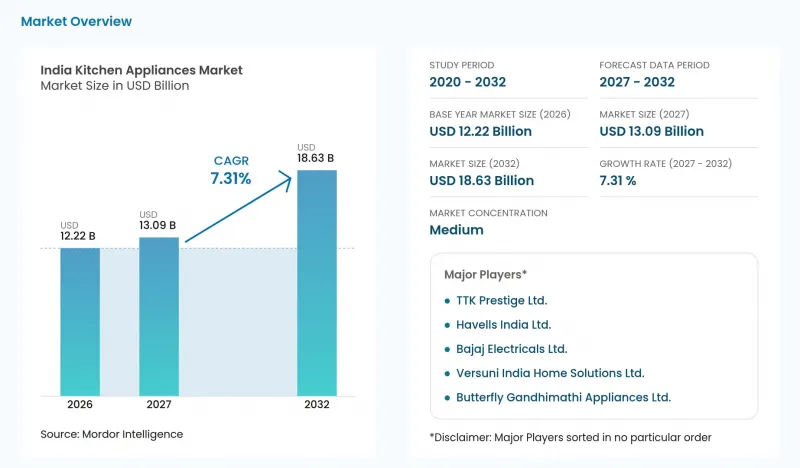
This report is segmented by Product (Large Kitchen Appliances and Small Kitchen Appliances), End User (Residential and Commercial), Distribution Channel (B2C/Retail and B2B), and Geography (South India, West India, North India, and East & North-East India). The market forecasts are provided in terms of value (USD), based on availability.
India Kitchen Appliances Market Trends and Insights
Rising Urban Middle-Class Disposable Income
Higher disposable income can widen the range of kitchen tasks an urban middle-income household can afford to automate. MoSPI's provisional FY2025-26 estimate showed national per-capita private final consumption expenditure increasing 8.4% in nominal terms from FY2024-25. For appliance suppliers, the income mechanism works when additional discretionary resources cover a new kitchen function alongside the household's existing equipment. An extra appliance can then represent an expansion in household spending without requiring the buyer to replace a functioning product or accept a higher price for the same task. Complementary cooking functions let suppliers seek another sale from an existing appliance owner before that household needs a replacement.
Growth of E-Commerce & D2C Appliance Brands
Digital distribution can connect first-home appliance purchases with brands that do not depend exclusively on local shelf space. In September 2026, Wonderchef said digital channels' share of its total sales had risen from around 25% to 35% over the preceding 2 to 2.5 years. The company linked that shift to young consumers furnishing their first homes and increasingly preferring online shopping. Beyond Appliances uses its D2C platform, online marketplaces and offline retail to sell smart kitchen appliances. For suppliers, this creates a route to reach appliance buyers during initial kitchen setup rather than waiting for replacement demand through established stores. The commercial opening is therefore broader access at a specific household decision point, with digital channels complementing the physical network instead of requiring its complete displacement.
Volatile Raw-Material & Component Costs
The West Asia conflict following US-Israel strikes on Iran in February 2026 added freight and component cost pressure for appliance suppliers in India. In March 2026, Godrej Enterprises Group reported ocean freight rates rising up to 3 times and imported-component costs increasing amid currency pressures. In a September 24, 2026, communication, LG Electronics India reported year-to-date input-cost increases of 34% for copper, 17% for resin, 24% for steel and 16% for aluminum. LG also reported higher logistics and energy costs and adverse foreign-exchange movements. The pressures span metals, resin, freight, energy and currency, so easing in a single input need not restore the earlier appliance cost base. Suppliers that pass these costs through raise refrigerator replacement prices, while those absorbing them accept thinner unit margins.
Other drivers and restraints analyzed in the detailed report include:
- Government Push For Domestic Manufacturing
- Energy-Efficiency Regulations Driving Replacements
- Wide Regional Price-Sensitivity Limiting Premiums
For complete list of drivers and restraints, kindly check the Table Of Contents.
Segment Analysis
Large kitchen appliances accounted for a 67.57% share of the India kitchen appliances market size in 2026, making them the largest segment. LG Electronics India reported that refrigerators contributed 28% of its own product-category revenue in FY2026. The company began producing 674-liter double-door and 790-liter side-by-side refrigerators at its Pune plant during FY2026. For a supplier with substantial refrigerator revenue, these formats broaden the storage requirements its existing product business can address. LG described one of these sizes as one no other brand then produced in India, which gives its Pune plant a differentiated position in large-capacity refrigerators.
Small kitchen appliances are the fastest-growing segment, with a forecast CAGR of 9.05% over 2027-2032. Wonderchef reported that its air-fryer sales growth doubled in 2025. A Chennai household that bought an air fryer in late 2025 described health and convenience as purchase motives and reported lower oil use and fewer takeout orders. That use case connects the appliance decision with meal preparation and spending outside equipment, since food cooked at home can replace ordered meals. Small-appliance suppliers can therefore compete on a repeatable cooking routine, giving buyers a reason to pay for tasks previously served through takeout.
Complete Report Scope:
- By Product
- Large Kitchen Appliances
- Refrigerators & Freezers
- Dishwashers
- Range Hoods
- Cooktops
- Ovens
- Other Large Kitchen Appliances
- Small Kitchen Appliances
- Food Processors
- Juicers and Blenders
- Grills and Roasters
- Air Fryers
- Coffee Makers
- Electric Cookers
- Toasters
- Electric Kettles
- Countertop Ovens
- Other Small Kitchen Appliances
- Large Kitchen Appliances
- By End User
- Residential
- Commercial
- By Distribution Channel
- B2C/Retail
- Multi-brand Stores
- Exclusive Brand Outlets
- Online
- Other Distribution Channels
- B2B (directly from the manufacturers)
- B2C/Retail
- By Geography
- North India
- South India
- West India
- East & North-East India
List of Companies Covered in this Report:
- TTK Prestige Ltd.
- Versuni India Home Solutions Ltd.
- Bajaj Electricals Ltd.
- Havells India Ltd.
- Butterfly Gandhimathi Appliances Ltd.
- LG Electronics India Ltd.
- Samsung India Electronics Pvt. Ltd.
- Whirlpool of India Ltd.
- Voltbek Home Appliances Pvt. Ltd.
- Godrej Appliances
- Panasonic India Pvt. Ltd.
- Usha International Ltd.
- IFB Industries Ltd.
- Crompton Greaves Consumer Electricals Ltd.
- Inalsa Home Appliances
- Morphy Richards India
- Kenstar
- Glen Appliances Pvt. Ltd.
- Maharaja Whiteline
- Hindware Home Innovation Ltd.
- Versuni India Home Solutions Ltd. (Preethi)
Additional Benefits:
- The market estimate (ME) sheet in Excel format
- 3 months of analyst support
TABLE OF CONTENTS
1 INTRODUCTION
- 1.1 Study Assumptions and Market Definition
- 1.2 Scope of the Study
2 RESEARCH METHODOLOGY
3 EXECUTIVE SUMMARY
4 MARKET LANDSCAPE
- 4.1 Market Overview
- 4.2 Market Drivers
- 4.2.1 Rising Urban Middle-Class Disposable Income
- 4.2.2 Growth of E-Commerce & D2C Appliance Brands
- 4.2.3 Government Push For Domestic Manufacturing
- 4.2.4 Energy-Efficiency Regulations Driving Replacements
- 4.2.5 Surge In Health-Centric Cooking Trends
- 4.2.6 Appliance-As-A-Service & Rental Models Emerging
- 4.3 Market Restraints
- 4.3.1 Volatile Raw-Material & Component Costs
- 4.3.2 Wide Regional Price-Sensitivity Limiting Premiums
- 4.3.3 Slow Smart-Appliance Uptake Over Data-Privacy Worries
- 4.3.4 Informal Repair Market Prolongs Product Lifecycles
- 4.4 Industry Value Chain Analysis
- 4.5 Regulatory Landscape
- 4.6 Technological Outlook
- 4.7 Porter's Five Forces Analysis
- 4.7.1 Threat of New Entrants
- 4.7.2 Bargaining Power of Suppliers
- 4.7.3 Bargaining Power of Buyers
- 4.7.4 Threat of Substitutes
- 4.7.5 Competitive Rivalry
- 4.8 Insights into the Latest Trends and Innovations in the Market
- 4.9 Insights on Recent Developments (New Product Launches, Strategic Initiatives, Investments, Partnerships, JVs, Expansion, M&As, etc.) in the Market
5 MARKET SIZE AND GROWTH FORECASTS (VALUE)
- 5.1 By Product
- 5.1.1 Large Kitchen Appliances
- 5.1.1.1 Refrigerators & Freezers
- 5.1.1.2 Dishwashers
- 5.1.1.3 Range Hoods
- 5.1.1.4 Cooktops
- 5.1.1.5 Ovens
- 5.1.1.6 Other Large Kitchen Appliances
- 5.1.2 Small Kitchen Appliances
- 5.1.2.1 Food Processors
- 5.1.2.2 Juicers and Blenders
- 5.1.2.3 Grills and Roasters
- 5.1.2.4 Air Fryers
- 5.1.2.5 Coffee Makers
- 5.1.2.6 Electric Cookers
- 5.1.2.7 Toasters
- 5.1.2.8 Electric Kettles
- 5.1.2.9 Countertop Ovens
- 5.1.2.10 Other Small Kitchen Appliances
- 5.1.1 Large Kitchen Appliances
- 5.2 By End User
- 5.2.1 Residential
- 5.2.2 Commercial
- 5.3 By Distribution Channel
- 5.3.1 B2C/Retail
- 5.3.1.1 Multi-brand Stores
- 5.3.1.2 Exclusive Brand Outlets
- 5.3.1.3 Online
- 5.3.1.4 Other Distribution Channels
- 5.3.2 B2B (directly from the manufacturers)
- 5.3.1 B2C/Retail
- 5.4 By Geography
- 5.4.1 North India
- 5.4.2 South India
- 5.4.3 West India
- 5.4.4 East & North-East India
6 COMPETITIVE LANDSCAPE
- 6.1 Market Concentration
- 6.2 Strategic Moves
- 6.3 Market Share Analysis
- 6.4 Company Profiles (includes Global level Overview, Market level overview, Core Segments, Financials as available, Strategic Information, Market Rank/Share for key companies, Products and Services, and Recent Developments)
- 6.4.1 TTK Prestige Ltd.
- 6.4.2 Versuni India Home Solutions Ltd.
- 6.4.3 Bajaj Electricals Ltd.
- 6.4.4 Havells India Ltd.
- 6.4.5 Butterfly Gandhimathi Appliances Ltd.
- 6.4.6 LG Electronics India Ltd.
- 6.4.7 Samsung India Electronics Pvt. Ltd.
- 6.4.8 Whirlpool of India Ltd.
- 6.4.9 Voltbek Home Appliances Pvt. Ltd.
- 6.4.10 Godrej Appliances
- 6.4.11 Panasonic India Pvt. Ltd.
- 6.4.12 Usha International Ltd.
- 6.4.13 IFB Industries Ltd.
- 6.4.14 Crompton Greaves Consumer Electricals Ltd.
- 6.4.15 Inalsa Home Appliances
- 6.4.16 Morphy Richards India
- 6.4.17 Kenstar
- 6.4.18 Glen Appliances Pvt. Ltd.
- 6.4.19 Maharaja Whiteline
- 6.4.20 Hindware Home Innovation Ltd.
- 6.4.21 Versuni India Home Solutions Ltd. (Preethi)
7 MARKET OPPORTUNITIES AND FUTURE OUTLOOK
- 7.1 White-Space and Unmet-Need Assessment

