PUBLISHER: Mordor Intelligence | PRODUCT CODE: 2187162

PUBLISHER: Mordor Intelligence | PRODUCT CODE: 2187162
Automotive Steering Sensor - Market Share Analysis, Industry Trends & Statistics, Growth Forecasts (2026 - 2031)
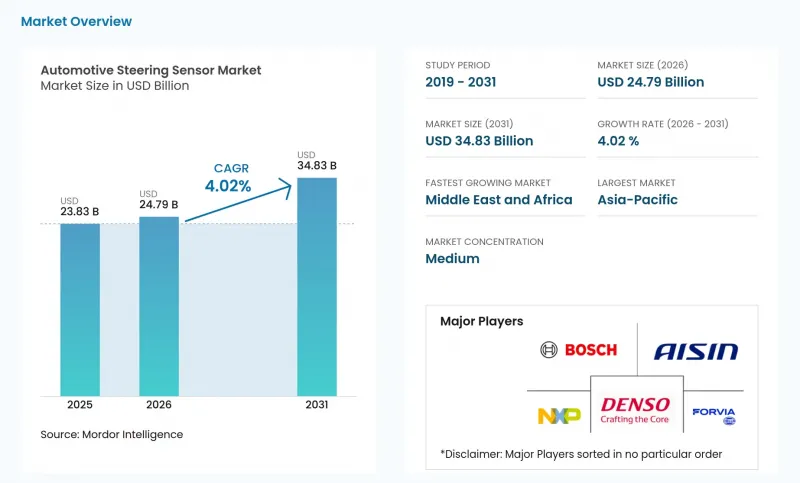
According to Mordor Intelligence, the automotive steering sensor market was valued at USD 23.83 billion in 2025, is estimated at USD 24.79 billion in 2026, and is projected to reach USD 34.83 billion by 2031, registering a 4.02% CAGR during 2026-2031.
Global Automotive Steering Sensor Market Trends and Insights
EPS Penetration Across Vehicle Classes
Electric power steering adoption accelerates across all vehicle segments. This widespread implementation creates demand for sophisticated torque and angle sensors that enable precise calibration of steering assistance. The technology's expansion into off-highway vehicles represents a paradigm shift, as construction and agricultural equipment manufacturers integrate EPS systems to reduce operator fatigue and improve fuel efficiency. In July 2026, ZF announced the production of its 100 millionth electric power steering (EPS) system, highlighting continued scaling of EPS across passenger cars, SUVs, and light commercial vehicles and indicating strong momentum in this traditionally hydraulically dominated segment.
Mandatory Safety and Fuel-Efficiency Norms
Regulatory frameworks increasingly mandate the integration of advanced steering sensors to meet safety and environmental standards. The European Union's General Safety Regulation requires lane-keeping assistance systems in all new vehicles from 2024, directly driving demand for high-precision angle sensors capable of detecting steering wheel movements within 0.1-degree accuracy. Similarly, the United States' Corporate Average Fuel Economy standards incentivize EPS adoption through fuel-efficiency credits, as electric steering systems consume 90% less energy than hydraulic alternatives under typical driving conditions. China's New Energy Vehicle mandate extends these requirements to commercial vehicles, with steering sensor specifications becoming integral to vehicle certification processes. ISO 26262 compliance factors add development complexity but ensure sensor reliability meets automotive safety integrity levels, particularly for ASIL-C and ASIL-D applications in autonomous driving systems.
High Reliability and Qualification Cost
Automotive steering sensor qualification requires extensive testing protocols that can take 18-24 months and cost USD 2-5 million per sensor variant, creating barriers for smaller suppliers and limiting the speed of innovation. The qualification process encompasses temperature cycling from -40°C to 150°C, vibration testing across multiple axes, and electromagnetic compatibility validation under various interference conditions. These requirements particularly affect emerging sensor technologies such as capacitive and ultrasonic designs, for which long-term reliability data remain limited compared to established magnetic sensing approaches. The cost burden forces suppliers to amortize development expenses across larger production volumes, potentially limiting sensor customization for niche applications and constraining market entry for innovative technologies.
Other drivers and restraints analyzed in the detailed report include:
- ADAS and Autonomy Sensor Demand
- Modular Steer-by-Wire Retrofits
- EMI/Thermal Issues in 800-V EV Platforms
For complete list of drivers and restraints, kindly check the Table Of Contents.
Segment Analysis
Torque sensors accounted for 46.10% of the automotive steering sensor market share in 2025, a testament to their indispensable role within EPS columns, where real-time driver-effort readings underpin assistance curves. These gauges provide high-resolution analog or digital outputs with latency below 2 ms, enabling a seamless handoff between manual input and motor assist. As cabin layouts evolve toward yoke-style wheels, torque-detection precision remains central to user comfort and perceived steering naturalness in the automotive steering sensor market.
Conversely, capacitive sensors are scaling at a 12.95% CAGR through 2031, driven by contactless electrodes that forgo mechanical parts, thereby improving lifetime in high-duty fleets. Tunnel-magnetoresistance topologies win favor among premium marques for their resilience to stray fields generated by 48 V alternators. At the same time, hybrid modules now bundle TMR and capacitive channels to offer dual-path redundancy. Sensor miniaturization enabled by 65-nm automotive-qualified CMOS enables integration into steering-wheel spokes, freeing up space for airbag modules and touchscreen controls.
Passenger cars accounted for 46.85% of the automotive steering sensor market share in 2025, sustained by global light-vehicle volumes and growing ADAS content per unit. Yet off-highway vehicles are advancing at a 9.75% CAGR as construction and agricultural OEMs digitalize field equipment. Bulldozers, excavators, and row-crop tractors integrate GPS-aligned steering automation that requires angle resolution below 0.05 degrees over the full rotation.
These environments impose harsher shock and contamination loads than those on highway cars, accelerating the migration to sealed, contactless sensing stacks. For example, Deere's latest tractor series integrates dual optical encoders with TMR chips to achieve sub-centimeter pass-to-pass accuracy in autonomous tillage, highlighting cross-sector technology transfer that is now shaping the automotive steering sensor market.
Complete Report Scope:
- By Sensor Type
- Torque Sensors
- Angle/Position Sensors
- Velocity Sensors
- Others
- By Vehicle Type
- Passenger Cars
- Light Commercial Vehicles
- Medium and Heavy Commercial Vehicles
- Off-Highway Vehicles
- By Technology
- Contacting Sensors
- Magnetic Sensors
- Optical Sensors
- Ultrasonic Sensors
- Capacitive Sensors
- Others
- By Application
- Steering Angle Detection
- Steering Torque Measurement
- Steering Position Tracking
- Autonomous Emergency Steering
- Adaptive Front Steering
- By Geography
- North America
- United States
- Canada
- Rest of North America
- South America
- Brazil
- Argentina
- Rest of South America
- Europe
- Germany
- United Kingdom
- France
- Italy
- Spain
- Rest of Europe
- Asia-Pacific
- China
- India
- Japan
- South Korea
- Rest of Asia-Pacific
- Middle East and Africa
- United Arab Emirates
- Saudi Arabia
- South Africa
- Turkey
- Rest of Middle East and Africa
- North America
Geography Analysis
Asia-Pacific dominates the automotive steering sensor market with a 54.25% share in 2025, driven by China's position as the world's largest automotive producer and its aggressive electric vehicle adoption targets. The region benefits from established automotive supply chains and government policies promoting vehicle electrification, creating sustained demand for advanced steering sensor technologies. China's New Energy Vehicle mandate requires 40% of new vehicle sales to be electric by 2030, directly driving EPS and steering sensor adoption across all vehicle segments. India's automotive sector contributes significantly through both domestic consumption and export manufacturing, with companies like Tata Motors and Mahindra integrating advanced steering systems in commercial vehicle platforms. Japan maintains technology leadership through companies like NSK and JTEKT that develop innovative sensor solutions for global automotive markets.
The Middle East and Africa represent the fastest-growing regional market at 11.05% CAGR through 2031, reflecting economic diversification efforts and infrastructure development programs that drive commercial vehicle demand. The United Arab Emirates leads regional adoption through its smart city initiatives and autonomous vehicle testing programs that require advanced sensor technologies. Saudi Arabia's Vision 2030 program includes automotive manufacturing development, creating opportunities for steering sensor suppliers to establish local production capabilities. South Africa's automotive industry benefits from established manufacturing infrastructure and preferential trade agreements that support export-oriented production of steering system components.
Europe maintains strong market presence through stringent safety regulations and premium vehicle production that demands high-performance steering sensor solutions. The region's focus on autonomous driving development creates demand for redundant sensor architectures and advanced signal processing capabilities. Germany's automotive industry leadership drives innovation in steering sensor technologies, with companies like Continental and ZF developing next-generation solutions for electric and autonomous vehicles. North America demonstrates steady growth driven by regulatory requirements for advanced safety systems and the transition toward electric vehicle platforms that require sophisticated steering control technologies.
- JTEKT Corporation
- Robert Bosch GmbH
- Nexteer Automotive
- NSK Ltd.
- ZF Friedrichshafen AG
- Mitsubishi Electric Mobility Corporation
- Hitachi Astemo Ltd.
- ThyssenKrupp AG
- Hyundai Mobis Co. Ltd.
- HL Mando Corporation
- China Automotive Systems Inc.
- Valeo SA
- Infineon Technologies AG
- Texas Instruments Inc.
- Analog Devices Inc.
- NXP Semiconductors N.V.
- Sensata Technologies
- TE Connectivity Ltd.
- Denso Corporation
- FORVIA HELLA
- Continental AG
Additional Benefits:
- The market estimate (ME) sheet in Excel format
- 3 months of analyst support
TABLE OF CONTENTS
1 Introduction
- 1.1 Study Assumptions and Market Definition
- 1.2 Scope of the Study
2 Research Methodology
3 Executive Summary
4 Market Landscape
- 4.1 Market Overview
- 4.2 Market Drivers
- 4.2.1 EPS Penetration Across Vehicle Classes
- 4.2.2 Mandatory Safety and Fuel-Efficiency Norms
- 4.2.3 ADAS and Autonomy Sensor Demand
- 4.2.4 Modular Steer-by-Wire Retrofits
- 4.2.5 Edge-AI Predictive Maintenance Sensors
- 4.2.6 Standardized Digital TMR Sensor Interfaces
- 4.3 Market Restraints
- 4.3.1 High Reliability and Qualification Cost
- 4.3.2 EMI/Thermal Issues in 800-V EV Platforms
- 4.3.3 Tariff-Driven MR Sensor Supply Risk
- 4.3.4 Cyber-Security Redesign Cost for CAN FD
- 4.4 Value Chain Analysis
- 4.5 Regulatory Landscape
- 4.6 Technological Outlook
- 4.7 Porter's Five Forces Analysis
- 4.7.1 Threat of New Entrants
- 4.7.2 Bargaining Power of Suppliers
- 4.7.3 Bargaining Power of Buyers
- 4.7.4 Threat of Substitutes
- 4.7.5 Competitive Rivalry
5 Market Size and Growth Forecasts (Value (USD))
- 5.1 By Sensor Type
- 5.1.1 Torque Sensors
- 5.1.2 Angle/Position Sensors
- 5.1.3 Velocity Sensors
- 5.1.4 Others
- 5.2 By Vehicle Type
- 5.2.1 Passenger Cars
- 5.2.2 Light Commercial Vehicles
- 5.2.3 Medium and Heavy Commercial Vehicles
- 5.2.4 Off-Highway Vehicles
- 5.3 By Technology
- 5.3.1 Contacting Sensors
- 5.3.2 Magnetic Sensors
- 5.3.3 Optical Sensors
- 5.3.4 Ultrasonic Sensors
- 5.3.5 Capacitive Sensors
- 5.3.6 Others
- 5.4 By Application
- 5.4.1 Steering Angle Detection
- 5.4.2 Steering Torque Measurement
- 5.4.3 Steering Position Tracking
- 5.4.4 Autonomous Emergency Steering
- 5.4.5 Adaptive Front Steering
- 5.5 By Geography
- 5.5.1 North America
- 5.5.1.1 United States
- 5.5.1.2 Canada
- 5.5.1.3 Rest of North America
- 5.5.2 South America
- 5.5.2.1 Brazil
- 5.5.2.2 Argentina
- 5.5.2.3 Rest of South America
- 5.5.3 Europe
- 5.5.3.1 Germany
- 5.5.3.2 United Kingdom
- 5.5.3.3 France
- 5.5.3.4 Italy
- 5.5.3.5 Spain
- 5.5.3.6 Rest of Europe
- 5.5.4 Asia-Pacific
- 5.5.4.1 China
- 5.5.4.2 India
- 5.5.4.3 Japan
- 5.5.4.4 South Korea
- 5.5.4.5 Rest of Asia-Pacific
- 5.5.5 Middle East and Africa
- 5.5.5.1 United Arab Emirates
- 5.5.5.2 Saudi Arabia
- 5.5.5.3 South Africa
- 5.5.5.4 Turkey
- 5.5.5.5 Rest of Middle East and Africa
- 5.5.1 North America
6 Competitive Landscape
- 6.1 Market Concentration
- 6.2 Strategic Moves
- 6.3 Market Share Analysis
- 6.4 Company Profiles (Includes Global level Overview, Market level overview, Core Segments, Financials as available, Strategic Information, Market Rank/Share, Products and Services, Recent Developments)
- 6.4.1 JTEKT Corporation
- 6.4.2 Robert Bosch GmbH
- 6.4.3 Nexteer Automotive
- 6.4.4 NSK Ltd.
- 6.4.5 ZF Friedrichshafen AG
- 6.4.6 Mitsubishi Electric Mobility Corporation
- 6.4.7 Hitachi Astemo Ltd.
- 6.4.8 ThyssenKrupp AG
- 6.4.9 Hyundai Mobis Co. Ltd.
- 6.4.10 HL Mando Corporation
- 6.4.11 China Automotive Systems Inc.
- 6.4.12 Valeo SA
- 6.4.13 Infineon Technologies AG
- 6.4.14 Texas Instruments Inc.
- 6.4.15 Analog Devices Inc.
- 6.4.16 NXP Semiconductors N.V.
- 6.4.17 Sensata Technologies
- 6.4.18 TE Connectivity Ltd.
- 6.4.19 Denso Corporation
- 6.4.20 FORVIA HELLA
- 6.4.21 Continental AG
7 Market Opportunities and Future Outlook
- 7.1 White-Space and Unmet-Need Assessment

