PUBLISHER: Mordor Intelligence | PRODUCT CODE: 2187164

PUBLISHER: Mordor Intelligence | PRODUCT CODE: 2187164
Wine - Market Share Analysis, Industry Trends & Statistics, Growth Forecasts (2027 - 2032)
According to Mordor Intelligence, the wine market size was valued at USD 372.1 billion in 2026 and estimated to grow from USD 384.6 billion in 2027 to reach USD 447.6 billion by 2032, at a CAGR of 3.08% during the forecast period (2027-2032).
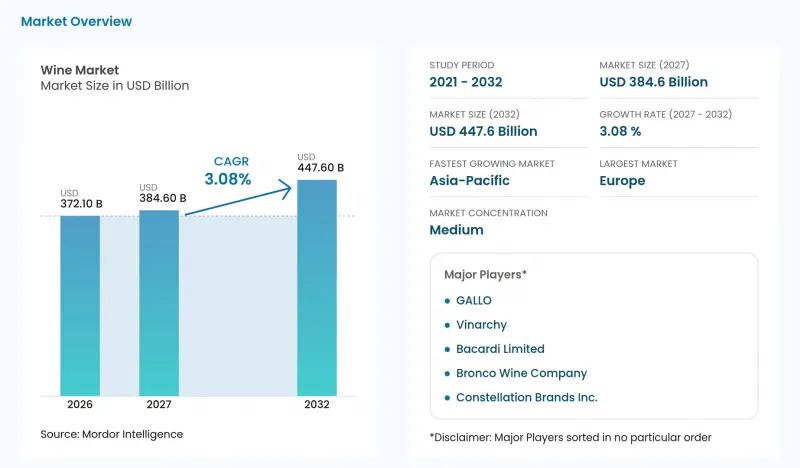
The wine market volume was valued at 204.3 million Hectoliters in 2026 and estimated to grow from 205 million Hectoliters in 2027 to reach 208.6 million Hectoliters by 2032, at a CAGR of 0.35% during the forecast period (2027-2032). This report is segmented by Product Type (Still Wine, Sparkling Wine, and more), Color (Red Wine, White Wine, and more), End User (Women and Men), Distribution Channel (Off-Trade and On-Trade), and Geography (Europe, North America, and more). The market forecasts are provided in terms of value (USD) and volume (Hectoliters), based on availability.
Global Wine Market Trends and Insights
Growing tourism and hospitality footprint
Winery hospitality gives producers a direct point of contact with visitors who can become buyers of their wines. DOCa Rioja wineries in Spain received 930,364 visits in 2025, up 1.96% from 2024. The designation counted 226 wineries open for wine tourism in 2025, compared with 214 in 2024. Because the number of venues grew faster than visits, regional traffic growth does not ensure higher traffic for each participating estate. Rioja estates can turn the larger hospitality footprint into wine demand through direct bottle purchases, while tasting fees alone add no wine sales.
Rising consumer preference for low-/no-alcohol wines
Alcohol-free wine gives producers a way to serve buyers for whom an alcoholic wine is unsuitable. In Germany, 44% more households bought alcohol-free wine through retail in 2025 than in 2024. German retail sales volume of alcohol-free wine rose 25% over the same period. Separately, one in 3 of the 506 wineries in the 2025 Geisenheim sales analysis reported alcohol-free wine in its assortment. Broader household reach and an established producer offering give this category a commercial basis beyond isolated product launches. The stronger expansion in household reach than in volume shifts the commercial task toward deepening purchases within that broader German retail buyer base.
Stringent and divergent alcohol regulations
Retail pricing rules can prevent wine sellers from using the full range of discounts to attract price-sensitive buyers. Scotland's minimum unit pricing law bars retailers from selling wine below the applicable legal minimum per unit of alcohol. Because the floor follows alcohol content, the constraint must be assessed against the strength and size of the wine being sold. A retailer willing to accept a thinner margin still cannot lower the shelf price of an affected bottle below the alcohol-based floor. Wines already priced above the floor may offer more promotional room, making the restriction especially relevant to offers positioned near the minimum. For the lowest-priced qualifying wines, regulatory compliance directly limits how far affordability can support additional demand.
Other drivers and restraints analyzed in the detailed report include:
- Surge in premium and super-premium wine demand
- Climate-resilient varietal Research and Development expands viable terroirs
- High production costs amplified by climate volatility
For complete list of drivers and restraints, kindly check the Table Of Contents.
Segment Analysis
Still wine accounted for a 71.61% share of the wine market size in 2026, making it the largest segment. Still-wine sales in France's Bourgogne-Franche-Comte totaled 1.26 million hectoliters in the 12 months through April 2026. Mass-retail weakness weighed on these regional sales, showing how channel pressure can coexist with a substantial annual still-wine sales base. Retaining mass-retail listings offers these regional producers a more direct defense of sales than adding output to a channel already losing volume.
Sparkling wine is forecast to be the fastest-growing segment, at a CAGR of 5.05% during 2027-2032. The 8 French Cremant appellations sold 122.9 million bottles in 2025 against 114.5 million in 2024, while their cellar releases rose 7.5% in 2025. Prosecco DOC bottled 667 million bottles in 2025, up 1.1% from 2024. Its US exports grew 8% in January-September 2025, when the country accounted for 23.8% of Prosecco DOC exports. Cremant sales rising alongside cellar releases show that sparkling expansion extends beyond Prosecco DOC bottling.
Red wine represented a 48.15% wine market share in 2026, making it the largest segment. Australian red-wine production rose 15% to 590 million liters in 2024-25 and returned to 52% of national wine output by volume after falling below white wine in 2023-24. Wine Australia's Market Insights manager, Peter Bailey, said red grapes accounted for nearly 90% of the additional grape-crush tonnage in 2025. Australian red producers have more wine to place with buyers before the output rebound can translate into higher revenue.
Rose wine is forecast to be the fastest-growing segment, at a CAGR of 3.9% during 2027-2032. Australian retail off-trade sales of still bottled rose rose 6% by volume in the year ended June 2026. The volume gain sat in bottled still rose, so suppliers already holding Australian retail shelf space in that format are best placed to capture it.
Complete Report Scope:
- By Product Type
- Fortified Wine
- Still Wine
- Sparkling Wine
- Others Wine Types
- By Color
- Red Wine
- White Wine
- Rose Wine
- By End User
- Men
- Women
- By Distribution Channel
- On-Trade
- Off-Trade
- Specialty/Liquor Stores
- Other off-Trade Channels
- By Geography
- North America
- United States
- Canada
- Mexico
- Rest of North America
- Europe
- Germany
- United Kingdom
- Italy
- France
- Spain
- Netherlands
- Poland
- Belgium
- Sweden
- Rest of Europe
- Asia-Pacific
- China
- India
- Japan
- Australia
- Indonesia
- South Korea
- Thailand
- Singapore
- Rest of Asia-Pacific
- South America
- Brazil
- Argentina
- Colombia
- Chile
- Peru
- Rest of South America
- Middle East and Africa
- South Africa
- Saudi Arabia
- United Arab Emirates
- Nigeria
- Egypt
- Morocco
- Turkey
- Rest of Middle East and Africa
- North America
Geography Analysis
Europe accounted for 45.06% of the wine market size in 2026, making it the largest geography. European Union wine consumption totaled 100.6 million hectoliters in 2025, or 48% of world consumption, down 3.1% from 2024 and 6.9% from the previous 5-year average. In 2025, Viva Wine Group integrated Netherlands-based wine importer and distributor Delta Wines, which became the foundation of its business-to-business platform outside the Nordics. For producers represented through Delta Wines, the EU contraction makes sales per listing a more relevant test of expansion than the platform's geographic reach.
Asia-Pacific is forecast to be the fastest-growing geography, at a CAGR of 5.2% during 2027-2032. Japan's preliminary wine consumption rose 6.8% from 2024 to 3.3 million hectoliters in 2025, in line with its 5-year average. Australian wine exports to Thailand increased 54% in value in the year ended June 2026 compared with the prior year. The Japanese rebound points to demand recovery, while the Thai export result identifies a distinct commercial route for suppliers seeking higher sales value. These different entry points favor country-specific expansion, with exporters able to pursue growing destination trade without assuming that every regional consumer base moves together.
The remaining regions combine substantial established consumption with sharply different recent demand conditions, creating different tasks for suppliers. In North America, US wine consumption was estimated at 31.9 million hectoliters in 2025, down 4.3% from 2024. In South America, Brazil was estimated to reach record consumption of 4.4 million hectoliters in 2025, up 41.9% from a low 2024 base and 19.9% above its 5-year average. Within Middle East and Africa, South Africa's estimated consumption fell 7.7% from 2024 to 4 million hectoliters in 2025 after peaking during 2022-2024. Brazil therefore offers a demand-rebuilding opening, whereas the US and South African readings put greater weight on retaining buyers within already substantial national consumption pools.
- GALLO
- Constellation Brands Inc.
- The Wine Group LLC
- Vinarchy
- Treasury Wine Estates
- Sula Vineyards Limited
- Bronco Wine Company
- Foley Family Wines & Spirits
- Bacardi Limited
- Symington Family Estates
- Madeira Wine Company SA
- Moet Hennessy (LVMH)
- Jackson Family Wines
- Caviro Group
- Grupo Penaflor
- Vina Concha y Toro SA
- Familia Torres
- Changyu Pioneer Wine
- Domaines Barons de Rothschild (Lafite)
- Henkell Freixenet
- Castel Freres
Additional Benefits:
- The market estimate (ME) sheet in Excel format
- 3 months of analyst support
TABLE OF CONTENTS
1 INTRODUCTION
- 1.1 Study Assumptions and Market Definition
- 1.2 Scope of the Study
2 RESEARCH METHODOLOGY
3 EXECUTIVE SUMMARY
4 MARKET LANDSCAPE
- 4.1 Market Overview
- 4.2 Market Drivers
- 4.2.1 Growing tourism and hospitality footprint
- 4.2.2 Rising consumer preference for low-/no-alcohol wines
- 4.2.3 Surge in premium and super-premium wine demand
- 4.2.4 Climate-resilient varietal Research and Development expands viable terroirs
- 4.2.5 Blockchain-enabled provenance boosts online sales trust
- 4.2.6 Vineyard robotics and AI analytics optimize yields
- 4.3 Market Restraints
- 4.3.1 Stringent and divergent alcohol regulations
- 4.3.2 High production costs amplified by climate volatility
- 4.3.3 Sophisticated counterfeits in e-commerce channels
- 4.3.4 Glass and logistics bottlenecks inflate packaging costs
- 4.4 Industry Value Chain Analysis
- 4.5 Regulatory Landscape
- 4.6 Technological Outlook
- 4.7 Porter's Five Forces Analysis
- 4.7.1 Threat of New Entrants
- 4.7.2 Bargaining Power of Suppliers
- 4.7.3 Bargaining Power of Buyers
- 4.7.4 Threat of Substitutes
- 4.7.5 Competitive Rivalry
- 4.8 Consumer Behaviour Analysis
5 MARKET SIZE AND GROWTH FORECASTS (VALUE AND VOLUME)
- 5.1 By Product Type
- 5.1.1 Fortified Wine
- 5.1.2 Still Wine
- 5.1.3 Sparkling Wine
- 5.1.4 Others Wine Types
- 5.2 By Color
- 5.2.1 Red Wine
- 5.2.2 White Wine
- 5.2.3 Rose Wine
- 5.3 By End User
- 5.3.1 Men
- 5.3.2 Women
- 5.4 By Distribution Channel
- 5.4.1 On-Trade
- 5.4.2 Off-Trade
- 5.4.2.1 Specialty/Liquor Stores
- 5.4.2.2 Other off-Trade Channels
- 5.5 By Geography
- 5.5.1 North America
- 5.5.1.1 United States
- 5.5.1.2 Canada
- 5.5.1.3 Mexico
- 5.5.1.4 Rest of North America
- 5.5.2 Europe
- 5.5.2.1 Germany
- 5.5.2.2 United Kingdom
- 5.5.2.3 Italy
- 5.5.2.4 France
- 5.5.2.5 Spain
- 5.5.2.6 Netherlands
- 5.5.2.7 Poland
- 5.5.2.8 Belgium
- 5.5.2.9 Sweden
- 5.5.2.10 Rest of Europe
- 5.5.3 Asia-Pacific
- 5.5.3.1 China
- 5.5.3.2 India
- 5.5.3.3 Japan
- 5.5.3.4 Australia
- 5.5.3.5 Indonesia
- 5.5.3.6 South Korea
- 5.5.3.7 Thailand
- 5.5.3.8 Singapore
- 5.5.3.9 Rest of Asia-Pacific
- 5.5.4 South America
- 5.5.4.1 Brazil
- 5.5.4.2 Argentina
- 5.5.4.3 Colombia
- 5.5.4.4 Chile
- 5.5.4.5 Peru
- 5.5.4.6 Rest of South America
- 5.5.5 Middle East and Africa
- 5.5.5.1 South Africa
- 5.5.5.2 Saudi Arabia
- 5.5.5.3 United Arab Emirates
- 5.5.5.4 Nigeria
- 5.5.5.5 Egypt
- 5.5.5.6 Morocco
- 5.5.5.7 Turkey
- 5.5.5.8 Rest of Middle East and Africa
- 5.5.1 North America
6 COMPETITIVE LANDSCAPE
- 6.1 Market Concentration
- 6.2 Strategic Moves
- 6.3 Market Share Analysis
- 6.4 Company Profiles (includes Global level Overview, Market level overview, Core Segments, Financials as available, Strategic Information, Market Rank/Share for key companies, Products and Services, and Recent Developments)
- 6.4.1 GALLO
- 6.4.2 Constellation Brands Inc.
- 6.4.3 The Wine Group LLC
- 6.4.4 Vinarchy
- 6.4.5 Treasury Wine Estates
- 6.4.6 Sula Vineyards Limited
- 6.4.7 Bronco Wine Company
- 6.4.8 Foley Family Wines & Spirits
- 6.4.9 Bacardi Limited
- 6.4.10 Symington Family Estates
- 6.4.11 Madeira Wine Company SA
- 6.4.12 Moet Hennessy (LVMH)
- 6.4.13 Jackson Family Wines
- 6.4.14 Caviro Group
- 6.4.15 Grupo Penaflor
- 6.4.16 Vina Concha y Toro SA
- 6.4.17 Familia Torres
- 6.4.18 Changyu Pioneer Wine
- 6.4.19 Domaines Barons de Rothschild (Lafite)
- 6.4.20 Henkell Freixenet
- 6.4.21 Castel Freres
7 MARKET OPPORTUNITIES AND FUTURE OUTLOOK
- 7.1 White-Space and Unmet-Need Assessment

