PUBLISHER: Mordor Intelligence | PRODUCT CODE: 2187207

PUBLISHER: Mordor Intelligence | PRODUCT CODE: 2187207
Unmanned Aerial Vehicles - Market Share Analysis, Industry Trends & Statistics, Growth Forecasts (2027 - 2032)
According to Mordor Intelligence, the unmanned aerial vehicles market size was valued at USD 18.55 billion in 2026 and estimated to grow from USD 19.85 billion in 2027 to reach USD 28.34 billion by 2032, at a CAGR of 7.38% during the forecast period (2027-2032).
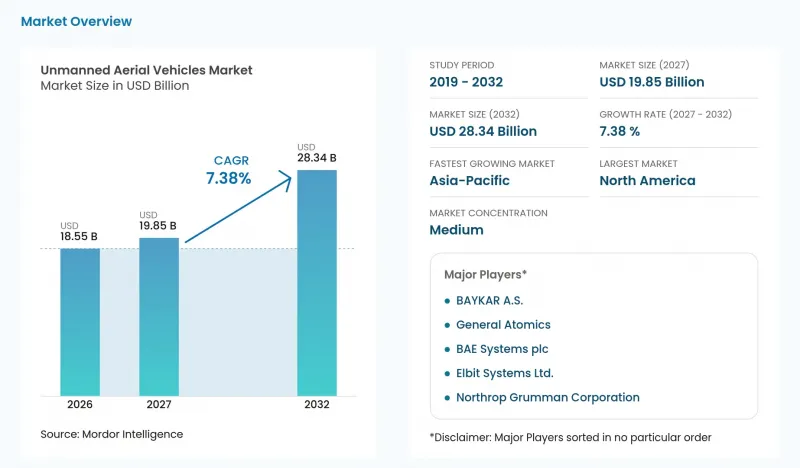
This report is segmented by UAV Class (Class I, Class II, and more), Platform Type (Fixed-wing, Rotary-wing, and more), Mode of Operation (Remotely Piloted, Fully Autonomous, and more), Application (Intelligence, Surveillance & Reconnaissance, Combat, and more), and Geography (North America, Asia-Pacific, and more). The market forecasts are provided in terms of value (USD), based on availability.
Global Unmanned Aerial Vehicles Market Trends and Insights
Rising defense budgets fueling UAV fleet expansion
Larger defense budgets support UAV demand when funding is translated into specific aircraft acquisition requirements. Global military expenditure increased 2.9% in real terms in 2025, marking its 11th consecutive annual rise. Japan's FY2026 defense budget included a planned acquisition of 5 wide-range UAVs to detect surface combatants early at long distances. The stated purpose connected information gathering with commanders' decisions and firepower projection. A complete reconnaissance package is therefore the relevant supplier offer, with the aircraft's sensing capability directly tied to the funded naval mission.
Operational demand for real-time, all-weather ISR
Long-range reconnaissance requirements translate surveillance needs into aircraft-system purchases for Army reconnaissance units. On July 20, 2026, AeroVironment announced a USD 117.3 million U.S. Army contract for P550 eVTOL UAS supporting Battalion Reconnaissance, the system's initial full-rate procurement. By December 2025, the Navy and Marine Corps ISR Services UAS program had surpassed one million cumulative flight hours since its inception in 2005. Over that period, the program completed more than 50 shipboard UAS installations and operated from more than 50 land-based locations worldwide. That record of sustained operation shows reconnaissance coverage is a standing requirement for Navy and Marine Corps operations on land and at sea. The Army award, by contrast, shows the requirement reaching suppliers as an aircraft purchase, with 82 P550 systems in the initial full-rate procurement.
Stringent export-control and security-prohibition regimes (e.g., MTCR, FAR 40.2)
Security eligibility can prevent a UAV supplier from reaching a federal buyer regardless of aircraft performance. FAR 40.202-3 prohibits executive agencies from procuring unmanned aircraft systems manufactured or assembled by covered foreign entities on the Federal Acquisition Security Council list unless an exemption, exception, or waiver applies. Its acquisition coverage includes commercial products and purchases at or below the micro-purchase threshold, so small orders do not automatically escape the restriction. Case-by-case waivers require Office of Management and Budget (OMB) Director approval after council consultation and congressional notification. A waiver-dependent federal sale therefore waits on OMB Director approval and congressional notification, a sequence that no technical improvement to the aircraft can shorten.
Other drivers and restraints analyzed in the detailed report include:
- Rapid advances in onboard autonomy and AI-driven mission systems
- Manned-unmanned teaming ("loyal wingman") concepts entering procurement cycles
- High acquisition and life-cycle cost of HALE/MALE platforms
For complete list of drivers and restraints, kindly check the Table Of Contents.
Segment Analysis
Class I UAVs below 150 kilograms accounted for a 43.57% share of the unmanned aerial vehicles market size in 2026, making them the largest segment. By May 28, 2026, Romania's Ministry of National Defence had signed a contract with Quantum Systems for 34 Class I Mini UAS (Vector) systems, with all deliveries scheduled for 2027. The agreement also included 15 Scorpion kits to convert the systems from fixed-wing to multicopter configuration. The Romanian Army intended the systems for surveillance missions. The conversion capability can therefore strengthen the complete system's appeal by accommodating more than one flight configuration within a surveillance procurement.
Class II aircraft weighing 150-600 kilograms are the fastest-growing segment, with a forecast CAGR of 7.9% during 2027-2032. Primoco UAV's October 5, 2026, schedule anticipated 32 One 150 deliveries that year, conditional on fulfillment of its contractual schedule. At a maximum takeoff weight of 150 kilograms, the model falls at the lower boundary of this class. Separately, Primoco described 6 aircraft intended for flight calibration and inspection of ground-based radio navigation systems. For navigation-system operators, the intended unmanned calibration mission offers a way to obtain airborne inspection without relying on a manned calibration aircraft.
Fixed-wing aircraft represented a 74.7% unmanned aerial vehicles market share in 2026 and were the largest segment. Primoco UAV sold 42 One 150 fixed-wing aircraft in 2025. General Atomics Aeronautical Systems delivered an MQ-9A Reaper Block 5 Extended Range system to the U.S. Marine Corps on April 22, 2025. VMX-1 at Marine Corps Air Station Yuma was the designated operator for operational testing and evaluation. Primoco's annual sales count and the Marine Corps' single evaluation system measure different purchasing scales, so aircraft volume alone cannot describe the fixed-wing buyer opportunity.
Hybrid UAVs are the fastest-growing segment, with a forecast CAGR of 9.55% during 2027-2032. In June 2025, Skyways received a USD 37 million U.S. Air Force AFWERX award to transition its V3 cargo aircraft toward full-rate production. Its double-hybrid configuration combines vertical takeoff and airplane-like flight using both electric and fuel energy. Rotary-wing demand includes the Czech Ministry of Defence's November 2025 tender for reconnaissance multicopter UAS kits for the Czech Army. The award funds a transition from prototype to full-rate production, whereas the Czech kits were tendered as complete systems, making manufacturing readiness the next commercial hurdle for Skyways.
Complete Report Scope:
- By UAV Class
- Class I (Below 150 kg)
- Class II (150-600 kg)
- Class III (Above 600 kg)
- By Platform Type
- Fixed-wing
- Rotary-wing
- Hybrid
- By Mode of Operation
- Remotely Piloted
- Optionally Piloted
- Fully Autonomous
- By Application
- Combat
- Intelligence, Surveillance & Reconnaissance (ISR)
- Delivery
- Loitering Munition
- By Geography
- North America
- United States
- Canada
- Mexico
- South America
- Brazil
- Rest of South America
- Europe
- United Kingdom
- France
- Germany
- Russia
- Rest of Europe
- Asia-Pacific
- China
- India
- Japan
- Australia
- Rest of Asia-Pacific
- Middle East and Africa
- Middle East
- Saudi Arabia
- United Arab Emirates
- Israel
- Rest of Middle East
- Africa
- South Africa
- Rest of Africa
- Middle East
- North America
Geography Analysis
North America held a 39.82% unmanned aerial vehicles market share in 2026, making it the largest regional segment. In September 2026, The Boeing Company announced a U.S. Navy production contract for 3 MQ-25A aircraft, bringing the number under Navy contract to 14. The award covered Lot 1 of low-rate initial production, with Lot 2 planned for 2027. The Navy's lot awards sit beside Army and Air Force production awards placed in the United States in 2026, giving North America a government buyer base spanning several services and procurement schedules.
Asia-Pacific is the fastest-growing regional segment, with a forecast CAGR of 8.6% during 2027-2032. Japan's Ministry of Defense plans a total fleet of 23 General Atomics MQ-9B aircraft for the Japan Maritime Self-Defense Force, with deployment scheduled to begin in fiscal 2027. Japan aims to strengthen maritime surveillance and support security objectives while improving operational efficiency and reducing manpower requirements. With deployment scheduled to begin in fiscal 2027, Japan's plan places the fleet's first operational phase at the start of the 2027-2032 forecast period.
In South America, a Colombian Marine Infantry battalion ordered one Mavic 3 Thermal and 2 DJI Matrice 4T drones from Veneplast Ltda. for security and surveillance in November 2025. In Europe, France's DGA ordered 5,000 Delco observation and reconnaissance drones from French supplier Harmattan AI for the French Army in May 2026, with delivery due by early 2027. In the Middle East, Israel's Ministry of Defense selected XTEND in August 2025 to supply thousands of FPV drones to IDF Ground Forces, with delivery then expected over the following months. In Africa, French supplier Milton delivered Long Range Observer drones to Mauritania's armed forces for land- and maritime-border security by November 2025. Veneplast's battalion-level supply route differs from XTEND's ministry tender, while French suppliers serve both home-country reconnaissance orders and Mauritanian border-security demand.
- AeroVironment
- Airbus SE
- BAE Systems plc
- BAYKAR A.S.
- The Boeing Company
- Elbit Systems Ltd.
- General Atomics
- Israel Aerospace Industries Ltd.
- Kratos Defense & Security Solutions, Inc.
- Leonardo S.p.A.
- Lockheed Martin Corporation
- Northrop Grumman Corporation
- Saab AB
- Textron Systems Corporation
- Turkish Aerospace Industries (TAI)
- QinetiQ Group
- Hindustan Aeronautics Limited
- Korea Aerospace Industries (KAI)
- Griffon Aerospace, Inc.
- Teledyne Technologies Incorporated
Additional Benefits:
- The market estimate (ME) sheet in Excel format
- 3 months of analyst support
TABLE OF CONTENTS
1 INTRODUCTION
- 1.1 Study Assumptions and Market Definition
- 1.2 Scope of the Study
2 RESEARCH METHODOLOGY
3 EXECUTIVE SUMMARY
4 MARKET LANDSCAPE
- 4.1 Market Overview
- 4.2 Market Drivers
- 4.2.1 Rising defense budgets fueling UAV fleet expansion
- 4.2.2 Operational demand for real-time, all-weather ISR
- 4.2.3 Rapid advances in onboard autonomy and AI-driven mission systems
- 4.2.4 Manned-unmanned teaming ("loyal wingman") concepts entering procurement cycles
- 4.2.5 Attritable-drone doctrine lowering cost threshold for mass deployment
- 4.2.6 Satellite-mesh networking enabling resilient BVLOS comms in GPS-contested theaters
- 4.3 Market Restraints
- 4.3.1 Stringent export-control and security-prohibition regimes (e.g., MTCR, FAR 40.2)
- 4.3.2 High acquisition and life-cycle cost of HALE/MALE platforms
- 4.3.3 Escalating electronic-warfare/counter-UAS threat environment
- 4.3.4 Supply-chain security restrictions driving component scarcity and cost inflation
- 4.4 Industry Value Chain Analysis
- 4.5 Regulatory Landscape
- 4.6 Technological Outlook
- 4.7 Porter's Five Forces Analysis
- 4.7.1 Threat of New Entrants
- 4.7.2 Bargaining Power of Suppliers
- 4.7.3 Bargaining Power of Buyers
- 4.7.4 Threat of Substitutes
- 4.7.5 Competitive Rivalry
5 MARKET SIZE AND GROWTH FORECASTS (VALUE)
- 5.1 By UAV Class
- 5.1.1 Class I (Below 150 kg)
- 5.1.2 Class II (150-600 kg)
- 5.1.3 Class III (Above 600 kg)
- 5.2 By Platform Type
- 5.2.1 Fixed-wing
- 5.2.2 Rotary-wing
- 5.2.3 Hybrid
- 5.3 By Mode of Operation
- 5.3.1 Remotely Piloted
- 5.3.2 Optionally Piloted
- 5.3.3 Fully Autonomous
- 5.4 By Application
- 5.4.1 Combat
- 5.4.2 Intelligence, Surveillance & Reconnaissance (ISR)
- 5.4.3 Delivery
- 5.4.4 Loitering Munition
- 5.5 By Geography
- 5.5.1 North America
- 5.5.1.1 United States
- 5.5.1.2 Canada
- 5.5.1.3 Mexico
- 5.5.2 South America
- 5.5.2.1 Brazil
- 5.5.2.2 Rest of South America
- 5.5.3 Europe
- 5.5.3.1 United Kingdom
- 5.5.3.2 France
- 5.5.3.3 Germany
- 5.5.3.4 Russia
- 5.5.3.5 Rest of Europe
- 5.5.4 Asia-Pacific
- 5.5.4.1 China
- 5.5.4.2 India
- 5.5.4.3 Japan
- 5.5.4.4 Australia
- 5.5.4.5 Rest of Asia-Pacific
- 5.5.5 Middle East and Africa
- 5.5.5.1 Middle East
- 5.5.5.1.1 Saudi Arabia
- 5.5.5.1.2 United Arab Emirates
- 5.5.5.1.3 Israel
- 5.5.5.1.4 Rest of Middle East
- 5.5.5.2 Africa
- 5.5.5.2.1 South Africa
- 5.5.5.2.2 Rest of Africa
- 5.5.5.1 Middle East
- 5.5.1 North America
6 COMPETITIVE LANDSCAPE
- 6.1 Market Concentration
- 6.2 Strategic Moves
- 6.3 Market Share Analysis
- 6.4 Company Profiles (includes Global level Overview, Market level overview, Core Segments, Financials as available, Strategic Information, Market Rank/Share for key companies, Products and Services, and Recent Developments)
- 6.4.1 AeroVironment
- 6.4.2 Airbus SE
- 6.4.3 BAE Systems plc
- 6.4.4 BAYKAR A.S.
- 6.4.5 The Boeing Company
- 6.4.6 Elbit Systems Ltd.
- 6.4.7 General Atomics
- 6.4.8 Israel Aerospace Industries Ltd.
- 6.4.9 Kratos Defense & Security Solutions, Inc.
- 6.4.10 Leonardo S.p.A.
- 6.4.11 Lockheed Martin Corporation
- 6.4.12 Northrop Grumman Corporation
- 6.4.13 Saab AB
- 6.4.14 Textron Systems Corporation
- 6.4.15 Turkish Aerospace Industries (TAI)
- 6.4.16 QinetiQ Group
- 6.4.17 Hindustan Aeronautics Limited
- 6.4.18 Korea Aerospace Industries (KAI)
- 6.4.19 Griffon Aerospace, Inc.
- 6.4.20 Teledyne Technologies Incorporated
7 MARKET OPPORTUNITIES AND FUTURE OUTLOOK
- 7.1 White-Space and Unmet-Need Assessment

