PUBLISHER: Mordor Intelligence | PRODUCT CODE: 2187214

PUBLISHER: Mordor Intelligence | PRODUCT CODE: 2187214
Bakery Products - Market Share Analysis, Industry Trends & Statistics, Growth Forecasts (2027 - 2032)
According to Mordor Intelligence, the bakery products market size is expected to grow from USD 650.5 billion in 2026 to USD 675.3 billion in 2027 and is forecast to reach USD 806.7 billion by 2032 at 3.62% CAGR over 2027-2032.
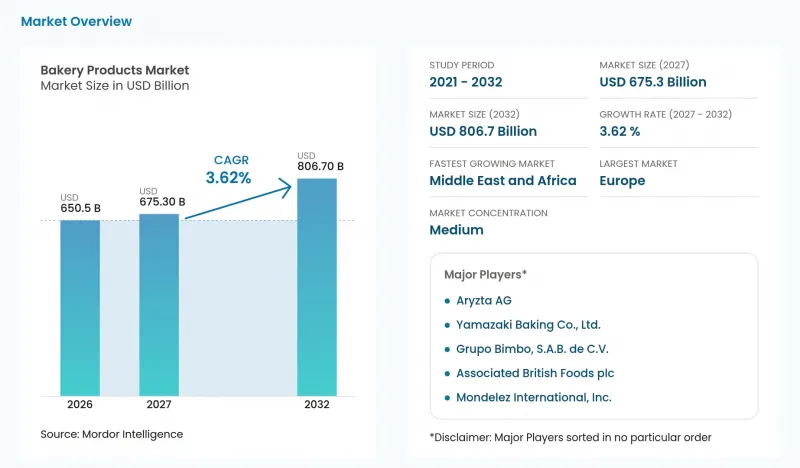
This report is segmented by Product Type (Bread, Cakes and Pastries, and more), Distribution Channel (Supermarkets/Hypermarkets, Convenience and Grocery Stores, and more), Form (Fresh and Frozen), and Geography (Europe, Asia-Pacific, and more). The market forecasts are provided in terms of value (USD), based on availability.
Global Bakery Products Market Trends and Insights
Gluten-free and Allergen-free Formulations
Specialty bread demand can develop beyond ingredient avoidance when formulations also provide a distinct bread style or nutritional function. On April 16, 2025, Flowers Foods said Canyon Bakehouse had introduced whole-grain Sourdough-Style Bread in the United States, free of gluten, dairy, soy, sesame, and nuts. Flowers Foods described it as the first nationally available gluten-free sourdough option. On October 13, 2026, Rudi's Bakery announced gluten-free White and Sourdough Daily Power Protein Bread, with 10 grams of protein and 3 grams of fiber per serving. Rudi's described those nutrients as typically missing from gluten-free bread and reported national availability in 18-ounce loaves at Sprouts, with Kroger availability in November 2026. These formulations give producers a route to compete on nutritional function and bread variety alongside dietary exclusions, broadening the reasons for choosing specialty loaves.
On-the-Go, Portion-Controlled Bakery Snacks
An established bakery snack can anchor convenience-store volume while its producer extends the assortment of portable pastries available in that channel. Little Debbie Honey Bun Glazed was the top-selling packaged sweet snack in United States convenience stores in Q1 2026, when its unit count grew 2%. McKee Foods had introduced 6 new Little Debbie grab-and-go bakery snacks for United States convenience-store shoppers in September 2025, including twin-wrapped pound cakes. The pack format gives the broader range a defined convenience-store proposition alongside an established unit-selling product. For the producer, protecting that core item while extending portable bakery choices connects assortment renewal to demonstrated channel demand.
Sugar, Fat and Additive Health Concerns
Health-based promotion restrictions constrain how bakery suppliers stimulate larger purchases, even when the products remain available for sale. England restricted volume-price promotions from October 1, 2025, for qualifying retailers with 50 or more employees. Covered bakery products include prepacked cakes, morning goods, and sweet biscuits classified as high in fat, sugar, or salt. The rules also cover qualifying retailers selling into England online, extending the constraint across physical and digital selling. For affected suppliers, multi-buy price offers therefore cannot serve as an unrestricted route to higher transaction volumes. Reformulation may change a product's classification, but products that retain the covered nutritional profile face a narrower promotional route to growth.
Other drivers and restraints analyzed in the detailed report include:
- Rising Disposable Incomes in Emerging Economies
- Direct-to-Consumer Subscription Bakeries
- Wheat and Other Cereal Price Volatility
For complete list of drivers and restraints, kindly check the Table Of Contents.
Segment Analysis
Bread accounted for a 43.02% share of the bakery products market size in 2026. Almarai, a Saudi food producer, ranked first with a majority value share of Saudi Arabia's sliced-bread market in 2025. For an industrial baker, such a national position offers a substantial established base for bread-specific commercial activity. A challenger entering that sliced-bread category must compete with a supplier already holding a large part of its sales value.
Morning goods are the fastest-growing segment, with a forecast 5.45% CAGR over 2027-2032. Almarai Bakery expanded its croissant-line capacity in Jeddah, Saudi Arabia, in 2025. Cakes, buns, and pastries averaged 153 grams of UK household purchases per person weekly in FYE 2025, down 3.6% from FYE 2024. Biscuits and crispbreads averaged 158 grams of UK household purchases per person weekly in FYE 2025, up 1.1% from FYE 2024. Dedicated croissant capacity in Jeddah supports expansion in a specific morning-goods format, while the UK household figures show differing demand across other baked goods.
Complete Report Scope:
- By Product Type
- Bread
- Cakes and Pastries
- Biscuits/Cookies
- Morning Goods
- Other Product Types
- By Distribution Channel
- Supermarkets/Hypermarkets
- Convenience and Grocery Stores
- Specialty Bakery Stores
- Online Retail Stores
- Other Channels
- By Form
- Fresh
- Frozen
- By Geography
- North America
- United States
- Canada
- Mexico
- Rest of North America
- Europe
- Germany
- United Kingdom
- Italy
- France
- Spain
- Netherlands
- Poland
- Belgium
- Sweden
- Rest of Europe
- Asia-Pacific
- China
- India
- Japan
- Australia
- Indonesia
- South Korea
- Thailand
- Singapore
- Rest of Asia-Pacific
- South America
- Brazil
- Argentina
- Colombia
- Chile
- Peru
- Rest of South America
- Middle East and Africa
- South Africa
- Saudi Arabia
- United Arab Emirates
- Nigeria
- Egypt
- Morocco
- Turkey
- Rest of Middle East and Africa
- North America
Geography Analysis
Europe held a 33.76% bakery products market share in 2026, making it the largest geography. Aryzta AG reported EUR 1.98 billion (USD 2.23 billion) in 2025 Europe segment revenue, allocated by customer geographic location. In the United Kingdom, integrated producer and retailer Greggs plc completed its Balliol Park savory-line expansion in 2025, adding capacity for around 4 million more bakes weekly. Greggs said the added capacity helped manage record demand in the final quarter of 2025. Europe's supply base combines substantial regional bakery operations with retailer-integrated production that can expand against demonstrated demand.
Middle East and Africa is the fastest-growing geography, with a forecast 5.85% CAGR over 2027-2032. In 2025, Almarai's bakery division made its daily production of 5 million bakery items accessible through more retail locations in Saudi Arabia and the wider GCC, linking expansion to retail reach alongside manufacturing capability. In Zimbabwe, Innscor Africa's Baker's Inn bakery in Harare expanded capacity by 154,000 loaves per day in FY2025, the year ended June 30, 2025.
In North America, United States commercial-aisle bakery unit sales rose 2.3% in Q4 2025 compared with Q4 2024, showing increased purchasing through that retail channel. In Asia-Pacific, China's bakery consumption centers on breakfast ahead of afternoon tea, snacking, and gifting, making the morning meal a distinct product-use focus. In South America, ABIP reported 332,558 active businesses in Brazil's broader panification and confectionery sector in 2025, including 212,258 individual microentrepreneurs. Krispy Kreme opened its first Brazilian doughnut shop in Sao Paulo on April 29, 2025, adding a branded retail format to that local supplier environment. A branded entrant in Brazil faces a supplier base dominated by very small operators.
- Grupo Bimbo, S.A.B. de C.V.
- Yamazaki Baking Co., Ltd.
- Mondelez International, Inc.
- Associated British Foods plc
- Aryzta AG
- Kellanova
- General Mills, Inc.
- Flowers Foods, Inc.
- Lantmannen Unibake
- Warburtons Ltd
- Britannia Industries Ltd
- Finsbury Food Group Limited
- Hostess Brands, LLC
- McKee Foods Corporation
- YIldIz Holding
- Premier Foods plc
- Barilla Group (Mulino Bianco)
- Parle Products Pvt. Ltd.
- Sunbulah Group
- Walker's Shortbread Ltd
Additional Benefits:
- The market estimate (ME) sheet in Excel format
- 3 months of analyst support
TABLE OF CONTENTS
1 INTRODUCTION
- 1.1 Study Assumptions and Market Definition
- 1.2 Scope of the Study
2 RESEARCH METHODOLOGY
3 EXECUTIVE SUMMARY
4 MARKET LANDSCAPE
- 4.1 Market Overview
- 4.2 Market Drivers
- 4.2.1 Gluten-free and Allergen-free Formulations
- 4.2.2 On-the-Go, Portion-Controlled Bakery Snacks
- 4.2.3 Rising Disposable Incomes in Emerging Economies
- 4.2.4 Direct-to-Consumer Subscription Bakeries
- 4.2.5 Upcycled Ingredients for Cost and Sustainability Edge
- 4.2.6 In-store Automated Micro-Bakeries Lift Freshness Perception
- 4.3 Market Restraints
- 4.3.1 Sugar, Fat and Additive Health Concerns
- 4.3.2 Wheat and Other Cereal Price Volatility
- 4.3.3 Carbon-Footprint Scrutiny of Global Supply Chains
- 4.3.4 Skilled Artisan-Baker Labor Shortages
- 4.4 Industry Value Chain Analysis
- 4.5 Regulatory Landscape
- 4.6 Technological Outlook
- 4.7 Porter's Five Forces Analysis
- 4.7.1 Threat of New Entrants
- 4.7.2 Bargaining Power of Suppliers
- 4.7.3 Bargaining Power of Buyers
- 4.7.4 Threat of Substitutes
- 4.7.5 Competitive Rivalry
5 MARKET SIZE AND GROWTH FORECASTS (VALUE)
- 5.1 By Product Type
- 5.1.1 Bread
- 5.1.2 Cakes and Pastries
- 5.1.3 Biscuits/Cookies
- 5.1.4 Morning Goods
- 5.1.5 Other Product Types
- 5.2 By Distribution Channel
- 5.2.1 Supermarkets/Hypermarkets
- 5.2.2 Convenience and Grocery Stores
- 5.2.3 Specialty Bakery Stores
- 5.2.4 Online Retail Stores
- 5.2.5 Other Channels
- 5.3 By Form
- 5.3.1 Fresh
- 5.3.2 Frozen
- 5.4 By Geography
- 5.4.1 North America
- 5.4.1.1 United States
- 5.4.1.2 Canada
- 5.4.1.3 Mexico
- 5.4.1.4 Rest of North America
- 5.4.2 Europe
- 5.4.2.1 Germany
- 5.4.2.2 United Kingdom
- 5.4.2.3 Italy
- 5.4.2.4 France
- 5.4.2.5 Spain
- 5.4.2.6 Netherlands
- 5.4.2.7 Poland
- 5.4.2.8 Belgium
- 5.4.2.9 Sweden
- 5.4.2.10 Rest of Europe
- 5.4.3 Asia-Pacific
- 5.4.3.1 China
- 5.4.3.2 India
- 5.4.3.3 Japan
- 5.4.3.4 Australia
- 5.4.3.5 Indonesia
- 5.4.3.6 South Korea
- 5.4.3.7 Thailand
- 5.4.3.8 Singapore
- 5.4.3.9 Rest of Asia-Pacific
- 5.4.4 South America
- 5.4.4.1 Brazil
- 5.4.4.2 Argentina
- 5.4.4.3 Colombia
- 5.4.4.4 Chile
- 5.4.4.5 Peru
- 5.4.4.6 Rest of South America
- 5.4.5 Middle East and Africa
- 5.4.5.1 South Africa
- 5.4.5.2 Saudi Arabia
- 5.4.5.3 United Arab Emirates
- 5.4.5.4 Nigeria
- 5.4.5.5 Egypt
- 5.4.5.6 Morocco
- 5.4.5.7 Turkey
- 5.4.5.8 Rest of Middle East and Africa
- 5.4.1 North America
6 COMPETITIVE LANDSCAPE
- 6.1 Market Concentration
- 6.2 Strategic Moves
- 6.3 Market Share Analysis
- 6.4 Company Profiles (includes Global level Overview, Market level overview, Core Segments, Financials as available, Strategic Information, Market Rank/Share for key companies, Products and Services, and Recent Developments)
- 6.4.1 Grupo Bimbo, S.A.B. de C.V.
- 6.4.2 Yamazaki Baking Co., Ltd.
- 6.4.3 Mondelez International, Inc.
- 6.4.4 Associated British Foods plc
- 6.4.5 Aryzta AG
- 6.4.6 Kellanova
- 6.4.7 General Mills, Inc.
- 6.4.8 Flowers Foods, Inc.
- 6.4.9 Lantmannen Unibake
- 6.4.10 Warburtons Ltd
- 6.4.11 Britannia Industries Ltd
- 6.4.12 Finsbury Food Group Limited
- 6.4.13 Hostess Brands, LLC
- 6.4.14 McKee Foods Corporation
- 6.4.15 YIldIz Holding
- 6.4.16 Premier Foods plc
- 6.4.17 Barilla Group (Mulino Bianco)
- 6.4.18 Parle Products Pvt. Ltd.
- 6.4.19 Sunbulah Group
- 6.4.20 Walker's Shortbread Ltd
7 MARKET OPPORTUNITIES AND FUTURE OUTLOOK
- 7.1 White-Space and Unmet-Need Assessment

