PUBLISHER: Mordor Intelligence | PRODUCT CODE: 2187243

PUBLISHER: Mordor Intelligence | PRODUCT CODE: 2187243
Paper Packaging - Market Share Analysis, Industry Trends & Statistics, Growth Forecasts (2027 - 2032)
According to Mordor Intelligence, the paper packaging market size is projected to expand from USD 480 billion in 2026 and USD 502.1 billion in 2027 to USD 623.1 billion by 2032, registering a CAGR of 4.41% between 2027 and 2032.
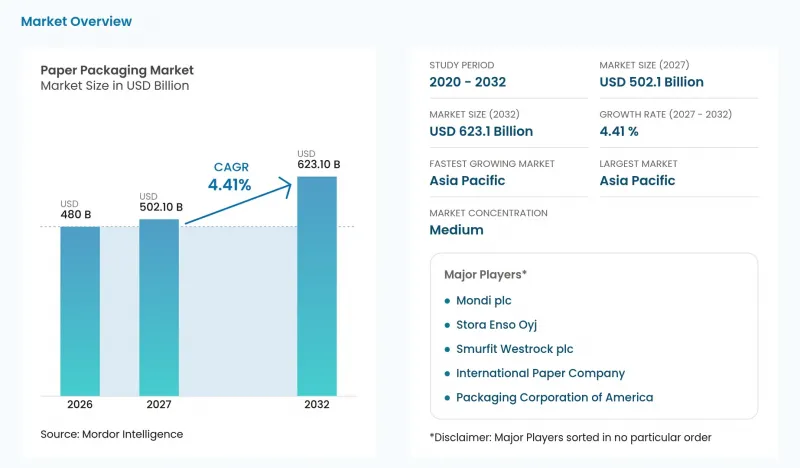
This report is segmented by Grade (Containerboard and Cartonboard), Product (Corrugated Boxes, Folding Cartons, and more), End-User Industry (Food, Beverage, and more), Packaging Format (Rigid, Semi-rigid, and more), and Geography (Asia Pacific, Europe, and more). The market forecasts are provided in terms of value (USD), based on availability.
Global Paper Packaging Market Trends and Insights
Development of barrier-coated paperboard solutions
Protection requirements can make the coating system decisive when a food buyer considers paper packaging. In May 2025, Istanbul-based Metpack offered Ezycompost coated paper and paperboard for food packaging using BASF's ecovio 70 PS14H6 coating. The offer combined barriers against liquids, fats, grease, and mineral oil with certified home-compostability. BASF reported a coating 40% thinner than polylactic acid (PLA). The coating is also food-contact approved by the FDA and stable at boiling-water temperatures up to 100°C, which widens the food applications in which a converter can offer the structure.
Rise in e-commerce corrugated demand
Distribution and e-commerce together provide an important end market for corrugated suppliers. International Paper estimated that distribution and e-commerce represented 19% of North American corrugated packaging industry demand in 2025. In 2025, Amazon India launched 12 fulfillment centers and expanded 6 others, adding 8.6 million cubic feet of storage capacity. Strategic logistics partners operated and managed the new sites, which were ready and operational ahead of the 2025 festive season. For box makers, the Indian expansion offers a potential route to additional shipping-packaging applications alongside the combined North American end market.
Deforestation and fiber-supply scrutiny
Fiber traceability can constrain commercially usable supply even when a producer has access to physical material. In its 2025 risk reporting, SCG Packaging (SCGP) identified possible disruption to its pulp and paper packaging exports to the European Union if it could not verify traceability. The company also identified potential higher costs and delays in raw-material sourcing. For exporters facing this exposure, an available fiber source is therefore less valuable when its documentation cannot support the destination's requirements. SCGP has strengthened its FSC Chain of Custody system for traceability under the EU Deforestation Regulation and says it is still improving its systems. Until verification is dependable, the potential cost and delay of proving provenance stay with the exporter.
Other drivers and restraints analyzed in the detailed report include:
- Brand-owner shift toward mono-material packs
- Extended Producer Responsibility (EPR) mandates
- Volatile recycled-fiber pricing
For complete list of drivers and restraints, kindly check the Table Of Contents.
Segment Analysis
Containerboard accounted for a 53.03% share of the paper packaging market size in 2026. U.S. containerboard production totaled 36.1 million short tons in 2025, down 4.4% from 2024. The American Forest & Paper Association (AF&PA) reported that U.S. containerboard capacity declined 5.1% in 2025, while mills operated at 91.9% of capacity. Because U.S. capacity fell faster than output, the high operating rate indicates capacity adaptation to demand rather than expansion. Returns from the remaining U.S. mill base therefore depend on converted-box demand absorbing its output.
Cartonboard is the fastest-growing segment, with a forecast CAGR of 6.85% between 2027 and 2032. Global upstream cartonboard consumption grew 2% in 2025, while European demand was stagnant and global oversupply persisted, especially in China. Stora Enso's Oulu consumer board line in Finland began operating in early 2025 with annual capacity of 750,000 metric tons for folding boxboard and coated unbleached kraft combined. With ramp-up continuing in H1 2026 and full capacity expected during 2027, the cartonboard portion of that combined capacity depends on how Stora Enso allocates the line between the 2 board products.
Corrugated boxes represented a 61.37% paper packaging market share in 2026. Smurfit Westrock's corrugated operations shipped approximately 100 billion square feet in North America and approximately 96.8 billion across Europe, the Middle East and Africa, and Asia Pacific in 2025. Its Latin America segment, including Central America and the Caribbean, shipped approximately 23 billion square feet of corrugated containers that year. North America's roughly 100 billion square feet were less than half of the roughly 220 billion square feet shipped across the company's 3 reporting segments, so its corrugated scale rests on a multi-region network.
Folding cartons are the fastest-growing segment, with a projected CAGR of 4.92% between 2027 and 2032. Mayr-Melnhof Karton's MM Food & Premium Packaging division reported around 1,100 customers worldwide, with around 88% of division revenue generated by multinational groups. The division nevertheless reported subdued folding-carton demand in H1 2026, with orders improving selectively in certain markets late in Q2. Multinational customers typically arrange supplies through multi-year agreements following upstream tenders. This buyer structure channels the forecast opportunity through program awards, while the selective order improvement indicates an uneven near-term demand base.
Complete Report Scope:
- By Grade
- Cartonboard
- Solid Bleached Sulphate (SBS)
- Solid Unbleached Sulphate (SUS)
- Folding Boxboard (FBB)
- Coated Recycled Board (CRB)
- Uncoated Recycled Board (URB)
- Other Cartonboard Grades
- Containerboard
- White-top Kraftliner
- Other Kraftliners
- White-top Testliner
- Other Testliners
- Semi-chemical Fluting
- Recycled Fluting
- Cartonboard
- By Product
- Folding Cartons
- Corrugated Boxes
- Other Products
- By End-User Industry
- Food
- Beverage
- Healthcare
- Personal Care
- Household Care
- Electrical and Electronics
- Other End-User Industries
- By Packaging Format
- Rigid (Corrugated, Solid Board)
- Semi-rigid (Folding Cartons)
- Flexible Paper (Sachets, Wraps)
- Molded Fiber and Pulp
- By Geography
- North America
- United States
- Canada
- Mexico
- South America
- Brazil
- Argentina
- Rest of South America
- Europe
- United Kingdom
- Germany
- France
- Italy
- Spain
- Russia
- Rest of Europe
- Asia Pacific
- China
- Japan
- India
- South Korea
- Australia
- Rest of Asia Pacific
- Middle East and Africa
- Middle East
- United Arab Emirates
- Saudi Arabia
- Turkey
- Rest of Middle East
- Africa
- South Africa
- Nigeria
- Rest of Africa
- Middle East
- North America
Geography Analysis
Asia Pacific held a 48.02% paper packaging market share in 2026 and is forecast to register a CAGR of 5.31% between 2027 and 2032, making it the largest and fastest-growing region. Oji India Packaging inaugurated its fifth Indian plant at Sri City on March 21, 2025, with packaging-accessory production and annual corrugated-box capacity of 100 million square meters for growing South Indian demand. In September 2026, SCG Packaging acquired a 90% stake in Jin Zhong Fa Paper Industrial, a fiber-packaging manufacturer in Chonburi, Thailand. Thailand's paper-packaging production index rose 0.50% in 2025, particularly driven by domestic market consumption. South Indian box demand and the domestic consumption behind Thailand's production-index gain favor country-specific production coverage, with acquisitions providing another route to an existing local manufacturing base.
In North America, U.S. packaging-paper production increased 1.7% in 2025 while overall paper and paperboard output fell 3.7%, making packaging a distinct operating proposition within the national production mix. In Europe, by May 2025, Mondi had expanded paper re/cycle MailerBAG capacity with a new line at Krapkowice, Poland, to meet e-commerce customers' size and protection requirements. The U.S. divergence makes aggregate paper output a poor guide to packaging-paper operating opportunities. Poland's converting investment adds a specific e-commerce shipping format, giving suppliers an application-led route alongside that broader production base.
In South America, food products accounted for 51.1% of Brazil's 2025 corrugated-box and accessory shipment volume among reporting companies. In 2025, Smurfit Westrock announced a new line at its Barranquilla, Colombia, corrugated-packaging plant, reporting an approximately 30% capacity increase to serve consumer, industrial, and banana-export customers. Greenliner reported its October 2025 PM 1 machine startup in Egypt's 10th of Ramadan City, supplying containerboard from 80 grams per square meter locally and for export. Across South America and the Middle East and Africa, these examples distinguish food-facing box demand, industrial and export conversion, and upstream board supply. The strongest local proposition depends on whether the customer needs a finished box for an application or board for subsequent conversion.
- International Paper Company
- Smurfit Westrock plc
- Mondi plc
- Packaging Corporation of America
- Stora Enso Oyj
- Graphic Packaging International, LLC
- Nippon Paper Industries Co. Ltd.
- Sonoco Products Company
- Oji Holdings Corporation
- Georgia-Pacific LLC
- Nine Dragons Paper Holdings
- Lee & Man Paper Manufacturing
- Sappi Limited
- Ilim Group
- Klabin S.A.
- Asia Pulp & Paper (APP)
Additional Benefits:
- The market estimate (ME) sheet in Excel format
- 3 months of analyst support
TABLE OF CONTENTS
1 INTRODUCTION
- 1.1 Study Assumptions and Market Definition
- 1.2 Scope of the Study
2 RESEARCH METHODOLOGY
3 EXECUTIVE SUMMARY
4 MARKET LANDSCAPE
- 4.1 Market Overview
- 4.2 Market Drivers
- 4.2.1 Development of barrier-coated paperboard solutions
- 4.2.2 Rise in e-commerce corrugated demand
- 4.2.3 Brand-owner shift toward mono-material packs
- 4.2.4 Extended Producer Responsibility (EPR) mandates
- 4.2.5 Nano-cellulose barrier breakthroughs
- 4.2.6 Converting-plant on-site digital printing economics
- 4.3 Market Restraints
- 4.3.1 Deforestation and fiber-supply scrutiny
- 4.3.2 Volatile recycled-fiber pricing
- 4.3.3 PFAS "forever-chemicals" phase-out costs
- 4.3.4 Limited recovery logistics in emerging markets
- 4.4 Industry Value Chain Analysis
- 4.5 Regulatory Landscape
- 4.6 Technological Outlook
- 4.7 Porter's Five Forces Analysis
- 4.7.1 Threat of New Entrants
- 4.7.2 Bargaining Power of Suppliers
- 4.7.3 Bargaining Power of Buyers
- 4.7.4 Threat of Substitutes
- 4.7.5 Competitive Rivalry
- 4.8 Global Recovered Paper Production Statistics
- 4.8.1 Recovered Paper - Production Quantity
- 4.8.2 Recovered Paper - Import Value and Quantity
- 4.8.3 Recovered Paper - Export Value and Quantity
- 4.8.4 Recovered Paper Production - Leading Countries
- 4.9 Cartonboard EXIM Scenario
- 4.9.1 Exports (Value and Volume)
- 4.9.2 Imports (Value and Volume)
5 MARKET SIZE AND GROWTH FORECASTS (VALUE)
- 5.1 By Grade
- 5.1.1 Cartonboard
- 5.1.1.1 Solid Bleached Sulphate (SBS)
- 5.1.1.2 Solid Unbleached Sulphate (SUS)
- 5.1.1.3 Folding Boxboard (FBB)
- 5.1.1.4 Coated Recycled Board (CRB)
- 5.1.1.5 Uncoated Recycled Board (URB)
- 5.1.1.6 Other Cartonboard Grades
- 5.1.2 Containerboard
- 5.1.2.1 White-top Kraftliner
- 5.1.2.2 Other Kraftliners
- 5.1.2.3 White-top Testliner
- 5.1.2.4 Other Testliners
- 5.1.2.5 Semi-chemical Fluting
- 5.1.2.6 Recycled Fluting
- 5.1.1 Cartonboard
- 5.2 By Product
- 5.2.1 Folding Cartons
- 5.2.2 Corrugated Boxes
- 5.2.3 Other Products
- 5.3 By End-User Industry
- 5.3.1 Food
- 5.3.2 Beverage
- 5.3.3 Healthcare
- 5.3.4 Personal Care
- 5.3.5 Household Care
- 5.3.6 Electrical and Electronics
- 5.3.7 Other End-User Industries
- 5.4 By Packaging Format
- 5.4.1 Rigid (Corrugated, Solid Board)
- 5.4.2 Semi-rigid (Folding Cartons)
- 5.4.3 Flexible Paper (Sachets, Wraps)
- 5.4.4 Molded Fiber and Pulp
- 5.5 By Geography
- 5.5.1 North America
- 5.5.1.1 United States
- 5.5.1.2 Canada
- 5.5.1.3 Mexico
- 5.5.2 South America
- 5.5.2.1 Brazil
- 5.5.2.2 Argentina
- 5.5.2.3 Rest of South America
- 5.5.3 Europe
- 5.5.3.1 United Kingdom
- 5.5.3.2 Germany
- 5.5.3.3 France
- 5.5.3.4 Italy
- 5.5.3.5 Spain
- 5.5.3.6 Russia
- 5.5.3.7 Rest of Europe
- 5.5.4 Asia Pacific
- 5.5.4.1 China
- 5.5.4.2 Japan
- 5.5.4.3 India
- 5.5.4.4 South Korea
- 5.5.4.5 Australia
- 5.5.4.6 Rest of Asia Pacific
- 5.5.5 Middle East and Africa
- 5.5.5.1 Middle East
- 5.5.5.1.1 United Arab Emirates
- 5.5.5.1.2 Saudi Arabia
- 5.5.5.1.3 Turkey
- 5.5.5.1.4 Rest of Middle East
- 5.5.5.2 Africa
- 5.5.5.2.1 South Africa
- 5.5.5.2.2 Nigeria
- 5.5.5.2.3 Rest of Africa
- 5.5.5.1 Middle East
- 5.5.1 North America
6 COMPETITIVE LANDSCAPE
- 6.1 Market Concentration
- 6.2 Strategic Moves
- 6.3 Market Share Analysis
- 6.4 Company Profiles (includes Global level Overview, Market level overview, Core Segments, Financials as available, Strategic Information, Market Rank/Share for key companies, Products and Services, and Recent Developments)
- 6.4.1 International Paper Company
- 6.4.2 Smurfit Westrock plc
- 6.4.3 Mondi plc
- 6.4.4 Packaging Corporation of America
- 6.4.5 Stora Enso Oyj
- 6.4.6 Graphic Packaging International, LLC
- 6.4.7 Nippon Paper Industries Co. Ltd.
- 6.4.8 Sonoco Products Company
- 6.4.9 Oji Holdings Corporation
- 6.4.10 Georgia-Pacific LLC
- 6.4.11 Nine Dragons Paper Holdings
- 6.4.12 Lee & Man Paper Manufacturing
- 6.4.13 Sappi Limited
- 6.4.14 Ilim Group
- 6.4.15 Klabin S.A.
- 6.4.16 Asia Pulp & Paper (APP)
7 MARKET OPPORTUNITIES AND FUTURE OUTLOOK
- 7.1 White-Space and Unmet-Need Assessment

