PUBLISHER: Mordor Intelligence | PRODUCT CODE: 2187268

PUBLISHER: Mordor Intelligence | PRODUCT CODE: 2187268
India Breakfast Cereals - Market Share Analysis, Industry Trends & Statistics, Growth Forecasts (2027 - 2032)
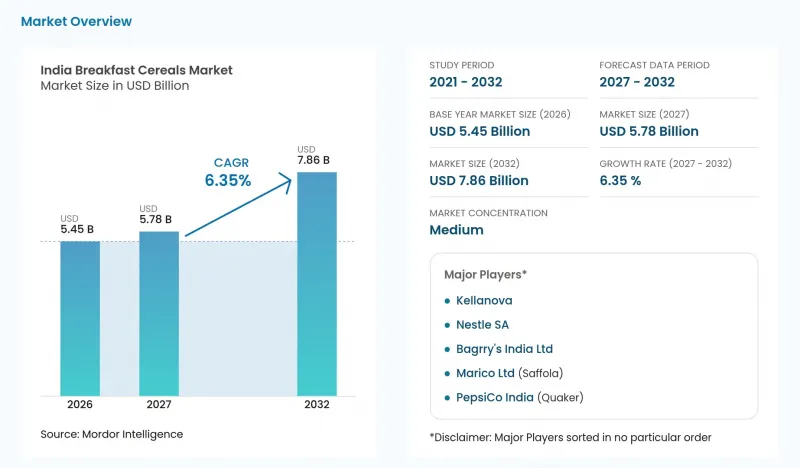
According to Mordor Intelligence, the India breakfast cereals market size is expected to increase from USD 5.45 billion in 2026 to USD 5.78 billion in 2027 and reach USD 7.86 billion by 2032, growing at a CAGR of 6.35% over 2027-2032.
This report is segmented by Product Type (Ready-to-Eat Cereals and Ready-to-Cook Cereals), Ingredient Source (Corn, Wheat, and more), Product Nature (Conventional and Organic), Packaging Type (Boxes, Stand-up Pouches, and more), and Distribution Channel (Supermarkets / Hypermarkets, Online Retail Stores, and more). The market forecasts are provided in terms of value (USD), based on availability.
India Breakfast Cereals Market Trends and Insights
Rising health-conscious consumer base
Diet management gives cereal producers a reason to compete on the composition of breakfast, extending their proposition beyond preparation time. NIQ's January-February 2025 survey found that 53% of India's adult grocery-shopping population reported active health-improving behaviors, including exercise, health-metric monitoring, and diet management. In the same online survey, 49% of Indian respondents planned to buy more high-fiber foods over the following 12 months. For a cereal producer, fiber content offers a way to translate that dietary interest into a breakfast recipe. Higher-fiber cereal must consequently earn a place in that planned food basket through a breakfast people want to eat, keeping nutritional appeal tied to the meal.
Premiumization via protein-fortified SKUs
Protein-led range extension gives cereal manufacturers another nutritional reason for shoppers to choose oats or muesli. In July 2026, Flipkart reported protein oats and protein muesli among the categories topping its demand chart among Gen Z shoppers in India. That platform signal supports targeting protein-seeking shoppers with both formats, each retaining its own preparation and eating characteristics. For a supplier offering ordinary oats or muesli, adding a protein-focused option could serve that need within an existing cereal range. The opportunity is to retain protein-seeking shoppers within that range as they choose between oats and muesli.
High price sensitivity
Price sensitivity makes a cereal's recurring breakfast cost part of the decision to adopt it. PwC's January-February 2025 survey found that 63% of Indian respondents were concerned about food costs. For a cereal supplier, that concern makes a nutritional proposition commercially incomplete unless the purchase also fits the household's food spending. The constraint is especially relevant to a range positioned around additional nutritional benefits, because those benefits still need to justify the outlay for repeated meals. A smaller entry pack can reduce the initial payment required to try a product. The remaining hurdle is affordability across successive breakfasts, which limits how readily a differentiated cereal proposition can turn an initial purchase into routine consumption.
Other drivers and restraints analyzed in the detailed report include:
- Rising demand for Ready-to-Eat cereals
- Increasing dual-income households
- Cultural preference for hot savory breakfasts
For complete list of drivers and restraints, kindly check the Table Of Contents.
Segment Analysis
Ready-to-eat cereals accounted for a 73.7% share of the India breakfast cereals market size in 2026. This position makes ready-to-eat recipes a broad commercial starting point for suppliers targeting established cereal spending. Product development can address different breakfast tastes within a cereal supplied ready for consumption, giving an entrant room to focus on one eating preference. A challenger can compete for that use without asking the buyer to adopt a cooked preparation routine. Because every ready-to-eat offer saves preparation time, a challenger's edge has to come from taste, texture or format that existing buyers notice in the first bowl.
Ready-to-cook cereals are forecast to grow at a CAGR of 6.85% over 2027-2032, making them the fastest-growing segment. In May 2026, Too Yumm!, a brand under the RP-Sanjiv Goenka Group, launched High Protein Super Oats in India's ready-to-cook breakfast segment. The launch pairs a protein proposition with preparation at home, giving the entrant a breakfast use different from an already finished cereal. For a buyer choosing to cook breakfast, that nutritional proposition has to sit within a recipe that makes the preparation steps worthwhile. An entrant consequently competes on the cooked meal the product enables, with convenience judged against that intended use.
Corn represented a 40.68% India breakfast cereals market share in 2026. Mohan Meakin, a diversified food and beverage producer, manufactured cornflakes in FY2025-26. Its manufacturing footprint separately included a breakfast-foods factory at Mohan Nagar in Ghaziabad. The example places cornflakes within a diversified manufacturer's food range, giving a cereal specialist an operating competitor to assess. Cornflake specialization therefore has to show buyers a finished-product benefit beyond the grain itself when competing with Mohan Meakin.
Oats are forecast to grow at a CAGR of 7.2% over 2027-2032, making them the fastest-growing segment. Marico reported that Saffola Oats gained market share in Q1FY2027, further strengthening its leadership position. A brand-level gain makes competitive execution within oats relevant to how a producer captures the ingredient's forecast expansion. Because the reported gain belongs to the category's leading brand, a challenger has to win share from Saffola Oats through formulation or flavor, since category growth alone does not secure share.
Complete Report Scope:
- By Product Type
- Ready-to-Eat Cereals
- Flakes
- Puffed Cereals
- Granola and Clusters
- Others (Coated/Sugar-Frosted Cereals, Shredded and Threaded)
- Ready-to-Cook Cereals
- Hot Oatmeal
- Muesli and Porridge Mixes
- Other Ready-to-Cook Cereals
- Ready-to-Eat Cereals
- By Ingredient Source
- Wheat
- Corn
- Oats
- Rice
- Barley
- Others
- By Product Nature
- Conventional
- Organic
- By Packaging Type
- Boxes
- Stand-up Pouches
- Cups and Bowls
- Others
- By Distribution Channel
- Supermarkets / Hypermarkets
- Convenience Stores
- Specialist Stores
- Online Retail Stores
- Other Distribution Channels
List of Companies Covered in this Report:
- Kellanova
- Bagrry's India Ltd
- PepsiCo India (Quaker)
- Nestle SA
- Marico Ltd (Saffola)
- Patanjali Ayurved Ltd
- Tata Consumer Products (Soulfull)
- General Mills India
- Future Consumer Ltd
- Shanti Foods
- V.R. Industries (8AM)
- True Elements (HW Wellness Solutions)
- YogaBar (Sproutlife Foods)
- Manna Foods (Southern Health Foods)
- Hindustan Unilever (Horlicks Cereals)
- Mohan Meakin (Champion Corn Flakes)
- Orkla India Ltd
- Natureland Organics
- Vitomorn Foods
- Veeba (Greensoul Granola)
Additional Benefits:
- The market estimate (ME) sheet in Excel format
- 3 months of analyst support
TABLE OF CONTENTS
1 INTRODUCTION
- 1.1 Study Assumptions and Market Definition
- 1.2 Scope of the Study
2 RESEARCH METHODOLOGY
3 EXECUTIVE SUMMARY
4 MARKET LANDSCAPE
- 4.1 Market Overview
- 4.2 Market Drivers
- 4.2.1 Rising health-conscious consumer base
- 4.2.2 Premiumization via protein-fortified SKUs
- 4.2.3 Rising demand for Ready-to-Eat cereals
- 4.2.4 Increasing dual-income households
- 4.2.5 Shift in consumer preferences toward clean-label products
- 4.2.6 Govt. Millet Mission accelerating millet cereals
- 4.3 Market Restraints
- 4.3.1 High price sensitivity
- 4.3.2 Cultural preference for hot savory breakfasts
- 4.3.3 Volatile specialty-grain input costs
- 4.3.4 Challenges in product reformulation
- 4.4 Industry Value Chain Analysis
- 4.5 Regulatory Landscape
- 4.6 Technological Outlook
- 4.7 Porter's Five Forces Analysis
- 4.7.1 Threat of New Entrants
- 4.7.2 Bargaining Power of Suppliers
- 4.7.3 Bargaining Power of Buyers
- 4.7.4 Threat of Substitutes
- 4.7.5 Competitive Rivalry
- 4.8 Consumer Behaviours Analysis
5 MARKET SIZE AND GROWTH FORECASTS (VALUE)
- 5.1 By Product Type
- 5.1.1 Ready-to-Eat Cereals
- 5.1.1.1 Flakes
- 5.1.1.2 Puffed Cereals
- 5.1.1.3 Granola and Clusters
- 5.1.1.4 Others (Coated/Sugar-Frosted Cereals, Shredded and Threaded)
- 5.1.2 Ready-to-Cook Cereals
- 5.1.2.1 Hot Oatmeal
- 5.1.2.2 Muesli and Porridge Mixes
- 5.1.2.3 Other Ready-to-Cook Cereals
- 5.1.1 Ready-to-Eat Cereals
- 5.2 By Ingredient Source
- 5.2.1 Wheat
- 5.2.2 Corn
- 5.2.3 Oats
- 5.2.4 Rice
- 5.2.5 Barley
- 5.2.6 Others
- 5.3 By Product Nature
- 5.3.1 Conventional
- 5.3.2 Organic
- 5.4 By Packaging Type
- 5.4.1 Boxes
- 5.4.2 Stand-up Pouches
- 5.4.3 Cups and Bowls
- 5.4.4 Others
- 5.5 By Distribution Channel
- 5.5.1 Supermarkets / Hypermarkets
- 5.5.2 Convenience Stores
- 5.5.3 Specialist Stores
- 5.5.4 Online Retail Stores
- 5.5.5 Other Distribution Channels
6 COMPETITIVE LANDSCAPE
- 6.1 Market Concentration
- 6.2 Strategic Moves
- 6.3 Market Share Analysis
- 6.4 Company Profiles (includes Global level Overview, Market level overview, Core Segments, Financials as available, Strategic Information, Market Rank/Share for key companies, Products and Services, and Recent Developments)
- 6.4.1 Kellanova
- 6.4.2 Bagrry's India Ltd
- 6.4.3 PepsiCo India (Quaker)
- 6.4.4 Nestle SA
- 6.4.5 Marico Ltd (Saffola)
- 6.4.6 Patanjali Ayurved Ltd
- 6.4.7 Tata Consumer Products (Soulfull)
- 6.4.8 General Mills India
- 6.4.9 Future Consumer Ltd
- 6.4.10 Shanti Foods
- 6.4.11 V.R. Industries (8AM)
- 6.4.12 True Elements (HW Wellness Solutions)
- 6.4.13 YogaBar (Sproutlife Foods)
- 6.4.14 Manna Foods (Southern Health Foods)
- 6.4.15 Hindustan Unilever (Horlicks Cereals)
- 6.4.16 Mohan Meakin (Champion Corn Flakes)
- 6.4.17 Orkla India Ltd
- 6.4.18 Natureland Organics
- 6.4.19 Vitomorn Foods
- 6.4.20 Veeba (Greensoul Granola)
7 MARKET OPPORTUNITIES AND FUTURE OUTLOOK
- 7.1 White-Space and Unmet-Need Assessment

