PUBLISHER: Mordor Intelligence | PRODUCT CODE: 2187272

PUBLISHER: Mordor Intelligence | PRODUCT CODE: 2187272
Cigarette - Market Share Analysis, Industry Trends & Statistics, Growth Forecasts (2027 - 2032)
According to Mordor Intelligence, the cigarette market size is estimated at USD 770.9 billion in 2026 and is projected to be USD 780.7 billion in 2027, reaching USD 825.4 billion by 2032, growing at a CAGR of 1.12% from 2027 to 2032.
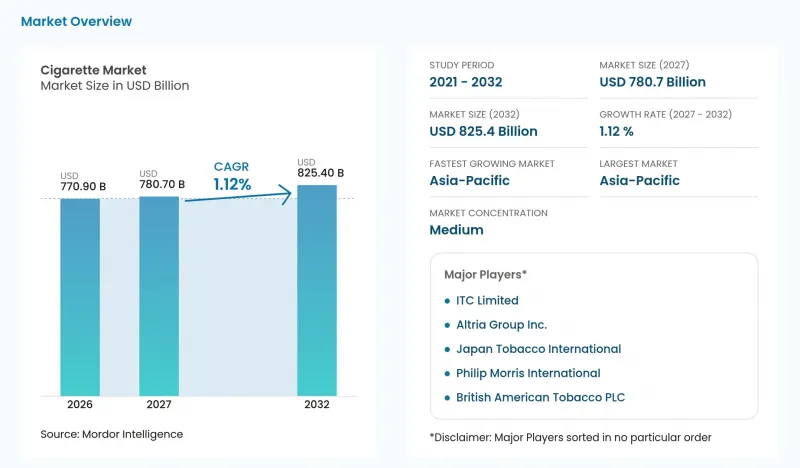
This report is segmented by Flavor Type (Unflavored and Flavored), Format (King Size, Regular, and more), Category (Mass and Premium), End User (Men and Women), Distribution Channels (Convenience/Grocery Stores, Other Distribution Channels, and more), and Geography (Asia-Pacific, Europe, and more). The market forecasts are provided in terms of value (USD), based on availability.
Global Cigarette Market Trends and Insights
Nicotine Addiction Ensuring Resilient Consumer Loyalty
Nicotine dependence supports persistent cigarette demand even when consumers have reasons to reduce tobacco spending. WHO links the difficulty of curbing tobacco expenditure to its addictiveness and identifies cigarettes as the most common form of tobacco use worldwide. For cigarette manufacturers, that mechanism provides a basis for recurring demand from existing smokers, although dependence does not guarantee loyalty to a particular brand. Its commercial importance lies in sustaining expenditure through repeated purchase occasions, which gives established suppliers a demand base to serve. The resulting revenue resilience is strongest at the product-category level, leaving individual producers exposed to switching when their prices or offerings become less attractive.
Rising Premiumization Trend
Premiumization creates a route to cigarette revenue growth through stronger brand value within selected price tiers. In the 6 months ended March 2026, Imperial Brands said investments in Davidoff and Gauloises supported its premium-segment share growth in Germany. That experience connects the driver to a concrete commercial lever, since spending on specific brands can compete for higher-value purchases within an established cigarette business. For manufacturers, the relevant opportunity is to earn a larger portion of premium spending rather than depend solely on additional sticks sold. Imperial's German result points to competition within the premium tier, where brand-equity investment can win spending without requiring a market-wide shift in cigarette preferences.
Stringent Plain Packaging Rules and Proposed Nicotine Caps
Restrictions on pack design narrow the ways manufacturers can distinguish cigarettes at the point of sale. Australia's Public Health (Tobacco and Other Products) Regulations 2024 require standardized color and a matte finish for primary and secondary tobacco packaging. These specifications limit the commercial return available from differentiated packaging, even when a producer can maintain its brand name. In January 2025, the U.S. Food and Drug Administration proposed a ceiling of 0.70 mg of nicotine per gram of total tobacco in finished cigarettes and certain other finished combusted tobacco products. Such a content ceiling would add a product-development constraint if finalized and effective. Pack redesign alone would therefore be insufficient for manufacturers facing both regimes, because the proposed U.S. limit would require compliance within the cigarette itself.
Other drivers and restraints analyzed in the detailed report include:
- Rising Disposable Incomes in Emerging Markets
- Technological Advancements in Production
- Health Awareness of Tobacco Risks
For complete list of drivers and restraints, kindly check the Table Of Contents.
Segment Analysis
Unflavored cigarettes were the largest segment, accounting for 85.07% of market revenue in 2026. Nonmenthol cigarettes accounted for 69.6% of U.S. retail cigarette packs sold in 2025, with cooling and other flavored nonmenthol products measured separately in CDC Foundation estimates. Menthol cigarettes accounted for 30.3% of packs in the same U.S. estimates. For unflavored suppliers, this balance makes established nonmenthol purchases a larger sales base to defend than the menthol category available to flavor-led competitors.
Flavored cigarettes are the fastest-growing segment, with a forecast CAGR of 2.3% from 2027 to 2032. Intercontinental Trading Corp., an importer and distributor, released Black Jack Supasawa Random 5 at tobacco retailers in Japan on June 9, 2025. The South Korean-made king-size cigarette offers randomly packed pineapple, lemon, mango, blueberry, and grapefruit flavor capsules. Combining flavor choices within one pack provides a way to differentiate the flavored offer without changing the cigarette format. Random packing makes variety the proposition for adult buyers, placing the appeal of the assortment ahead of certainty about a particular flavor.
King-size cigarettes represented a 52.35% cigarette market share in 2026, making the format the largest segment. Demerara Tobacco Company reported that Lucky Strike brand demand in Guyana increased 8% in 2025 versus 2024 following its king-size relaunch in 2024. The sequence shows an established format participating in brand renewal, giving a producer a way to refresh its offer while retaining a familiar cigarette presentation.
Super slim cigarettes are the fastest-growing segment, with a projected CAGR of 2.2% from 2027 to 2032. KT&G's super slim brand ESSE recorded more than USD 700 million in revenue outside Korea in 2025. In January 2025, KT&G established a legal subsidiary in Uzbekistan after exporting localized ESSE ultra-slim cigarettes there since 2023. The local entity creates an operating route for an already localized product, making development of an existing export business a concrete expansion mechanism for super slim.
Complete Report Scope:
- By Flavor Type
- Flavored
- Unflavored
- By Format
- Slim
- Super Slim
- King Size
- Regular
- By Category
- Mass
- Premium
- By End User
- Men
- Women
- By Distribution Channels
- Convenience/Grocery Stores
- Specialty Stores
- Online Retail Stores
- Other Distribution Channels
- By Geography
- North America
- United States
- Canada
- Mexico
- Rest of North America
- Europe
- Germany
- United Kingdom
- Italy
- France
- Spain
- Netherlands
- Poland
- Belgium
- Sweden
- Rest of Europe
- Asia-Pacific
- China
- India
- Japan
- Australia
- Indonesia
- South Korea
- Thailand
- Singapore
- Rest of Asia-Pacific
- South America
- Brazil
- Argentina
- Colombia
- Chile
- Peru
- Middle East and Africa
- South Africa
- Saudi Arabia
- United Arab Emirates
- Nigeria
- Egypt
- Morocco
- Turkey
- Rest of Middle East and Africa
- North America
Geography Analysis
Asia-Pacific was the largest geography with a 48.84% share of the cigarette market size in 2026 and is the fastest-growing region, at a forecast CAGR of 2.3% from 2027 to 2032. China produced 2.47 trillion cigarettes in 2025, an increase of 0.2% from the previous year. Following India's cigarette tax increase under a new GST and excise structure from February 2026, ITC implemented more than 30 portfolio interventions across price points, several reaching meaningful scale. In a January 2026 release, Malaysia's Ministry of Health said its Ops Selamat PaPa enforcement operation focused on manufacturing, distribution and sales of all smoking products. Adapting legal cigarette offers across price points creates a route to retain spending after India's tax shock, while Malaysia's enforcement focus makes compliance throughout the supply chain relevant alongside portfolio execution.
Altria's U.S. domestic cigarette shipments, including promotional units, fell 2.8% to 29.42 billion sticks in the 6 months ended June 30, 2026, from a year earlier. Philip Morris International's cigarette shipments in its Europe region fell 5.5% to 153.8 billion units in 2025 compared with 2024. Costa Rica applies a specific tobacco tax to domestic and imported cigarettes, while Switzerland bars under-18 tobacco sales across all channels. With North America and Europe forecast to contract and these incumbents' shipments falling, defending revenue puts greater weight on price realization and portfolio mix as sources of return.
South America and Middle East and Africa present different commercial conditions for cigarette suppliers. A KPMG study commissioned by Philip Morris Products SA estimated counterfeit and contraband cigarettes represented 10.7% of Argentina's total cigarette consumption in 2025, the lowest among 10 Latin American markets and Canada. Kenya prohibits under-18 tobacco sales, with a seller defense for attempts to verify adult age by requesting and examining legally specified documents reasonably believed authentic. In Egypt, Eastern Company S.A.E. produced 56 billion cigarettes in the year ended June 2025, compared with 47 billion in the preceding fiscal year. Entry conditions therefore turn on competition with illicit supply in Argentina, documentary age checks supporting a seller defense in Kenya, and an expanding domestic production base in Egypt.
- China National Tobacco Corporation
- Philip Morris International
- British American Tobacco PLC
- Japan Tobacco International
- Imperial Brands PLC
- Altria Group Inc.
- ITC Limited
- KT&G Corp.
- Gudang Garam Tbk
- Djarum Group
- 22nd Century Group
- Taiwan Tobacco & Liquor Corp.
- VST Industries Ltd.
- Godfrey Phillips India Ltd.
- Vector Group Ltd.
- Scandinavian Tobacco Group
- Smoore International Holdings
- Vietnam National Tobacco Corp.
- PT Wismilak Inti Makmur
- Bulgartabac Holding AD
- Eastern Company S.A.E.
- Karelia Tobacco Company Inc.
Additional Benefits:
- The market estimate (ME) sheet in Excel format
- 3 months of analyst support
TABLE OF CONTENTS
1 INTRODUCTION
- 1.1 Study Assumptions and Market Definition
- 1.2 Scope of the Study
2 RESEARCH METHODOLOGY
3 EXECUTIVE SUMMARY
4 MARKET LANDSCAPE
- 4.1 Market Overview
- 4.2 Market Drivers
- 4.2.1 Nicotine Addiction Ensuring Resilient Consumer Loyalty
- 4.2.2 Rising Premiumization Trend
- 4.2.3 Rising Disposable Incomes in Emerging Markets
- 4.2.4 Technological Advancements in Production
- 4.2.5 Effective Marketing and Peer Influence Sustain Demand Among Millennials
- 4.2.6 Introduction of Herbal and Nicotine-Free Flavors
- 4.3 Market Restraints
- 4.3.1 Stringent Plain Packaging Rules and Proposed Nicotine Caps
- 4.3.2 Health Awareness of Tobacco Risks
- 4.3.3 Shift to Smokeless Alternatives Like E-Cigarettes
- 4.3.4 Aggressive Public Health Campaigns
- 4.4 Industry Value Chain Analysis
- 4.5 Regulatory Landscape
- 4.6 Technological Outlook
- 4.7 Porter's Five Forces Analysis
- 4.7.1 Threat of New Entrants
- 4.7.2 Bargaining Power of Suppliers
- 4.7.3 Bargaining Power of Buyers
- 4.7.4 Threat of Substitutes
- 4.7.5 Competitive Rivalry
5 MARKET SIZE AND GROWTH FORECASTS (VALUE)
- 5.1 By Flavor Type
- 5.1.1 Flavored
- 5.1.2 Unflavored
- 5.2 By Format
- 5.2.1 Slim
- 5.2.2 Super Slim
- 5.2.3 King Size
- 5.2.4 Regular
- 5.3 By Category
- 5.3.1 Mass
- 5.3.2 Premium
- 5.4 By End User
- 5.4.1 Men
- 5.4.2 Women
- 5.5 By Distribution Channels
- 5.5.1 Convenience/Grocery Stores
- 5.5.2 Specialty Stores
- 5.5.3 Online Retail Stores
- 5.5.4 Other Distribution Channels
- 5.6 By Geography
- 5.6.1 North America
- 5.6.1.1 United States
- 5.6.1.2 Canada
- 5.6.1.3 Mexico
- 5.6.1.4 Rest of North America
- 5.6.2 Europe
- 5.6.2.1 Germany
- 5.6.2.2 United Kingdom
- 5.6.2.3 Italy
- 5.6.2.4 France
- 5.6.2.5 Spain
- 5.6.2.6 Netherlands
- 5.6.2.7 Poland
- 5.6.2.8 Belgium
- 5.6.2.9 Sweden
- 5.6.2.10 Rest of Europe
- 5.6.3 Asia-Pacific
- 5.6.3.1 China
- 5.6.3.2 India
- 5.6.3.3 Japan
- 5.6.3.4 Australia
- 5.6.3.5 Indonesia
- 5.6.3.6 South Korea
- 5.6.3.7 Thailand
- 5.6.3.8 Singapore
- 5.6.3.9 Rest of Asia-Pacific
- 5.6.4 South America
- 5.6.4.1 Brazil
- 5.6.4.2 Argentina
- 5.6.4.3 Colombia
- 5.6.4.4 Chile
- 5.6.4.5 Peru
- 5.6.5 Middle East and Africa
- 5.6.5.1 South Africa
- 5.6.5.2 Saudi Arabia
- 5.6.5.3 United Arab Emirates
- 5.6.5.4 Nigeria
- 5.6.5.5 Egypt
- 5.6.5.6 Morocco
- 5.6.5.7 Turkey
- 5.6.5.8 Rest of Middle East and Africa
- 5.6.1 North America
6 COMPETITIVE LANDSCAPE
- 6.1 Market Concentration
- 6.2 Strategic Moves
- 6.3 Market Share Analysis
- 6.4 Company Profiles (includes Global level Overview, Market level overview, Core Segments, Financials as available, Strategic Information, Market Rank/Share for key companies, Products and Services, and Recent Developments)
- 6.4.1 China National Tobacco Corporation
- 6.4.2 Philip Morris International
- 6.4.3 British American Tobacco PLC
- 6.4.4 Japan Tobacco International
- 6.4.5 Imperial Brands PLC
- 6.4.6 Altria Group Inc.
- 6.4.7 ITC Limited
- 6.4.8 KT&G Corp.
- 6.4.9 Gudang Garam Tbk
- 6.4.10 Djarum Group
- 6.4.11 22nd Century Group
- 6.4.12 Taiwan Tobacco & Liquor Corp.
- 6.4.13 VST Industries Ltd.
- 6.4.14 Godfrey Phillips India Ltd.
- 6.4.15 Vector Group Ltd.
- 6.4.16 Scandinavian Tobacco Group
- 6.4.17 Smoore International Holdings
- 6.4.18 Vietnam National Tobacco Corp.
- 6.4.19 PT Wismilak Inti Makmur
- 6.4.20 Bulgartabac Holding AD
- 6.4.21 Eastern Company S.A.E.
- 6.4.22 Karelia Tobacco Company Inc.
7 MARKET OPPORTUNITIES AND FUTURE OUTLOOK
- 7.1 White-Space and Unmet-Need Assessment

