PUBLISHER: Mordor Intelligence | PRODUCT CODE: 2187304

PUBLISHER: Mordor Intelligence | PRODUCT CODE: 2187304
India Crane - Market Share Analysis, Industry Trends & Statistics, Growth Forecasts (2027 - 2032)
According to Mordor Intelligence, the India crane market size is expected to increase from USD 1.58 billion in 2026 to USD 1.69 billion in 2027 and reach USD 2.3 billion by 2032, growing at a CAGR of 6.4% over 2027-2032.
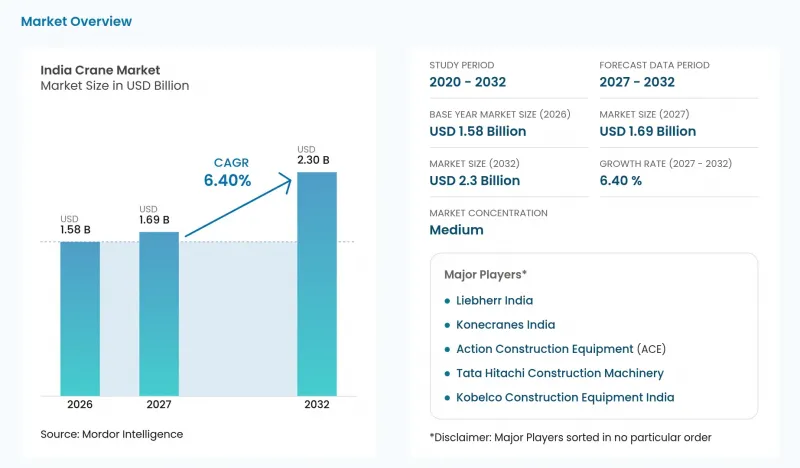
The market volume is expected to increase from 10.71 thousand Units in 2026 to 11.2 thousand Units in 2027 and reach 14.02 thousand Units by 2032, growing at a CAGR of 4.6% over 2027-2032. This report is segmented by Machine Type (Mobile Cranes, Fixed / Tower Cranes, and more), Application (Construction, Energy and Utilities, and more), Lifting Capacity (20 - 100 tons, Below 20 tons, and more), Boom Type (Telescopic Boom, Lattice Boom, and more), and Power Source (Diesel, Hybrid, and more). The market forecasts are provided in terms of value (USD) and volume (Units), based on availability.
India Crane Market Trends and Insights
Surge In National Infrastructure Pipeline (NIP) Investments
The National Infrastructure Pipeline expands the pool of projects that could require cranes, while equipment demand depends on construction within that pool. The National Infrastructure Pipeline (NIP) had approximately 14,563 projects by March 2026, compared with approximately 6,800 at its 2019 inception. ICRA also reported that pipeline investment had risen approximately 92% from its 2019 inception by March 2026. Its FY2026 assessment identified moderating project additions despite the elevated pipeline value. A larger stock of listed projects and slower additions describe different demand signals, with crane requirements arising when work reaches lifting-intensive construction.
Housing-Led Urban Revitalization Under Smart Cities Mission
The completed housing projects show the neighborhood-scale residential work delivered through Smart Cities Mission redevelopment. The Tumakuru Smart City project relocated 55 to 60 families from slums into newly built, free G+4 apartments. Smart City Thiruvananthapuram Ltd built a 4-story, 32-apartment Rajaji Nagar block under the Smart Cities Mission, which was ready for occupation in July 2026 pending a water connection. Tumakuru reported full project closure in September 2026. Both buildings rise only 4 to 5 floors, placing this redevelopment activity in low-rise residential construction.
Shortage of Certified Crane Operators and Riggers
Operator skill gaps constrain a rental fleet when otherwise available machines lack crews able to run them safely. In June 2026, Vertikal Rentals' managing director described the operator skills shortage as the company's biggest growth constraint. The managing director said the company could deploy 30% more equipment if it had operators to run it safely. This shortfall can limit the revenue-producing use of additional machines, so fleet expansion depends on crew availability. Vertikal also said in June 2026 that it had established a Chennai training program with theoretical and practical assessment before deployment. Until deployable operators are available, another machine can add holding costs while its intended lifting work waits.
Other drivers and restraints analyzed in the detailed report include:
- Renewable-Energy Build-Out Driving Heavy-Lift Demand
- Public Private Partnerships in Metro-Rail and RRTS Corridors
- Rupee Volatility Raising Imported Component Costs
For complete list of drivers and restraints, kindly check the Table Of Contents.
Segment Analysis
Mobile cranes accounted for a 62.13% share of the India crane market size in 2026, making them the largest segment. In its November 2025 presentation, ACE claimed leadership in India's mobile-crane segment and identified itself as a pick-and-carry crane manufacturer. For a buyer requiring both lifting and load movement, the product decision centers on how those tasks fit within one equipment assignment. ACE's stated leadership makes pick-and-carry specialization a competitive reference point for suppliers addressing mobile lifting and load movement.
Fixed / tower cranes are forecast to be the fastest-growing segment, at a CAGR of 7.9% during 2027-2032. In July 2026, ACE expected its own tower-crane volumes in India to grow during FY2027. In May 2026, ACE said it had recently supplied around 3 special tower cranes to Garden Reach Shipbuilders and Engineers for ship construction and loading materials onto completed ships. In May 2026, ACE's executive director estimated that perhaps 10, 15, or 20 of its roughly 700 annual tower-crane sales might be larger units for shipyards. This places shipyards as a specialized outlet within ACE's tower-crane business, with configurations serving both ship construction and subsequent material placement.
Construction represented a 56.69% India crane market share in 2026, making it the largest segment. In a July 2026 parliamentary reply, Union Road Transport and Highways Minister Nitin Gadkari said 22,709 kilometers of the 26,425 kilometers awarded under Bharatmala Phase I had been completed. This program scale makes civil-work execution a substantial potential customer base for equipment manufacturers, with lifting needs tied to particular construction packages. As awarded work moves through completion, repeat crane orders depend on new active work fronts, so a supplier's construction opportunity follows project execution rather than the accumulated road base.
Energy and utilities are forecast to be the fastest-growing segment, at a CAGR of 9.9% during 2027-2032. On September 16, 2025, L&T said its Heavy Civil Infrastructure business had won NPCIL's mechanical-package order for Kudankulam units 5 and 6 in Tamil Nadu. The 2x1,000 MWe nuclear project package included polar and trestle crane installation alongside reactor and turbine systems. In July 2026, Bharat Heavy Electricals Limited (BHEL) invited bids for a 3-year framework to hire 250-metric-ton hydraulic crawler cranes for erection, loading, unloading, and other engineer-directed work at Power Sector Western Region sites. The proposed framework channels lifting through fleet providers, conditional on award and individual work orders, while the nuclear package embeds crane installation within a wider construction contract.
Complete Report Scope:
- By Machine Type
- Mobile Cranes
- Fixed / Tower Cranes
- Marine & Port Cranes
- By Application
- Construction
- Mining and Excavation
- Marine and Offshore
- Industrial Manufacturing
- Energy and Utilities
- By Lifting Capacity
- Below 20 tons
- 20 - 100 tons
- 100 - 300 tons
- Above 300 tons
- By Boom Type
- Telescopic Boom
- Lattice Boom
- Knuckle Boom
- By Power Source
- Diesel
- Hybrid
- Fully-Electric
List of Companies Covered in this Report:
- Action Construction Equipment (ACE)
- Konecranes India
- Liebherr India
- SANY India
- Escorts Kubota
- Kobelco Construction Equipment India
- Tata Hitachi Construction Machinery
- TIL Ltd
- Palfinger India
- Anupam Industries
- Zoomlion India
- XCMG India
- Tadano India
- Sennebogen India
- Manitowoc India
- Indo Farm Equipment
Additional Benefits:
- The market estimate (ME) sheet in Excel format
- 3 months of analyst support
TABLE OF CONTENTS
1 INTRODUCTION
- 1.1 Study Assumptions and Market Definition
- 1.2 Scope of the Study
2 RESEARCH METHODOLOGY
3 EXECUTIVE SUMMARY
4 MARKET LANDSCAPE
- 4.1 Market Overview
- 4.2 Market Drivers
- 4.2.1 Surge In National Infrastructure Pipeline (NIP) Investments
- 4.2.2 Housing-Led Urban Revitalization Under Smart Cities Mission
- 4.2.3 Renewable-Energy Build-Out Driving Heavy-Lift Demand
- 4.2.4 Public Private Partnerships in Metro-Rail and RRTS Corridors
- 4.2.5 Rental-First Procurement Models Among EPC Contractors
- 4.2.6 Automation Push: Telematics and Planned Autonomous Crane Development
- 4.3 Market Restraints
- 4.3.1 Shortage of Certified Crane Operators and Riggers
- 4.3.2 Rupee Volatility Raising Imported Component Costs
- 4.3.3 Fragmented Safety Regulations Across Indian States
- 4.3.4 High Working-Capital Cycle for Small Rental Fleets
- 4.4 Industry Value Chain Analysis
- 4.5 Regulatory Landscape
- 4.6 Technological Outlook
- 4.7 Porter's Five Forces Analysis
- 4.7.1 Threat of New Entrants
- 4.7.2 Bargaining Power of Suppliers
- 4.7.3 Bargaining Power of Buyers
- 4.7.4 Threat of Substitutes
- 4.7.5 Competitive Rivalry
5 MARKET SIZE AND GROWTH FORECASTS (VALUE AND VOLUME)
- 5.1 By Machine Type
- 5.1.1 Mobile Cranes
- 5.1.2 Fixed / Tower Cranes
- 5.1.3 Marine & Port Cranes
- 5.2 By Application
- 5.2.1 Construction
- 5.2.2 Mining and Excavation
- 5.2.3 Marine and Offshore
- 5.2.4 Industrial Manufacturing
- 5.2.5 Energy and Utilities
- 5.3 By Lifting Capacity
- 5.3.1 Below 20 tons
- 5.3.2 20 - 100 tons
- 5.3.3 100 - 300 tons
- 5.3.4 Above 300 tons
- 5.4 By Boom Type
- 5.4.1 Telescopic Boom
- 5.4.2 Lattice Boom
- 5.4.3 Knuckle Boom
- 5.5 By Power Source
- 5.5.1 Diesel
- 5.5.2 Hybrid
- 5.5.3 Fully-Electric
6 COMPETITIVE LANDSCAPE
- 6.1 Market Concentration
- 6.2 Strategic Moves
- 6.3 Market Share Analysis
- 6.4 Company Profiles (includes Global level Overview, Market level overview, Core Segments, Financials as available, Strategic Information, Market Rank/Share for key companies, Products and Services, and Recent Developments)
- 6.4.1 Action Construction Equipment (ACE)
- 6.4.2 Konecranes India
- 6.4.3 Liebherr India
- 6.4.4 SANY India
- 6.4.5 Escorts Kubota
- 6.4.6 Kobelco Construction Equipment India
- 6.4.7 Tata Hitachi Construction Machinery
- 6.4.8 TIL Ltd
- 6.4.9 Palfinger India
- 6.4.10 Anupam Industries
- 6.4.11 Zoomlion India
- 6.4.12 XCMG India
- 6.4.13 Tadano India
- 6.4.14 Sennebogen India
- 6.4.15 Manitowoc India
- 6.4.16 Indo Farm Equipment
7 MARKET OPPORTUNITIES AND FUTURE OUTLOOK
- 7.1 White-Space and Unmet-Need Assessment

