PUBLISHER: Mordor Intelligence | PRODUCT CODE: 2187313

PUBLISHER: Mordor Intelligence | PRODUCT CODE: 2187313
United States Home Furniture - Market Share Analysis, Industry Trends & Statistics, Growth Forecasts (2027 - 2032)
According to Mordor Intelligence, the United States home furniture market size was valued at USD 130.6 billion in 2026 and estimated to grow from USD 135.5 billion in 2027 to reach USD 160.2 billion by 2032, at a CAGR of 3.41% during the forecast period (2027-2032).
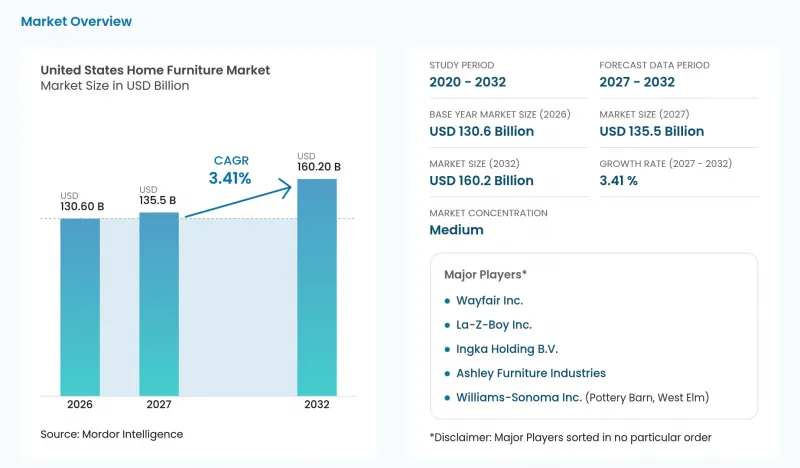
This report is segmented by Product (Living Room and Dining Room Furniture, Bedroom Furniture, and more), Material (Wood, Metal, and more), Price Range (Mid-Range, Economy, and more), Distribution Channel (Specialty Furniture Stores, Online, and more), and Geography (West, Southeast, and more). The market forecasts are provided in terms of value (USD), based on availability.
United States Home Furniture Market Trends and Insights
Improved Condo Affordability Spurs Demand for Modular, Multi-Functional Furniture
A condo buyer furnishing a newly acquired unit can gain from modular furniture when separate components accommodate the room's layout. Improved purchase affordability would widen the opening for that first furnishing decision. Multifunctional designs can also serve more than one use within the same footprint, linking the product's appeal to the space it occupies. In a smaller unit, combining seating and storage in one piece can equip a shared living space without assigning separate floor area to each function. The first-time condo owner can then furnish several uses within a smaller footprint in one purchase, making a multifunctional piece an alternative to leaving part of the room unequipped.
Rising Home-Renovation Spending
Renovation creates an opportunity to refurnish existing homes when projects change how rooms are used. The National Association of Home Builders reported that inflation-adjusted remodeling spending in the United States increased more than 10% from 2023 to 2025. It linked that expansion to an aging housing stock and record-high home equity gains for existing homeowners. Projects that alter a room's layout can create a new requirement for finished furniture even when the household keeps the same address. For suppliers, a room conversion offers a firmer furnishing trigger than a cosmetic repair, because the new use can require seating, storage or work surfaces.
Interest-Rate-Driven Housing-Market Slowdown Dampening Big-Ticket Furniture Sales
For the period ended August 29, 2026, Bassett Furniture linked below-trend housing activity to reduced furniture and home furnishings demand. Its assessment identified higher home prices, mortgage rates, low-rate mortgage lock-in and economic uncertainty together. Census advance estimates put furniture and home furnishings store sales 1.5% lower in January-September 2026 than in the same 2025 period. September's single-month estimate for the same store category increased year over year. The year-to-date store-sales shortfall has not been offset by September's increase, limiting the case for a broad furniture-demand rebound.
Other drivers and restraints analyzed in the detailed report include:
- Rapid Growth Of D2C Online Furniture Start-Ups With Free-Return Logistics
- Immigration-Led Household Formation Increasing First-Time Furniture Purchases
- Persistent Freight & Port Delays Lengthening Delivery Lead-Times
For complete list of drivers and restraints, kindly check the Table Of Contents.
Segment Analysis
Living room and dining room furniture accounted for a 36.95% share of the United States home furniture market size in 2026, making it the largest segment. Haverty Furniture Companies reported double-digit sales increases in its upholstery and dining categories across its US retail business in the second quarter of 2026. An upholstery purchase and a dining-room purchase can address separate household activities, giving the combined segment several routes into a residential furnishing decision. Haverty's growth in both upholstery and dining gives retailers a reason to preserve breadth across the combined segment rather than rely on one category.
Bedroom furniture is forecast to grow at a 3.8% CAGR during 2027-2032, making it the fastest-growing segment. Somnigroup International acquired Mattress Firm on February 5, 2025, adding its US retail stores and distribution centers. The Mattress Firm retail segment generated USD 3.51 billion in US net sales from that acquisition through December 31, 2025. A bedding manufacturer and distributor thus has a substantial retail business serving sleep-product buyers, connecting bedroom purchases with production and distribution within the same group.
Wood represented a 62.02% United States home furniture market share in 2026, making it the largest segment. In 2025, Woodbridge Furniture completed an approximately 50,000-square-foot addition to its Thomasville, North Carolina, warehouse and distribution space, increasing finished-goods room for its wood furniture and upholstery lines. The project brought the building to 114,000 square feet and consolidated shipping from 2 locations into one. Its wood-furniture mix includes beds, dining tables, cabinets and writing desks. Keeping that assortment behind one dispatch operation makes the added storage useful across room categories, rather than tying the expansion to a single product line.
Plastic and polymer furniture is forecast to grow at a 4.3% CAGR during 2027-2032, making it the fastest-growing segment. POLYWOOD makes furniture from lumber extruded from recycled high-density polyethylene. By September 2026, around 75% of POLYWOOD's sales as an outdoor-furniture retailer came from e-commerce. That company sales mix connects a specific recycled material with an online finished-product offer. For polymer manufacturers, selling branded outdoor furniture can capture the retail value of the finished piece alongside the value of processing recycled material.
Complete Report Scope:
- By Product
- Living Room and Dining Room Furniture
- Bedroom Furniture
- Kitchen Furniture
- Home Office Furniture
- Bathroom Furniture
- Outdoor Furniture
- Other Furniture
- By Material
- Wood
- Metal
- Plastic & Polymer
- Others
- By Price Range
- Economy
- Mid-Range
- Premium
- By Distribution Channel
- Home Centers
- Specialty Furniture Stores (including exclusive brand outlets)
- Online
- Other Distribution Channels (includes hypermarkets, supermarkets, teleshopping, warehouse clubs, departmental stores, etc.)
- By Geography
- Northeast
- Southeast
- Midwest
- Southwest
- West
List of Companies Covered in this Report:
- Ashley Furniture Industries
- Ingka Holding B.V.
- Williams-Sonoma Inc. (Pottery Barn, West Elm)
- Wayfair Inc.
- La-Z-Boy Inc.
- American Signature Inc. (Value City)
- RH (Restoration Hardware)
- Ethan Allen Interiors
- Bassett Furniture Industries
- Flexsteel Industries
- Haverty Furniture Companies
- Hooker Furnishings Corp.
- Sauder Woodworking Co.
- American Woodmark Corp.
- Sleep Number Corp.
- Somnigroup International
- Casper Sleep Inc.
- Rooms To Go Inc.
- Crate & Barrel Holdings
- Amazon.com Inc. (Furniture category)
- Walmart Inc.
- Bed Bath & Beyond Inc.
Additional Benefits:
- The market estimate (ME) sheet in Excel format
- 3 months of analyst support
TABLE OF CONTENTS
1 INTRODUCTION
- 1.1 Study Assumptions and Market Definition
- 1.2 Scope of the Study
2 RESEARCH METHODOLOGY
3 EXECUTIVE SUMMARY
4 MARKET LANDSCAPE
- 4.1 Market Overview
- 4.2 Market Drivers
- 4.2.1 Improved Condo Affordability Spurs Demand for Modular, Multi-Functional Furniture
- 4.2.2 Rising Home-Renovation Spending
- 4.2.3 Rapid Growth Of D2C Online Furniture Start-Ups With Free-Return Logistics
- 4.2.4 Immigration-Led Household Formation Increasing First-Time Furniture Purchases
- 4.2.5 Federal/Provincial Sustainability Rebates Accelerating Uptake Of Eco-Certified Wooden Products
- 4.2.6 AI-powered AR/VR visualization tools boosting conversion
- 4.3 Market Restraints
- 4.3.1 Interest-Rate-Driven Housing-Market Slowdown Dampening Big-Ticket Furniture Sales
- 4.3.2 Persistent Freight & Port Delays Lengthening Delivery Lead-Times
- 4.3.3 US Import Price Competition Under USMCA Squeezing Domestic Margins
- 4.3.4 Rising import penetration despite Section 301 tariffs
- 4.4 Industry Value Chain Analysis
- 4.5 Regulatory Landscape
- 4.6 Technological Outlook
- 4.7 Porter's Five Forces Analysis
- 4.7.1 Threat of New Entrants
- 4.7.2 Bargaining Power of Suppliers
- 4.7.3 Bargaining Power of Buyers
- 4.7.4 Threat of Substitutes
- 4.7.5 Competitive Rivalry
- 4.8 Insights into the Latest Trends and Innovations in the Market
- 4.9 Insights on Recent Developments (New Product Launches, Strategic Initiatives, Investments, Partnerships, JVs, Expansion, M&As, etc.) in the Market
5 MARKET SIZE AND GROWTH FORECASTS (VALUE)
- 5.1 By Product
- 5.1.1 Living Room and Dining Room Furniture
- 5.1.2 Bedroom Furniture
- 5.1.3 Kitchen Furniture
- 5.1.4 Home Office Furniture
- 5.1.5 Bathroom Furniture
- 5.1.6 Outdoor Furniture
- 5.1.7 Other Furniture
- 5.2 By Material
- 5.2.1 Wood
- 5.2.2 Metal
- 5.2.3 Plastic & Polymer
- 5.2.4 Others
- 5.3 By Price Range
- 5.3.1 Economy
- 5.3.2 Mid-Range
- 5.3.3 Premium
- 5.4 By Distribution Channel
- 5.4.1 Home Centers
- 5.4.2 Specialty Furniture Stores (including exclusive brand outlets)
- 5.4.3 Online
- 5.4.4 Other Distribution Channels (includes hypermarkets, supermarkets, teleshopping, warehouse clubs, departmental stores, etc.)
- 5.5 By Geography
- 5.5.1 Northeast
- 5.5.2 Southeast
- 5.5.3 Midwest
- 5.5.4 Southwest
- 5.5.5 West
6 COMPETITIVE LANDSCAPE
- 6.1 Market Concentration
- 6.2 Strategic Moves
- 6.3 Market Share Analysis
- 6.4 Company Profiles (includes Global level Overview, Market level overview, Core Segments, Financials as available, Strategic Information, Market Rank/Share for key companies, Products and Services, and Recent Developments)
- 6.4.1 Ashley Furniture Industries
- 6.4.2 Ingka Holding B.V.
- 6.4.3 Williams-Sonoma Inc. (Pottery Barn, West Elm)
- 6.4.4 Wayfair Inc.
- 6.4.5 La-Z-Boy Inc.
- 6.4.6 American Signature Inc. (Value City)
- 6.4.7 RH (Restoration Hardware)
- 6.4.8 Ethan Allen Interiors
- 6.4.9 Bassett Furniture Industries
- 6.4.10 Flexsteel Industries
- 6.4.11 Haverty Furniture Companies
- 6.4.12 Hooker Furnishings Corp.
- 6.4.13 Sauder Woodworking Co.
- 6.4.14 American Woodmark Corp.
- 6.4.15 Sleep Number Corp.
- 6.4.16 Somnigroup International
- 6.4.17 Casper Sleep Inc.
- 6.4.18 Rooms To Go Inc.
- 6.4.19 Crate & Barrel Holdings
- 6.4.20 Amazon.com Inc. (Furniture category)
- 6.4.21 Walmart Inc.
- 6.4.22 Bed Bath & Beyond Inc.
7 MARKET OPPORTUNITIES AND FUTURE OUTLOOK
- 7.1 White-Space and Unmet-Need Assessment

