PUBLISHER: Mordor Intelligence | PRODUCT CODE: 2187317

PUBLISHER: Mordor Intelligence | PRODUCT CODE: 2187317
Printed Circuit Board - Market Share Analysis, Industry Trends & Statistics, Growth Forecasts (2027 - 2032)
According to Mordor Intelligence, the printed circuit board market size is projected to expand from USD 100.6 billion in 2026 and USD 105.5 billion in 2027 to USD 136 billion by 2032, registering a CAGR of 5.21% between 2027 and 2032.
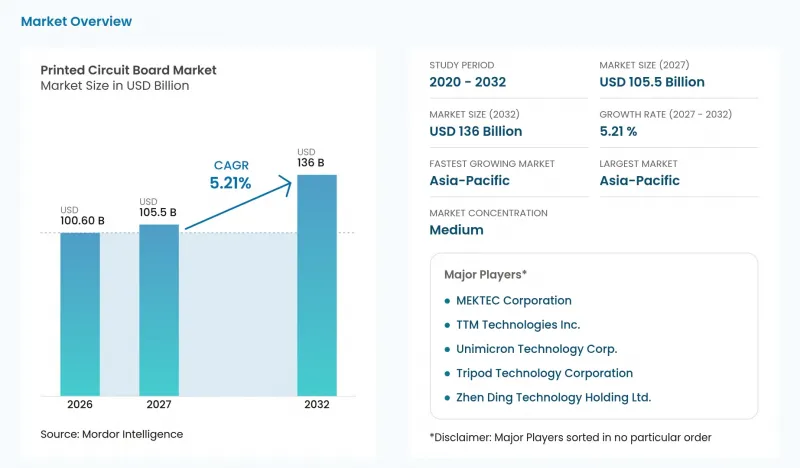
This report is segmented by PCB Type (Standard Multilayer, Flexible Circuits, and more), Substrate Material (Glass Epoxy, High-Speed and Low-Loss, and more), End-User Industry (Consumer Electronics, Computing and Data Centers, and more), and Geography (Asia-Pacific, North America, and more). The market forecasts are provided in terms of value (USD), based on availability.
Global Printed Circuit Board Market Trends and Insights
Surge in AI Server and High-Performance Computing Demand
AI server demand is expanding through physical system deliveries as well as new orders. Dell Technologies reported USD 16.4 billion in AI-optimized server revenue in its fiscal 2027 second quarter ended July 31, 2026, up 100% year over year. Increased unit sales drove most of that growth, with higher average selling prices contributing less. Dell also booked record AI server orders of USD 60.9 billion during the quarter. The shipment-led expansion gives PCB producers a demand mechanism beyond higher equipment prices. Converting the larger order pipeline into board sales will depend on server production schedules, making delivery capacity commercially more valuable than exposure to order announcements alone.
Accelerated EV Power Electronics Content
EV power-electronics demand expands through both higher drive output and commercial inverter programs. Volkswagen Group Components' Kassel plant increased electric-drive production by around 24% year on year to over 850,000 units in 2025. Its integrated network covers electric-drive engineering, industrialization and power electronics, with Kassel helping bring drives and pulse inverters into series production. In September 2025, Schaeffler reported volume production in Tianjin, China, of a high-voltage inverter submodule intended for a leading Chinese automaker's new EV models. These production examples connect the electronics opportunity to both integrated drive systems and specialized modules. For PCB suppliers, participation in such manufacturing programs can turn a design application into recurring production demand.
Prolonged Copper and Epoxy Resin Price Volatility
Material-cost variability can constrain PCB expansion even when manufacturers protect access to supply. Kunshan Wanyuantong Electronics Technology Co., Ltd. reported gross profit margins of 21.7% in 2024 and 19.7% in 2025. Its profitability reflected combined product-price adjustments, product mix and cost pressures that included raw-material fluctuations. For producers facing those pressures, additional sales offer less room to absorb an adverse change in material costs. The company maintains multiple qualified suppliers for key materials and aligns flexible procurement with production plans to mitigate supply risk and price volatility. Even with diversified supply, uncertain input costs raise the earnings hurdle for committing to additional production.
Other drivers and restraints analyzed in the detailed report include:
- 5G Deployment and 6G Prototyping Boosting HDI Adoption
- Shift Toward Advanced IC Substrates for Chiplet Integration
- Talent Shortages in Advanced PCB Design and Process Engineering
For complete list of drivers and restraints, kindly check the Table Of Contents.
Segment Analysis
Standard multilayer (non-HDI) boards accounted for a 29.48% share of the printed circuit board market size in 2026. The largest segment serves designs that require multiple circuit layers without specifying high-density interconnect technology. Additional interconnect density has commercial value for these programs when the intended design requires it, making a change in board architecture a distinct product decision. Maintaining standard multilayer capability therefore preserves a supplier's ability to serve programs on their specified terms, with commercial relevance tied to the board architecture and the requirements of the intended electronic product.
Flexible circuits (FPC) are the fastest-growing segment, with a projected 5.79% CAGR between 2027 and 2032. Flexium Interconnect Inc. reported that FPCs accounted for 94.91% of its operating revenue in 2025. The group's business covers FPC design, development, manufacturing and sales, as well as module assembly. This concentration puts FPC performance at the center of the supplier's commercial exposure, while its activities extend beyond fabrication alone. Serving programs across design and production can consequently give an FPC specialist a broader role in the customer's product cycle, with module assembly representing an additional business capability.
Complete Report Scope:
- By PCB Type
- Standard Multilayer (non-HDI)
- Rigid 1-2 Sided
- High-Density Interconnect (HDI)
- Flexible Circuits (FPC)
- IC Substrates (Package Substrates)
- Rigid-Flex
- Other PCB Types
- By Substrate Material
- Glass Epoxy (FR-4)
- High-Speed and Low-Loss
- Polyimide (PI)
- Packaging Resins (BT and ABF)
- Other Substrate Materials
- By End-User Industry
- Consumer Electronics
- Computing and Data Centers
- Telecommunications and 5G
- Automotive and EV
- Industrial and Power
- Healthcare and Medical
- Aerospace and Defense
- Other End-User Industries
- By Geography
- North America
- United States
- Rest of North America
- Europe
- Germany
- United Kingdom
- Italy
- Rest of Europe
- Asia-Pacific
- China
- Taiwan
- Japan
- India
- South Korea
- Southeast Asia
- Rest of Asia-Pacific
- Rest of World
- North America
Geography Analysis
Asia-Pacific, the largest geography, accounted for 82.66% of the printed circuit board market size in 2026 and is projected to be the fastest-growing geography, with a 5.25% CAGR between 2027 and 2032. Zhen Ding Technology Holding Ltd.'s group began small-volume ABF substrate production for advanced packaging at Kaohsiung Park, Taiwan, in the first half of 2026. The company expected a second-half 2026 ramp-up and had repurposed capacity designated for intelligent high-density interconnect and high-layer-count rigid PCBs for higher-specification probe-card products. Delton Technology (Guangzhou) Inc., a multilayer and high-layer-count PCB producer, reported that its Thailand subsidiary began production in June 2025. Regional growth can therefore combine specialized substrate production with new multilayer-board locations, while capacity reallocation makes product mix as important as factory footprint.
The U.S.-China Economic and Security Review Commission's 2025 report described U.S. producers as mainly making low-volume specialty boards for industrial, medical, defense and aerospace products, with many dependent on defense contracts for continued operations. In Canada, FTG Circuits negotiated and ratified a new 4-year collective agreement with represented employees at its Toronto facility in the third quarter of 2026, expiring in July 2030. In Europe, AT&S AG opened its IC-substrate research and production center in Leoben, Austria, in June 2025, with 420 new employees already working there. In North America, longer agreed workforce terms can reduce one element of operating uncertainty, while the European center links IC-substrate development to local production.
Rest of World includes project-linked PCB procurement and local manufacturing, illustrated by Brazil. In March 2025, Fundacao Instituto Nacional de Telecomunicacoes contracted Griffus PCB to supply boards for its Sebrae Trivale VOT project. SGS do Brasil certified Griffus PCB's management system for PCB manufacturing under ISO 9001:2015, with validity from February 18, 2025, to February 18, 2028, subject to satisfactory surveillance audits. The buyer's project-linked funding tied the procurement to a defined program and its institutional purchasing decision. For project-oriented fabricators, revenue opportunities consequently follow the institutional program's purchasing decisions, while certification describes a separate aspect of the supplier's manufacturing organization.
- Zhen Ding Technology Holding Ltd.
- Unimicron Technology Corp.
- MEKTEC Corporation
- TTM Technologies Inc.
- Samsung Electro-Mechanics Co., Ltd.
- Compeq Manufacturing Co., Ltd.
- Tripod Technology Corporation
- Shennan Circuits Co., Ltd.
- Young Poong Electronics Co., Ltd.
- Ibiden Co., Ltd.
- HannStar Board Corp.
- AT&S AG
- LG Innotek Co., Ltd.
- Kinwong Electronic Co., Ltd.
- DSBJ (Dongshan Precision)
- Kingboard Holdings Ltd.
- Shinko Electric Industries Co., Ltd.
- Flexium Interconnect Inc.
- Nan Ya PCB Corp.
- Isola Group
Additional Benefits:
- The market estimate (ME) sheet in Excel format
- 3 months of analyst support
TABLE OF CONTENTS
1 INTRODUCTION
- 1.1 Study Assumptions and Market Definition
- 1.2 Scope of the Study
2 RESEARCH METHODOLOGY
3 EXECUTIVE SUMMARY
4 MARKET LANDSCAPE
- 4.1 Market Overview
- 4.2 Market Drivers
- 4.2.1 Surge in AI Server and High-Performance Computing Demand
- 4.2.2 Accelerated EV Power Electronics Content
- 4.2.3 5G Deployment and 6G Prototyping Boosting HDI Adoption
- 4.2.4 Shift Toward Advanced IC Substrates for Chiplet Integration
- 4.2.5 Re-shoring Incentives in U.S. and EU for Critical PCB Supply Chains
- 4.2.6 Adoption of Ultra-Low-Loss Materials for 112-224 Gbps per Lane Signaling
- 4.3 Market Restraints
- 4.3.1 Prolonged Copper and Epoxy Resin Price Volatility
- 4.3.2 Talent Shortages in Advanced PCB Design and Process Engineering
- 4.3.3 Escalating ESG Compliance Costs for Wastewater and PFAS Regulation
- 4.3.4 Geopolitical Export Controls Limiting Advanced Substrate Equipment
- 4.4 Industry Value Chain Analysis
- 4.5 Regulatory Landscape
- 4.6 Technological Outlook
- 4.7 Porter's Five Forces Analysis
- 4.7.1 Threat of New Entrants
- 4.7.2 Bargaining Power of Suppliers
- 4.7.3 Bargaining Power of Buyers
- 4.7.4 Threat of Substitutes
- 4.7.5 Competitive Rivalry
- 4.8 Impact of Macroeconomic Factors on the Market
5 MARKET SIZE AND GROWTH FORECASTS (VALUE)
- 5.1 By PCB Type
- 5.1.1 Standard Multilayer (non-HDI)
- 5.1.2 Rigid 1-2 Sided
- 5.1.3 High-Density Interconnect (HDI)
- 5.1.4 Flexible Circuits (FPC)
- 5.1.5 IC Substrates (Package Substrates)
- 5.1.6 Rigid-Flex
- 5.1.7 Other PCB Types
- 5.2 By Substrate Material
- 5.2.1 Glass Epoxy (FR-4)
- 5.2.2 High-Speed and Low-Loss
- 5.2.3 Polyimide (PI)
- 5.2.4 Packaging Resins (BT and ABF)
- 5.2.5 Other Substrate Materials
- 5.3 By End-User Industry
- 5.3.1 Consumer Electronics
- 5.3.2 Computing and Data Centers
- 5.3.3 Telecommunications and 5G
- 5.3.4 Automotive and EV
- 5.3.5 Industrial and Power
- 5.3.6 Healthcare and Medical
- 5.3.7 Aerospace and Defense
- 5.3.8 Other End-User Industries
- 5.4 By Geography
- 5.4.1 North America
- 5.4.1.1 United States
- 5.4.1.2 Rest of North America
- 5.4.2 Europe
- 5.4.2.1 Germany
- 5.4.2.2 United Kingdom
- 5.4.2.3 Italy
- 5.4.2.4 Rest of Europe
- 5.4.3 Asia-Pacific
- 5.4.3.1 China
- 5.4.3.2 Taiwan
- 5.4.3.3 Japan
- 5.4.3.4 India
- 5.4.3.5 South Korea
- 5.4.3.6 Southeast Asia
- 5.4.3.7 Rest of Asia-Pacific
- 5.4.4 Rest of World
- 5.4.1 North America
6 COMPETITIVE LANDSCAPE
- 6.1 Market Concentration
- 6.2 Strategic Moves
- 6.3 Market Share Analysis
- 6.4 Company Profiles (includes Global level Overview, Market level overview, Core Segments, Financials as available, Strategic Information, Market Rank/Share for key companies, Products and Services, and Recent Developments)
- 6.4.1 Zhen Ding Technology Holding Ltd.
- 6.4.2 Unimicron Technology Corp.
- 6.4.3 MEKTEC Corporation
- 6.4.4 TTM Technologies Inc.
- 6.4.5 Samsung Electro-Mechanics Co., Ltd.
- 6.4.6 Compeq Manufacturing Co., Ltd.
- 6.4.7 Tripod Technology Corporation
- 6.4.8 Shennan Circuits Co., Ltd.
- 6.4.9 Young Poong Electronics Co., Ltd.
- 6.4.10 Ibiden Co., Ltd.
- 6.4.11 HannStar Board Corp.
- 6.4.12 AT&S AG
- 6.4.13 LG Innotek Co., Ltd.
- 6.4.14 Kinwong Electronic Co., Ltd.
- 6.4.15 DSBJ (Dongshan Precision)
- 6.4.16 Kingboard Holdings Ltd.
- 6.4.17 Shinko Electric Industries Co., Ltd.
- 6.4.18 Flexium Interconnect Inc.
- 6.4.19 Nan Ya PCB Corp.
- 6.4.20 Isola Group
7 MARKET OPPORTUNITIES AND FUTURE OUTLOOK
- 7.1 White-Space and Unmet-Need Assessment

