PUBLISHER: Mordor Intelligence | PRODUCT CODE: 2187342

PUBLISHER: Mordor Intelligence | PRODUCT CODE: 2187342
Wire and Cable - Market Share Analysis, Industry Trends & Statistics, Growth Forecasts (2027 - 2032)
According to Mordor Intelligence, the wire and cable market size was valued at USD 245.4 billion in 2026 and estimated to grow from USD 258.1 billion in 2027 to reach USD 334.5 billion by 2032, at a CAGR of 5.32% during the forecast period (2027-2032).
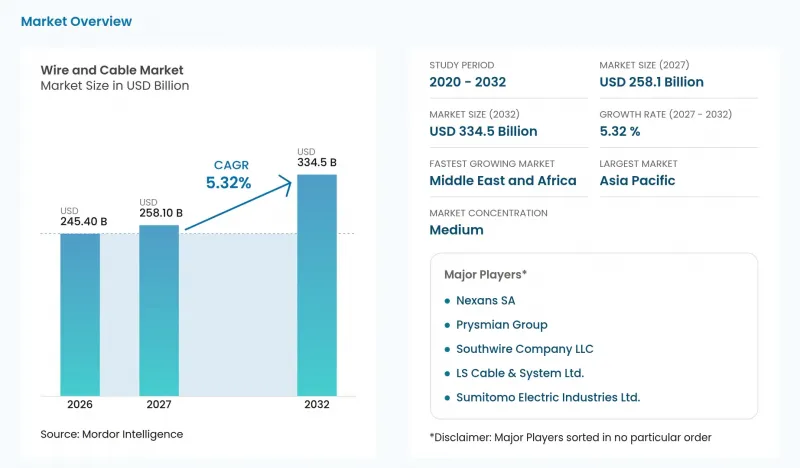
This report is segmented by Voltage (Low-Voltage and more), Cable Type (Power Cable and more), Conductor Material (Copper and more), Installation (Underground and more), End-User Vertical (Power Infrastructure and more), and Geography (Asia Pacific and more). The market forecasts are provided in terms of value (USD), based on availability.
Global Wire and Cable Market Trends and Insights
Surging Offshore Wind HV Cable Demand in North Sea and East Asia
Offshore wind awards expand demand for cable systems together with the engineering and installation needed to deliver their connections. Nexans secured the LanWin 2 agreement in January 2025 for 250 kilometers of 525 kV HVDC XLPE onshore and offshore export cable systems in TenneT's German North Sea program. In March 2026, Sumitomo Electric Industries Ltd. received an order to design, manufacture, and install approximately 57 kilometers of 66 kV AC submarine transmission cable for a 315 MW wind farm off Akita, Japan. The awards therefore turn offshore wind connections into orders for specified export and submarine transmission cables. Both awards also carry installation scope, so winning suppliers need installation capability alongside manufacturing capacity.
Accelerated Fiber-To-The-Home Roll-Outs in India and ASEAN
Fiber deployment draws demand from both public connection programs and commercial prepaid broadband services. By January 29, 2026, India's Ministry of Communications reported that BharatNet had delivered more than 1.4 million FTTH connections nationwide. In the Philippines, Converge's Surf2Sawa prepaid fiber service had 674,000 customers at the end of March 2026, up 86.7% year over year. These examples establish different routes into fiber adoption, combining government connection delivery with commercial subscriber expansion. The growing prepaid customer base strengthens the commercial case for operators to convert network reach into active service. Growth in take-up supports cable demand most directly when it extends physical connections into newly served premises.
XLPE Resin Supply Bottlenecks Limiting EHV Output
Qualified insulation availability places a separate constraint on extra-high-voltage cable production beyond factory expansion. Hua Eng Wire & Cable reported shortages of ultra-high-voltage XLPE insulation and outer-conductor materials in Taiwan on May 21, 2026. In its 2025 risk disclosure, Nexans identified dependence on XLPE compounds, long qualification lead times, and market capacity shortages as cable-industry supply-disruption risks. Together, these conditions make switching material sources a potential scheduling constraint when established supplies are short. Hua Eng reported testing new materials to strengthen supply-chain resilience in May 2026. For cable buyers, qualification lead times create exposure to delivery delays that additional factory capacity alone cannot resolve.
Other drivers and restraints analyzed in the detailed report include:
- Electrification of Automotive Harnesses for EV Platforms
- Sub-Saharan Grid Interconnect Projects Unlocking Multilateral Funding
- Copper Price Volatility Squeezing Contractor Margins in MENA
For complete list of drivers and restraints, kindly check the Table Of Contents.
Segment Analysis
Low-voltage cables below 1 kV accounted for a 45.59% share of the wire and cable market size in 2026. The largest segment's demand base includes Indian building wires used in households, apartments, and commercial spaces, where Polycab India reported sharply growing demand in 2025-26. Polycab linked this demand to India's rapid urbanization and commercialization. Building wire therefore follows urban construction activity across all 3 premises types rather than any single project pipeline.
Extra- and high-voltage cables above 35 kV are the fastest-growing segment, with a forecast CAGR of 8.03% during 2027-2032. On June 30, 2026, Prysmian received Transpower New Zealand's notice to proceed for the Cook Strait HVDC Link Upgrade, activating full project delivery. The design called for 350 kV single-core HVDC cables to replace existing Cook Strait cable infrastructure near the end of its operational life. Replacement of an operating link gives the specified cables a commercial purpose tied to asset condition and the continuity of cross-island power transfer.
Power cable represented a 38.09% wire and cable market share in 2026. The largest segment benefits from utility demand, with NKT's 2025 annual report describing strong transmission and distribution system operator activity since 2023 that drove high- and medium-voltage power-cable demand. That activity connects the segment's sales opportunity to the work programs of utilities operating at different levels of the grid. Serving transmission and distribution buyers can reduce a manufacturer's reliance on the delivery timetable of any single major network project.
Fiber-optic cable is the fastest-growing segment, with a forecast CAGR of 8.74% during 2027-2032. In January 2026, Meta announced a multiyear agreement worth up to USD 6 billion for Corning to supply fiber-optic cables for Meta's US data centers. That horizon can support manufacturing plans organized around a specified customer's infrastructure needs. Signal and control cable drew a March 2025 tender award from Trinidad and Tobago Electricity Commission to CN Cable Group Co., Ltd. for 8-, 16- and 27-core, 600/1000V protection and control multicore cables. Optical-cable suppliers can plan around multiyear hyperscale commitments, while signal and control suppliers must meet the core counts and voltage ratings specified in utility tenders.
Complete Report Scope:
- By Voltage
- Extra- and High-Voltage (Greater Than 35 kV)
- Medium-Voltage (1-35 kV)
- Low-Voltage (Less Than 1 kV)
- By Cable Type
- Power Cable
- Fiber-Optic Cable
- Signal and Control Cable
- Coaxial and Data Cable
- By Conductor Material
- Copper
- Aluminum
- Optical Glass / Polymer
- By Installation
- Overhead
- Underground
- Submarine
- By End-User Vertical
- Construction - Residential
- Construction - Commercial
- Power Infrastructure (Utilities and Renewables)
- Telecommunications and Data Centers
- Oil and Gas and Petrochemicals
- Automotive and Mobility
- Industrial Manufacturing
- By Geography
- North America
- United States
- Canada
- Mexico
- South America
- Brazil
- Argentina
- Rest of South America
- Europe
- United Kingdom
- Germany
- France
- Spain
- Italy
- Rest of Europe
- Asia Pacific
- China
- India
- Japan
- Australia
- South Korea
- Rest of Asia-Pacific
- Middle East and Africa
- Middle East
- Saudi Arabia
- United Arab Emirates
- Turkey
- Rest of Middle East
- Africa
- South Africa
- Kenya
- Rest of Africa
- Middle East
- North America
Geography Analysis
Asia Pacific was the largest region, accounting for a 38.76% share of the wire and cable market size in 2026. China recorded 2.11 million kilometers of new optical-fiber cable lines in 2025. In June 2026, joint developers PT Ketrosden Triasmitra Tbk and PT Ekamas Mora Republik Tbk announced Rising 8 was operating after construction, testing, and commissioning, linking Jakarta and Batam through an Indonesian submarine cable system. China's line additions establish a large domestic deployment base, while the operating Jakarta-Batam system shows that island connectivity also converts project plans into installed cable.
Middle East and Africa is the fastest-growing region, with a forecast CAGR of 6.4% during 2027-2032. In June 2026, Middle East Specialised Cables Company's wholly owned UAE subsidiary won an order to manufacture and supply low-voltage power and communication cables for Lower Zakum LTDP-1 in the UAE. In Africa, ZESCO's Zambia-Malawi Interconnector Project includes a planned 46.6-kilometer, 400 kV double-circuit overhead line in Zambia using triple-bundle ACSR conductor. The UAE order links cable business to offshore production infrastructure, while the Zambian design shows a potential route for regional transmission demand. For suppliers, the UAE order offers a defined manufacturing commitment, while the Zambian conductor opportunity depends on progression from project design to procurement.
In North America, the US Department of Energy's July 2026 draft study identified generation and load connections and congestion relief as transmission needs, highlighting NYISO, NorthernGrid South, and MISO. In South America, Codelco's April 2025 meeting included 6 Chilean cathode buyers that make wire rod and cable, illustrating a local copper-supply channel. In August 2026, Argentina's Secretariat of Energy published a tender notice for the planned AMBA I project, which would add 270 kilometers of 500 kV, 220 kV, and 132 kV transmission lines around Buenos Aires. In Europe, the European Commission selected EMACOM, Lda.'s Porto Santo Domestic Cable project in Portugal for CEF Digital funding in November 2025. The DOE study, AMBA I tender and Porto Santo selection are planning and funding steps rather than awarded cable orders, leaving manufacturers' production commitments dependent on later procurement.
- Prysmian Group
- Nexans SA
- Sumitomo Electric Industries Ltd.
- LS Cable & System Ltd.
- Southwire Company LLC
- Fujikura Ltd.
- Furukawa Electric Co. Ltd.
- NKT A/S
- Belden Inc.
- CommScope Technologies LLC
- TE Connectivity Ltd.
- Corning Incorporated
- Leoni AG
- Amphenol Corporation
- HELU KABEL GmbH
- Jiangsu Zhongtian Technology Co. Ltd.
- Hengtong Optic-Electric Co. Ltd.
- Riyadh Cables Group Company
- Polycab India Ltd.
- KEI Industries Ltd.
- ZTT Group
Additional Benefits:
- The market estimate (ME) sheet in Excel format
- 3 months of analyst support
TABLE OF CONTENTS
1 INTRODUCTION
- 1.1 Study Assumptions and Market Definition
- 1.2 Scope of the Study
2 RESEARCH METHODOLOGY
3 EXECUTIVE SUMMARY
4 MARKET LANDSCAPE
- 4.1 Market Overview
- 4.2 Market Drivers
- 4.2.1 Surging Offshore Wind HV Cable Demand in North Sea and East Asia
- 4.2.2 Accelerated Fiber-To-The-Home Roll-Outs in India and ASEAN
- 4.2.3 Electrification of Automotive Harnesses for EV Platforms
- 4.2.4 Sub-Saharan Grid Interconnect Projects Unlocking Multilateral Funding
- 4.2.5 Rapid Build-Out of Data Center Interconnects in Emerging Digital Hubs
- 4.2.6 Corporate Net-Zero Procurement Driving Green Cable Materials Adoption
- 4.3 Market Restraints
- 4.3.1 XLPE Resin Supply Bottlenecks Limiting EHV Output
- 4.3.2 Copper Price Volatility Squeezing Contractor Margins in MENA
- 4.3.3 Vulnerability of Subsea Cables to Geopolitical Sabotage
- 4.3.4 Skilled Workforce Shortages in High-Voltage Cable Jointing
- 4.4 Industry Value Chain Analysis
- 4.5 Regulatory Landscape
- 4.6 Technological Outlook
- 4.7 Porter's Five Forces Analysis
- 4.7.1 Threat of New Entrants
- 4.7.2 Bargaining Power of Suppliers
- 4.7.3 Bargaining Power of Buyers
- 4.7.4 Threat of Substitutes
- 4.7.5 Competitive Rivalry
- 4.8 The Impact of Macroeconomic Factors on the Market
- 4.9 Investment Analysis
5 MARKET SIZE AND GROWTH FORECASTS (VALUE)
- 5.1 By Voltage
- 5.1.1 Extra- and High-Voltage (Greater Than 35 kV)
- 5.1.2 Medium-Voltage (1-35 kV)
- 5.1.3 Low-Voltage (Less Than 1 kV)
- 5.2 By Cable Type
- 5.2.1 Power Cable
- 5.2.2 Fiber-Optic Cable
- 5.2.3 Signal and Control Cable
- 5.2.4 Coaxial and Data Cable
- 5.3 By Conductor Material
- 5.3.1 Copper
- 5.3.2 Aluminum
- 5.3.3 Optical Glass / Polymer
- 5.4 By Installation
- 5.4.1 Overhead
- 5.4.2 Underground
- 5.4.3 Submarine
- 5.5 By End-User Vertical
- 5.5.1 Construction - Residential
- 5.5.2 Construction - Commercial
- 5.5.3 Power Infrastructure (Utilities and Renewables)
- 5.5.4 Telecommunications and Data Centers
- 5.5.5 Oil and Gas and Petrochemicals
- 5.5.6 Automotive and Mobility
- 5.5.7 Industrial Manufacturing
- 5.6 By Geography
- 5.6.1 North America
- 5.6.1.1 United States
- 5.6.1.2 Canada
- 5.6.1.3 Mexico
- 5.6.2 South America
- 5.6.2.1 Brazil
- 5.6.2.2 Argentina
- 5.6.2.3 Rest of South America
- 5.6.3 Europe
- 5.6.3.1 United Kingdom
- 5.6.3.2 Germany
- 5.6.3.3 France
- 5.6.3.4 Spain
- 5.6.3.5 Italy
- 5.6.3.6 Rest of Europe
- 5.6.4 Asia Pacific
- 5.6.4.1 China
- 5.6.4.2 India
- 5.6.4.3 Japan
- 5.6.4.4 Australia
- 5.6.4.5 South Korea
- 5.6.4.6 Rest of Asia-Pacific
- 5.6.5 Middle East and Africa
- 5.6.5.1 Middle East
- 5.6.5.1.1 Saudi Arabia
- 5.6.5.1.2 United Arab Emirates
- 5.6.5.1.3 Turkey
- 5.6.5.1.4 Rest of Middle East
- 5.6.5.2 Africa
- 5.6.5.2.1 South Africa
- 5.6.5.2.2 Kenya
- 5.6.5.2.3 Rest of Africa
- 5.6.5.1 Middle East
- 5.6.1 North America
6 COMPETITIVE LANDSCAPE
- 6.1 Market Concentration
- 6.2 Strategic Moves
- 6.3 Market Share Analysis
- 6.4 Company Profiles (includes Global level Overview, Market level overview, Core Segments, Financials as available, Strategic Information, Market Rank/Share for key companies, Products and Services, and Recent Developments)
- 6.4.1 Prysmian Group
- 6.4.2 Nexans SA
- 6.4.3 Sumitomo Electric Industries Ltd.
- 6.4.4 LS Cable & System Ltd.
- 6.4.5 Southwire Company LLC
- 6.4.6 Fujikura Ltd.
- 6.4.7 Furukawa Electric Co. Ltd.
- 6.4.8 NKT A/S
- 6.4.9 Belden Inc.
- 6.4.10 CommScope Technologies LLC
- 6.4.11 TE Connectivity Ltd.
- 6.4.12 Corning Incorporated
- 6.4.13 Leoni AG
- 6.4.14 Amphenol Corporation
- 6.4.15 HELU KABEL GmbH
- 6.4.16 Jiangsu Zhongtian Technology Co. Ltd.
- 6.4.17 Hengtong Optic-Electric Co. Ltd.
- 6.4.18 Riyadh Cables Group Company
- 6.4.19 Polycab India Ltd.
- 6.4.20 KEI Industries Ltd.
- 6.4.21 ZTT Group
7 MARKET OPPORTUNITIES AND FUTURE OUTLOOK
- 7.1 White-Space and Unmet-Need Assessment

