PUBLISHER: Mordor Intelligence | PRODUCT CODE: 2187355

PUBLISHER: Mordor Intelligence | PRODUCT CODE: 2187355
Heparin - Market Share Analysis, Industry Trends & Statistics, Growth Forecasts (2027 - 2032)
According to Mordor Intelligence, the heparin market size is expected to increase from USD 10.73 billion in 2026 to USD 11.51 billion in 2027 and reach USD 16.16 billion by 2032, growing at a CAGR of 7.02% over 2027-2032.
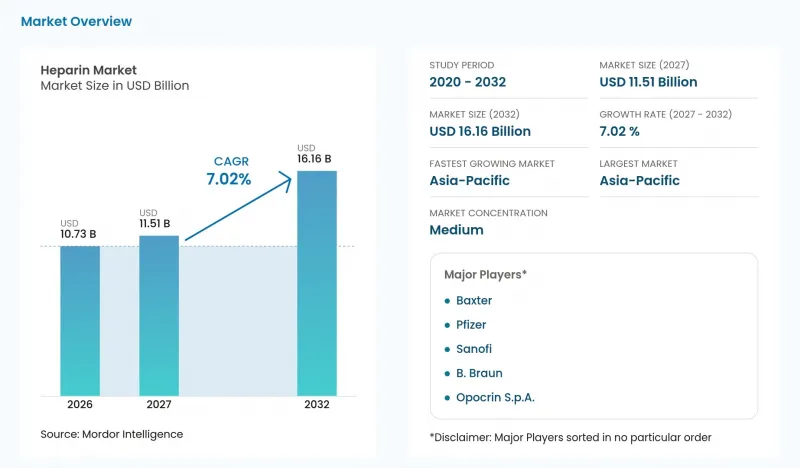
This report is segmented by Product (Low-Molecular-Weight Heparin and more), Source (Porcine and more), Dosage Form (Injectable Solution and more), Route of Administration (Sub-cutaneous and more), Application (Deep Vein Thrombosis and more), End User (Hospitals and more), and Geography (Asia-Pacific and more). The market forecasts are provided in terms of value (USD), based on availability.
Global Heparin Market Trends and Insights
Escalating Surgical Procedure Volumes and Dialysis Procedures
Recurring dialysis care supports repeat anticoagulant demand as the treated population expands. Fresenius Medical Care estimated that about 4.5 million people worldwide received regular dialysis in 2025, compared with about 4.3 million in 2024. NHS Highland guidance provides routine heparin dosing to reduce extracorporeal-circuit clotting during adult hemodialysis and hemodiafiltration for patients at low bleeding risk. Specified higher-risk patients require renal-unit medical assessment before heparin anticoagulation. These clinical boundaries tie the supply opportunity to eligible treatment activity. For dialysis providers, clot prevention makes access to suitable anticoagulation part of delivering the treatment itself.
Rapid Adoption of Low-Molecular-Weight Heparin Coupled with Expansion of Biosynthetic Heparin Programs
A guideline preference for LMWH in a defined population with acute pulmonary embolism (PE) gives suppliers a clinical basis for expanding initial injectable treatment. In its 2026 acute pulmonary embolism guideline, the American Heart Association and American College of Cardiology recommended LMWH over unfractionated heparin for adults in the guideline's C1-E1 clinical categories who require initial parenteral anticoagulation. The guideline states that this preference aims to reduce recurrent venous thromboembolism (VTE) and major bleeding. For treating teams, these objectives connect anticoagulant selection to both recurrent clotting risk and treatment-related harm, increasing the importance of the initial product choice. A 2026 review reported multi-gram-scale bioengineered heparin production, while noting that reaching industrial volumes remained challenging. The guideline preference can shape initial treatment now, whereas the review describes research-scale bioengineered heparin, so the nearer-term demand mechanism is LMWH selection.
Supply-Chain Vulnerability due to Dependence on Animal Derived Raw Material
Animal-derived sourcing exposes pharmaceutical manufacturers to constraints before purification begins. In its 2026 assessment, the Council on Foreign Relations identified China as the origin of 80% of global heparin supply and 74% of U.S. supply, describing porcine intestinal mucosa as a raw material. Converting that slaughter byproduct into pharmaceutical input requires dedicated collection, segregation, preservation, and processing infrastructure. Separately, the council reported that, as of May 2025, the American Pharmacists Association listed heparin as in shortage and experts advised clinicians to begin rationing. The same assessment found that the United States did not produce porcine mucosa at meaningful pharmaceutical scale. Replacing imports concentrated in China with U.S. raw material would require collection to scale first, delaying that domestic route to additional medicine supply.
Other drivers and restraints analyzed in the detailed report include:
- High Burden of Targeted Diseases and Aging Population
- Expanding Application in Medical Devices
- Risk and Adverse Bleeding Events
For complete list of drivers and restraints, kindly check the Table Of Contents.
Segment Analysis
Low-molecular-weight heparin (LMWH) accounted for a 63.19% share of the heparin market size in 2026. Shenzhen Hepalink Pharmaceutical Group Co. Ltd. (Hepalink) reported double-digit year-over-year growth in enoxaparin sodium formulation sales volume during the 6 months ended June 30, 2026. The company's in-house sales management system accompanied its reported expansion across the group's major regional markets. The reported growth rests on channel reach for an established enoxaparin medicine, so access to treatment channels is an expansion lever within the largest segment.
Synthetic / biosynthetic heparin is forecast to be the fastest-growing segment, at a CAGR of 8.15% over 2027-2032. A 2026 review classified heparosan followed by chemoenzymatic modification of bioengineered heparin as semi-industrial and still scaling. Unfractionated heparin's intravenous infusion role in NHS Ayrshire & Arran's August 2025 guidance includes weight-based dosing, coagulation monitoring, and protamine reversal after hematology advice. For bioengineered supply to reach finished-dose manufacturers at industrial volumes, the semi-industrial route must move beyond its reported scale.
Porcine heparin held 87.39% of revenue in 2026, making it the largest segment. In 2025, Bioiberica S.A.U. reported manufacturing one in every 5 heparin doses administered worldwide. The company sources its heparin entirely from porcine material in Europe, North America, and South America. Its dose-based production scale illustrates an operating manufacturer's reach, while the sourcing footprint shows that porcine participation can span several continents. Bioiberica sources its heparin from 3 continents but from a single animal species, so diversifying where it sources does not diversify what it sources.
Recombinant microbial heparin is forecast to be the fastest-growing segment, at a CAGR of 8.85% over 2027-2032. Shenzhen Hepalink reported completing pilot-scale amplification of heparin precursor fermentation in a collaborative research project targeting microbial heparin manufacturing. Carrying precursor fermentation through to finished API production is the next commercial requirement for turning this research pathway into medicine supply. Bovine heparin's quality role was illustrated when Argentina's medicines regulator ANMAT established an active pharmaceutical ingredient (API) reference substance in February 2026 for proton nuclear magnetic resonance identification and coagulometric identification and biological potency testing. Argentina's reference material gives local quality testing a source-specific basis for distinguishing bovine API identity and potency within the national framework.
Complete Report Scope:
- By Product
- Unfractionated Heparin
- Low-Molecular-Weight Heparin (LMWH)
- Ultra-Low-Molecular-Weight Heparin (ULMWH)
- Synthetic / Biosynthetic Heparin
- By Source
- Porcine
- Bovine
- Recombinant Microbial
- By Dosage Form
- Injectable Solution
- Pre-filled Syringe
- Topical Gel / Cream
- Others
- By Route of Administration
- Intravenous
- Sub-cutaneous
- By Application
- Deep Vein Thrombosis (DVT)
- Atrial Fibrillation and Heart Attack
- Coronary Artery Disease
- Hemodialysis
- Other Applications
- By End User
- Hospitals
- Ambulatory Surgical Centers
- Specialty Clinics
- Home-care Settings
- By Geography
- North America
- United States
- Canada
- Mexico
- Europe
- Germany
- United Kingdom
- France
- Italy
- Spain
- Rest of Europe
- Asia-Pacific
- China
- Japan
- India
- South Korea
- Australia
- Rest of Asia-Pacific
- Middle East and Africa
- GCC
- South Africa
- Rest of Middle East and Africa
- South America
- Brazil
- Argentina
- Rest of South America
- North America
Geography Analysis
Asia-Pacific held a 32.41% heparin market share in 2026 and is forecast to grow at a CAGR of 7.95% over 2027-2032, making it the largest and fastest-growing region. In February 2026, Hepalink's enoxaparin manufacturing subsidiary ranked first in China's national centralized procurement renewal for Prolongin injection. Renewal of access through national procurement connects a named formulation to an institutional channel that can support distribution beyond individual prescribing decisions. Cambodia's Ministry of Health approved the 40 mg/0.4 mL strength of Prolongin enoxaparin injection manufactured by Hepalink subsidiary Shenzhen Techdow Pharmaceutical Co., Ltd. in February 2026. Together the 2 events extend one enoxaparin brand's reach, through institutional procurement in China and ministry registration in Cambodia, with sustained supply needed to turn that access into treatment availability.
In North America, the 2025 U.S. guideline recommends enoxaparin or fondaparinux as alternatives to unfractionated heparin for non-ST-segment elevation acute coronary syndrome at diagnosis when early invasive management is not anticipated. Europe's 2025 survey of 114 cardiac surgery centers across 29 countries found 78.1% reported written heparinization protocols and 70.2% had no universal activated-clotting-time target after heparin reversal. Norway's Directorate of Health weakly recommended protamine sulfate for heparin users with acute intracerebral hemorrhage in its August 2026 update. In each setting a guideline or local protocol sets the anticoagulant choice and its monitoring routine, so product positioning in these regions has to follow protocol content.
Within Middle East and Africa, South Africa's adult hospital guidance recommends subcutaneous unfractionated heparin with bleeding monitoring, or enoxaparin, for high-risk medical inpatients when rivaroxaban is contraindicated. Egypt's 2025 national drug formulary includes enoxaparin prophylaxis for moderate- and high-risk surgical patients and acutely ill medical patients with reduced mobility and increased VTE risk. South America's purchasing channel is illustrated by Brazil's Ministry of Health, which contracted Biomm S/A in 2025 to supply enoxaparin 100 mg/mL in pre-filled syringes. A July 2025 enoxaparin sodium order from Chile's Hospital de Cauquenes to Laboratorio Chile S.A. records accepted receipt. Brazil's federal contract and Chile's hospital order point to different purchasing levels, while the Egyptian and South African documents tie enoxaparin and heparin use to defined risk groups.
- B. Braun
- Baxter
- Dr. Reddy's Laboratories
- Hebei Changshan Biochemical Pharmaceutical Co. Ltd.
- Leo Pharma
- Opocrin S.p.A.
- Pfizer
- Fresenius
- GLAND PHARMA
- Hikma Pharmaceuticals
- Techdow USA Inc.
- Viatris
- Abbott Laboratories
- Smiths Group
- Sanofi
- Shenzhen Hepalink Pharmaceutical Group Co. Ltd.
- Bioiberica
- Nanjing King-Friend Biochemical Pharmaceutical Co. Ltd.
- Cipla
- Emcure Pharmaceuticals Ltd
Additional Benefits:
- The market estimate (ME) sheet in Excel format
- 3 months of analyst support
TABLE OF CONTENTS
1 INTRODUCTION
- 1.1 Study Assumptions and Market Definition
- 1.2 Scope of the Study
2 RESEARCH METHODOLOGY
3 EXECUTIVE SUMMARY
4 MARKET LANDSCAPE
- 4.1 Market Overview
- 4.2 Market Drivers
- 4.2.1 Escalating Surgical Procedure Volumes and Dialysis Procedures
- 4.2.2 Rapid Adoption of Low-Molecular-Weight Heparin Coupled with Expansion of Biosynthetic Heparin Programs
- 4.2.3 High Burden of Targeted Diseases and Aging Population
- 4.2.4 Expanding Application in Medical Devices
- 4.2.5 Increasing Application in Oncology Care
- 4.2.6 Escalating Use of Heparin in Extracorporeal Membrane Oxygenation (ECMO) and Cardiopulmonary Bypass Circuits
- 4.3 Market Restraints
- 4.3.1 Supply-Chain Vulnerability due to Dependence on Animal Derived Raw Material
- 4.3.2 Risk and Adverse Bleeding Events
- 4.3.3 Stringent Regulatory Requirements
- 4.3.4 Therapeutic Shift Toward Direct Oral Anticoagulants in Long-term Thromboprophylaxis
- 4.4 Industry Value Chain Analysis
- 4.5 Regulatory Landscape
- 4.6 Technological Outlook
- 4.7 Porter's Five Forces Analysis
- 4.7.1 Threat of New Entrants
- 4.7.2 Bargaining Power of Suppliers
- 4.7.3 Bargaining Power of Buyers
- 4.7.4 Threat of Substitutes
- 4.7.5 Competitive Rivalry
5 MARKET SIZE AND GROWTH FORECASTS (VALUE)
- 5.1 By Product
- 5.1.1 Unfractionated Heparin
- 5.1.2 Low-Molecular-Weight Heparin (LMWH)
- 5.1.3 Ultra-Low-Molecular-Weight Heparin (ULMWH)
- 5.1.4 Synthetic / Biosynthetic Heparin
- 5.2 By Source
- 5.2.1 Porcine
- 5.2.2 Bovine
- 5.2.3 Recombinant Microbial
- 5.3 By Dosage Form
- 5.3.1 Injectable Solution
- 5.3.2 Pre-filled Syringe
- 5.3.3 Topical Gel / Cream
- 5.3.4 Others
- 5.4 By Route of Administration
- 5.4.1 Intravenous
- 5.4.2 Sub-cutaneous
- 5.5 By Application
- 5.5.1 Deep Vein Thrombosis (DVT)
- 5.5.2 Atrial Fibrillation and Heart Attack
- 5.5.3 Coronary Artery Disease
- 5.5.4 Hemodialysis
- 5.5.5 Other Applications
- 5.6 By End User
- 5.6.1 Hospitals
- 5.6.2 Ambulatory Surgical Centers
- 5.6.3 Specialty Clinics
- 5.6.4 Home-care Settings
- 5.7 By Geography
- 5.7.1 North America
- 5.7.1.1 United States
- 5.7.1.2 Canada
- 5.7.1.3 Mexico
- 5.7.2 Europe
- 5.7.2.1 Germany
- 5.7.2.2 United Kingdom
- 5.7.2.3 France
- 5.7.2.4 Italy
- 5.7.2.5 Spain
- 5.7.2.6 Rest of Europe
- 5.7.3 Asia-Pacific
- 5.7.3.1 China
- 5.7.3.2 Japan
- 5.7.3.3 India
- 5.7.3.4 South Korea
- 5.7.3.5 Australia
- 5.7.3.6 Rest of Asia-Pacific
- 5.7.4 Middle East and Africa
- 5.7.4.1 GCC
- 5.7.4.2 South Africa
- 5.7.4.3 Rest of Middle East and Africa
- 5.7.5 South America
- 5.7.5.1 Brazil
- 5.7.5.2 Argentina
- 5.7.5.3 Rest of South America
- 5.7.1 North America
6 COMPETITIVE LANDSCAPE
- 6.1 Market Concentration
- 6.2 Strategic Moves
- 6.3 Market Share Analysis
- 6.4 Company Profiles (includes Global level Overview, Market level overview, Core Segments, Financials as available, Strategic Information, Market Rank/Share for key companies, Products and Services, and Recent Developments)
- 6.4.1 B. Braun Melsungen AG
- 6.4.2 Baxter International Inc.
- 6.4.3 Dr. Reddy's Laboratories Ltd.
- 6.4.4 Hebei Changshan Biochemical Pharmaceutical Co. Ltd.
- 6.4.5 LEO Pharma A/S
- 6.4.6 Opocrin S.p.A.
- 6.4.7 Pfizer Inc.
- 6.4.8 Fresenius Kabi AG
- 6.4.9 Gland Pharma Ltd.
- 6.4.10 Hikma Pharmaceuticals PLC
- 6.4.11 Techdow USA Inc.
- 6.4.12 Viatris Inc.
- 6.4.13 Abbott
- 6.4.14 Smiths Medical (ICU Medical)
- 6.4.15 Sanofi S.A.
- 6.4.16 Shenzhen Hepalink Pharmaceutical Group Co. Ltd.
- 6.4.17 Bioiberica S.A.U.
- 6.4.18 Nanjing King-Friend Biochemical Pharmaceutical Co. Ltd.
- 6.4.19 Cipla
- 6.4.20 Emcure Pharmaceuticals Ltd
7 MARKET OPPORTUNITIES AND FUTURE OUTLOOK
- 7.1 White-Space and Unmet-Need Assessment

