PUBLISHER: Mordor Intelligence | PRODUCT CODE: 2187388

PUBLISHER: Mordor Intelligence | PRODUCT CODE: 2187388
Robotic Lawn Mower - Market Share Analysis, Industry Trends & Statistics, Growth Forecasts (2027 - 2032)
According to Mordor Intelligence, the robotic lawn mower market size is projected to expand from USD 2.74 billion in 2026 and USD 3.13 billion in 2027 to USD 6.16 billion by 2032, registering a CAGR of 14.5% between 2027 and 2032.
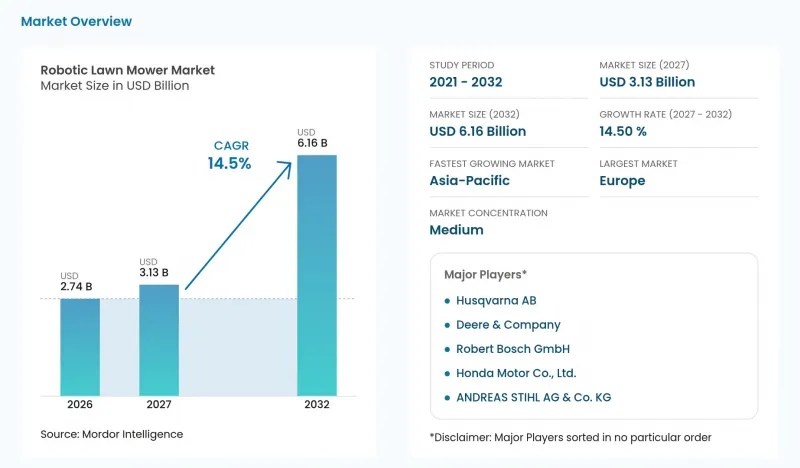
This report is segmented by Range (Medium and more), Navigation Technology (Boundary-Wire and more), End-User (Residential and more), Distribution Channel (Offline and more), and Geography (Europe, North America, and more). The market forecasts are provided in terms of value (USD), based on availability.
Global Robotic Lawn Mower Market Trends and Insights
Rising Residential Lawn-Care Outsourcing
Residential outsourcing offers mower suppliers a route to households through lawn-care operators. In September 2025, TruGreen said it served more than 2.3 million residential and commercial customers across all 50 U.S. states through company-owned and franchised locations. GreenPal recorded 238,374 U.S. lawn-care bookings in the 30 days before June 5, 2026, up 6.6% from the prior 30-day period. LawnStarter analyzed more than 2 million mowing jobs completed through its platform across more than 2,000 U.S. cities in 2025. These service relationships give suppliers potential operator customers with recurring cutting work to automate. A provider's decision to add autonomous mowing to several customer routes could turn that service base into a bulk-buyer channel for equipment.
Shift Toward Battery-Electric Outdoor Equipment
Electrification gives autonomous mowing another route into decisions about replacing lawn-maintenance equipment. In the rolling 12 months through September 2025, Husqvarna Group's combined robotics and battery categories accounted for 22% of Group sales, compared with 20% in the prior-year period. California began phasing in zero smog-forming emission standards for new spark-ignition small off-road engines of 25 hp and below in model year 2026, reaching zero by model year 2028. Manufacturers may use emission-reduction credits until used or expired, and owners can continue using and repairing existing CARB-compliant equipment. The sales mix signals product-category weight, while California's rules change the conditions for new engines. For suppliers, the opening is an electric mowing offer that also substitutes for cutting work, without relying on an owner replacement mandate.
High Upfront Cost versus Conventional Mowers
Purchasing a robotic mower commits funds before any operating savings can offset the equipment cost. STIHL France's 2026 tax-included selling prices for iMOW robotic mowers ranged from EUR 699 to EUR 1,799. Recovering that outlay depends on how much recurring cutting the machine can actually replace. STIHL's listed prices were 33% to 59% below their nonpromotional 2025 levels, easing this burden. Even at the lowest listed price of EUR 699, buyers with little cutting work to automate must recover the full purchase cost from a small amount of replaced mowing.
Other drivers and restraints analyzed in the detailed report include:
- Labor Shortages in Landscaping Services
- Retailer Push for High-Margin Smart-Home SKUs
- Limited Performance on Uneven and Tall-Grass Terrains
For complete list of drivers and restraints, kindly check the Table Of Contents.
Segment Analysis
Medium-range mowers (501-2,000 square meters) accounted for a 42.56% share of the robotic lawn mower market size in 2026. In Ibaraki, Japan, PLOW installed a Sunseeker X5 rated for lawns up to 2,000 square meters at Ushiku Chateau's approximately 1,250-square-meter lawn. The medium range spans typical suburban lot sizes, which supports its role as the largest segment. The installation illustrates room to expand the maintained lawn without immediately moving to a higher-capacity class.
High-range mowers (more than 2,000 square meters) are forecast to be the fastest-growing segment at a 17.4% CAGR from 2027 to 2032. At the 2025 AIG Women's Open in Wales, 15 Husqvarna CEORA mowers managed all 18 fairways. The example illustrates how a large mowing requirement can be divided among several autonomous machines while retaining a single course-wide coverage objective. Suppliers in this range are judged on how many machines they can keep productive across the maintained area.
Boundary-wire mowers represented a 63.6% robotic lawn mower market share in 2026, making them the largest segment. The wire turns site preparation into part of the autonomous mowing system, with the working area defined before cutting begins. Its physical boundary does not depend on satellite reception or lighting conditions, supporting operation where those alternatives are less suitable. An established perimeter also retains value when replacing the mower, because switching navigation systems can require changing the site's mowing arrangement.
Vision / camera mowers are forecast to be the fastest-growing segment at a 19.3% CAGR from 2027 to 2032. MOVA reported that Frost & Sullivan ranked it first globally by sales volume of AI binocular robotic lawn mowers, a camera-based subset, from April 2025 through March 2026. The commercial test for visual navigation is how consistently the mower distinguishes its working area during autonomous cutting. GNSS / RTK-GPS offers a different configuration, with MAMMOTION launching iNavi NetRTK for compatible U.S. mowers in April 2026 without a physical RTK base station. For that service-based configuration, eliminating the local station changes what must be deployed on the property without removing the need for positioning support.
Complete Report Scope:
- By Range
- Low (Less Than 500 m2)
- Medium (501-2,000 m2)
- High (More Than 2,000 m2)
- By Navigation Technology
- Boundary-Wire
- Vision / Camera
- GNSS / RTK-GPS
- By End-User
- Residential
- Commercial
- By Distribution Channel
- Online (Direct, Marketplaces)
- Offline (DIY Stores, Specialty Dealers)
- By Geography
- North America
- United States
- Canada
- Rest of North America
- Europe
- Germany
- United Kingdom
- France
- Spain
- Italy
- Rest of Europe
- Asia-Pacific
- China
- Japan
- South Korea
- India
- Australia
- New Zealand
- Rest of Asia-Pacific
- South America
- Brazil
- Argentina
- Rest of South America
- Middle East
- United Arab Emirates
- Saudi Arabia
- Iran
- Oman
- Rest of Middle East
- Africa
- South Africa
- Rest of Africa
- North America
Geography Analysis
Europe held a 44.47% share of the robotic lawn mower market size in 2026. GFU reported NIQ data showing 110,000 robotic lawn mowers sold in Germany from January through April 2025, up 45% from the same period in 2024. The European Commission opened a 9-month customs-registration window for Chinese-origin electric robot mower imports into the EU from January 24, 2026, enabling retroactive duties only if the legal conditions are met. For importers of covered Chinese-origin mowers, possible retroactive duties add landed-cost risk that this registration measure does not impose on European-built equipment.
Asia-Pacific is forecast to be the fastest-growing region at a 15.9% CAGR from 2027 to 2032. In September 2026, Inside Golf reported that Woodford Golf Club in Victoria, Australia, saved around 20 labor hours per week after trialing autonomous mowers on its fairways. A weekly time saving gives managers a measure of the staff hours a mowing task returns, alongside the equipment's nominal coverage capacity. For Asia-Pacific suppliers, this creates an entry route through defined turf-maintenance tasks, with further demand tied to whether another site's operating schedule can accommodate autonomous fairway work.
In North America, the Town of Palm Beach, Florida, marked robotic-mower implementation for most mowing at Seaview Park complete in its adopted FY2025-2026 budget. In South America, specialists at a 2026 golf-industry panel said about 90% of Brazil's golf courses sit within residential condominiums, where combustion-equipment noise restricts mowing hours. Saudi Arabia's HS-code-dependent wireless conformity route covers devices with radio transmitters, including combinations with non-radio equipment, creating a conditional entry consideration in the Middle East. In Africa, BroCo Turf reported delivering an FJDynamics MYR 21 autonomous mower and ball picker to South Africa's Fancourt Golf Estate in 2026. The municipal and golf-course examples point toward institutional buyers, while Saudi entry depends first on whether the configured product falls within that wireless route.
- Husqvarna AB
- ANDREAS STIHL AG & Co. KG
- Honda Motor Co., Ltd.
- Deere & Company
- Robert Bosch GmbH
- Positec Technology Co., Ltd.
- The Toro Company
- Stanley Black & Decker, Inc.
- STIGA S.p.A. (3i Group plc)
- Globe Tools Group Co., Ltd.
- Segway Inc. (Ninebot Ltd.)
- Shenzhen Mammotion Innovation Co., Ltd.
- EcoFlow Technology Inc.
- FJDynamics International Ltd.
- Yamabiko Corporation
Additional Benefits:
- The market estimate (ME) sheet in Excel format
- 3 months of analyst support
TABLE OF CONTENTS
1 INTRODUCTION
- 1.1 Study Assumptions and Market Definition
- 1.2 Scope of the Study
2 RESEARCH METHODOLOGY
3 EXECUTIVE SUMMARY
4 MARKET LANDSCAPE
- 4.1 Market Overview
- 4.2 Market Drivers
- 4.2.1 Rising Residential Lawn-Care Outsourcing
- 4.2.2 Shift Toward Battery-Electric Outdoor Equipment
- 4.2.3 Labor Shortages in Landscaping Services
- 4.2.4 Retailer Push for High-Margin Smart-Home SKUs
- 4.2.5 Advent of Vision-Based, Perimeter-Free Navigation
- 4.2.6 Original Equipment Manufacturer Subscription Models for Autonomous Mowing
- 4.3 Market Restraints
- 4.3.1 High Upfront Cost versus Conventional Mowers
- 4.3.2 Limited Performance on Uneven and Tall-Grass Terrains
- 4.3.3 Cyber-Security and Data-Privacy Concerns
- 4.3.4 Fire-Risk Recalls of Li-ion Garden Equipment
- 4.4 Industry Value Chain Analysis
- 4.5 Regulatory Landscape
- 4.6 Technological Outlook
- 4.7 Porter's Five Forces Analysis
- 4.7.1 Threat of New Entrants
- 4.7.2 Bargaining Power of Suppliers
- 4.7.3 Bargaining Power of Buyers
- 4.7.4 Threat of Substitutes
- 4.7.5 Competitive Rivalry
5 MARKET SIZE AND GROWTH FORECASTS (VALUE)
- 5.1 By Range
- 5.1.1 Low (Less Than 500 m2)
- 5.1.2 Medium (501-2,000 m2)
- 5.1.3 High (More Than 2,000 m2)
- 5.2 By Navigation Technology
- 5.2.1 Boundary-Wire
- 5.2.2 Vision / Camera
- 5.2.3 GNSS / RTK-GPS
- 5.3 By End-User
- 5.3.1 Residential
- 5.3.2 Commercial
- 5.4 By Distribution Channel
- 5.4.1 Online (Direct, Marketplaces)
- 5.4.2 Offline (DIY Stores, Specialty Dealers)
- 5.5 By Geography
- 5.5.1 North America
- 5.5.1.1 United States
- 5.5.1.2 Canada
- 5.5.1.3 Rest of North America
- 5.5.2 Europe
- 5.5.2.1 Germany
- 5.5.2.2 United Kingdom
- 5.5.2.3 France
- 5.5.2.4 Spain
- 5.5.2.5 Italy
- 5.5.2.6 Rest of Europe
- 5.5.3 Asia-Pacific
- 5.5.3.1 China
- 5.5.3.2 Japan
- 5.5.3.3 South Korea
- 5.5.3.4 India
- 5.5.3.5 Australia
- 5.5.3.6 New Zealand
- 5.5.3.7 Rest of Asia-Pacific
- 5.5.4 South America
- 5.5.4.1 Brazil
- 5.5.4.2 Argentina
- 5.5.4.3 Rest of South America
- 5.5.5 Middle East
- 5.5.5.1 United Arab Emirates
- 5.5.5.2 Saudi Arabia
- 5.5.5.3 Iran
- 5.5.5.4 Oman
- 5.5.5.5 Rest of Middle East
- 5.5.6 Africa
- 5.5.6.1 South Africa
- 5.5.6.2 Rest of Africa
- 5.5.1 North America
6 COMPETITIVE LANDSCAPE
- 6.1 Market Concentration
- 6.2 Strategic Moves
- 6.3 Market Share Analysis
- 6.4 Company Profiles (includes Global level Overview, Market level overview, Core Segments, Financials as available, Strategic Information, Market Rank/Share for key companies, Products and Services, and Recent Developments)
- 6.4.1 Husqvarna AB
- 6.4.2 ANDREAS STIHL AG & Co. KG
- 6.4.3 Honda Motor Co., Ltd.
- 6.4.4 Deere & Company
- 6.4.5 Robert Bosch GmbH
- 6.4.6 Positec Technology Co., Ltd.
- 6.4.7 The Toro Company
- 6.4.8 Stanley Black & Decker, Inc.
- 6.4.9 STIGA S.p.A. (3i Group plc)
- 6.4.10 Globe Tools Group Co., Ltd.
- 6.4.11 Segway Inc. (Ninebot Ltd.)
- 6.4.12 Shenzhen Mammotion Innovation Co., Ltd.
- 6.4.13 EcoFlow Technology Inc.
- 6.4.14 FJDynamics International Ltd.
- 6.4.15 Yamabiko Corporation
7 MARKET OPPORTUNITIES AND FUTURE OUTLOOK
- 7.1 White-Space and Unmet-Need Assessment

