PUBLISHER: Mordor Intelligence | PRODUCT CODE: 2187398

PUBLISHER: Mordor Intelligence | PRODUCT CODE: 2187398
United Kingdom Data Center - Market Share Analysis, Industry Trends & Statistics, Growth Forecasts (2027 - 2032)
According to Mordor Intelligence, the United Kingdom data center market size was valued at 3.71 thousand megawatt in 2026 and estimated to grow from 5.8 thousand megawatt in 2027 to reach 53.12 thousand megawatt by 2032, at a CAGR of 55.73% during the forecast period (2027-2032).
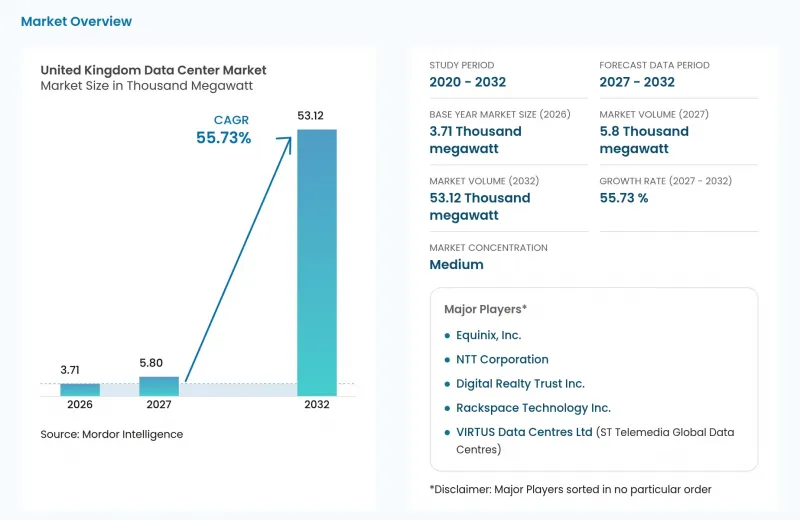
This report is segmented by Data Center Size (Massive, Large, and more), Tier Type (Tier 3, Tier 1 and 2, and more), Data Center Type (Colocation, Hyperscale / Self-built, and more), End User (IT and ITES, Other End Users, and more), and Hotspot (Greater London and Rest of United Kingdom). The market forecasts are provided in terms of volume (megawatt), based on availability.
United Kingdom Data Center Market Trends and Insights
Surge in hyperscale cloud and AI compute demand
AI demand creates facility requirements through both shared public systems and commercial cloud-capacity commitments. In June 2026, the University of Bristol reported 5,448 Nvidia GH200 Grace Hopper superchips in Isambard-AI, its public AI-compute facility. The university operates the system through the Bristol Centre for Supercomputing within the government-funded AI Research Resource, providing access for academia and industry. On August 13, 2026, Vantage Data Centers and Nebius agreed that Nebius would lease high-density, Nvidia-powered AI capacity at Vantage's operating CWL1 campus in Newport, Wales. The lease was intended to support training, inference, and enterprise AI workloads. Nebius's agreement to lease high-density campus capacity gives facility operators a commercial demand signal, while Isambard-AI shows AI compute at public-sector scale.
Growth of 5G and edge computing across the United Kingdom
Industrial network deployment connects the 5G driver to specific locations and compute applications. Ofcom reported that UK monthly 5G traffic increased approximately 53% to 348 PB in 2025 compared with 2024. In June 2025, Verizon Business, Thames Freeport, and Nokia announced a private-5G partnership for logistics, manufacturing, and innovation sites along the Thames Estuary. Verizon was to deploy the networks with Nokia as sole hardware and software supplier, including its MX Industrial Edge platform. The partners identified edge-compute infrastructure as a planned use of the network buildout, which would also enable process automation, safety monitoring, and real-time logistics orchestration. Edge capacity tied to these Thames Estuary sites would serve individual port and manufacturing applications, favoring suppliers able to place processing close to each site's operations.
Power-grid connection delays in London availability zones
Power access can separate a completed building from capacity that an operator can put to commercial use. NESO's Greater London transitional energy plan, published in January 2026, described West London transmission and distribution constraints as limiting growth and causing significant connection delays. The plan concerned the price-control period from 2028 to 2033. For a developer exposed to those constraints, construction progress alone cannot establish when customer equipment can be energized. A connection delay can therefore postpone the conversion of development spending into service income even when demand supports the site. For a buyer with a fixed deployment date, a firm energization window can consequently outweigh a faster building schedule.
Other drivers and restraints analyzed in the detailed report include:
- Rising adoption of hybrid IT among BFSI and enterprise segments
- Government incentives for digital infrastructure and the National Planning Policy Framework
- Escalating construction and energy costs
For complete list of drivers and restraints, kindly check the Table Of Contents.
Segment Analysis
Massive facilities accounted for a 55.14% share of the United Kingdom data center market size in 2026. Colt DCS plans 3 hyperscale data centers at its London Hayes campus, adding 98 MW of IT power and taking total campus capacity to 160 MW, with first-phase delivery planned for 2028. Colt states that delivery of the buildings can be altered to meet customer requirements. For a buyer concentrating a large load, the sequence in which campus buildings are delivered shapes when capacity becomes usable.
Mega facilities are the fastest-growing segment, with a forecast CAGR of 71.2% during 2027-2032. Their smaller starting base means this expansion begins with less capacity than the established massive estate. Buyers seeking additional mega-scale blocks therefore depend on new campus deliveries, with 2027-2032 the forecast window for expanding that supply.
Tier 3 represented a 76.84% United Kingdom data center market share in 2026. Apollo and Stantec's October 2025 study reported that most UK data-center facilities fell into Uptime Institute Tier III. Uptime Institute defines Tier III as concurrently maintainable, using redundant components and distribution paths so components can be shut down for maintenance or replacement without affecting IT operation.
Tier 4 is the fastest-growing segment, with a forecast CAGR of 124.6% during 2027-2032. Uptime Institute lists IONOS Cloud Ltd.'s Worcester facility in the United Kingdom with Tier IV design-document and constructed-facility certifications. Tier IV adds physically isolated redundant systems, fault-tolerant power for all IT equipment and continuous cooling to protect operations from equipment or distribution-path failures, although redundant-system maintenance shutdowns may increase risk during another failure. Apollo and Stantec's October 2025 study reported growing demand for Tier IV facilities to support cloud computing, AI, and mission-critical applications requiring ultra-reliable, fault-tolerant infrastructure. Worcester's certification gives buyers a UK example of constructed fault-tolerant infrastructure, making protection against equipment failure a concrete facility specification beyond component redundancy.
Complete Report Scope:
- By Data Center Size
- Small
- Medium
- Large
- Mega
- Massive
- By Tier Type
- Tier 1 and 2
- Tier 3
- Tier 4
- By Data Center Type
- Hyperscale / Self-built
- Enterprise / Edge
- Colocation
- Non-Utilized
- Utilized
- Retail Colocation
- Wholesale Colocation
- By End User
- BFSI
- IT and ITES
- E-Commerce
- Government
- Manufacturing
- Media and Entertainment
- Telecom
- Other End Users
- By Hotspot
- Greater London
- Rest of United Kingdom
List of Companies Covered in this Report:
- Digital Realty Trust Inc.
- Equinix, Inc.
- VIRTUS Data Centres Ltd (ST Telemedia Global Data Centres)
- IBM Corporation
- Ark Data Centres
- Vantage Data Centers Management Company, LLC
- NTT Corporation
- CyrusOne LLC
- Redcentric Data Centres
- Rackspace Technology Inc.
- Green Mountain AS
- Global Switch Holdings Limited
- Amazon Web Services, Inc.
- Telehouse International Corporation of Europe Ltd
- Oracle Corporation
Additional Benefits:
- The market estimate (ME) sheet in Excel format
- 3 months of analyst support
TABLE OF CONTENTS
1 INTRODUCTION
- 1.1 Study Assumptions and Market Definition
- 1.2 Scope of the Study
2 RESEARCH METHODOLOGY
3 EXECUTIVE SUMMARY
4 MARKET LANDSCAPE
- 4.1 Market Overview
- 4.2 Market Drivers
- 4.2.1 Surge in hyperscale cloud and AI compute demand
- 4.2.2 Growth of 5G and edge computing across the United Kingdom
- 4.2.3 Rising adoption of hybrid IT among BFSI and enterprise segments
- 4.2.4 Government incentives for digital infrastructure and the National Planning Policy Framework
- 4.2.5 Proliferation of new submarine-cable landings on the United Kingdom east coast
- 4.2.6 Repurposing of legacy industrial estates into AI-ready campuses in northern England
- 4.3 Market Restraints
- 4.3.1 Power-grid connection delays in London availability zones
- 4.3.2 Escalating construction and energy costs
- 4.3.3 Stringent sustainability and carbon-reduction regulations
- 4.3.4 Skilled-labor shortage for liquid-cooling and high-density operations outside London
- 4.4 Industry Value Chain Analysis
- 4.5 Regulatory Landscape
- 4.6 Technological Outlook
- 4.7 Porter's Five Forces Analysis
- 4.7.1 Threat of New Entrants
- 4.7.2 Bargaining Power of Suppliers
- 4.7.3 Bargaining Power of Buyers
- 4.7.4 Threat of Substitutes
- 4.7.5 Competitive Rivalry
- 4.8 Market Outlook
- 4.8.1 IT Load Capacity
- 4.8.2 Raised Floor Space
- 4.8.3 Colocation Revenue
- 4.8.4 Installed Racks
- 4.8.5 Rack Space Utilization
- 4.8.6 Submarine Cable
- 4.9 Key Industry Trends
- 4.9.1 Smartphone Users
- 4.9.2 Data Traffic Per Smartphone
- 4.9.3 Mobile Data Speed
- 4.9.4 Broadband Data Speed
- 4.9.5 Fiber Connectivity Network
- 4.9.6 Regulatory Framework
- 4.9.6.1 Greater London
- 4.9.6.2 Rest of United Kingdom
5 MARKET SIZE AND GROWTH FORECASTS (VOLUME)
- 5.1 By Data Center Size
- 5.1.1 Small
- 5.1.2 Medium
- 5.1.3 Large
- 5.1.4 Mega
- 5.1.5 Massive
- 5.2 By Tier Type
- 5.2.1 Tier 1 and 2
- 5.2.2 Tier 3
- 5.2.3 Tier 4
- 5.3 By Data Center Type
- 5.3.1 Hyperscale / Self-built
- 5.3.2 Enterprise / Edge
- 5.3.3 Colocation
- 5.3.3.1 Non-Utilized
- 5.3.3.2 Utilized
- 5.3.3.2.1 Retail Colocation
- 5.3.3.2.2 Wholesale Colocation
- 5.4 By End User
- 5.4.1 BFSI
- 5.4.2 IT and ITES
- 5.4.3 E-Commerce
- 5.4.4 Government
- 5.4.5 Manufacturing
- 5.4.6 Media and Entertainment
- 5.4.7 Telecom
- 5.4.8 Other End Users
- 5.5 By Hotspot
- 5.5.1 Greater London
- 5.5.2 Rest of United Kingdom
6 COMPETITIVE LANDSCAPE
- 6.1 Market Concentration
- 6.2 Strategic Moves
- 6.3 Market Share Analysis
- 6.4 Company Profiles (includes Global level Overview, Market level overview, Core Segments, Financials as available, Strategic Information, Market Rank/Share for key companies, Products and Services, and Recent Developments)
- 6.4.1 Digital Realty Trust Inc.
- 6.4.2 Equinix, Inc.
- 6.4.3 VIRTUS Data Centres Ltd (ST Telemedia Global Data Centres)
- 6.4.4 IBM Corporation
- 6.4.5 Ark Data Centres
- 6.4.6 Vantage Data Centers Management Company, LLC
- 6.4.7 NTT Corporation
- 6.4.8 CyrusOne LLC
- 6.4.9 Redcentric Data Centres
- 6.4.10 Rackspace Technology Inc.
- 6.4.11 Green Mountain AS
- 6.4.12 Global Switch Holdings Limited
- 6.4.13 Amazon Web Services, Inc.
- 6.4.14 Telehouse International Corporation of Europe Ltd
- 6.4.15 Oracle Corporation
7 MARKET OPPORTUNITIES AND FUTURE OUTLOOK
- 7.1 White-Space and Unmet-Need Assessment

