PUBLISHER: Mordor Intelligence | PRODUCT CODE: 2187399

PUBLISHER: Mordor Intelligence | PRODUCT CODE: 2187399
India Payment Gateway - Market Share Analysis, Industry Trends & Statistics, Growth Forecasts (2027 - 2032)
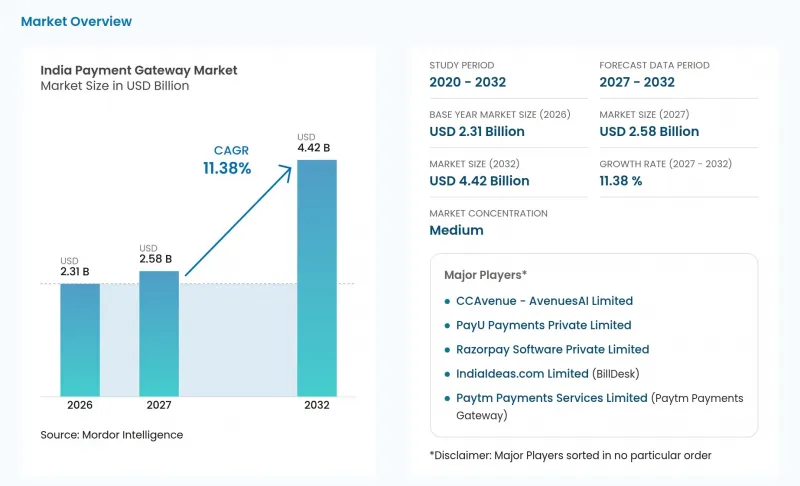
According to Mordor Intelligence, the India payment gateway market size is expected to increase from USD 2.31 billion in 2026 to USD 2.58 billion in 2027 and reach USD 4.42 billion by 2032, growing at a CAGR of 11.38% over 2027-2032.
This report is segmented by Payment Mode (UPI and more), Organization Size (Large Enterprises and more), Deployment Mode (Cloud-Based and more), End-User Industry (E-Commerce and Marketplaces and more), and Geography (West India and more). The market forecasts are provided in terms of value (USD), based on availability.
India Payment Gateway Market Trends and Insights
Surge in E-Commerce and D2C Transactions
Online sellers need payment processing that can support a growing flow of completed digital purchases. Online card payment volume in India rose 28% to 4.34 billion transactions in 2025 compared with 2024. The increase makes card acceptance a material component of the online seller's processing requirement. For direct-to-consumer businesses offering checkout through their own storefronts, supporting that activity can make the gateway's card-processing capability part of the sales infrastructure. That volume supports retaining card processing in gateway offers even as other payment options are added.
Explosive UPI Adoption and International Expansion
UPI adoption creates a substantial merchant-facing use case within a payment rail that also serves transfers between individuals. UPI processed 241.6 billion transactions in India in FY2025-26, with transaction volume growing 30% year over year. Person-to-merchant payments accounted for 63% of UPI transaction volume in H1 2025, when UPI processed 106.36 billion transactions. That merchant component makes the rail relevant to sellers' acceptance needs, alongside its role in personal transfers. For gateways, the paying business relationship can therefore center on the merchant receiving funds through checkout.
Zero-MDR Economics Pressure on Gateways
High payment activity offers limited direct monetization where the merchant discount rate, or MDR, is zero. In September 2026, the Ministry of Finance announced a UPI framework retaining zero MDR for merchant payments up to INR 2,000 (USD 20.85) and qualifying small-merchant receipts. MDR applies to specified larger merchant transactions, leaving about 96% of merchant transactions unaffected. Small-merchant eligibility covers receipts up to INR 100,000 (USD 1,042.5) per month through UPI QR codes under the Person-to-Person-Merchant category. That extensive coverage limits the discount-rate revenue available on covered flows, which narrows what acceptance volume alone can fund for gateway businesses.
Other drivers and restraints analyzed in the detailed report include:
- Government-Backed Digital Public Infrastructure
- MSME Digital On-Boarding Incentives (PIDF through 2025, ONDC)
- Intensifying RBI Compliance and PA Licensing Costs
For complete list of drivers and restraints, kindly check the Table Of Contents.
Segment Analysis
UPI accounted for a 63.95% share of the India payment gateway market size in 2026, making it the largest segment. The UPI platform had 554.9 million onboarded users in India as of June 2026. That enrollment creates a substantial potential audience for merchants considering bank-linked checkout, even though each seller must secure its own customers. With the consumer side already enrolled at that scale, the gateway proposition centers on merchant integration and checkout reliability.
BNPL is forecast to grow at an 11.7% CAGR during 2027-2032, making it the fastest-growing segment. On July 30, 2026, Flipkart Group launched Pay Later across Flipkart, Myntra, and Flipkart Minutes in partnership with PayU Finance. The offering provides repayment within 30 days, in 3 payments, or through 3-to-12-month EMIs for higher-value categories. PayU Finance is the licensed lender, while Flipkart Finance manages customer relationships and credit intelligence. The gateway opportunity lies in connecting merchant checkout with these defined repayment choices, so suppliers must coordinate acceptance with the lending relationship.
Large enterprises represented a 57.04% India payment gateway market share in 2026, making them the largest segment. IRCTC's in-house iPay gateway was reported to process about 20% of its ticketing platform gross merchandise value in April 2026. That example illustrates a substantial payment program in which the merchant also operates a gateway. An outside provider approaching a buyer with its own gateway must earn a role alongside an internal payment operation, rather than assume all processing will be outsourced. The commercial task is to win a defined acceptance role within a substantial enterprise program, making account depth more relevant than the number of merchant connections.
Small and medium enterprises are forecast to grow at a 12.35% CAGR over 2027-2032, making them the fastest-growing segment. India SME Forum's voluntary 2024-25 survey covered 7,835 MSMEs using convenience sampling. Among digitized respondents, 70.4% used e-commerce platforms, an indicative finding from the survey. For a digitally engaged smaller seller, the practical requirement is a payment service that fits the business's existing online selling workflow. That favors gateway distribution through the seller's commerce environment, linking merchant acquisition and payment integration to an existing digital selling relationship.
Complete Report Scope:
- By Payment Mode
- UPI
- Cards
- Net-Banking
- Wallets
- BNPL
- By Organization Size
- Small and Medium Enterprises
- Large Enterprises
- By Deployment Mode
- Cloud-Based
- On-Premise
- Hybrid
- By End-User Industry
- E-Commerce and Marketplaces
- Retail and FMCG
- BFSI and FinTech Platforms
- Healthcare and Pharmaceuticals
- Education and Ed-Tech
- Travel and Hospitality
- By Geography
- North India
- West India
- South India
- East and Northeast India
- Central India
List of Companies Covered in this Report:
- PayU Payments Private Limited
- Razorpay Software Private Limited
- Paytm Payments Services Limited (Paytm Payments Gateway)
- CCAvenue - AvenuesAI Limited
- IndiaIdeas.com Limited (BillDesk)
- PayPal Payments Private Limited
- Instamojo Technologies Private Limited
- One MobiKwik Systems Limited
- Cashfree Payments India Private Limited
- Pine Labs Limited (Plural by Pine Labs)
- Stripe India Private Limited
- Worldline ePayments India Private Limited
- Google India Digital Services Private Limited (Google Pay for Merchants)
- Amazon Pay (India) Private Limited
- BharatPe (Resilient Innovations Private Limited)
- Juspay Technologies Private Limited
- PayG Solutions Private Limited
- Fiserv Merchant Solutions Private Limited (IMSL-Fiserv)
- Adyen India Technology Services Private Limited
- Payoneer India Private Limited
Additional Benefits:
- The market estimate (ME) sheet in Excel format
- 3 months of analyst support
TABLE OF CONTENTS
1 INTRODUCTION
- 1.1 Study Assumptions and Market Definition
- 1.2 Scope of the Study
2 RESEARCH METHODOLOGY
3 EXECUTIVE SUMMARY
4 MARKET LANDSCAPE
- 4.1 Market Overview
- 4.2 Market Drivers
- 4.2.1 Surge in E-Commerce and D2C Transactions
- 4.2.2 Explosive UPI Adoption and International Expansion
- 4.2.3 Government-Backed Digital Public Infrastructure
- 4.2.4 MSME Digital On-Boarding Incentives (PIDF through 2025, ONDC)
- 4.2.5 API-First Open Finance and Embedded Payments
- 4.2.6 Rapid Growth of Credit-on-UPI and BNPL
- 4.3 Market Restraints
- 4.3.1 Zero-MDR Economics Pressure on Gateways
- 4.3.2 Intensifying RBI Compliance and PA Licensing Costs
- 4.3.3 Rising Fraud, Cyber-Risk and Outage Incidents
- 4.3.4 Merchant Concentration Among Top UPI Apps
- 4.4 Industry Value Chain Analysis
- 4.5 Regulatory Landscape
- 4.6 Technological Outlook
- 4.7 Porter's Five Forces Analysis
- 4.7.1 Threat of New Entrants
- 4.7.2 Bargaining Power of Suppliers
- 4.7.3 Bargaining Power of Buyers
- 4.7.4 Threat of Substitutes
- 4.7.5 Competitive Rivalry
- 4.8 Impact of Macroeconomic Factors
5 MARKET SIZE AND GROWTH FORECASTS (VALUE)
- 5.1 By Payment Mode
- 5.1.1 UPI
- 5.1.2 Cards
- 5.1.3 Net-Banking
- 5.1.4 Wallets
- 5.1.5 BNPL
- 5.2 By Organization Size
- 5.2.1 Small and Medium Enterprises
- 5.2.2 Large Enterprises
- 5.3 By Deployment Mode
- 5.3.1 Cloud-Based
- 5.3.2 On-Premise
- 5.3.3 Hybrid
- 5.4 By End-User Industry
- 5.4.1 E-Commerce and Marketplaces
- 5.4.2 Retail and FMCG
- 5.4.3 BFSI and FinTech Platforms
- 5.4.4 Healthcare and Pharmaceuticals
- 5.4.5 Education and Ed-Tech
- 5.4.6 Travel and Hospitality
- 5.5 By Geography
- 5.5.1 North India
- 5.5.2 West India
- 5.5.3 South India
- 5.5.4 East and Northeast India
- 5.5.5 Central India
6 COMPETITIVE LANDSCAPE
- 6.1 Market Concentration
- 6.2 Strategic Moves
- 6.3 Market Share Analysis
- 6.4 Company Profiles (includes Global level Overview, Market level overview, Core Segments, Financials as available, Strategic Information, Market Rank/Share for key companies, Products and Services, and Recent Developments)
- 6.4.1 PayU Payments Private Limited
- 6.4.2 Razorpay Software Private Limited
- 6.4.3 Paytm Payments Services Limited (Paytm Payments Gateway)
- 6.4.4 CCAvenue - AvenuesAI Limited
- 6.4.5 IndiaIdeas.com Limited (BillDesk)
- 6.4.6 PayPal Payments Private Limited
- 6.4.7 Instamojo Technologies Private Limited
- 6.4.8 One MobiKwik Systems Limited
- 6.4.9 Cashfree Payments India Private Limited
- 6.4.10 Pine Labs Limited (Plural by Pine Labs)
- 6.4.11 Stripe India Private Limited
- 6.4.12 Worldline ePayments India Private Limited
- 6.4.13 Google India Digital Services Private Limited (Google Pay for Merchants)
- 6.4.14 Amazon Pay (India) Private Limited
- 6.4.15 BharatPe (Resilient Innovations Private Limited)
- 6.4.16 Juspay Technologies Private Limited
- 6.4.17 PayG Solutions Private Limited
- 6.4.18 Fiserv Merchant Solutions Private Limited (IMSL-Fiserv)
- 6.4.19 Adyen India Technology Services Private Limited
- 6.4.20 Payoneer India Private Limited
7 MARKET OPPORTUNITIES AND FUTURE OUTLOOK
- 7.1 White-Space and Unmet-Need Assessment

