PUBLISHER: Mordor Intelligence | PRODUCT CODE: 2187662

PUBLISHER: Mordor Intelligence | PRODUCT CODE: 2187662
United States Lawn Care - Market Share Analysis, Industry Trends & Statistics, Growth Forecasts (2027 - 2032)
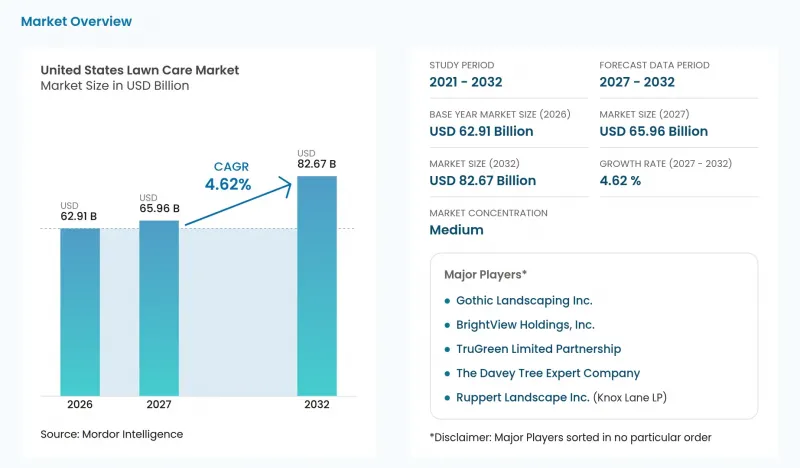
According to Mordor Intelligence, the United States lawn care market size was valued at USD 62.91 billion in 2026 and estimated to grow from USD 65.96 billion in 2027 to reach USD 82.67 billion by 2032, at a CAGR of 4.62% during the forecast period (2027-2032).
This report is segmented by Service Type (Maintenance Services and Ancillary Services), Application (Commercial and Industrial, Residential, and more), Business Model (Subscription Contracts and One-Off / On-Demand Visits), and Distribution Channel (Direct In-House Teams, Franchise Network, and more). The market forecasts are provided in terms of value (USD), based on availability.
United States Lawn Care Market Trends and Insights
Ongoing Migration to Sun-Belt States Increasing Lawn Footprints
Population movement can expand the customer base for recurring lawn care where new residents occupy properties with maintained grounds. The U.S. Census Bureau estimated South Carolina's net domestic migration at 66,622 from July 1, 2024, through June 30, 2025. That migration contributed to population growth of 79,958 between July 1, 2024, and July 1, 2025. For service providers, the relevant transmission is additional occupied properties requiring upkeep, rather than population growth automatically becoming lawn acreage. Concentrated settlement would create a stronger opportunity than equally large inflows scattered across distant service areas.
Growth in Golf Course Renovations and New Short-Course Formats
New short-course formats and course renovations create an opening for specialist turf care around new or restored playing surfaces. Over the 5 years preceding July 2025, short courses accounted for 41 U.S. golf-course openings, representing 37% of openings. Three-fifths of those short-course openings were at higher-end private or resort destinations. In GCSAA's 2025 survey, 55% of superintendent respondents reported major drainage projects during the previous 3 years, and 47% reported rebuilding sand bunkers. Providers serving these properties could connect care following construction with the grounds requirements of the wider destination. A bid covering the transition into recurring upkeep would address both the renewed course and its surrounding property, broadening the service relationship beyond an isolated project.
Acute Seasonal Labor Shortages Despite H-2B Supplemental Visa Allocations
Staffing limits can prevent a maintenance contractor from committing to additional work even when customer demand is available. In a survey of 1,015 U.S. commercial landscape owners and executives conducted May 2-23, 2025, Aspire reported labor shortages threatening timely job starts and finishes. The FY2026 H-2B rule authorized up to 64,716 supplemental visas across 3 start-date-based allocations for employers attesting to actual or impending irreparable harm, defined as permanent and severe financial loss. That conditional access makes supplemental availability different from assured staffing for an individual service provider. Aspire's 2027 outlook also identified labor among commercial landscaping operators' biggest concerns. For contractors expanding seasonal work, the remaining constraint is the cost and timing of securing enough qualified people to fulfill each commitment.
Other drivers and restraints analyzed in the detailed report include:
- DIY-Turned-DIWM (Do-It-With-Me) Consumer Trend
- Rapid Adoption of Robotic and Autonomous Mowing Equipment
- Escalating Fuel and Equipment Costs Squeezing Margins
For complete list of drivers and restraints, kindly check the Table Of Contents.
Segment Analysis
Maintenance services accounted for a 91.68% share of the United States lawn care market size in 2026 and were both the largest segment and the fastest-growing segment, with a forecast CAGR of 4.8% during 2027-2032. BrightView's Maintenance Services reporting segment, covering commercial landscaping and snow removal, generated USD 1.51 billion in net service revenue in the 9 months ended June 30, 2026. Repeated service requires execution quality to be reproduced across care cycles rather than delivered only at project handover. For a commercial owner, a maintenance agreement can place routine mowing and related upkeep under a continuing grounds-care responsibility. The provider therefore competes on reliable repetition, making delivery discipline part of the commercial offer alongside the physical lawn-care work.
Maintenance growth can also arise from the depth of a service account rather than a separate property-development project. In the 3 months ended June 30, 2026, BrightView's commercial landscaping revenue grew 2.3% year over year, which it attributed to higher contract revenue and, to a lesser extent, ancillary services. That combination supports an account-development strategy in which repeated core work provides a base for separately scoped additional assignments. Providers pursuing that strategy would need to distinguish the core care commitment from each added task, so the commercial relationship can expand without making responsibility for routine upkeep unclear.
Commercial and industrial applications represented a 53.68% United States lawn care market share in 2026, making this the largest segment. BrightView reported approximately 7,400 office parks and corporate campuses in its broad commercial landscaping customer base for fiscal 2025, with operations principally conducted through BrightView Landscapes, LLC. For a commercial owner managing more than one property, a consistent care scope could bring related grounds assignments under a shared service relationship while allowing site-specific work. That creates a route to larger account responsibilities for contractors able to reproduce agreed work across commercial sites, making service integration relevant to the segment's scale.
Golf courses and sports facilities are the fastest-growing segment, with a forecast CAGR of 9.6% during 2027-2032. U.S. golf-course rounds were 1.1% higher in January-August 2026 than in January-August 2025, although August 2026 rounds fell 5.1% year over year. For course operators, variation in play can make the timing of turf care as important as the annual maintenance scope. Municipal and government buyers also define specific work, as Hoboken's 2026 solicitation for rights-of-way and resiliency-park maintenance included lawn rehabilitation, aeration, seeding, and irrigation. Performance-focused golf care and formally specified public-space work would therefore favor different service capabilities within the broader application mix.
Complete Report Scope:
- By Service Type
- Maintenance Services
- Mowing
- Fertilization and Weed Control
- Irrigation System Maintenance
- Pest Control
- Ancillary Services
- Landscape Design and Installation
- Hardscaping Services
- Snow Removal
- Maintenance Services
- By Application
- Residential
- Commercial and Industrial
- Golf Courses and Sports Facilities
- Municipal and Government
- By Business Model
- Subscription Contracts
- One-Off / On-Demand Visits
- By Distribution Channel
- Direct In-House Teams
- Franchise Network
- Online Marketplaces
List of Companies Covered in this Report:
- BrightView Holdings, Inc.
- TruGreen Limited Partnership
- The Davey Tree Expert Company
- Yellowstone Landscape, Inc. (Harvest Partners, LP)
- Gothic Landscaping Inc.
- Park West Inc.
- Ruppert Landscape Inc. (Knox Lane LP)
- LandCare USA LLC
- HeartLand LLC (Pritzker Private Capital)
- SavATree, Inc. (Apax Partners LLP)
- Spring-Green Lawn Care Corp. (Spring-Green Enterprises Inc.)
- Landscape Development, Inc.
- Schill Grounds Maintenance, Inc. (Argonne Capital Group)
- Augusta Lawn Care Services, LLC
- Gibbs Landscape Company
Additional Benefits:
- The market estimate (ME) sheet in Excel format
- 3 months of analyst support
TABLE OF CONTENTS
1 INTRODUCTION
- 1.1 Study Assumptions and Market Definition
- 1.2 Scope of the Study
2 RESEARCH METHODOLOGY
3 EXECUTIVE SUMMARY
4 MARKET LANDSCAPE
- 4.1 Market Overview
- 4.2 Market Drivers
- 4.2.1 Ongoing Migration to Sun-Belt States Increasing Lawn Footprints
- 4.2.2 Growth in Golf Course Renovations and New Short-Course Formats
- 4.2.3 DIY-Turned-DIWM (Do-It-With-Me) Consumer Trend
- 4.2.4 Rapid Adoption of Robotic and Autonomous Mowing Equipment
- 4.2.5 Rising Millennial Home-Ownership and Outdoor Living Upgrades
- 4.2.6 Landscaping Tax Incentives in Water-Stressed Municipalities
- 4.3 Market Restraints
- 4.3.1 Acute Seasonal Labor Shortages Despite H-2B Supplemental Visa Allocations
- 4.3.2 Escalating Fuel and Equipment Costs Squeezing Margins
- 4.3.3 Rising Liability Insurance Premiums for Contractors
- 4.3.4 Fragmented Regulatory Codes Across States Inflating Compliance Cost
- 4.4 Industry Value Chain Analysis
- 4.5 Regulatory Landscape
- 4.6 Technological Outlook
- 4.7 Porter's Five Forces Analysis
- 4.7.1 Threat of New Entrants
- 4.7.2 Bargaining Power of Suppliers
- 4.7.3 Bargaining Power of Buyers
- 4.7.4 Threat of Substitutes
- 4.7.5 Competitive Rivalry
5 MARKET SIZE AND GROWTH FORECASTS (VALUE)
- 5.1 By Service Type
- 5.1.1 Maintenance Services
- 5.1.1.1 Mowing
- 5.1.1.2 Fertilization and Weed Control
- 5.1.1.3 Irrigation System Maintenance
- 5.1.1.4 Pest Control
- 5.1.2 Ancillary Services
- 5.1.2.1 Landscape Design and Installation
- 5.1.2.2 Hardscaping Services
- 5.1.2.3 Snow Removal
- 5.1.1 Maintenance Services
- 5.2 By Application
- 5.2.1 Residential
- 5.2.2 Commercial and Industrial
- 5.2.3 Golf Courses and Sports Facilities
- 5.2.4 Municipal and Government
- 5.3 By Business Model
- 5.3.1 Subscription Contracts
- 5.3.2 One-Off / On-Demand Visits
- 5.4 By Distribution Channel
- 5.4.1 Direct In-House Teams
- 5.4.2 Franchise Network
- 5.4.3 Online Marketplaces
6 COMPETITIVE LANDSCAPE
- 6.1 Market Concentration
- 6.2 Strategic Moves
- 6.3 Market Share Analysis
- 6.4 Company Profiles (includes Global level Overview, Market level overview, Core Segments, Financials as available, Strategic Information, Market Rank/Share for key companies, Products and Services, and Recent Developments)
- 6.4.1 BrightView Holdings, Inc.
- 6.4.2 TruGreen Limited Partnership
- 6.4.3 The Davey Tree Expert Company
- 6.4.4 Yellowstone Landscape, Inc. (Harvest Partners, LP)
- 6.4.5 Gothic Landscaping Inc.
- 6.4.6 Park West Inc.
- 6.4.7 Ruppert Landscape Inc. (Knox Lane LP)
- 6.4.8 LandCare USA LLC
- 6.4.9 HeartLand LLC (Pritzker Private Capital)
- 6.4.10 SavATree, Inc. (Apax Partners LLP)
- 6.4.11 Spring-Green Lawn Care Corp. (Spring-Green Enterprises Inc.)
- 6.4.12 Landscape Development, Inc.
- 6.4.13 Schill Grounds Maintenance, Inc. (Argonne Capital Group)
- 6.4.14 Augusta Lawn Care Services, LLC
- 6.4.15 Gibbs Landscape Company
7 MARKET OPPORTUNITIES AND FUTURE OUTLOOK
- 7.1 White-Space and Unmet-Need Assessment

