PUBLISHER: Mordor Intelligence | PRODUCT CODE: 2187665

PUBLISHER: Mordor Intelligence | PRODUCT CODE: 2187665
India POS Terminals - Market Share Analysis, Industry Trends & Statistics, Growth Forecasts (2027 - 2032)
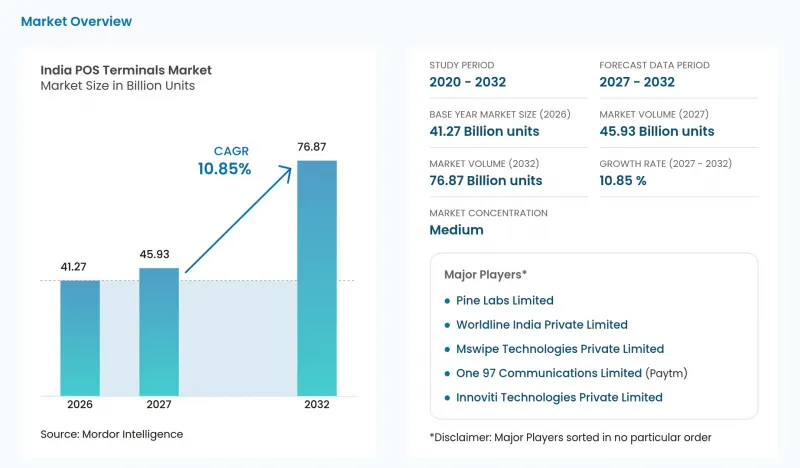
According to Mordor Intelligence, the India POS terminals market size is expected to increase from 41.27 billion units in 2026 to 45.93 billion units in 2027 and reach 76.87 billion units by 2032, growing at a CAGR of 10.85% over 2027-2032.
This report is segmented by Mode of Payment Acceptance (Contact-based and Contactless), POS Type (Mobile / Portable Point-of-Sale Systems and Fixed Point-of-Sale Systems), and End-User Industry (Retail, Hospitality, Other End-user Industries, Healthcare, and Transportation and Logistics). The market forecasts are provided in terms of volume (units), based on availability.
India POS Terminals Market Trends and Insights
PIDF subsidies accelerated Tier-3-Tier-6 roll-outs
Subsidized deployment lowered the initial expansion hurdle for payment acceptance beyond major urban centers. During FY2024-25, the Reserve Bank of India (RBI) said Payments Infrastructure Development Fund (PIDF) subsidies aided digital-payment growth by subsidizing acceptance-infrastructure availability, especially in Tier 3-6 centers. By November 30, 2025, the Department of Financial Services reported 841,018 physical payment devices deployed through PIDF in Tier 5-6 centers. The scheme's stated term ended December 31, 2025, making its established footprint the relevant foundation for subsequent terminal opportunities. These were installed physical acceptance devices, giving acquirers an equipped merchant base rather than an unserved prospect pool. Follow-on demand at those locations depends on whether transaction activity justifies keeping equipment active after the initial deployment support.
Surging credit-card base (>100 mn) lifts card-swipe volumes
India had 124.05 million credit cards outstanding in August 2026, compared with 112.34 million in August 2025. Credit-card transactions at POS terminals in India totaled 2.868 billion in 2025, up 23% year over year. These separate measures strengthen the commercial case for physical acceptance by showing both a large card base and rising credit-card transaction volume at terminals. Higher transaction throughput can improve the case for funding a terminal at locations that attract card spending. For acquiring banks, targeting those locations links deployment to a measurable payment need and limits exposure to devices with insufficient card use.
Zero-MDR low-value UPI erodes small-merchant economics
Zero-MDR acceptance limits the revenue pool available to support device-based services for small merchants. From October 15, 2026, qualifying P2PM small merchants receiving low monthly UPI QR receipts directly into their accounts retained exemption from MDR, including on individual payments above the standard threshold. In its September 2026 FAQ, the Department of Financial Services said only well-capitalized technology conglomerates could sustain long-term operating losses under zero-MDR UPI processing. For a provider considering physical terminals at those merchants, payment processing alone can offer a weak basis for recovering equipment and service costs. Unless the terminal supplies monetizable functions beyond exempt UPI flows, its provider faces the continuing expense of supporting a physical device with limited transaction-fee income.
Other drivers and restraints analyzed in the detailed report include:
- Omni-payment Android POS (cards + UPI + BNPL in one device)
- GST e-invoice compliance driving real-time POS upgrades
- QR-code ubiquity dampens new POS demand
For complete list of drivers and restraints, kindly check the Table Of Contents.
Segment Analysis
Contact-based terminals accounted for a 54.92% share of the India POS terminals market size in 2026, making them the largest segment. Because the share measures installed stock, renewal can sustain a large contact-based footprint even when the format chosen for an entirely new location differs. Replacing a card-contact device at an equipped merchant preserves an existing acceptance point rather than creating a new one, so renewal demand does not depend on finding an additional merchant. The supplier's commercial task is to retain the installed account through its next replacement decision, while judging new-location opportunities separately.
Contactless is the fastest-growing segment, with a projected CAGR of 11.95% over 2027-2032. PhonePe and Mastercard launched smartphone contactless payments on September 29, 2025, with a phased rollout for eligible Mastercard cardholders. The feature requires an NFC-enabled Android phone and a merchant terminal with NFC functionality. By allowing an eligible phone to become the payment instrument, this arrangement can expand the ways an existing contactless endpoint is used. New placements become commercially compelling where eligible mobile-payment use encounters an absence of NFC-capable merchant equipment.
Complete Report Scope:
- By Mode of Payment Acceptance
- Contact-based
- Contactless
- By POS Type
- Fixed Point-of-Sale Systems
- Mobile / Portable Point-of-Sale Systems
- By End-User Industry
- Retail
- Hospitality
- Healthcare
- Transportation and Logistics
- Other End-user Industries
List of Companies Covered in this Report:
- Pine Labs Limited
- One 97 Communications Limited (Paytm)
- Worldline India Private Limited
- Mswipe Technologies Private Limited
- Innoviti Technologies Private Limited
- Razorpay Payments Private Limited (Ezetap)
- Verifone India Sales Private Limited
- Ingenico International India Private Limited
- SBI Payment Services Private Limited
- HDFC Bank Limited
- ICICI Bank Limited
- Axis Bank Limited
- RBL Bank Limited
- Kotak Mahindra Bank Limited
- Union Bank of India
- BharatPe (Resilient Innovations Private Limited)
- PhonePe Limited
- First Data (India) Private Limited
- Hitachi Payment Services Private Limited
- PayU Payments Private Limited
Additional Benefits:
- The market estimate (ME) sheet in Excel format
- 3 months of analyst support
TABLE OF CONTENTS
1 INTRODUCTION
- 1.1 Study Assumptions and Market Definition
- 1.2 Scope of the Study
2 RESEARCH METHODOLOGY
3 EXECUTIVE SUMMARY
4 MARKET LANDSCAPE
- 4.1 Market Overview
- 4.2 Market Drivers
- 4.2.1 PIDF subsidies accelerated Tier-3-Tier-6 roll-outs
- 4.2.2 Surging credit-card base (>100 mn) lifts card-swipe volumes
- 4.2.3 Omni-payment Android POS (cards + UPI + BNPL in one device)
- 4.2.4 GST e-invoice compliance driving real-time POS upgrades
- 4.2.5 Smart-mall boom in Tier-2/3 cities raises fixed-POS demand
- 4.2.6 Advanced analytics/AI add-ons boosting retailer ROI
- 4.3 Market Restraints
- 4.3.1 Zero-MDR low-value UPI erodes small-merchant economics
- 4.3.2 QR-code ubiquity dampens new POS demand
- 4.3.3 High total-cost-of-ownership for micro-merchants
- 4.3.4 RBI PA-Physical directions raise compliance cost
- 4.4 Industry Value Chain Analysis
- 4.5 Regulatory Landscape
- 4.6 Technological Outlook
- 4.7 Porter's Five Forces Analysis
- 4.7.1 Threat of New Entrants
- 4.7.2 Bargaining Power of Suppliers
- 4.7.3 Bargaining Power of Buyers
- 4.7.4 Threat of Substitutes
- 4.7.5 Competitive Rivalry
5 MARKET SIZE AND GROWTH FORECASTS (VOLUME)
- 5.1 By Mode of Payment Acceptance
- 5.1.1 Contact-based
- 5.1.2 Contactless
- 5.2 By POS Type
- 5.2.1 Fixed Point-of-Sale Systems
- 5.2.2 Mobile / Portable Point-of-Sale Systems
- 5.3 By End-User Industry
- 5.3.1 Retail
- 5.3.2 Hospitality
- 5.3.3 Healthcare
- 5.3.4 Transportation and Logistics
- 5.3.5 Other End-user Industries
6 COMPETITIVE LANDSCAPE
- 6.1 Market Concentration
- 6.2 Strategic Moves
- 6.3 Market Share Analysis
- 6.4 Company Profiles (includes Global level Overview, Market level overview, Core Segments, Financials as available, Strategic Information, Market Rank/Share for key companies, Products and Services, and Recent Developments)
- 6.4.1 Pine Labs Limited
- 6.4.2 One 97 Communications Limited (Paytm)
- 6.4.3 Worldline India Private Limited
- 6.4.4 Mswipe Technologies Private Limited
- 6.4.5 Innoviti Technologies Private Limited
- 6.4.6 Razorpay Payments Private Limited (Ezetap)
- 6.4.7 Verifone India Sales Private Limited
- 6.4.8 Ingenico International India Private Limited
- 6.4.9 SBI Payment Services Private Limited
- 6.4.10 HDFC Bank Limited
- 6.4.11 ICICI Bank Limited
- 6.4.12 Axis Bank Limited
- 6.4.13 RBL Bank Limited
- 6.4.14 Kotak Mahindra Bank Limited
- 6.4.15 Union Bank of India
- 6.4.16 BharatPe (Resilient Innovations Private Limited)
- 6.4.17 PhonePe Limited
- 6.4.18 First Data (India) Private Limited
- 6.4.19 Hitachi Payment Services Private Limited
- 6.4.20 PayU Payments Private Limited
7 MARKET OPPORTUNITIES AND FUTURE OUTLOOK
- 7.1 White-Space and Unmet-Need Assessment

