PUBLISHER: Mordor Intelligence | PRODUCT CODE: 2187672

PUBLISHER: Mordor Intelligence | PRODUCT CODE: 2187672
Iced Tea - Market Share Analysis, Industry Trends & Statistics, Growth Forecasts (2027 - 2032)
According to Mordor Intelligence, the iced tea market size is expected to increase from USD 61.47 billion in 2026 to USD 64.18 billion in 2027 and reach USD 80.06 billion by 2032, growing at a CAGR of 4.52% over 2027-2032.
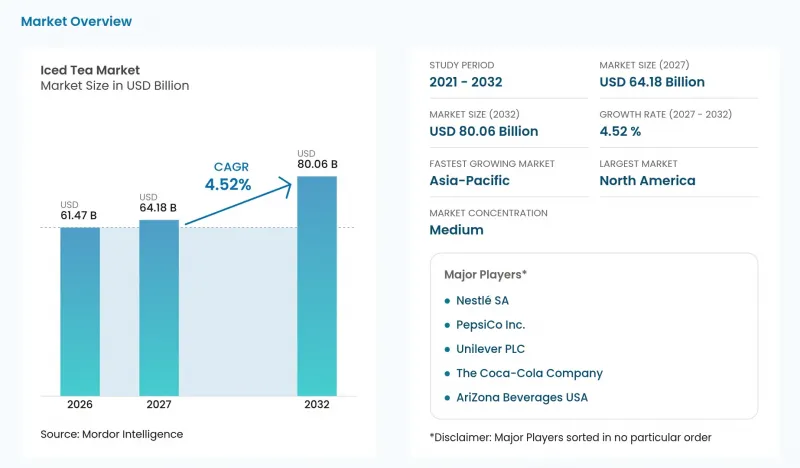
This report is segmented by Product Type (Black Iced Tea, Green Iced Tea, and more), Form (Ready-to-Drink, Powder/Premix, and more), Flavor Profile (Flavored and Unflavored), Packaging Type (PET Bottles, Cans, and more), Distribution Channel (Off-Trade and On-Trade), and Geography (North America, Europe, and more). The market forecasts are provided in terms of value (USD), based on availability.
Global Iced Tea Market Trends and Insights
Rising preference for healthier alternative to carbonated soft-drinks
Lower-sugar preferences create a formulation-specific opening for iced tea suppliers competing for health-oriented beverage spending. In EY's survey conducted in November and December 2025, 66% of US respondents said they choose lower-sugar, lower-calorie drinks. Separately, sugar-free ready-to-drink tea sales value rose 12.16% year over year in China's traditional offline retail channels in the third quarter of 2026, according to Mashangying Brand CT. The commercial case therefore extends beyond a general wellness message to a product tier with an observed sales result. Suppliers addressing this opportunity have a stronger basis for prioritizing reduced-sugar formulations than for applying the same health positioning across an entire sweetened tea portfolio.
Continuous flavor innovation and line extensions
Flavor development can give iced tea brands a way to address a specific household audience rather than simply expand assortment. In early 2026, Fuze Tea Te Verde-Maracuya was among the brand's fastest-growing flavors in Spain, with 50% of its volume coming from households in the under-49 age group. That buyer profile gives green tea and passion fruit a commercially defined audience without requiring the same proposition for every household. Coca-Cola Spain also launched the seasonal Fuze Tea Te Verde & Lima Menta flavor for summer 2026. Together, the examples suggest distinct roles for a growing flavor and a seasonal extension within the same portfolio. The demand opportunity lies in matching flavor development to audience and occasion, rather than treating every added variety as interchangeable growth.
Intense competition from other healthy beverages
For suppliers of packaged iced tea, competition from other health-oriented drinks limits the value of a tea-based identity alone. In a June 2025 Beverage Industry article, Beverage Marketing Corporation senior analyst Roger Dilworth attributed some US ready-to-drink tea consumers' switch to PET water, sparkling water, and functional beverages to sugar-reduction trends. A buyer seeking less sugar can compare the finished recipe across beverage categories, so a tea supplier must offer a reason to retain that buyer's spending. An iced tea positioned around refreshment may face a different competitive test from one positioned around a functional benefit. This substitution risk exposes suppliers in North America, the largest region, to lost beverage spending even when their products retain a familiar tea identity.
Other drivers and restraints analyzed in the detailed report include:
- Convenience and on-the-go consumption
- Premiumization and clean-label positioning
- Sugar-reduction regulations raising reformulation costs
For complete list of drivers and restraints, kindly check the Table Of Contents.
Segment Analysis
Black iced tea accounted for a 37.88% share of the iced tea market size in 2026, making it the largest segment. Kirin Beverage's 2 fruit-flavored black-tea iced teas reached cumulative shipments of 50 million bottles in Japan by February 3, 2026, following their September 23, 2025 launch. The range paired orange with grapefruit and white grape with lemon, bringing fruit variation to a black-tea base. Shipments at that scale within about 4 months show that fruit variation can build commercial volume on a black-tea base.
Herbal iced tea is forecast to be the fastest-growing segment, with a 6.25% CAGR over 2027-2032. ChariTea Red, a rooibos iced tea, was part of a 3-product rollout into 141 larger Waitrose stores in the United Kingdom reported complete by January 6, 2026. Red combines South African rooibos with passion fruit and agave, giving the range a botanical base distinct from its other tea offerings. Because the 141-store rollout covered 3 products together, the rooibos variant reached shelves alongside ChariTea's other teas within one retailer listing.
Ready-to-drink tea represented a 78.52% iced tea market share in 2026, making it the largest segment. Fuze Tea, distributed by Coca-Cola Europacific Partners, had more than 3.1 million buyer households across Spain in early 2026. For this format, household reach illustrates the commercial relevance of a complete beverage that does not require consumers to prepare the tea themselves.
Powder/premix is forecast to be the fastest-growing segment, with a 5.52% CAGR over 2027-2032. Continental Coffee, a subsidiary of CCL Products (India), launched THIS Lemon Iced Tea Premix as CCL's first consumer-facing tea product for pan-India availability. The move extended a tea business previously offered through institutional formats into a product consumers could prepare themselves. Concentrate/syrup offers another preparation route, with LIPTON Teas and Infusions introducing 32-ounce concentrates exclusively at Walmart in July 2025 for mixing with water, seltzer, lemonade, or juice. These formats let the supplier sell a tea base while leaving the final mixing step to the buyer, creating a household proposition distinct from a finished bottled drink.
Complete Report Scope:
- By Product Type
- Black Iced Tea
- Green Iced Tea
- Herbal Iced Tea
- Fruit Iced Tea
- Other Product Types
- By Form
- Ready-to-Drink
- Powder/Premix
- Concentrate/Syrup
- By Flavor Profile
- Unflavored
- Flavored
- By Packaging Type
- PET Bottles
- Tetra Packs
- Cans
- Other Packaging Types
- By Distribution Channel
- On-Trade
- Off-Trade
- Supermarkets/Hypermarkets
- Convenience Stores
- Online Retail Stores
- Food-service and HoReCa
- Other Distribution Channels
- By Geography
- North America
- United States
- Canada
- Mexico
- Rest of North America
- South America
- Brazil
- Colombia
- Argentina
- Rest of South America
- Europe
- Germany
- United Kingdom
- France
- Italy
- Spain
- Russia
- Netherlands
- Rest of Europe
- Asia-Pacific
- China
- Japan
- India
- South Korea
- Australia
- Indonesia
- Vietnam
- Rest of Asia-Pacific
- Middle East and Africa
- United Arab Emirates
- Saudi Arabia
- Turkey
- South Africa
- Egypt
- Rest of Middle East and Africa
- North America
Geography Analysis
North America accounted for a 43.78% share of the iced tea market size in 2026, making it the largest region. In April 2025, Just Ice Tea doubled its US retail store footprint to 12,000 stores, adding chains including Target and CVS and regional placements at 7-Eleven and Walmart. The brand's bottle and can formats give this distribution model more than one packaged presentation for retailers. Regional placement can complement broader chain access, giving an expanding brand a way to add stores without treating every retail relationship as a nationwide account.
Asia-Pacific is forecast to be the fastest-growing region, with a 7.3% CAGR over 2027-2032. In China, Nongfu Spring reported 30.1% revenue growth for its ready-to-drink tea business in the first half of 2026 versus the same period of 2025. The producer also launched an iced lemon-flavor carbonated tea beverage made with whole-leaf tea extract and real lemon juice in 2025. Nongfu Spring's range extension adds a carbonated option to an established tea operation, giving the producer another way to compete for finished-drink purchases.
In Europe, Fuze Tea's presence at more than 150,000 Spanish foodservice establishments in 2025 illustrates the reach available through restaurant and hospitality channels. In South America, Andina Brazil, a subsidiary of Embotelladora Andina, sold and distributed Leao Ice Tea in 2025 across all of Espirito Santo and parts of 3 other Brazilian states. Within the Middle East and Africa, Almarai reported solid year-end 2025 performance for its Saudi ready-to-drink iced tea brand Ice Leaf, which addressed on-the-go use. Foodservice breadth and territorial bottling provide different routes for supplying packaged tea, while the Saudi example emphasizes consumption outside the home. For a supplier, working with that bottler means subnational rather than national reach in Brazil, so wider coverage needs other routes.
- PepsiCo Inc.
- Unilever PLC
- The Coca-Cola Company
- AriZona Beverages USA
- Keurig Dr Pepper Inc.
- Nestle SA
- Tata Consumer Products Ltd.
- Milo's Tea Company
- Brew Dr. Tea Company
- Starbucks Corporation
- BOS Brands
- 4C Foods Corp.
- Jade Forest
- Hain Celestial Group
- Halfday Iced Tea
- Saint James Tea
- The Ryl Company
- Otsuka Foods Co., Ltd.
- Weird Beverages
- Gujarat Tea Processors and Packers Ltd. (GTPPL)
Additional Benefits:
- The market estimate (ME) sheet in Excel format
- 3 months of analyst support
TABLE OF CONTENTS
1 INTRODUCTION
- 1.1 Study Assumptions and Market Definition
- 1.2 Scope of the Study
2 RESEARCH METHODOLOGY
3 EXECUTIVE SUMMARY
4 MARKET LANDSCAPE
- 4.1 Market Overview
- 4.2 Market Drivers
- 4.2.1 Rising preference for healthier alternative to carbonated soft-drinks
- 4.2.2 Continuous flavor innovation and line extensions
- 4.2.3 Convenience and on-the-go consumption
- 4.2.4 Premiumization and clean-label positioning
- 4.2.5 Indulgence of social media and collaboration
- 4.2.6 Increasing awareness of sustainability and ethical sourcing
- 4.3 Market Restraints
- 4.3.1 Intense competition from other healthy beverages
- 4.3.2 Sugar-reduction regulations raising reformulation costs
- 4.3.3 Regulatory and labeling compliance
- 4.3.4 Potential caffeine sensitivity concerns
- 4.4 Industry Value Chain Analysis
- 4.5 Regulatory Landscape
- 4.6 Technological Outlook
- 4.7 Porter's Five Forces Analysis
- 4.7.1 Threat of New Entrants
- 4.7.2 Bargaining Power of Suppliers
- 4.7.3 Bargaining Power of Buyers
- 4.7.4 Threat of Substitutes
- 4.7.5 Competitive Rivalry
- 4.8 Consumer Behaviour Analysis
5 MARKET SIZE AND GROWTH FORECASTS (VALUE)
- 5.1 By Product Type
- 5.1.1 Black Iced Tea
- 5.1.2 Green Iced Tea
- 5.1.3 Herbal Iced Tea
- 5.1.4 Fruit Iced Tea
- 5.1.5 Other Product Types
- 5.2 By Form
- 5.2.1 Ready-to-Drink
- 5.2.2 Powder/Premix
- 5.2.3 Concentrate/Syrup
- 5.3 By Flavor Profile
- 5.3.1 Unflavored
- 5.3.2 Flavored
- 5.4 By Packaging Type
- 5.4.1 PET Bottles
- 5.4.2 Tetra Packs
- 5.4.3 Cans
- 5.4.4 Other Packaging Types
- 5.5 By Distribution Channel
- 5.5.1 On-Trade
- 5.5.2 Off-Trade
- 5.5.2.1 Supermarkets/Hypermarkets
- 5.5.2.2 Convenience Stores
- 5.5.2.3 Online Retail Stores
- 5.5.2.4 Food-service and HoReCa
- 5.5.2.5 Other Distribution Channels
- 5.6 By Geography
- 5.6.1 North America
- 5.6.1.1 United States
- 5.6.1.2 Canada
- 5.6.1.3 Mexico
- 5.6.1.4 Rest of North America
- 5.6.2 South America
- 5.6.2.1 Brazil
- 5.6.2.2 Colombia
- 5.6.2.3 Argentina
- 5.6.2.4 Rest of South America
- 5.6.3 Europe
- 5.6.3.1 Germany
- 5.6.3.2 United Kingdom
- 5.6.3.3 France
- 5.6.3.4 Italy
- 5.6.3.5 Spain
- 5.6.3.6 Russia
- 5.6.3.7 Netherlands
- 5.6.3.8 Rest of Europe
- 5.6.4 Asia-Pacific
- 5.6.4.1 China
- 5.6.4.2 Japan
- 5.6.4.3 India
- 5.6.4.4 South Korea
- 5.6.4.5 Australia
- 5.6.4.6 Indonesia
- 5.6.4.7 Vietnam
- 5.6.4.8 Rest of Asia-Pacific
- 5.6.5 Middle East and Africa
- 5.6.5.1 United Arab Emirates
- 5.6.5.2 Saudi Arabia
- 5.6.5.3 Turkey
- 5.6.5.4 South Africa
- 5.6.5.5 Egypt
- 5.6.5.6 Rest of Middle East and Africa
- 5.6.1 North America
6 COMPETITIVE LANDSCAPE
- 6.1 Market Concentration
- 6.2 Strategic Moves
- 6.3 Market Share Analysis
- 6.4 Company Profiles (includes Global level Overview, Market level overview, Core Segments, Financials as available, Strategic Information, Market Rank/Share for key companies, Products and Services, and Recent Developments)
- 6.4.1 PepsiCo Inc.
- 6.4.2 Unilever PLC
- 6.4.3 The Coca-Cola Company
- 6.4.4 AriZona Beverages USA
- 6.4.5 Keurig Dr Pepper Inc.
- 6.4.6 Nestle SA
- 6.4.7 Tata Consumer Products Ltd.
- 6.4.8 Milo's Tea Company
- 6.4.9 Brew Dr. Tea Company
- 6.4.10 Starbucks Corporation
- 6.4.11 BOS Brands
- 6.4.12 4C Foods Corp.
- 6.4.13 Jade Forest
- 6.4.14 Hain Celestial Group
- 6.4.15 Halfday Iced Tea
- 6.4.16 Saint James Tea
- 6.4.17 The Ryl Company
- 6.4.18 Otsuka Foods Co., Ltd.
- 6.4.19 Weird Beverages
- 6.4.20 Gujarat Tea Processors and Packers Ltd. (GTPPL)
7 MARKET OPPORTUNITIES AND FUTURE OUTLOOK
- 7.1 White-Space and Unmet-Need Assessment

