PUBLISHER: Mordor Intelligence | PRODUCT CODE: 2187695

PUBLISHER: Mordor Intelligence | PRODUCT CODE: 2187695
United States Commercial Vehicles - Market Share Analysis, Industry Trends & Statistics, Growth Forecasts (2026 - 2031)
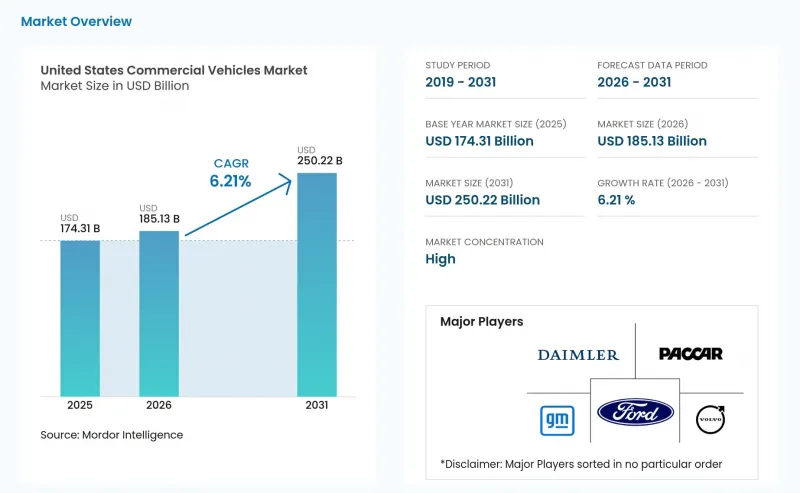
According to Mordor Intelligence, the United States commercial vehicle market size was valued at USD 174.31 billion in 2025 and is expected to increase from USD 185.13 billion in 2026 to reach USD 250.22 billion by 2031, growing at a CAGR of 6.21% over 2026-2031.
United States Commercial Vehicles Market Trends and Insights
Federal GHG Phase-3 and NOx Standards Accelerate Fleet Turnover
The Environmental Protection Agency finalized heavy-duty greenhouse-gas limits covering model years 2027-2032, pushing OEMs toward zero-emission drivelines. Manufacturers have responded by committing fresh capital to electric assembly capacity and by refreshing product roadmaps on accelerated timelines. Fleets with older vehicles now face a cost comparison between expensive diesel after-treatment retrofits and battery-electric models that qualify for federal purchase incentives. California's Advanced Clean Fleets rule was withdrawn in January 2025, though state fleet procurement policy and the Advanced Clean Trucks sales mandate continue to pull public and high-priority fleets toward zero-emission purchases . The combined federal-state policy stack is shortening replacement cycles and boosting order books for zero-emission chassis.
E-Commerce Surge Raising Last-Mile Light-CV Demand
United States online retail exceeded USD 1 trillion in 2025, intensifying parcel volumes that favor nimble, battery-electric vans. Amazon, FedEx, and UPS have each unveiled multiyear electrification roadmaps, locking in thousands of van orders and stimulating a secondary ecosystem of charging-depot integrators. Same-day delivery guarantees in dense metros reinforce the need for vehicles that recharge quickly during planned dwell times. As delivery windows shrink, operators increasingly value the instant torque and regenerative-brake wear savings inherent to electric drivetrains. The resulting demand is cascading into Tier-1 supplier tooling for purpose-built light-commercial platforms.
Grid-Upgrade Delays at Warehouse Depots
Utilities in several Midwestern and Southeastern states report double-digit-month interconnection queues for high-capacity depot chargers. Fleets planning to deploy dozens of electric trucks often discover that nearby substations lack headroom, necessitating costly upgrades that push out project timelines. Some operators, therefore, renew diesel leases until power-delivery schedules align with fleet replacement cycles. The lag risks creating uneven geographic adoption, with coastal and hydro-powered regions moving faster toward electrification than interior states.
Other drivers and restraints analyzed in the detailed report include:
- USD 7.5 Billion NEVI Funding for Nationwide Charging and Fueling Corridors
- Corporate ESG Targets Pushing Zero-Emission Fleet Procurement
- Inflationary Pressure on Lithium-Iron-Phosphate Cathode Minerals
For complete list of drivers and restraints, kindly check the Table Of Contents.
Segment Analysis
Light commercial vans accounted for 31.58% of 2025 revenue, the largest share in the United States commercial vehicle market. Their compact design makes them ideal for navigating urban streets, while their frequent stops maximize the benefits of regenerative braking. This segment is also projected to grow at the fastest rate, with a CAGR of 7.61%, as parcel carriers increasingly focus on decarbonizing their last-mile delivery fleets to meet sustainability goals and regulatory requirements. OEMs are actively expanding their offerings by introducing various wheelbase and roof-height options to address a broader range of cargo applications.
Additionally, e-commerce-focused body conversions now incorporate modular shelving and advanced telematics systems, which help optimize route density and improve operational efficiency. Fleet operators are particularly drawn to the reduced maintenance downtime offered by electric drivetrains compared to traditional diesel engines, which translates to lower operational costs and increased vehicle availability. At the same time, public incentives for depot chargers are easing the financial burden of transitioning to electric fleets, especially for small and medium enterprises, making the shift more accessible and practical for a wider range of businesses.
ICE propulsion retained 62.76% of 2025 revenue, the highest within the propulsion mix. Meanwhile, hybrid and electric vehicles are poised to achieve the fastest growth rate, with a 16.24% CAGR, driven by tightening emissions regulations that are making diesel maintenance increasingly expensive. This shift highlights the growing pressure on traditional propulsion systems to adapt to evolving environmental standards. Fleet decisions are becoming more reliant on predictable duty cycles and fluctuating electricity tariffs. For routes spanning urban and regional areas under 250 miles, the total cost of ownership for battery-electric vehicles is nearing parity with diesel, especially when incentives are factored in.
OEMs are ramping up in-house battery sourcing, aiming to mitigate commodity risks and accelerate development timelines. By securing their supply chains, OEMs are better positioned to meet the growing demand for electric vehicles while maintaining competitive pricing. However, the quest for infrastructure interoperability is proving challenging, with the industry still divided over connector standards, namely CCS and NACS. This lack of standardization continues to create uncertainty for fleet operators, underscoring the need for collaborative efforts to streamline charging solutions and enhance adoption rates.
Complete Report Scope:
- By Vehicle Type
- Buses
- Heavy-Duty Commercial Trucks
- Medium-Duty Commercial Trucks
- Light Commercial Pick-up Trucks
- Light Commercial Vans
- By Propulsion Type
- Hybrid and Electric Vehicles
- BEV
- FCEV
- HEV
- PHEV
- Internal Combustion Engine (ICE)
- Diesel
- CNG/LPG
- Gasoline
- Hybrid and Electric Vehicles
- By Gross Vehicle Weight Rating
- Class 1 (Below 1.8 t)
- Class 2 (1.8 to 3.5 t)
- Class 3 (3.5 to 7.5 t)
- Class 4 (7.5 to 16 t)
- Class 5 (Above 16 t)
- By End-Use Industry
- Logistics and E-commerce
- Construction and Mining
- Public Transport
- Utilities and Municipal Services
- Others (Agriculture, Retail)
List of Companies Covered in this Report:
- Daimler Truck Holding AG
- Ford Motor Company
- General Motors Company
- Hino Motors Ltd.
- Isuzu Motors Limited
- PACCAR Inc.
- Ram Trucks (Stellantis)
- Toyota Motor Corporation
- Volvo Group
- Navistar International Corp.
- Oshkosh Corporation
- Blue Bird Corporation
- Gillig LLC
- BYD Co. Ltd.
- Proterra Inc.
- Nikola Corporation
- Workhorse Group Inc.
- Rivian Automotive LLC
Additional Benefits:
- The market estimate (ME) sheet in Excel format
- 3 months of analyst support
TABLE OF CONTENTS
1 Introduction
- 1.1 Study Assumptions and Market Definition
- 1.2 Scope of the Study
2 Research Methodology
3 Executive Summary
4 Market Landscape
- 4.1 Market Overview
- 4.2 Key Industry Trend
- 4.2.1 Urbanization, Population and Vehicle/Transit Demand
- 4.2.2 EV Penetration in Commercial Vehicles
- 4.2.3 Fuel vs Electricity Price Spread (per km, ICE vs EV)
- 4.2.4 EV vs ICE Total Cost of Ownership (TCO) Gap
- 4.2.5 Financing and Ownership Models (Loans, Leasing, Subscription)
- 4.2.6 Battery Chemistry Mix and Pack Energy Density (LFP vs NMC etc.)
- 4.2.7 Home, Workplace and Public Charger Access / Density
- 4.2.8 Fast-Charging Network Coverage and Power Bands
- 4.2.9 Alternative Fuels Infrastructure (Hydrogen for FCEVs)
- 4.2.10 Subsidy and Consumer Incentive Value (Purchase, Tax, Toll/Parking Benefits)
- 4.2.11 OEM EV Line-up and Model Pipeline
- 4.2.12 Value-Chain and Distribution-Channel Analysis
- 4.2.13 Regulatory, Fiscal and Industrial Policy Framework
- 4.3 Market Drivers
- 4.3.1 Federal GHG Phase-3 and NOx Standards Accelerate Fleet Turnover
- 4.3.2 E-Commerce Surge Raising Last-Mile Light-CV Demand
- 4.3.3 USD 7.5 Billion NEVI Funding for Nationwide Charging and Fueling Corridors
- 4.3.4 Corporate ESG Targets Pushing Zero-Emission Fleet Procurement
- 4.3.5 Second-Life Battery Value Streams Lowering EV TCO
- 4.3.6 Autonomous-Ready Chassis Platforms Driving OEM Innovation
- 4.4 Market Restraints
- 4.4.1 Grid-Upgrade Delays at Warehouse Depots
- 4.4.2 Inflationary Pressure on Lithium-Iron-Phosphate Cathode Minerals
- 4.4.3 Shortage of Certified EV-CV Technicians
- 4.4.4 Tight Freight Rates Curbing Capex for Heavy-Duty Electrification
- 4.5 Value / Supply-Chain Analysis
- 4.6 Regulatory Landscape
- 4.7 Technological Outlook
- 4.8 Porter's Five Forces
- 4.8.1 Threat of New Entrants
- 4.8.2 Bargaining Power of Buyers
- 4.8.3 Bargaining Power of Suppliers
- 4.8.4 Threat of Substitutes
- 4.8.5 Intensity of Competitive Rivalry
5 Market Size and Growth Forecasts (Value and Volume)
- 5.1 By Vehicle Type
- 5.1.1 Buses
- 5.1.2 Heavy-Duty Commercial Trucks
- 5.1.3 Medium-Duty Commercial Trucks
- 5.1.4 Light Commercial Pick-up Trucks
- 5.1.5 Light Commercial Vans
- 5.2 By Propulsion Type
- 5.2.1 Hybrid and Electric Vehicles
- 5.2.1.1 BEV
- 5.2.1.2 FCEV
- 5.2.1.3 HEV
- 5.2.1.4 PHEV
- 5.2.2 Internal Combustion Engine (ICE)
- 5.2.2.1 Diesel
- 5.2.2.2 CNG/LPG
- 5.2.2.3 Gasoline
- 5.2.1 Hybrid and Electric Vehicles
- 5.3 By Gross Vehicle Weight Rating
- 5.3.1 Class 1 (Below 1.8 t)
- 5.3.2 Class 2 (1.8 to 3.5 t)
- 5.3.3 Class 3 (3.5 to 7.5 t)
- 5.3.4 Class 4 (7.5 to 16 t)
- 5.3.5 Class 5 (Above 16 t)
- 5.4 By End-Use Industry
- 5.4.1 Logistics and E-commerce
- 5.4.2 Construction and Mining
- 5.4.3 Public Transport
- 5.4.4 Utilities and Municipal Services
- 5.4.5 Others (Agriculture, Retail)
6 Competitive Landscape
- 6.1 Market Concentration
- 6.2 Strategic Moves
- 6.3 Market Share Analysis
- 6.4 Company Profiles (Includes Global level Overview, Market level overview, Core Segments, Financials as available, Strategic Information, Market Rank/Share for key companies, Products and Services, and Recent Developments)
- 6.4.1 Daimler Truck Holding AG
- 6.4.2 Ford Motor Company
- 6.4.3 General Motors Company
- 6.4.4 Hino Motors Ltd.
- 6.4.5 Isuzu Motors Limited
- 6.4.6 PACCAR Inc.
- 6.4.7 Ram Trucks (Stellantis)
- 6.4.8 Toyota Motor Corporation
- 6.4.9 Volvo Group
- 6.4.10 Navistar International Corp.
- 6.4.11 Oshkosh Corporation
- 6.4.12 Blue Bird Corporation
- 6.4.13 Gillig LLC
- 6.4.14 BYD Co. Ltd.
- 6.4.15 Proterra Inc.
- 6.4.16 Nikola Corporation
- 6.4.17 Workhorse Group Inc.
- 6.4.18 Rivian Automotive LLC
7 Market Opportunities and Future Outlook
- 7.1 White-space and Unmet-Need Assessment
8 Key Strategic Questions for CEOs

