PUBLISHER: Mordor Intelligence | PRODUCT CODE: 2187699

PUBLISHER: Mordor Intelligence | PRODUCT CODE: 2187699
India Hybrid Vehicles - Market Share Analysis, Industry Trends & Statistics, Growth Forecasts (2026 - 2031)
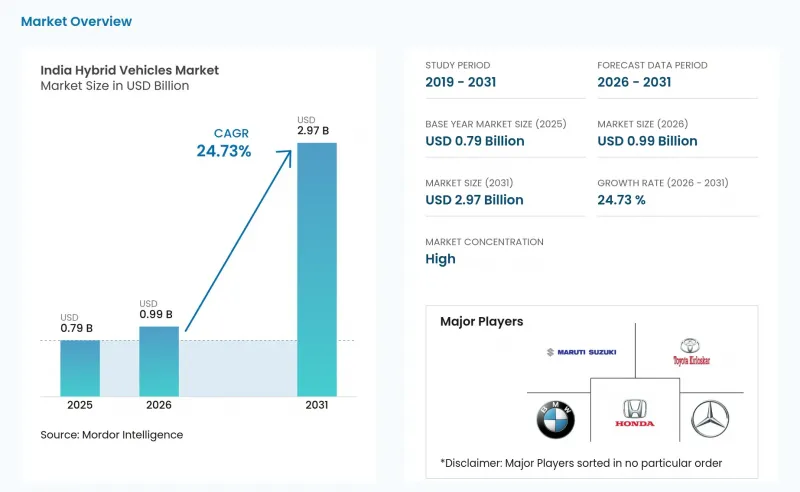
According to Mordor Intelligence, the India hybrid vehicles market size was valued at USD 0.79 billion in 2025 and is expected to increase from USD 0.99 billion in 2026 to reach USD 2.97 billion by 2031, growing at a 24.73% CAGR over 2026-2031.
India Hybrid Vehicles Market Trends and Insights
Stricter Fleet CO2 Norms Push OEM Hybrid Mix Higher
CAFE-III, finalized in 2025, retains the 2.0 derogation factor for strong hybrids, enabling each sale to count twice toward compliance, a boon for OEMs that rely on heavy SUVs. Integrating a strong-hybrid powertrain costs far less than redesigning an electric skateboard platform, so brands such as Toyota Kirloskar and Maruti Suzuki have publicly committed to a hybrid-led roadmap to 2030. Flex-fuel hybrids also earn additional CO2 credits, further easing targets. The small-car concession of 3 g CO2/km incentivizes hybrid hatchbacks, aligning regulatory rewards with entry-level affordability. This combination makes hybrids the most economical path to fleet compliance for the next decade.
Lower Import Tariffs Slash Hybrid BOM Cost
The 2025 Union Budget eliminated customs duties on 35 capital goods vital to battery and motor production. OEMs responded with fresh investments, such as Maruti Suzuki's new battery-pack line in Gujarat, targeting 200,000-unit annual capacity. Zero-duty equipment lowers the landed cost of cell-assembly lines, allowing suppliers to localize packs and motors and cut logistics lead times. Toyota's Karnataka plant already sources locally assembled NiMH modules, trimming transport from six weeks to just over a week. The tariff holiday, therefore, accelerates domestic value addition and price competitiveness.
Withdrawal Risk of PM E-DRIVE Subsidies Post-2028
While India's latest e-mobility subsidy initiative, PM E-DRIVE, extends its benefits, passenger cars find themselves excluded. With no clear roadmap set for post-2028, potential buyers in smaller cities are left in a quandary. They worry that as price parity approaches, hybrids might suddenly lose their fiscal backing. This looming uncertainty nudges Original Equipment Manufacturers (OEMs) to focus on product economics over incentives, hindering the adoption of hybrids outside major metropolitan areas.
Other drivers and restraints analyzed in the detailed report include:
- Mandatory Hybrid Share in State-Run Taxi & Bus Tenders
- Capex Subsidies Accelerate Local Hybrid Component Plants
- Limited Nickel-Rich Cathode Supply in India
For complete list of drivers and restraints, kindly check the Table Of Contents.
Segment Analysis
SUVs and crossovers commanded 39.13% of India's hybrid vehicle market share in 2025, underscoring their role as family-oriented status symbols. Strong ground clearance and high seating positions justify the technology premium for many urban buyers, while extensive dealer advertising keeps these larger vehicles top of mind. Even so, the hatchback segment is positioned for rapid diffusion because compact footprints simplify parking in crowded cities and reduce ownership anxiety for first-time buyers. Automakers also view hatchbacks as ideal compliance levers because lighter curb weights help offset emissions from heavier models across the fleet.
Hatchbacks post the fastest 28.71% CAGR through 2031, driven by localized battery integration that narrows price gaps and by rising demand in tier-2 catchment areas. Model pipelines now include hybrid versions of popular nameplates, signaling a strategic push into volume territory. Loan products with longer tenures further soften monthly outflows, giving budget-conscious households confidence to choose electrified options. As more consumers encounter hybrid hatchbacks during test drives or ride-sharing trips, familiarity should reinforce word-of-mouth adoption, expanding the Indian hybrid vehicles market.
The mid-range bracket held the largest 42.51% of India's hybrid vehicle market share in 2025, owing to crossovers that balance affordability with desirable features. Buyers in this tier value connected-car functions, panoramic roofs, and advanced safety aids, all of which pair well with hybrid efficiency narratives. Retail financiers bundle these extras into competitive EMIs, ensuring that discretionary features do not deter purchase decisions. Consequently, the mid-range space remains a reliable revenue anchor for leading manufacturers.
Entry-level hybrids are gaining momentum at a 28.54% CAGR, powered by localized systems that trim material costs and reduce sticker shock. Automakers are repurposing proven small-car platforms, which minimizes retooling and speeds time to market. Dealers emphasize lifetime fuel savings in marketing campaigns, reinforcing economic logic for buyers climbing the motorization ladder. As insurance premiums and maintenance packages become standardized, the perceived complexity of hybrid ownership fades, advancing mass-market penetration.
Complete Report Scope:
- By Vehicle Class
- Hatchback
- Sedan
- SUV / Crossover
- MPV
- By Price Band
- Entry
- Mid-Range
- Premium
- Luxury
- By Battery Chemistry
- Nickel-Metal Hydride (NiMH)
- Lithium Iron Phosphate (LFP)
- Lithium Nickel Manganese Cobalt Oxide (NMC)
- By Driving Range (km)
- 0 to 100
- 100 to 200
- 200 to 400
- Above 400
- By Customer Type
- Individual Retail
- Fleet & Leasing Operators
- Government & Institutional
- By Region
- North India
- South India
- East India
- West India
- Central India
List of Companies Covered in this Report:
- Maruti Suzuki India Ltd.
- Toyota Kirloskar Motor Pvt. Ltd.
- Honda Cars India Ltd.
- Kia India Pvt. Ltd.
- MG Motor India Pvt. Ltd.
- BYD India Pvt. Ltd.
- Volvo Auto India Pvt. Ltd.
- BMW India Pvt. Ltd.
- Mercedes-Benz India Pvt. Ltd.
- Audi India Pvt. Ltd.
- Nissan Motor India Pvt. Ltd.
- Renault India Pvt. Ltd.
Additional Benefits:
- The market estimate (ME) sheet in Excel format
- 3 months of analyst support
TABLE OF CONTENTS
1 Introduction
- 1.1 Study Assumptions & Market Definition
- 1.2 Scope of the Study
2 Research Methodology
3 Executive Summary
4 Market Landscape
- 4.1 Market Overview
- 4.2 Key Industry Trends
- 4.2.1 Urbanization, Population & Transit Demand
- 4.2.2 Car Ownership & Motorization Rate
- 4.2.3 HEV Penetration in Car Market
- 4.2.4 Fuel vs Electricity Price Spread (per km, ICE vs HEV)
- 4.2.5 HEV vs ICE Total Cost of Ownership Gap
- 4.2.6 Financing & Ownership Models (Loans, Leasing, Subscription)
- 4.2.7 Battery-Chemistry Mix & Pack Energy Density
- 4.2.8 Home, Workplace & Public Charger Density
- 4.2.9 Alternative-Fuels Infrastructure (H2 for FCEVs)
- 4.2.10 Subsidy & Consumer Incentive Value
- 4.2.11 OEM HEV Line-up & Model Pipeline
- 4.2.12 Value-Chain & Distribution-Channel Analysis
- 4.2.13 Regulatory, Fiscal & Industrial-Policy Framework
- 4.3 Market Drivers
- 4.3.1 Stricter Fleet CO2 Norms Push OEM Hybrid Mix Higher
- 4.3.2 Lower Import Tariffs Slash Hybrid BOM Cost
- 4.3.3 Mandatory Hybrid Share in State-Run Taxi & Bus Tenders
- 4.3.4 Capex Subsidies Accelerate Local Hybrid Component Plants
- 4.3.5 Tailored Loans & Subscriptions Cut Monthly Outflow Gap
- 4.3.6 Heavier Vehicle Mix Makes FHEVs Most Cost-Effective to Hit Fuel-Efficiency Goals
- 4.4 Market Restraints
- 4.4.1 Withdrawal Risk of FAME-III Subsidies Post-2028
- 4.4.2 Limited Nickel-Rich Cathode Supply in India
- 4.4.3 Consumer Range-Anxiety Spill-Over from BEVs to HEVs
- 4.4.4 High-Ambient-Temperature Battery Stress
- 4.5 Value / Supply-Chain Analysis
- 4.6 Regulatory Landscape
- 4.7 Technological Outlook
- 4.8 Porter's Five Forces
- 4.8.1 Threat of New Entrants
- 4.8.2 Bargaining Power of Suppliers
- 4.8.3 Bargaining Power of Buyers
- 4.8.4 Threat of Substitutes
- 4.8.5 Competitive Rivalry
5 Market Size & Growth Forecasts (Value (USD) & Volume (Units))
- 5.1 By Vehicle Class
- 5.1.1 Hatchback
- 5.1.2 Sedan
- 5.1.3 SUV / Crossover
- 5.1.4 MPV
- 5.2 By Price Band
- 5.2.1 Entry
- 5.2.2 Mid-Range
- 5.2.3 Premium
- 5.2.4 Luxury
- 5.3 By Battery Chemistry
- 5.3.1 Nickel-Metal Hydride (NiMH)
- 5.3.2 Lithium Iron Phosphate (LFP)
- 5.3.3 Lithium Nickel Manganese Cobalt Oxide (NMC)
- 5.4 By Driving Range (km)
- 5.4.1 0 to 100
- 5.4.2 100 to 200
- 5.4.3 200 to 400
- 5.4.4 Above 400
- 5.5 By Customer Type
- 5.5.1 Individual Retail
- 5.5.2 Fleet & Leasing Operators
- 5.5.3 Government & Institutional
- 5.6 By Region
- 5.6.1 North India
- 5.6.2 South India
- 5.6.3 East India
- 5.6.4 West India
- 5.6.5 Central India
6 Competitive Landscape
- 6.1 Market Concentration
- 6.2 Strategic Moves
- 6.3 Market Share Analysis
- 6.4 Company Profiles (Includes Global level Overview, Market level overview, Core Segments, Financials as available, Strategic Information, Market Rank/Share for key companies, Products & Services, and Recent Developments)
- 6.4.1 Maruti Suzuki India Ltd.
- 6.4.2 Toyota Kirloskar Motor Pvt. Ltd.
- 6.4.3 Honda Cars India Ltd.
- 6.4.4 Kia India Pvt. Ltd.
- 6.4.5 MG Motor India Pvt. Ltd.
- 6.4.6 BYD India Pvt. Ltd.
- 6.4.7 Volvo Auto India Pvt. Ltd.
- 6.4.8 BMW India Pvt. Ltd.
- 6.4.9 Mercedes-Benz India Pvt. Ltd.
- 6.4.10 Audi India Pvt. Ltd.
- 6.4.11 Nissan Motor India Pvt. Ltd.
- 6.4.12 Renault India Pvt. Ltd.
7 Market Opportunities & Future Outlook
- 7.1 White-space & Unmet-need Assessment
8 Key Strategic Questions for CEOs

