PUBLISHER: Mordor Intelligence | PRODUCT CODE: 2187705

PUBLISHER: Mordor Intelligence | PRODUCT CODE: 2187705
North America Electric Truck - Market Share Analysis, Industry Trends & Statistics, Growth Forecasts (2026 - 2031)
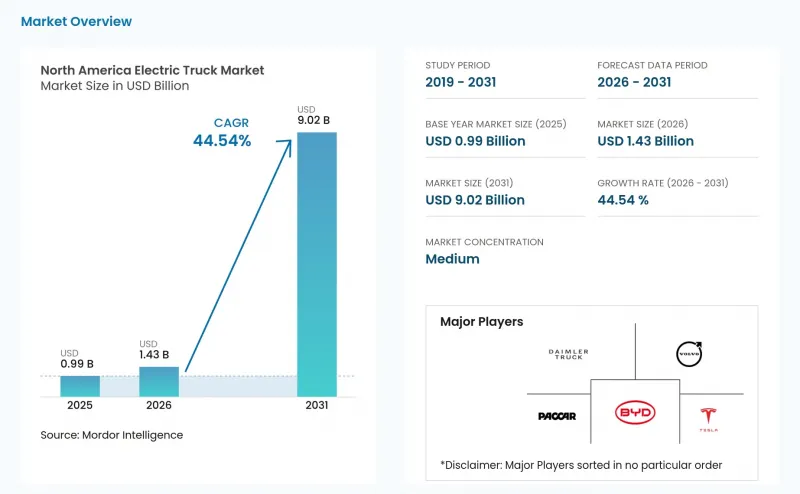
According to Mordor Intelligence, the North American electric truck market size was valued at USD 0.99 billion in 2025, is estimated at USD 1.43 billion in 2026, and is projected to reach USD 9.02 billion by 2031, growing at a CAGR of 44.54% from 2026 to 2031.
North America Electric Truck Market Trends and Insights
Stricter ZEV Mandates and HDV CO2 Standards
EPA Phase 3 rules demand a notable CO2 cut for model-year 2027 vocational trucks, while California's Advanced Clean Fleets measure forces high-priority fleets to transition drayage tractors to 100% zero emissions by 2035 . In Washington, Oregon, and several Northeastern states, copycat adoption now accounts for a significant portion of the United States truck registrations. Transport Canada's draft mandate targets 35% ZEV medium- and heavy-duty sales by 2030, broadening regulatory pull. Despite facing a considerable increase in certification costs, Daimler Truck anticipates that ZEV models will contribute meaningfully to its North American revenue in the coming years. These overlapping mandates not only tighten product-launch timelines but also establish a baseline of captive demand, providing a buffer for OEM volumes amidst freight downturns
Rapid Battery-Pack Cost Decline Enabling TCO Parity
In early 2025, commercial LFP pack prices experienced a significant decline, driven by an oversupply of Chinese cathodes and the scaling effects of gigafactories. Similarly, high-nickel NMC 811 packs saw a notable reduction in costs, following the ramp-up of a production line in Michigan during late 2024. In California, heavy-commercial electric vehicles achieved cost parity with diesel under specific conditions related to fuel and electricity prices. A study by NACFE, which analyzed a large number of delivery vehicles, revealed that electric vehicles offered a shorter payback period compared to diesel vehicles. This advantage was primarily due to reduced maintenance expenses and the availability of voucher incentives. Consequently, the decreasing costs of packs are broadening the scope of fleet adoption, extending beyond initial urban pilot programs.
High Upfront Price and Limited HD Model Availability
In Q4 2025, a Class 8 tractor with advanced battery capacity was significantly more expensive than its diesel counterpart, with batteries accounting for a substantial portion of the bill of materials. While tax credits are available to offset costs, limitations on the number of eligible units create uncertainty for buyers. Among the available models, only a few sleeper-cab BEVs offer long-range capabilities, compared to a much larger variety of diesel options. Production remains limited, with manufacturers facing capacity constraints. Smaller fleets encounter stricter lease terms and higher initial costs, which slow adoption outside the largest carriers.
Other drivers and restraints analyzed in the detailed report include:
- Expansion of Depot and Corridor Fast-Charging in North America
- Corporate Net-Zero Freight Commitments
- Utility Interconnection Delays for >=1 MW Depots
For complete list of drivers and restraints, kindly check the Table Of Contents.
Segment Analysis
Medium-duty models commanded 43.15% of 2025 revenue, reflecting early alignment with depot charging and municipal duty cycles. Heavy-duty entries will deliver the steepest upside, posting a 45.22% CAGR that will lift the North American electric truck market size for Class 8 tractors significantly by 2031, aided by megawatt-charging corridors and 800 kWh battery packs.
Capital intensity stays lower in Class 6 platforms, yet the performance gap is narrowing. The North American electric truck market share for medium-duty units, therefore, peaks early and transitions toward proportional parity with heavy-duty by 2030.
Battery-electric vehicles held 77.45% of the 2025 revenue and generated the largest slice of the North American electric truck market share due to 85-90% well-to-wheel efficiency and the broadest charging footprint. Fuel-cell electric vehicles are projected to climb at a 50.13% CAGR, pushing the collective North America electric truck market size for hydrogen platforms by 2031. Plug-in hybrids offered a middle ground for fleets with mixed duty cycles, yet policy incentives have begun shifting away from transitional technologies, tilting investment toward pure zero-emission powertrains.
As the outlook period unfolds, the dominance of Battery Electric Vehicles (BEVs) begins to wane. This shift is largely attributed to the advent of corridor megawatt chargers and a drop in green-hydrogen prices, making it feasible to refuel quickly for long distances. Supporting this transition, Original Equipment Manufacturers (OEMs) are making notable announcements: Nikola is set to establish a significant number of hydrogen stations, while Hyundai's XCIENT program has demonstrated high reliability and extensive fleet performance. Despite this, BEVs, favored for their compatibility with depots, continue to be the preferred choice for urban and regional operators. These operators are primarily focused on predictable routes spanning shorter distances. Consequently, the competitive landscape is evolving: BEVs are solidifying their hold on high-volume metropolitan routes, while Fuel Cell Electric Vehicles (FCEVs) are carving out niches, especially for payload-sensitive and refrigerated long hauls.
Complete Report Scope:
- By Truck Type
- Light Truck (Less than/Equals 3.5 t)
- Medium-Duty Truck (3.6-12 t)
- Heavy-Duty Truck (Above 12 t)
- By Propulsion Type
- Battery Electric Vehicle (BEV)
- Fuel-Cell Electric Vehicle (FCEV)
- Plug-in Hybrid Electric Vehicle (PHEV)
- Hybrid Electric Vehicle (HEV)
- By Range
- Below 150 km (Urban)
- 150-300 km (Regional)
- 301-500 km (Long-Haul)
- Above 500 km (Extended)
- By Battery Capacity
- Less than/Equals 200 kWh
- 201-400 kWh
- 401-800 kWh
- Above 800 kWh
- By Motor Architecture
- Single-Motor Direct Drive
- Dual-Motor
- Integrated eAxle
- In-Wheel Hub Motor
- By Application
- Logistics and Parcel
- Municipal Services (Waste, Street-sweep)
- Construction and Mining
- Retail and FMCG Delivery
- Utility and Other Industrial
- By Country
- United States
- California
- Texas
- Florida
- New York
- Illinois
- Washington
- Pennsylvania
- Ohio
- Michigan
- Georgia
- North Carolina
- New Jersey
- Virginia
- Canada
- Ontario
- Quebec
- British Columbia
- Alberta
- Manitoba
- Saskatchewan
- Nova Scotia
- New Brunswick
- Newfoundland and Labrador
- Prince Edward Island
- Mexico
- Baja California
- Sonora
- Chihuahua
- Nuevo Leon
- Coahuila
- Jalisco
- Guanajuato
- Estado de Mexico
- Puebla
- Veracruz
- Yucatan
- Quintana Roo
- United States
List of Companies Covered in this Report:
- Daimler Truck Holding AG
- Volvo Group
- PACCAR Inc.
- BYD Auto Co., Ltd.
- Ford Motor Company
- Orange EV
- Tesla, Inc.
- Rivian Automotive LLC
- Lion Electric Co.
- Xos, Inc.
- International Motors, LLC
- Mitsubishi Fuso Truck and Bus Corporation
- Isuzu Motors
- Workhorse Group
- Hyundai Motor Company
- GreenPower Motor Company Inc.
Additional Benefits:
- The market estimate (ME) sheet in Excel format
- 3 months of analyst support
TABLE OF CONTENTS
1 Introduction
- 1.1 Study Assumptions & Market Definition
- 1.2 Scope of the Study
2 Research Methodology
3 Executive Summary
4 Key Industry Trends
- 4.1 Urbanization, Population & Vehicle/Transit Demand
- 4.2 EV Penetration in Truck Market
- 4.3 Fuel vs Electricity Price Spread (Per km, ICE vs EV)
- 4.4 EV vs ICE Total Cost of Ownership (TCO) Gap
- 4.5 Financing & Ownership Models (Loans, Leasing, Subscription)
- 4.6 Battery Chemistry Mix & Pack Energy Density (LFP vs NMC)
- 4.7 Home, Workplace & Public Charger Access / Density
- 4.8 Fast-Charging Network Coverage & Power Bands
- 4.9 Alternative Fuels Infrastructure (Hydrogen for FCEVs)
- 4.10 Subsidy & Consumer Incentive Value
- 4.11 OEM EV Line-up & Model Pipeline
- 4.12 Value-Chain & Distribution-Channel Analysis
- 4.13 Regulatory, Fiscal & Industrial Policy Framework
5 Market Landscape
- 5.1 Market Overview
- 5.2 Market Drivers
- 5.2.1 Stricter ZEV Mandates and HDV CO2 Standards
- 5.2.2 Rapid Battery-Pack Cost Decline Enabling TCO Parity
- 5.2.3 Expansion of Depot and Corridor Fast-Charging in North America
- 5.2.4 Corporate Net-Zero Freight Commitments
- 5.2.5 Megawatt-Charging Corridors on USMCA Trade Routes
- 5.2.6 Battery-Swap Drayage Pilots at Pacific Ports
- 5.3 Market Restraints
- 5.3.1 High Upfront Price and Limited HD Model Availability
- 5.3.2 Utility Interconnection Delays for >=1 MW Depots
- 5.3.3 Lithium-Price Volatility Impacting Battery-Lease Rates
- 5.3.4 Driver HV-Safety Skill Gaps in Small Fleets
- 5.4 Value/Supply-Chain Analysis
- 5.5 Regulatory Landscape
- 5.6 Technological Outlook
- 5.7 Porter's Five Forces Analysis
- 5.7.1 Threat of New Entrants
- 5.7.2 Bargaining Power of Suppliers
- 5.7.3 Bargaining Power of Buyers
- 5.7.4 Threat of Substitutes
- 5.7.5 Competitive Rivalry
6 Market Size & Growth Forecasts (Value (USD) and Volume (Units))
- 6.1 By Truck Type
- 6.1.1 Light Truck (Less than/Equals 3.5 t)
- 6.1.2 Medium-Duty Truck (3.6-12 t)
- 6.1.3 Heavy-Duty Truck (Above 12 t)
- 6.2 By Propulsion Type
- 6.2.1 Battery Electric Vehicle (BEV)
- 6.2.2 Fuel-Cell Electric Vehicle (FCEV)
- 6.2.3 Plug-in Hybrid Electric Vehicle (PHEV)
- 6.2.4 Hybrid Electric Vehicle (HEV)
- 6.3 By Range
- 6.3.1 Below 150 km (Urban)
- 6.3.2 150-300 km (Regional)
- 6.3.3 301-500 km (Long-Haul)
- 6.3.4 Above 500 km (Extended)
- 6.4 By Battery Capacity
- 6.4.1 Less than/Equals 200 kWh
- 6.4.2 201-400 kWh
- 6.4.3 401-800 kWh
- 6.4.4 Above 800 kWh
- 6.5 By Motor Architecture
- 6.5.1 Single-Motor Direct Drive
- 6.5.2 Dual-Motor
- 6.5.3 Integrated eAxle
- 6.5.4 In-Wheel Hub Motor
- 6.6 By Application
- 6.6.1 Logistics and Parcel
- 6.6.2 Municipal Services (Waste, Street-sweep)
- 6.6.3 Construction and Mining
- 6.6.4 Retail and FMCG Delivery
- 6.6.5 Utility and Other Industrial
- 6.7 By Country
- 6.7.1 United States
- 6.7.1.1 California
- 6.7.1.2 Texas
- 6.7.1.3 Florida
- 6.7.1.4 New York
- 6.7.1.5 Illinois
- 6.7.1.6 Washington
- 6.7.1.7 Pennsylvania
- 6.7.1.8 Ohio
- 6.7.1.9 Michigan
- 6.7.1.10 Georgia
- 6.7.1.11 North Carolina
- 6.7.1.12 New Jersey
- 6.7.1.13 Virginia
- 6.7.2 Canada
- 6.7.2.1 Ontario
- 6.7.2.2 Quebec
- 6.7.2.3 British Columbia
- 6.7.2.4 Alberta
- 6.7.2.5 Manitoba
- 6.7.2.6 Saskatchewan
- 6.7.2.7 Nova Scotia
- 6.7.2.8 New Brunswick
- 6.7.2.9 Newfoundland and Labrador
- 6.7.2.10 Prince Edward Island
- 6.7.3 Mexico
- 6.7.3.1 Baja California
- 6.7.3.2 Sonora
- 6.7.3.3 Chihuahua
- 6.7.3.4 Nuevo Leon
- 6.7.3.5 Coahuila
- 6.7.3.6 Jalisco
- 6.7.3.7 Guanajuato
- 6.7.3.8 Estado de Mexico
- 6.7.3.9 Puebla
- 6.7.3.10 Veracruz
- 6.7.3.11 Yucatan
- 6.7.3.12 Quintana Roo
- 6.7.1 United States
7 Competitive Landscape
- 7.1 Market Concentration
- 7.2 Strategic Moves
- 7.3 Market Share Analysis
- 7.4 Company Profiles (includes Global Level Overview, Market Level Overview, Core Segments, Financials as Available, Strategic Information, Market Rank/Share for Key Companies, Products and Services, SWOT Analysis, and Recent Developments)
- 7.4.1 Daimler Truck Holding AG
- 7.4.2 Volvo Group
- 7.4.3 PACCAR Inc.
- 7.4.4 BYD Auto Co., Ltd.
- 7.4.5 Ford Motor Company
- 7.4.6 Orange EV
- 7.4.7 Tesla, Inc.
- 7.4.8 Rivian Automotive LLC
- 7.4.9 Lion Electric Co.
- 7.4.10 Xos, Inc.
- 7.4.11 International Motors, LLC
- 7.4.12 Mitsubishi Fuso Truck and Bus Corporation
- 7.4.13 Isuzu Motors
- 7.4.14 Workhorse Group
- 7.4.15 Hyundai Motor Company
- 7.4.16 GreenPower Motor Company Inc.
8 Market Opportunities & Future Outlook
- 8.1 White-space & Unmet-need Assessment
9 Key Strategic Questions for CEOs

