PUBLISHER: Mordor Intelligence | PRODUCT CODE: 2187706

PUBLISHER: Mordor Intelligence | PRODUCT CODE: 2187706
Asia-Pacific Fuel Cell Vehicles - Market Share Analysis, Industry Trends & Statistics, Growth Forecasts (2026 - 2031)
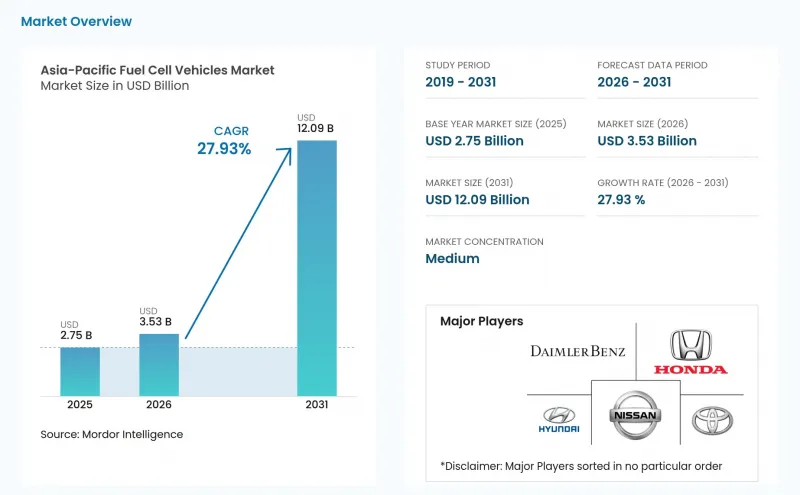
According to Mordor Intelligence, the Asia-Pacific fuel cell vehicles market size was valued at USD 2.75 billion in 2025 and reached USD 3.53 billion in 2026, and is expected to reach USD 12.09 billion by 2031, growing at a CAGR of 27.93% over 2026-2031.
Asia-Pacific Fuel Cell Vehicles Market Trends and Insights
Commercial & Heavy-Duty Decarbonization
Freight companies are increasingly turning to hydrogen, as battery packs reduce payload capacity and charging downtimes disrupt multi-shift operations. In recent years, Hyundai delivered a significant number of Xcient Fuel Cell trucks to domestic fleets, achieving a notable utilization rate due to quick refueling. This outperformed the utilization recorded by their battery-electric counterparts. Around the same period, Toyota and Hino initiated a pilot with several fuel-cell rigs for the Tokyo-Osaka port drayage, a route set to ban diesel in the near future. Responding to Chinese municipal decrees, cities with large populations must transition a portion of their transit buses to zero-emission powertrains within the next few years. This mandate leans towards fuel cells for routes covering longer distances. Internal fleet models suggest that operators with high annual mileage will see fuel-cell trucks reach cost parity with diesel in the coming years. With an increasing number of heavy-duty chassis surpassing this mileage, demand for these units is expected to surge rapidly over the forecast period.
Strong Government Policy & Subsidies
National and provincial treasuries are shifting from one-time purchase rebates to co-funding initiatives. These initiatives bundle together vehicles, hydrogen supply, and depot infrastructure. China is continuing its per-vehicle incentive for several years. However, the disbursement is now tied to sourcing hydrogen from renewable or industrial by-products. This move encourages fleets to opt for low-carbon supply contracts. South Korea's Hydrogen Economy Roadmap 2.0 allocates significant funding to establish heavy-duty corridors. These corridors stretch between major cities and aim to reduce payback periods for long-haul trucks to a competitive timeframe. Japan's updated Green Growth Strategy mandates that within a few years, metropolitan freight operators must ensure a notable portion of new commercial registrations are zero-emission. This effectively creates a reserved demand pool for fuel-cell trucks. India is investing heavily in viability-gap funding.
High Upfront Costs
In 2025, fuel-cell trucks were significantly more expensive than their diesel counterparts, with a substantial price premium. This pricing dynamic restricted their adoption primarily to fleets benefiting from subsidies or those operating on long-distance duty cycles. For instance, a Hyundai fuel-cell truck required high annual utilization over several years to achieve payback, a threshold typically met by operations such as hub-and-spoke logistics or port drayage. Meanwhile, Toyota's Mirai was priced significantly higher than hybrid sedans in Japan, limiting its sales predominantly to corporate entities. In India, prototype buses were considerably more expensive than their CNG counterparts, leading municipalities to depend on central grants for purchases. To eliminate the premium in commercial classes, manufacturers aimed to significantly reduce stack costs within a few years.
Other drivers and restraints analyzed in the detailed report include:
- Strategic Infrastructure Investment
- Rapid Refueling Advantages
- Nascent Refueling Infrastructure
For complete list of drivers and restraints, kindly check the Table Of Contents.
Segment Analysis
Heavy-duty trucks are on track for a 28.94% CAGR through 2031, steadily narrowing the gap with the passenger-car segment that commanded 57.16% of 2025 revenue within the Asia Pacific fuel cell vehicles market. Last year, China's municipal fleets logged significant daily duty cycles for thousands of buses. As Japan and South Korea gear up for urban diesel restrictions in the near future, light commercial vans and pick-ups accounted for a notable portion of sales, catering to last-mile operators.
Stricter port and freeway regulations, which penalize particulate emissions, are driving momentum in the heavy-duty sector. Additionally, once vehicles reach high annual mileage, owners benefit from total-cost-of-ownership gains. In recent years, fuel cell vehicles have captured a growing market share in Asia Pacific for off-highway machinery, including port forklifts and airport tugs. This share is increasing as equipment owners realize battery packs hinder multi-shift operations. While passenger-car demand is limited by infrastructure, OEM order books remain devoid of surplus stock, indicating a balanced, albeit modest, retail niche.
PEMFC technology held an 83.37% share in 2025, and supplier forecasts point to a 28.98% CAGR as automotive-grade membranes dominate propulsion use cases. Solid-oxide units captured a notable market share, primarily serving as auxiliary power sources in trucks and marine platforms, where they reap efficiency benefits at high operating temperatures.
In the Asia Pacific, the market for alkaline and phosphoric-acid fuel cell vehicles remains limited. This is due to challenges with weight, start-up time, and electrolyte handling, which don't meet fleet expectations. Meanwhile, at Hyundai Mobis, reductions in platinum loading have significantly lowered the costs of PEM stacks. On the other hand, SOFC suppliers are still addressing startup latency issues, pushing the commercial launch for their range-extender roles to a later timeline.
Complete Report Scope:
- By Vehicle Type
- Passenger Cars
- Buses
- Light Commercial Vehicles (vans & pick-ups)
- Medium- & Heavy-Duty Trucks
- Off-Highway & Special-Purpose Vehicles
- By Fuel Cell Type
- Proton-Exchange-Membrane (PEMFC)
- Solid-Oxide (SOFC)
- Alkaline (AFC)
- Phosphoric-Acid (PAFC)
- By Power Output Rating
- Less than 100 kW
- 100 to 250 kW
- More than 250 kW
- By Driving Range
- Less than 400 km
- 400 to 700 km
- More than 700 km
- By Country
- Australia
- China
- India
- Indonesia
- Japan
- Malaysia
- South Korea
- Thailand
- Rest of Asia-Pacific
List of Companies Covered in this Report:
- Ballard Power Systems
- Daimler Truck
- Dongfeng Motor Corporation
- Honda Motor Co. Ltd.
- Hyundai Motor Company
- Sinopec
- Nissan Motor Co. Ltd.
- Toyota Motor Corporation
- Foton Motor Group
- SAIC Motor Corporation
- FAW Group
- Hyzon Motors
- Weichai Power
- Tata Motors
- Ashok Leyland
- XCMG Automotive
- SANY Group
- UD Trucks
Additional Benefits:
- The market estimate (ME) sheet in Excel format
- 3 months of analyst support
TABLE OF CONTENTS
1 Introduction
- 1.1 Study Assumptions & Market Definition
- 1.2 Scope of the Study
2 Research Methodology
3 Executive Summary
4 Key Industry Trend
- 4.1 Urbanization, freight growth & duty-cycle fit
- 4.2 Vehicle ownership pattern
- 4.3 ZEV penetration split by segment
- 4.4 Hydrogen vs diesel/electricity cost spread (per km)
- 4.5 FCEV vs diesel/BEV TCO gap (route-specific)
- 4.6 Financing & contracting models shifting to H?-as-a-service
- 4.7 Fuel-cell tech roadmap (cost, durability, platinum loading)
- 4.8 Hydrogen refueling access/density & corridor build-out
- 4.9 Station economics & utilization (the real bottleneck)
- 4.10 Hydrogen supply mix & carbon-intensity rules
- 4.11 Subsidies & incentives shifting from "vehicle purchase" to "ecosystem"
- 4.12 OEM & model pipeline skewing commercial
- 4.13 Value-chain localization (stacks, MEAs, tanks) + industrial policy
- 4.14 Regulatory & safety/standards maturation
- 4.15 Value-Chain & Distribution-Channel Analysis
- 4.16 Regulatory, Fiscal & Industrial Policy Framework
5 Market Landscape
- 5.1 Market Overview
- 5.2 Market Drivers
- 5.2.1 Commercial & Heavy-Duty Decarbonization
- 5.2.2 Strong Government Policy & Subsidies
- 5.2.3 Strategic Infrastructure Investment
- 5.2.4 Rapid Refueling Advantages
- 5.2.5 Indigenous Manufacturing & R&D
- 5.2.6 Energy Security Initiatives
- 5.3 Market Restraints
- 5.3.1 High Upfront Costs
- 5.3.2 Nascent Refueling Infrastructure
- 5.3.3 Hydrogen Supply Chain Challenges
- 5.3.4 Technical & Durability Issues
- 5.4 Porter's Five Forces Analysis
- 5.4.1 Threat of New Entrants
- 5.4.2 Bargaining Power of Suppliers
- 5.4.3 Bargaining Power of Buyers
- 5.4.4 Threat of Substitutes
- 5.4.5 Competitive Rivalry
6 Market Size & Growth Forecasts (Value (USD) and Volume (Units))
- 6.1 By Vehicle Type
- 6.1.1 Passenger Cars
- 6.1.2 Buses
- 6.1.3 Light Commercial Vehicles (vans & pick-ups)
- 6.1.4 Medium- & Heavy-Duty Trucks
- 6.1.5 Off-Highway & Special-Purpose Vehicles
- 6.2 By Fuel Cell Type
- 6.2.1 Proton-Exchange-Membrane (PEMFC)
- 6.2.2 Solid-Oxide (SOFC)
- 6.2.3 Alkaline (AFC)
- 6.2.4 Phosphoric-Acid (PAFC)
- 6.3 By Power Output Rating
- 6.3.1 Less than 100 kW
- 6.3.2 100 to 250 kW
- 6.3.3 More than 250 kW
- 6.4 By Driving Range
- 6.4.1 Less than 400 km
- 6.4.2 400 to 700 km
- 6.4.3 More than 700 km
- 6.5 By Country
- 6.5.1 Australia
- 6.5.2 China
- 6.5.3 India
- 6.5.4 Indonesia
- 6.5.5 Japan
- 6.5.6 Malaysia
- 6.5.7 South Korea
- 6.5.8 Thailand
- 6.5.9 Rest of Asia-Pacific
7 Competitive Landscape
- 7.1 Market Concentration
- 7.2 Strategic Moves
- 7.3 Market Share Analysis
- 7.4 Company Profiles (includes Global Level Overview, Market Level Overview, Core Segments, Financials as Available, Strategic Information, Market Rank/Share for Key Companies, Products and Services, SWOT Analysis, and Recent Developments)
- 7.4.1 Ballard Power Systems
- 7.4.2 Daimler Truck
- 7.4.3 Dongfeng Motor Corporation
- 7.4.4 Honda Motor Co. Ltd.
- 7.4.5 Hyundai Motor Company
- 7.4.6 Sinopec
- 7.4.7 Nissan Motor Co. Ltd.
- 7.4.8 Toyota Motor Corporation
- 7.4.9 Foton Motor Group
- 7.4.10 SAIC Motor Corporation
- 7.4.11 FAW Group
- 7.4.12 Hyzon Motors
- 7.4.13 Weichai Power
- 7.4.14 Tata Motors
- 7.4.15 Ashok Leyland
- 7.4.16 XCMG Automotive
- 7.4.17 SANY Group
- 7.4.18 UD Trucks
8 Market Opportunities & Future Outlook
- 8.1 White-Space & Unmet-Need Assessment
9 Key Strategic Questions for CEOs

