PUBLISHER: Mordor Intelligence | PRODUCT CODE: 2187722

PUBLISHER: Mordor Intelligence | PRODUCT CODE: 2187722
Cleaning Products - Market Share Analysis, Industry Trends & Statistics, Growth Forecasts (2027 - 2032)
According to Mordor Intelligence, the cleaning products market size is estimated at USD 248.1 billion in 2026 and is projected to be USD 260.6 billion in 2027, reaching USD 330.2 billion by 2032, growing at a CAGR of 4.85% from 2027 to 2032.
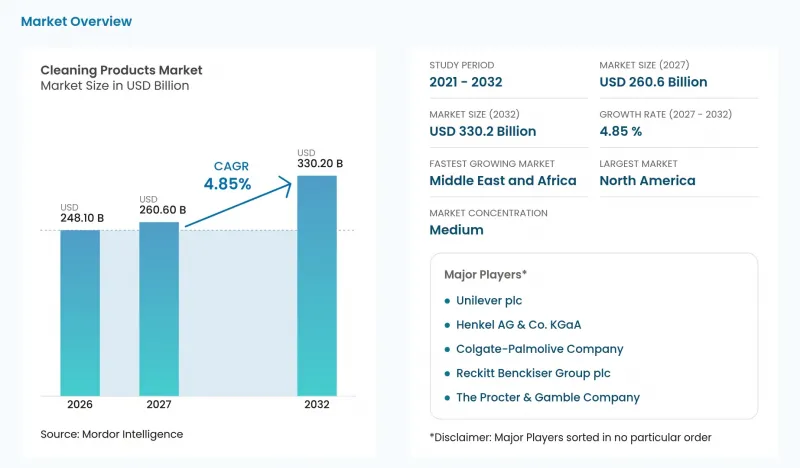
This report is segmented by Category (Conventional and more), Product Type (Laundry Care Products and more), Form (Liquid and more), Application (Household/Residential and more), Distribution Channel (Retail and more), and Geography (North America and more). The market forecasts are provided in terms of value (USD), based on availability.
Global Cleaning Products Market Trends and Insights
Shift toward eco-friendly, biodegradable, and non-toxic products
Environmental positioning and ingredient claims can influence cleaner choice through different buyer expectations. In BASF's 2025 survey of 515 Latin American laundry consumers, 29% wanted their most-used brand to be more environmentally friendly, selecting up to 3 of 10 improvement options. In August 2026, Censuswide surveyed 2,000 UK adults for smol, and 84% said they had chosen one cleaning product over another because it claimed to contain fewer chemicals. This creates a role for clearer ingredient information within a cleaner's environmental proposition. A brand can address environmental-improvement demand and claim-sensitive choice through distinct parts of the same finished-product offer.
Demand for natural and plant-based formulations amid preferences for chemical-free options
Natural-formulation labels can influence the price consumers report paying for household cleaners. Censuswide surveyed 2,000 UK adults in August 2026 for research commissioned by smol. Among respondents, 47% said they had paid more for a cleaning product because it claimed to be natural. The same survey found that 40% said they had paid more because a product claimed to be chemical-free. For suppliers, these responses give formulation wording a commercial role in describing the value attached to the finished product. Clear formulation positioning can therefore support a premium proposition around the particular claim the buyer recognizes.
Regulatory complexity and regional differences
Regional differences make compliance a market-access burden because information duties and sale permissions require separate decisions. Regulation (EU) 2026/405 identified duplicated and incoherent detergent information requirements in the preceding EU framework. It entered into force on March 22, 2026, but generally applies from September 23, 2029. In the United States, the Environmental Protection Agency (EPA) settled with grocery-chain owner Chedraui USA Inc. on December 2, 2025. The action led to illegal disinfectant and sanitizer products being removed from its El Super and Smart & Final stores in Arizona, California, and Nevada. Suppliers serving these jurisdictions therefore face distinct information and market-access requirements, with distribution exposed to interruption when the relevant permission is missing.
Other drivers and restraints analyzed in the detailed report include:
- Busy lifestyles of working professionals favoring convenient formats
- Growth in specialized products for specific surfaces
- Consumer health concerns over harsh chemicals causing allergies
For complete list of drivers and restraints, kindly check the Table Of Contents.
Segment Analysis
Conventional products accounted for an 87.97% share of the cleaning products market size in 2026, making them the largest segment. With most sales value residing in the category, manufacturers have a commercial reason to keep conventional cleaners central to application development. For a dosed laundry or surface-cleaning formulation, development can focus on the cleaning task accomplished by each dose and the physical form through which it is delivered. That gives suppliers a route to differentiate conventional offers through the cleaning job itself, making formulation and dosing choices part of defending the main revenue base.
Organic/natural products are the fastest-growing segment, with a projected CAGR of 8.1% from 2027 to 2032. Purdy & Figg produces natural, refillable cleaning products at its Hertfordshire factory. Its company team numbered 100 in 2026. For a manufacturer with its own product and production roles, natural formulation and a refillable format offer separate ways to develop the same finished-cleaner proposition. The commercial opportunity is a branded household range whose formulation positioning can carry across repeated refill purchases, linking product identity to the continuing cleaning task.
Laundry care products represented a 35.25% cleaning products market share in 2026, making them the largest segment. The Japan Soap and Detergent Association (JSDA) reported 2025 manufacturer sales of 588,350 metric tons of liquid synthetic laundry detergent in Japan. The figures cover domestic manufacturers with at least 10 employees that produced or imported the products. That physical product flow offers a context for supplier specialization in laundry formulations, allowing development work to focus on the defined wash function served by a substantial, established category of finished cleaning products.
Surface cleaners are the fastest-growing segment, with a projected CAGR of 5.68% from 2027 to 2032. Henkel AG & Co. KGaA reported that hard surface cleaners helped drive 2025 growth in the global Home Care market relevant to its Laundry & Home Care business. Dishwashing products also contributed to growth in that same market assessment. Toilet care products recorded a decline in that 2025 global Home Care assessment. These contrasts favor application-specific ranges, allowing suppliers to link each product-development decision to the demand conditions for its particular cleaning task.
Complete Report Scope:
- By Category
- Conventional
- Organic/Natural
- By Product Type
- Laundry Care Products
- Surface Cleaners
- Dishwashing Products
- Toilet/Bathroom Cleaners
- Floor Cleaners
- Glass and Metal Cleaners
- Other Specialty Cleaners
- By Form
- Liquid
- Powder
- Gel and Cream
- Wipes
- Tablets and Aerosol
- By Application
- Household/Residential
- Institutional and Commercial
- By Distribution Channel
- Wholesale/Corporate Procurement
- Retail
- Supermarkets and Hypermarkets
- Convenience/Grocery Stores
- Online Retail
- Other Distribution Channels
- By Geography
- North America
- United States
- Canada
- Mexico
- Rest of North America
- Europe
- Germany
- United Kingdom
- Italy
- France
- Spain
- Netherlands
- Poland
- Belgium
- Sweden
- Rest of Europe
- Asia-Pacific
- China
- India
- Japan
- Australia
- Indonesia
- South Korea
- Thailand
- Singapore
- Rest of Asia-Pacific
- South America
- Brazil
- Argentina
- Colombia
- Chile
- Peru
- Rest of South America
- Middle East and Africa
- South Africa
- Saudi Arabia
- United Arab Emirates
- Nigeria
- Egypt
- Morocco
- Turkey
- Rest of Middle East and Africa
- North America
Geography Analysis
North America accounted for a 29.22% share of the cleaning products market size in 2026, making it the largest geography. P&G invested more than USD 500 million in the Lima area of Ohio, adding the area's first in-house production line for Downy and Gain in-wash scent beads and an expanded fully automated warehouse. Shipping capacity for the broader expansion increased by 40%, linking the production project with greater capacity to dispatch finished laundry-care products. P&G brought a previously outsourced scent-bead process into an established fabric-care location, making this an expansion of internal manufacturing scope as well as shipping capability.
The Middle East and Africa is the fastest-growing geography, with a projected CAGR of 6.45% from 2027 to 2032. In a Q1 2026 update, Unilever reported that Yumos in Turkey had delivered the highest single day of sales in the brand's history. The company identified Yumos within fabric enhancers, placing this demand example in the finished laundry-care offer. For manufacturers, the brand-level result makes a defined fabric-care identity a relevant focus for developing household demand. Serving the separate enhancement task can broaden a supplier's laundry range while keeping the product proposition tied to an established washing routine.
In Europe, Germany requires German-language labels on covered washing and cleaning products under Regulation (EC) No 648/2004, Article 11(2) to (4), leaving Chemicals Act labeling duties unaffected. In Asia-Pacific, JSDA's May 2025 survey found frequent automatic detergent and softener dosing among married women in their 20s through 50s in Tokyo and 3 neighboring prefectures. Respondents lived in households of at least 2 people and had bought a washer within 5 years. South America has a different channel consideration, with cleaning associations ABIPLA and ABRALIMP reporting 14% informal household cleaning-products consumption in Brazil from 1,219 interviews in July 2025. These differences put labeling, dosing fit, and formal distribution in distinct commercial roles for suppliers.
- The Procter & Gamble Company
- Unilever plc
- Henkel AG & Co. KGaA
- Reckitt Benckiser Group plc
- Colgate-Palmolive Company
- The Clorox Company
- SC Johnson & Son Inc.
- Church & Dwight Co. Inc.
- Kao Corporation
- Ecolab Inc.
- Diversey Holdings Ltd.
- Amway Corp.
- LG Household & Health Care Ltd.
- Lion Corporation
- Godrej Consumer Products Ltd.
- Blue Moon Group Holdings
- PZ Cussons plc
- Bombril S/A
- McBride plc
- Werner & Mertz GmbH
Additional Benefits:
- The market estimate (ME) sheet in Excel format
- 3 months of analyst support
TABLE OF CONTENTS
1 INTRODUCTION
- 1.1 Study Assumptions and Market Definition
- 1.2 Scope of the Study
2 RESEARCH METHODOLOGY
3 EXECUTIVE SUMMARY
4 MARKET LANDSCAPE
- 4.1 Market Overview
- 4.2 Market Drivers
- 4.2.1 Shift toward eco-friendly, biodegradable, and non-toxic products
- 4.2.2 Demand for natural and plant-based formulations amid preferences for chemical-free options
- 4.2.3 Busy lifestyles of working professionals favoring convenient formats
- 4.2.4 Growth in specialized products for specific surfaces
- 4.2.5 Technological advancements in formulations for better efficacy and longer-lasting results
- 4.2.6 Preference for products with pleasant fragrances and attractive packaging
- 4.3 Market Restraints
- 4.3.1 Regulatory complexity and regional differences
- 4.3.2 Consumer health concerns over harsh chemicals causing allergies
- 4.3.3 Low brand loyalty as consumers switch based on promotions or trials
- 4.3.4 Supply chain disruptions leading to ingredient shortages
- 4.4 Industry Value Chain Analysis
- 4.5 Regulatory Landscape
- 4.6 Technological Outlook
- 4.7 Porter's Five Forces Analysis
- 4.7.1 Threat of New Entrants
- 4.7.2 Bargaining Power of Suppliers
- 4.7.3 Bargaining Power of Buyers
- 4.7.4 Threat of Substitutes
- 4.7.5 Competitive Rivalry
5 MARKET SIZE AND GROWTH FORECASTS (VALUE)
- 5.1 By Category
- 5.1.1 Conventional
- 5.1.2 Organic/Natural
- 5.2 By Product Type
- 5.2.1 Laundry Care Products
- 5.2.2 Surface Cleaners
- 5.2.3 Dishwashing Products
- 5.2.4 Toilet/Bathroom Cleaners
- 5.2.5 Floor Cleaners
- 5.2.6 Glass and Metal Cleaners
- 5.2.7 Other Specialty Cleaners
- 5.3 By Form
- 5.3.1 Liquid
- 5.3.2 Powder
- 5.3.3 Gel and Cream
- 5.3.4 Wipes
- 5.3.5 Tablets and Aerosol
- 5.4 By Application
- 5.4.1 Household/Residential
- 5.4.2 Institutional and Commercial
- 5.5 By Distribution Channel
- 5.5.1 Wholesale/Corporate Procurement
- 5.5.2 Retail
- 5.5.2.1 Supermarkets and Hypermarkets
- 5.5.2.2 Convenience/Grocery Stores
- 5.5.2.3 Online Retail
- 5.5.2.4 Other Distribution Channels
- 5.6 By Geography
- 5.6.1 North America
- 5.6.1.1 United States
- 5.6.1.2 Canada
- 5.6.1.3 Mexico
- 5.6.1.4 Rest of North America
- 5.6.2 Europe
- 5.6.2.1 Germany
- 5.6.2.2 United Kingdom
- 5.6.2.3 Italy
- 5.6.2.4 France
- 5.6.2.5 Spain
- 5.6.2.6 Netherlands
- 5.6.2.7 Poland
- 5.6.2.8 Belgium
- 5.6.2.9 Sweden
- 5.6.2.10 Rest of Europe
- 5.6.3 Asia-Pacific
- 5.6.3.1 China
- 5.6.3.2 India
- 5.6.3.3 Japan
- 5.6.3.4 Australia
- 5.6.3.5 Indonesia
- 5.6.3.6 South Korea
- 5.6.3.7 Thailand
- 5.6.3.8 Singapore
- 5.6.3.9 Rest of Asia-Pacific
- 5.6.4 South America
- 5.6.4.1 Brazil
- 5.6.4.2 Argentina
- 5.6.4.3 Colombia
- 5.6.4.4 Chile
- 5.6.4.5 Peru
- 5.6.4.6 Rest of South America
- 5.6.5 Middle East and Africa
- 5.6.5.1 South Africa
- 5.6.5.2 Saudi Arabia
- 5.6.5.3 United Arab Emirates
- 5.6.5.4 Nigeria
- 5.6.5.5 Egypt
- 5.6.5.6 Morocco
- 5.6.5.7 Turkey
- 5.6.5.8 Rest of Middle East and Africa
- 5.6.1 North America
6 COMPETITIVE LANDSCAPE
- 6.1 Market Concentration
- 6.2 Strategic Moves
- 6.3 Market Share Analysis
- 6.4 Company Profiles (includes Global level Overview, Market level overview, Core Segments, Financials as available, Strategic Information, Market Rank/Share for key companies, Products and Services, and Recent Developments)
- 6.4.1 The Procter & Gamble Company
- 6.4.2 Unilever plc
- 6.4.3 Henkel AG & Co. KGaA
- 6.4.4 Reckitt Benckiser Group plc
- 6.4.5 Colgate-Palmolive Company
- 6.4.6 The Clorox Company
- 6.4.7 SC Johnson & Son Inc.
- 6.4.8 Church & Dwight Co. Inc.
- 6.4.9 Kao Corporation
- 6.4.10 Ecolab Inc.
- 6.4.11 Diversey Holdings Ltd.
- 6.4.12 Amway Corp.
- 6.4.13 LG Household & Health Care Ltd.
- 6.4.14 Lion Corporation
- 6.4.15 Godrej Consumer Products Ltd.
- 6.4.16 Blue Moon Group Holdings
- 6.4.17 PZ Cussons plc
- 6.4.18 Bombril S/A
- 6.4.19 McBride plc
- 6.4.20 Werner & Mertz GmbH
7 MARKET OPPORTUNITIES AND FUTURE OUTLOOK
- 7.1 White-Space and Unmet-Need Assessment

