PUBLISHER: Mordor Intelligence | PRODUCT CODE: 2187729

PUBLISHER: Mordor Intelligence | PRODUCT CODE: 2187729
Textile - Market Share Analysis, Industry Trends & Statistics, Growth Forecasts (2027 - 2032)
According to Mordor Intelligence, the textile market size was valued at USD 0.79 trillion in 2026 and estimated to grow from USD 0.83 trillion in 2027 to reach USD 1.04 trillion by 2032, at a CAGR of 4.55% during the forecast period (2027-2032).
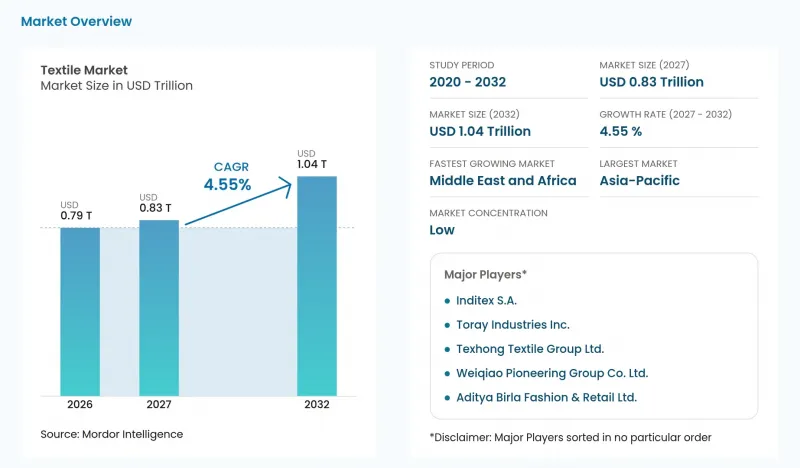
This report is segmented by Application (Fashion and Apparel, Industrial/Technical Textiles, and more), Raw Material (Synthetic Fibers, Natural Fibers, and more), Process / Technology (Woven, Knitted, and more), and Geography (Asia-Pacific, Europe, and more). The market forecasts are provided in terms of value (USD), based on availability.
Global Textile Market Trends and Insights
EU Digital Product Passport accelerating traceability technology investments
Fabric suppliers can strengthen their position when material provenance travels with the garment made from their output. Errea launched a Digital Product Passport with Ympact in July 2025, connecting company systems and digital modules with supply-chain data for individual garments. Regulation (EU) 2024/1781 makes market access for products covered by applicable delegated acts conditional on a digital product passport under those acts and Articles 10 and 11, with accurate, complete, up-to-date data. Errea's business systems and Ympact's mapping tool channel collected data into the passport associated with each item. Supplying fabric data those systems can ingest can reduce the brand's integration work, giving an apparel-facing mill a practical advantage when its material is onboarded.
Uyghur Forced Labor Prevention Act (UFLPA) shifting sourcing toward certified non-Xinjiang cotton
U.S. apparel buyers can influence cotton selection before textile manufacturers commit materials to fabric production. In 2026, approximately 63% of surveyed U.S. fashion companies encouraged suppliers to incorporate more U.S. cotton in response to UFLPA, up from 59% in 2025. Import enforcement adds a separate incentive to substantiate sourcing. In August 2025, the Forced Labor Enforcement Task Force reported 78 UFLPA Entity List additions over the preceding year, bringing the total to 144 Chinese entities whose goods were presumptively prohibited from U.S. entry. Buyer requests can consequently favor fabric suppliers able to demonstrate cotton origin. For mills serving these companies, a supportable sourcing record becomes part of securing access to U.S. apparel programs.
Escalating renewable-energy surcharges raising electricity costs for energy-intensive spinning mills
Electricity-network costs can constrain the economic case for rooftop solar at spinning mills. On July 4, 2026, the Southern India Spinners Association called for removal of a Tamil Nadu network charge levied on rooftop-solar projects. In 2025, the Southern India Mills' Association (SIMA) said higher wheeling, transmission and system-operation charges would make renewable energy and open-access power unviable for Tamil Nadu textile mills. This broader exposure can limit the cost advantage of changing electricity sources, constraining the economics of yarn production even when renewable power is available. For a Tamil Nadu spinning mill subject to the rooftop-solar charge, installing its own generation leaves a network payment attached to the electricity it produces.
Other drivers and restraints analyzed in the detailed report include:
- Bio-based PEF polyester advancing from European pilot toward commercial-scale production
- Proposed carbon-credit methodology for textile recycling could boost recycled-fiber profitability
- Tightening microplastic shedding regulations increasing R&D and compliance spend for synthetics
For complete list of drivers and restraints, kindly check the Table Of Contents.
Segment Analysis
Fashion and apparel accounted for a 55.9% share of the textile market size in 2026. Textile Exchange's 2026 report identified apparel as the largest broad end-use market for fiber production. Arvind Ltd. reported denim-fabric business volume of 59.5 million meters in the year ended March 31, 2026, compared with 51.6 million meters in the preceding fiscal year. Arvind's denim-fabric volume rose by 7.9 million meters in one fiscal year, showing that a fabric maker serving apparel buyers can add volume within an existing product line.
Industrial/technical textiles are projected to be the fastest-growing segment, at a CAGR of 5.65% during 2027-2032. In China, above-scale technical-textile enterprises' operating revenue rose 4.5% year over year in January-February 2026. China's exports of nonwovens, a technical-textile product family, rose 13.8% in value to USD 720 million in January-February 2026 compared with the same period in 2025. The operating profit margin among China's above-scale technical-textile enterprises held at 3.6%, unchanged from January-February 2025. Export demand gives technical-textile suppliers an expansion channel, while an unchanged operating margin makes the profitability of additional application programs central to that growth.
Complete Report Scope:
- By Application
- Fashion and Apparel
- Industrial/Technical Textiles
- Household and Home Textiles
- Medical and Healthcare Textiles
- Automotive and Transport Textiles
- Other Applications (Protective, Sports Textiles, etc.)
- By Raw Material
- Natural Fibers
- Cotton
- Wool
- Silk
- Synthetic Fibers
- Polyester
- Nylon
- Rayon / Viscose
- Acrylic
- Polypropylene
- Recycled Fibers
- Other Raw Materials (Specialty High-Performance Fibers (Aramid, Carbon, UHMWPE))
- Natural Fibers
- By Process / Technology
- Woven
- Knitted
- Non-woven
- Spunlaid (Spunbond / Melt-blown)
- Dry-laid Hydro-entangled
- Wet-Laid
- Needle-punched
- 3-D Weaving and Spacer Fabrics
- By Geography
- North America
- United States
- Canada
- Mexico
- South America
- Brazil
- Argentina
- Peru
- Rest of South America
- Europe
- United Kingdom
- Germany
- France
- Italy
- Spain
- BENELUX (Belgium, Netherlands, and Luxembourg)
- NORDICS (Denmark, Finland, Iceland, Norway, and Sweden)
- Rest of Europe
- Asia-Pacific
- China
- India
- Japan
- Australia
- South Korea
- ASEAN (Indonesia, Thailand, Philippines, Malaysia, Vietnam)
- Rest of Asia-Pacific
- Middle East and Africa
- Saudi Arabia
- United Arab Emirates
- Qatar
- Kuwait
- Turkey
- Egypt
- South Africa
- Nigeria
- Rest of Middle East and Africa
- North America
Geography Analysis
Asia-Pacific accounted for a 54.2% share of the textile market size in 2026, making it the largest region. In 2025, China's technical-textile industry processed 22.796 million metric tons of fiber, up 6.6% from 2024, according to the China Nonwovens & Industrial Textiles Association. China also exported 1.69 million metric tons of nonwoven rolls in 2025, with the association describing strong overseas demand for that finished textile product. In Bangladesh, local yarn primarily supplies domestic knitwear and fabric manufacturers, reducing yarn-import reliance and garment exporters' production lead times while providing a nearby input channel for fabric production.
The Middle East and Africa region is projected to grow fastest, at a CAGR of 5.4% during 2027-2032. The Industrial Development Authority reported annual fabric capacity of 8.3 million meters at Misr Spinning and Weaving Company's Al-Mahalla factories in Egypt in July 2026. Its integrated spinning, weaving, dyeing and finishing operations offer fabric buyers several production stages within one complex. Valerius Morocco, a joint venture between Morocco's SG3H and Portugal's VALERIUS GROUP, inaugurated a garment manufacturing unit in Sale on May 29, 2025. The Moroccan ministry linked the investment to proximity-based co-production, making garment manufacturing a potential local outlet for textile-material suppliers.
In North America, U.S. textile producers supply the U.S. military, giving domestic fabric makers an institutional sales channel. Brazilian textile production rose 6.8% in January-November 2025 against the same period in 2024, according to Abit data, reinforcing domestic production as a source of textile supply in South America. Colombia's 0% import tariff on 10 specified clothing and footwear input codes from December 1, 2025, through November 30, 2026, removes the tariff component of those inputs' landed costs. The EU specializes in technical textiles, while Portugal's Tecealfa produces custom jacquard fabrics for hospitality, decorative and home-textile customers, including hotels and designers. For suppliers serving hotel and designer programs, that tailored jacquard model places fabric development close to the customer's chosen application.
- Toray Industries Inc.
- Weiqiao Pioneering Group Co. Ltd.
- Texhong Textile Group Ltd.
- Inditex S.A.
- Aditya Birla Fashion & Retail Ltd.
- Hyosung TNC Corp.
- Far Eastern New Century Corp.
- PVH Corp.
- Nisshinbo Holdings Inc.
- Arvind Ltd.
- Chori Co. Ltd.
- DuPont de Nemours Inc.
- Freudenberg Group
- Magnera Corporation
- Lenzing AG
- Reliance Industries Ltd. (RIL)
- Shandong Ruyi Technology Group
- Low & Bonar Limited
- Kimberly-Clark Corp.
Additional Benefits:
- The market estimate (ME) sheet in Excel format
- 3 months of analyst support
TABLE OF CONTENTS
1 INTRODUCTION
- 1.1 Study Assumptions and Market Definition
- 1.2 Scope of the Study
2 RESEARCH METHODOLOGY
3 EXECUTIVE SUMMARY
4 MARKET LANDSCAPE
- 4.1 Market Overview
- 4.2 Market Drivers
- 4.2.1 EU Digital Product Passport accelerating traceability technology investments
- 4.2.2 Uyghur Forced Labor Prevention Act (UFLPA) shifting sourcing toward certified non-Xinjiang cotton
- 4.2.3 Bio-based PEF polyester advancing from European pilot toward commercial-scale production
- 4.2.4 Proposed carbon-credit methodology for textile recycling could boost recycled-fiber profitability
- 4.2.5 AI-driven on-demand manufacturing reducing inventory waste and enabling micro-batch runs
- 4.2.6 Protective & antiviral textiles demand surge for pathogen-resilient indoor environments
- 4.3 Market Restraints
- 4.3.1 Escalating renewable-energy surcharges raising electricity costs for energy-intensive spinning mills
- 4.3.2 Tightening microplastic shedding regulations increasing R&D and compliance spend for synthetics
- 4.3.3 Red Sea shipping disruptions inflating freight costs for Asia-to-EU textile trade lanes
- 4.3.4 PFAS "forever-chemicals" bans forcing costly reformulation of performance finishes
- 4.4 Industry Value Chain Analysis
- 4.5 Regulatory Landscape
- 4.6 Technological Outlook
- 4.7 Porter's Five Forces Analysis
- 4.7.1 Threat of New Entrants
- 4.7.2 Bargaining Power of Suppliers
- 4.7.3 Bargaining Power of Buyers
- 4.7.4 Threat of Substitutes
- 4.7.5 Competitive Rivalry
- 4.8 Impact of Geopolitics on Textile Market
5 MARKET SIZE AND GROWTH FORECASTS (VALUE)
- 5.1 By Application
- 5.1.1 Fashion and Apparel
- 5.1.2 Industrial/Technical Textiles
- 5.1.3 Household and Home Textiles
- 5.1.4 Medical and Healthcare Textiles
- 5.1.5 Automotive and Transport Textiles
- 5.1.6 Other Applications (Protective, Sports Textiles, etc.)
- 5.2 By Raw Material
- 5.2.1 Natural Fibers
- 5.2.1.1 Cotton
- 5.2.1.2 Wool
- 5.2.1.3 Silk
- 5.2.2 Synthetic Fibers
- 5.2.2.1 Polyester
- 5.2.2.2 Nylon
- 5.2.2.3 Rayon / Viscose
- 5.2.2.4 Acrylic
- 5.2.2.5 Polypropylene
- 5.2.3 Recycled Fibers
- 5.2.4 Other Raw Materials (Specialty High-Performance Fibers (Aramid, Carbon, UHMWPE))
- 5.2.1 Natural Fibers
- 5.3 By Process / Technology
- 5.3.1 Woven
- 5.3.2 Knitted
- 5.3.3 Non-woven
- 5.3.3.1 Spunlaid (Spunbond / Melt-blown)
- 5.3.3.2 Dry-laid Hydro-entangled
- 5.3.3.3 Wet-Laid
- 5.3.3.4 Needle-punched
- 5.3.4 3-D Weaving and Spacer Fabrics
- 5.4 By Geography
- 5.4.1 North America
- 5.4.1.1 United States
- 5.4.1.2 Canada
- 5.4.1.3 Mexico
- 5.4.2 South America
- 5.4.2.1 Brazil
- 5.4.2.2 Argentina
- 5.4.2.3 Peru
- 5.4.2.4 Rest of South America
- 5.4.3 Europe
- 5.4.3.1 United Kingdom
- 5.4.3.2 Germany
- 5.4.3.3 France
- 5.4.3.4 Italy
- 5.4.3.5 Spain
- 5.4.3.6 BENELUX (Belgium, Netherlands, and Luxembourg)
- 5.4.3.7 NORDICS (Denmark, Finland, Iceland, Norway, and Sweden)
- 5.4.3.8 Rest of Europe
- 5.4.4 Asia-Pacific
- 5.4.4.1 China
- 5.4.4.2 India
- 5.4.4.3 Japan
- 5.4.4.4 Australia
- 5.4.4.5 South Korea
- 5.4.4.6 ASEAN (Indonesia, Thailand, Philippines, Malaysia, Vietnam)
- 5.4.4.7 Rest of Asia-Pacific
- 5.4.5 Middle East and Africa
- 5.4.5.1 Saudi Arabia
- 5.4.5.2 United Arab Emirates
- 5.4.5.3 Qatar
- 5.4.5.4 Kuwait
- 5.4.5.5 Turkey
- 5.4.5.6 Egypt
- 5.4.5.7 South Africa
- 5.4.5.8 Nigeria
- 5.4.5.9 Rest of Middle East and Africa
- 5.4.1 North America
6 COMPETITIVE LANDSCAPE
- 6.1 Market Concentration
- 6.2 Strategic Moves
- 6.3 Market Share Analysis
- 6.4 Company Profiles (includes Global level Overview, Market level overview, Core Segments, Financials as available, Strategic Information, Market Rank/Share for key companies, Products and Services, and Recent Developments)
- 6.4.1 Toray Industries Inc.
- 6.4.2 Weiqiao Pioneering Group Co. Ltd.
- 6.4.3 Texhong Textile Group Ltd.
- 6.4.4 Inditex S.A.
- 6.4.5 Aditya Birla Fashion & Retail Ltd.
- 6.4.6 Hyosung TNC Corp.
- 6.4.7 Far Eastern New Century Corp.
- 6.4.8 PVH Corp.
- 6.4.9 Nisshinbo Holdings Inc.
- 6.4.10 Arvind Ltd.
- 6.4.11 Chori Co. Ltd.
- 6.4.12 DuPont de Nemours Inc.
- 6.4.13 Freudenberg Group
- 6.4.14 Magnera Corporation
- 6.4.15 Lenzing AG
- 6.4.16 Reliance Industries Ltd. (RIL)
- 6.4.17 Shandong Ruyi Technology Group
- 6.4.18 Low & Bonar Limited
- 6.4.19 Kimberly-Clark Corp.
7 MARKET OPPORTUNITIES AND FUTURE OUTLOOK
- 7.1 White-Space and Unmet-Need Assessment

