PUBLISHER: Mordor Intelligence | PRODUCT CODE: 2187731

PUBLISHER: Mordor Intelligence | PRODUCT CODE: 2187731
Fragrance - Market Share Analysis, Industry Trends & Statistics, Growth Forecasts (2027 - 2032)
According to Mordor Intelligence, the fragrance market size is expected to increase from USD 98.56 billion in 2026 to USD 105.8 billion in 2027 and reach USD 148.8 billion by 2032, growing at a CAGR of 7.05% over 2027-2032.
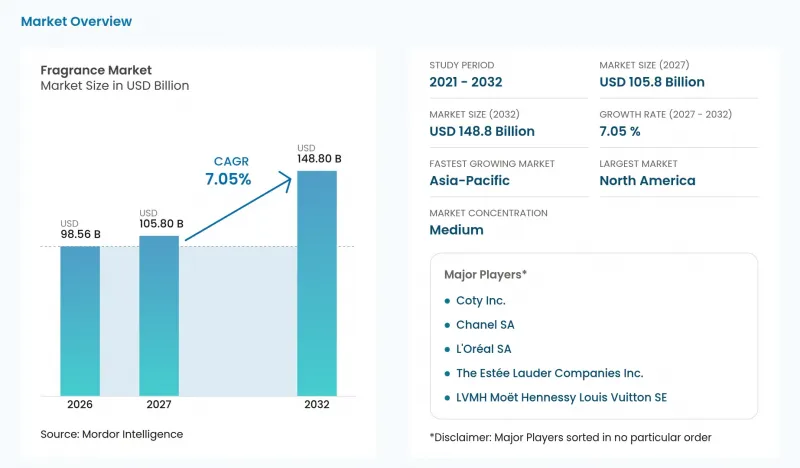
This report is segmented by Product Type (Body Fragrances and Home Fragrances), Category (Conventional and Organic), Price (Premium/Luxury and Mass), Distribution Channel (Specialty Stores, Hypermarkets/Supermarkets, and more), and Geography (North America, Europe, and more). The market forecasts are provided in terms of value (USD), based on availability.
Global Fragrance Market Trends and Insights
Shift toward natural, clean-label, and sustainable fragrance formulations
Buyers' acceptance of a defined performance trade-off gives sustainable fragrance formulations room to compete. In July 2025, 53.9% of 790 Hong Kong and Macau survey respondents were receptive to eco-friendly fragrances with reduced longevity from excluding certain synthetic ingredients. Separately, the International Fragrance Association's 2025 member survey found that the fragrance industry was shifting away from fossil-based feedstocks, after quantifying its mix of synthetic, natural, and renewable ingredients for the first time. These developments give producers different ways to build an ingredient proposition, with consumer receptivity supporting a clearly explained wear profile. Only 4.8% of those respondents found the reduced-longevity trade-off unacceptable, so shorter wear time does not rule out sustainability-led formulations among these buyers.
Growing demand for niche, artisanal, and bespoke fragrances
Niche perfumery can grow into a substantial retail business, and dedicated retail space gives individual houses a way to reach shoppers. Amouage reported estimated global retail sales of USD 430 million in 2025, up 66% from 2024. Boots opened a fragrance-only boutique in London on October 23, 2025, featuring more than 400 luxury and niche scents, including over 20 brands new to Boots. For a specialist house, that mix creates an opportunity to be considered alongside luxury fragrances in a destination devoted to scent. Boots' selection determines which niche houses gain access to that London destination, making retailer admission a practical limit on an individual house's additional reach.
Rising penetration of counterfeit and grey-market fragrances
Authenticity becomes a commercial constraint when counterfeit perfumes circulate across national borders. Spain's Tax Agency and Mossos d'Esquadra seized 1.21 million counterfeit perfumes in Catalonia in 2026 during an investigation into trafficking from Spain to France and elsewhere in Europe, with French Customs' collaboration. Cross-border trafficking exposes legitimate sellers to competing imitation stock in more than one destination. Proof of origin can help distinguish a genuine perfume when its name is also used on counterfeit stock. Even with that safeguard, sellers face the cost of authentication and exposure to purchases diverted toward imitations.
Other drivers and restraints analyzed in the detailed report include:
- Increasing consumer focus on home aesthetics and wellness-driven lifestyles
- Social media influence and celebrity-led brand collaborations
- Heightened consumer concerns over synthetic and allergenic ingredients
For complete list of drivers and restraints, kindly check the Table Of Contents.
Segment Analysis
Body fragrances held 84.86% of global fragrance sales in 2026, making them the largest segment, and are forecast to be the fastest-growing segment at a CAGR of 7.88% over 2027-2032. In its Q4 FY2026 presentation, Coty reported that prestige fragrance mists continued to grow, drew new Gen Z consumers to its brands, and were incremental to its portfolio. The company also reported mist gross margins comparable to its Prestige division. That combination makes the format relevant as a buyer-acquisition route with its own commercial economics. In Q1 FY2026, Coty reported sales gains and strong margins from mist launches under Calvin Klein, Kylie Cosmetics, philosophy, adidas, and Nautica collectively, showing the format's application across a multibrand portfolio.
Further development in body fragrances can focus on how an existing brand is worn, while household scents address a separate use setting. Home fragrances were used regularly by 81.1% of 790 Hong Kong and Macau survey respondents in July 2025, including products such as candles and diffusers. That regular-use base gives producers a reason to develop the delivery format as part of the product proposition. Producers expanding beyond wearable scents can organize a household line around the candles and diffusers used regularly by the surveyed consumers.
Conventional fragrances represented a 75.87% fragrance market share in 2026, making the category the largest segment. The category's mass deodorant and mainstream fine-fragrance applications give it a broad range of wearing occasions. Formulation decisions can then focus on matching scent profile and concentration to the intended wearing occasion.
Organic fragrances are forecast to be the fastest-growing segment, with a CAGR of 8.95% over 2027-2032. Ffern says at least 75% of each fragrance is COSMOS-certified organic. That quantified content promise gives organic positioning a concrete basis for buyers who prioritize certified ingredients. Because the claim names a certification standard and a minimum share, buyers can compare it directly with competing organic or natural claims.
Complete Report Scope:
- By Product Type
- Body Fragrances
- Perfumes
- Deodorants
- Others
- Home Fragrances
- Candles
- Diffusers
- Room Sprays
- Others
- Body Fragrances
- By Category
- Organic
- Conventional
- By Price
- Mass
- Premium/Luxury
- By Distribution Channel
- Hypermarkets/Supermarkets
- Specialty Stores
- Convenience Stores
- Online Retail Stores
- Other Distribution Channel
- By Geography
- North America
- United States
- Canada
- Mexico
- Rest of North America
- Europe
- Germany
- United Kingdom
- Italy
- France
- Spain
- Netherlands
- Poland
- Belgium
- Sweden
- Rest of Europe
- Asia-Pacific
- China
- India
- Japan
- South Korea
- Australia
- Indonesia
- Thailand
- Singapore
- Rest of Asia-Pacific
- South America
- Brazil
- Argentina
- Colombia
- Chile
- Peru
- Rest of South America
- Middle East and Africa
- South Africa
- Saudi Arabia
- United Arab Emirates
- Turkey
- Nigeria
- Egypt
- Morocco
- Rest of Middle East and Africa
- North America
Geography Analysis
North America accounted for a 46.54% fragrance market share in 2026, making it the largest geography. Interparfums, Inc. reported that North America was its largest market in the first half of 2026, when its regional sales rose 5%. The company attributed that advance to market growth, new brand extensions, particularly for Coach, and marketing and advertising investment. An extension-led strategy therefore calls for funding product renewal and advertising together, with Coach illustrating the established franchise that can anchor that investment.
Asia-Pacific is forecast to be the fastest-growing geography, with a CAGR of 9.4% over 2027-2032. In China, prestige fragrance e-commerce sales rose 26% year over year in January-November 2025, covering Tmall and JD.com business-to-consumer sales and Douyin livestreaming. Separately, department-store monitoring across 51 Chinese cities found fragrance and home-scent sales up 3.7% year over year for the year-to-date period in 2025. These examples show fragrance demand developing through both digital selling and monitored physical retail, giving suppliers more than one route into the Chinese consumer base. China's digital prestige-fragrance results and broader department-store scent activity favor channel-specific assortments over a uniform rollout.
Europe has a fragrance-production role illustrated by L'Oreal SA doubling capacity at its Gauchy, France, plant in 2025. That French plant produced the majority of the company's L'Oreal Luxe fragrances in 2025. In South America, direct selling represented 35% of Brazilian perfume sales in the 12 months ended July 2025, especially for national brands. In January 2026, Amour brand owner Badr Al-Sayyed said Saudi Arabia led perfume sales among the Gulf markets he sells to, followed by the United Arab Emirates, Oman, and Bahrain. Kantar reported Brazilian perfume sales up 17% in units and 15% in revenue in the 12 months ended July 2025, making direct selling commercially significant for serving that expanding demand.
- Chanel SA
- The Estee Lauder Companies Inc.
- LVMH Moet Hennessy Louis Vuitton SE
- Coty Inc.
- L'Oreal SA
- Shiseido Company Limited
- Natura Cosmeticos S.A.
- Hermes International SCA
- Revlon Group Holdings LLC
- Bath & Body Works Inc.
- Beiersdorf AG
- Interparfums, Inc.
- Henkel AG & Co. KGaA
- Unilever Plc
- The Procter & Gamble Company
- Clarins Group
- Puig Brands SA
- Groupe Rocher
- Kao Corporation
- SC Johnson & Son Inc.
- Reckitt Benckiser Group plc
- Godrej Consumer Products Limited
Additional Benefits:
- The market estimate (ME) sheet in Excel format
- 3 months of analyst support
TABLE OF CONTENTS
1 INTRODUCTION
- 1.1 Study Assumptions and Market Definition
- 1.2 Scope of the Study
2 RESEARCH METHODOLOGY
3 EXECUTIVE SUMMARY
4 MARKET LANDSCAPE
- 4.1 Market Overview
- 4.2 Market Drivers
- 4.2.1 Shift toward natural, clean-label, and sustainable fragrance formulations
- 4.2.2 Growing demand for niche, artisanal, and bespoke fragrances
- 4.2.3 Increasing consumer focus on home aesthetics and wellness-driven lifestyles
- 4.2.4 Social media influence and celebrity-led brand collaborations
- 4.2.5 Premiumization and rising demand for luxury fragrance offerings
- 4.2.6 Growing demand for personalized fragrances
- 4.3 Market Restraints
- 4.3.1 Rising penetration of counterfeit and grey-market fragrances
- 4.3.2 Heightened consumer concerns over synthetic and allergenic ingredients
- 4.3.3 Tightening volatile organic compounds compliance standards restricting product formulation options
- 4.3.4 Regulatory restrictions complicate formulations
- 4.4 Industry Value Chain Analysis
- 4.5 Regulatory Landscape
- 4.6 Technological Outlook
- 4.7 Porter's Five Forces Analysis
- 4.7.1 Threat of New Entrants
- 4.7.2 Bargaining Power of Suppliers
- 4.7.3 Bargaining Power of Buyers
- 4.7.4 Threat of Substitutes
- 4.7.5 Competitive Rivalry
- 4.8 Consumer Behavior Analysis
5 MARKET SIZE AND GROWTH FORECASTS (VALUE)
- 5.1 By Product Type
- 5.1.1 Body Fragrances
- 5.1.1.1 Perfumes
- 5.1.1.2 Deodorants
- 5.1.1.3 Others
- 5.1.2 Home Fragrances
- 5.1.2.1 Candles
- 5.1.2.2 Diffusers
- 5.1.2.3 Room Sprays
- 5.1.2.4 Others
- 5.1.1 Body Fragrances
- 5.2 By Category
- 5.2.1 Organic
- 5.2.2 Conventional
- 5.3 By Price
- 5.3.1 Mass
- 5.3.2 Premium/Luxury
- 5.4 By Distribution Channel
- 5.4.1 Hypermarkets/Supermarkets
- 5.4.2 Specialty Stores
- 5.4.3 Convenience Stores
- 5.4.4 Online Retail Stores
- 5.4.5 Other Distribution Channel
- 5.5 By Geography
- 5.5.1 North America
- 5.5.1.1 United States
- 5.5.1.2 Canada
- 5.5.1.3 Mexico
- 5.5.1.4 Rest of North America
- 5.5.2 Europe
- 5.5.2.1 Germany
- 5.5.2.2 United Kingdom
- 5.5.2.3 Italy
- 5.5.2.4 France
- 5.5.2.5 Spain
- 5.5.2.6 Netherlands
- 5.5.2.7 Poland
- 5.5.2.8 Belgium
- 5.5.2.9 Sweden
- 5.5.2.10 Rest of Europe
- 5.5.3 Asia-Pacific
- 5.5.3.1 China
- 5.5.3.2 India
- 5.5.3.3 Japan
- 5.5.3.4 South Korea
- 5.5.3.5 Australia
- 5.5.3.6 Indonesia
- 5.5.3.7 Thailand
- 5.5.3.8 Singapore
- 5.5.3.9 Rest of Asia-Pacific
- 5.5.4 South America
- 5.5.4.1 Brazil
- 5.5.4.2 Argentina
- 5.5.4.3 Colombia
- 5.5.4.4 Chile
- 5.5.4.5 Peru
- 5.5.4.6 Rest of South America
- 5.5.5 Middle East and Africa
- 5.5.5.1 South Africa
- 5.5.5.2 Saudi Arabia
- 5.5.5.3 United Arab Emirates
- 5.5.5.4 Turkey
- 5.5.5.5 Nigeria
- 5.5.5.6 Egypt
- 5.5.5.7 Morocco
- 5.5.5.8 Rest of Middle East and Africa
- 5.5.1 North America
6 COMPETITIVE LANDSCAPE
- 6.1 Market Concentration
- 6.2 Strategic Moves
- 6.3 Market Share Analysis
- 6.4 Company Profiles (includes Global level Overview, Market level overview, Core Segments, Financials as available, Strategic Information, Market Rank/Share for key companies, Products and Services, and Recent Developments)
- 6.4.1 Chanel SA
- 6.4.2 The Estee Lauder Companies Inc.
- 6.4.3 LVMH Moet Hennessy Louis Vuitton SE
- 6.4.4 Coty Inc.
- 6.4.5 L'Oreal SA
- 6.4.6 Shiseido Company Limited
- 6.4.7 Natura Cosmeticos S.A.
- 6.4.8 Hermes International SCA
- 6.4.9 Revlon Group Holdings LLC
- 6.4.10 Bath & Body Works Inc.
- 6.4.11 Beiersdorf AG
- 6.4.12 Interparfums, Inc.
- 6.4.13 Henkel AG & Co. KGaA
- 6.4.14 Unilever Plc
- 6.4.15 The Procter & Gamble Company
- 6.4.16 Clarins Group
- 6.4.17 Puig Brands SA
- 6.4.18 Groupe Rocher
- 6.4.19 Kao Corporation
- 6.4.20 SC Johnson & Son Inc.
- 6.4.21 Reckitt Benckiser Group plc
- 6.4.22 Godrej Consumer Products Limited
7 MARKET OPPORTUNITIES AND FUTURE OUTLOOK
- 7.1 White-Space and Unmet-Need Assessment

