PUBLISHER: Mordor Intelligence | PRODUCT CODE: 2187743

PUBLISHER: Mordor Intelligence | PRODUCT CODE: 2187743
Malaysia Data Center - Market Share Analysis, Industry Trends & Statistics, Growth Forecasts (2027 - 2032)
According to Mordor Intelligence, the Malaysia data center market size is projected to expand from USD 6.55 billion in 2026 and USD 7.83 billion in 2027 to USD 19.32 billion by 2032, registering a CAGR of 19.8% between 2027 and 2032.
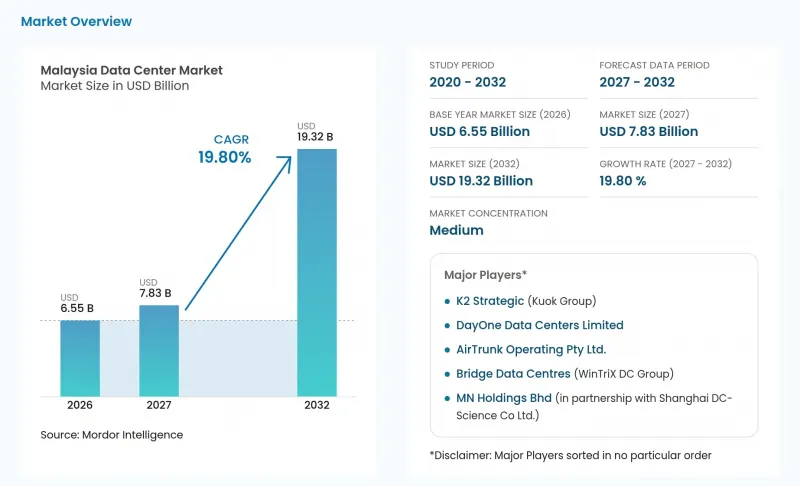
This report is segmented by Data Center Size (Large, Massive, and more), Tier Type (Tier 3, Tier 1 and 2, and more), Data Center Type (Colocation, Hyperscale/Self-built, and more), End User (IT and ITES, Telecom, and more), and Hotspot (Johor Bahru, Kuala Lumpur, and more). The market forecasts are provided in terms of value (USD), based on availability.
Malaysia Data Center Market Trends and Insights
Rising hyperscale cloud deployments
Locally available cloud regions can remove a service-location obstacle for regulated workloads. Microsoft made Malaysia West, its first cloud region in the country, generally available on May 28, 2025. The AI-ready hyperscale infrastructure in Greater Kuala Lumpur comprises 3 availability zones. In August 2025, Maybank agreed to use Azure for some strategic systems, functions, and data workloads under a partnership covering ASEAN and beyond. Malaysia West's in-country data residency was identified as key to Malaysian financial-services regulatory and sovereignty requirements. Infrastructure providers can therefore connect regional capacity with data-residency capabilities that make a local cloud service usable for financial customers.
Surge in FinTech and e-commerce digitalization
Transaction processing gives digitalization a route into hosting demand across financial services and commerce-enabled businesses. DuitNow QR transactions by individuals and merchants through banks and non-bank financial institutions doubled from 1.5 billion in 2024 to 3 billion in 2025. Income of Malaysian establishments with e-commerce transactions rose 2.8% year over year in the first quarter of 2026. Payment volume points to processing activity, while establishment income indicates the commercial scale of businesses transacting electronically. The sharper opportunity is payment-processing capacity for banks and non-bank institutions handling higher transaction counts, where computing demand follows processing volume rather than the monetary value of establishment income.
High electricity tariff volatility
Electricity price variability complicates the revenue needed to justify additional hosting capacity when generation costs can change each month. In Peninsular Malaysia, Automatic Fuel Adjustment changes generation charges monthly to reflect fuel prices and other generation costs. Tenaga Nasional Berhad (TNB) said electricity consumers received rebates for 9 consecutive months from August 2025 through April 2026, followed by a surcharge beginning in May 2026. The reversal shows why a favorable adjustment cannot safely become a fixed assumption for an operator's future electricity costs. A facility offering fixed hosting prices would consequently retain exposure unless its commercial terms address changes in the power charge. That unresolved exposure can raise the revenue threshold for committing additional capacity.
Other drivers and restraints analyzed in the detailed report include:
- Rapid submarine cable landings boosting connectivity
- Government tax incentives for green ICT investments
- Lengthy Tier 3/Tier 4 approval cycles
For complete list of drivers and restraints, kindly check the Table Of Contents.
Segment Analysis
Large facilities accounted for a 23.62% share of the Malaysia data center market size in 2026. TM Nxera, the joint venture of Telekom Malaysia and Nxera, completed its Iskandar Puteri campus's first building structural framework in April 2026, with first-phase operations targeted for the second half of 2026. The campus was designed to scale up to 200 MW, with mechanical and electrical installation, systems integration, and commissioning following the structural milestone. That sequence ties a buyer's deployment date to commissioning of the first phase, not to the campus's 200 MW design ceiling.
Medium facilities are the fastest-growing segment, with a forecast CAGR of 30.5% between 2027 and 2032. PLANMalaysia's 2024 planning guideline defined medium facilities as above 5 MVA through 25 MVA and identified Infinaxis Cyberjaya at 12 MVA. The project had been expected to finish in 2025, and Sime Darby Property subsequently reported its completion that year. The guideline places the 12 MVA Infinaxis project in a commercial planning zone in Cyberjaya, showing a siting route for medium facilities in commercial areas.
Tier 3 represented an 81.26% Malaysia data center market share in 2026 and is the fastest-growing segment, with a forecast CAGR of 34.4% between 2027 and 2032. In 2025, Telekom Malaysia said its Uptime Tier III data centers supported AI workloads, alongside locally hosted GPU infrastructure for developing and deploying AI solutions. This operating example links the facility specification to an application requiring computing capacity, giving the tier a role within an implemented AI ecosystem. Operators pursuing similar workloads can pair Tier III resilience with locally hosted GPU infrastructure, the combination Telekom Malaysia described in 2025.
The Tier 1 and 2 segment is forecast to contract. Uptime Institute describes Tier I as basic capacity for office IT and beyond, and Tier II as adding redundant power and cooling components while retaining exposure to unexpected shutdowns. Tier 4 uses independent, physically isolated redundant systems so equipment or distribution-path failures do not affect IT operations. However, maintenance shutdowns of redundant components or paths can increase disruption risk if another failure occurs. Tier II's exposure to unexpected shutdowns weakens its fit for workloads that cannot tolerate interruption, a technical reason consistent with the forecast contraction.
Complete Report Scope:
- By Data Center Size
- Large
- Massive
- Medium
- Mega
- Small
- By Tier Type
- Tier 1 and 2
- Tier 3
- Tier 4
- By Data Center Type
- Hyperscale/Self-built
- Enterprise/Edge
- Colocation
- Non-Utilized
- Utilized
- Retail Colocation
- Wholesale Colocation
- By End User
- BFSI
- IT and ITES
- E-Commerce
- Government
- Manufacturing
- Media and Entertainment
- Telecom
- Other End Users
- By Hotspot
- Kuala Lumpur
- Cyberjaya
- Johor Bahru
- Rest of Malaysia
List of Companies Covered in this Report:
- Bridge Data Centres (WinTriX DC Group)
- MN Holdings Bhd (in partnership with Shanghai DC-Science Co Ltd.)
- DayOne Data Centers Limited
- K2 Strategic (Kuok Group)
- AirTrunk Operating Pty Ltd.
- AIMS Data Centre Sdn. Bhd. (DigitalBridge Group, Inc.)
- Telekom Malaysia Berhad
- NTT DATA, Inc.
- CSF Group
- Alibaba Cloud
- Keppel Data Centres
- Open DC Sdn Bhd
- SAP SE
- Vantage Data Centers
- Telstra Group Limited
Additional Benefits:
- The market estimate (ME) sheet in Excel format
- 3 months of analyst support
TABLE OF CONTENTS
1 INTRODUCTION
- 1.1 Study Assumptions and Market Definition
- 1.2 Scope of the Study
2 RESEARCH METHODOLOGY
3 EXECUTIVE SUMMARY
4 MARKET LANDSCAPE
- 4.1 Market Overview
- 4.2 Market Drivers
- 4.2.1 Rising hyperscale cloud deployments
- 4.2.2 Surge in FinTech and e-commerce digitalization
- 4.2.3 Rapid submarine cable landings boosting connectivity
- 4.2.4 Government tax incentives for green ICT investments
- 4.2.5 Penang-Johor industrial corridor edge demand
- 4.2.6 AI training clusters driving campuses
- 4.3 Market Restraints
- 4.3.1 High electricity tariff volatility
- 4.3.2 Lengthy Tier 3/Tier 4 approval cycles
- 4.3.3 Scarcity of low-carbon power PPAs in Malaysia
- 4.3.4 Shortage of accredited Uptime-qualified engineers
- 4.4 Industry Value Chain Analysis
- 4.5 Regulatory Landscape
- 4.6 Technological Outlook
- 4.7 Porter's Five Forces Analysis
- 4.7.1 Threat of New Entrants
- 4.7.2 Bargaining Power of Suppliers
- 4.7.3 Bargaining Power of Buyers
- 4.7.4 Threat of Substitutes
- 4.7.5 Competitive Rivalry
- 4.8 Market Outlook
- 4.8.1 IT Load Capacity
- 4.8.2 Raised Floor Space
- 4.8.3 Colocation Revenue
- 4.8.4 Installed Racks
- 4.8.5 Rack Space Utilization
- 4.8.6 Submarine Cable
- 4.9 Key Industry Trends
- 4.9.1 Smartphone Users
- 4.9.2 Data Traffic Per Smartphone
- 4.9.3 Mobile Data Speed
- 4.9.4 Broadband Data Speed
- 4.9.5 Fiber Connectivity Network
- 4.9.6 Regulatory Framework
5 MARKET SIZE AND GROWTH FORECASTS (VALUE)
- 5.1 By Data Center Size
- 5.1.1 Large
- 5.1.2 Massive
- 5.1.3 Medium
- 5.1.4 Mega
- 5.1.5 Small
- 5.2 By Tier Type
- 5.2.1 Tier 1 and 2
- 5.2.2 Tier 3
- 5.2.3 Tier 4
- 5.3 By Data Center Type
- 5.3.1 Hyperscale/Self-built
- 5.3.2 Enterprise/Edge
- 5.3.3 Colocation
- 5.3.3.1 Non-Utilized
- 5.3.3.2 Utilized
- 5.3.3.2.1 Retail Colocation
- 5.3.3.2.2 Wholesale Colocation
- 5.4 By End User
- 5.4.1 BFSI
- 5.4.2 IT and ITES
- 5.4.3 E-Commerce
- 5.4.4 Government
- 5.4.5 Manufacturing
- 5.4.6 Media and Entertainment
- 5.4.7 Telecom
- 5.4.8 Other End Users
- 5.5 By Hotspot
- 5.5.1 Kuala Lumpur
- 5.5.2 Cyberjaya
- 5.5.3 Johor Bahru
- 5.5.4 Rest of Malaysia
6 COMPETITIVE LANDSCAPE
- 6.1 Market Concentration
- 6.2 Strategic Moves
- 6.3 Market Share Analysis
- 6.4 Company Profiles (includes Global level Overview, Market level overview, Core Segments, Financials as available, Strategic Information, Market Rank/Share for key companies, Products and Services, and Recent Developments)
- 6.4.1 Bridge Data Centres (WinTriX DC Group)
- 6.4.2 MN Holdings Bhd (in partnership with Shanghai DC-Science Co Ltd.)
- 6.4.3 DayOne Data Centers Limited
- 6.4.4 K2 Strategic (Kuok Group)
- 6.4.5 AirTrunk Operating Pty Ltd.
- 6.4.6 AIMS Data Centre Sdn. Bhd. (DigitalBridge Group, Inc.)
- 6.4.7 Telekom Malaysia Berhad
- 6.4.8 NTT DATA, Inc.
- 6.4.9 CSF Group
- 6.4.10 Alibaba Cloud
- 6.4.11 Keppel Data Centres
- 6.4.12 Open DC Sdn Bhd
- 6.4.13 SAP SE
- 6.4.14 Vantage Data Centers
- 6.4.15 Telstra Group Limited
7 MARKET OPPORTUNITIES AND FUTURE OUTLOOK
- 7.1 White-Space and Unmet-Need Assessment

