PUBLISHER: Mordor Intelligence | PRODUCT CODE: 2187766

PUBLISHER: Mordor Intelligence | PRODUCT CODE: 2187766
Europe Space Propulsion - Market Share Analysis, Industry Trends & Statistics, Growth Forecasts (2026 - 2031)
According to Mordor Intelligence, the Europe space propulsion market size was valued at USD 0.92 billion in 2025 and is forecast to grow from USD 1.03 billion in 2026 to reach USD 1.66 billion by 2031, at a 10.02% CAGR during the forecast period (2026-2031).
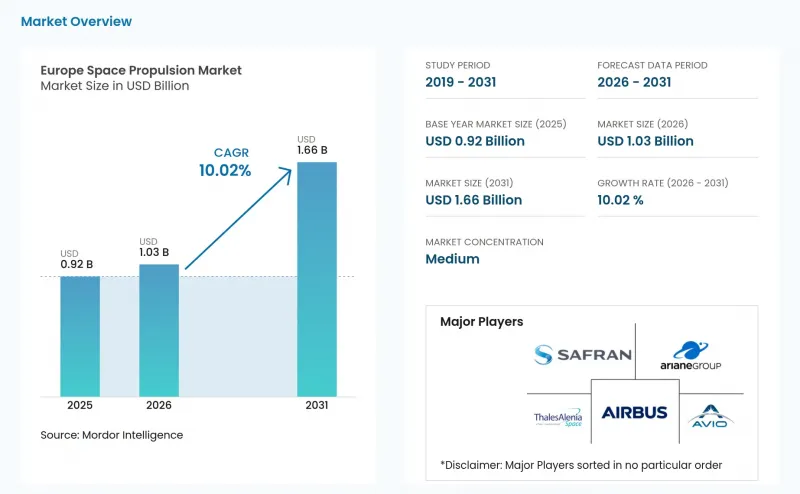
Europe Space Propulsion Market Trends and Insights
Institutional and Commercial Satellite Deployment
The EU IRIS2 program requires a multi-orbital LEO and MEO architecture, creating demand for satellites with station-keeping and deorbit capability. The program provides the Europe space propulsion market with a source of institutional demand that is less exposed to commercial pricing cycles. Renewal of the Galileo and Copernicus fleets also adds demand that is tied to public missions. Larger constellation orders favor standardized, modular propulsion units over bespoke heritage designs. This shift requires established suppliers to reduce manufacturing costs and streamline certification processes while maintaining reliability. Safran's PPS5000 Hall thruster became a European alternative after the disruption of Russian SPT-140d supply accelerated domestic qualification efforts.
Expansion of European Launch Capacity
The Ariane 6 program links European launch capacity directly to demand for large solid- and liquid-propulsion systems. Ariane 6 flight VA269 demonstrated the P160C-powered Ariane 64 configuration by deploying 36 Amazon LEO satellites and setting a European payload record. The flight also demonstrated a 10-15% performance uplift for LEO missions with the new booster configuration. Scaling production requires investment in propellant mixing, carbon-fiber winding, and transportation capacity. These investments have long lead times, so suppliers need sustained institutional commitments before they can increase output. ArianeGroup's CNES contract for a next-generation liquid-oxygen-and-methane engine showed that Europe is scaling up existing launch systems while developing a successor architecture.
High Qualification and Reliability Requirements
European propulsion systems require environmental testing, materials verification, and failure-mode analysis before flight readiness. The process can span from initial design to qualification over 5 to 8 years, delaying the supply response to new demand. The constraint is acute for electric propulsion because iodine, krypton-fed, and air-breathing concepts can change before a test program is complete. The INVICTUS project used a delta-qualification approach to extend qualified systems to krypton without a complete new cycle. High-vacuum testing capacity is concentrated at national facilities such as DLR Lampoldshausen, ESTEC, and ONERA, which can create scheduling constraints. Propellant handling, export controls, and environmental requirements add further documentation and operating requirements for the Europe space propulsion market.
Other drivers and restraints analyzed in the detailed report include:
- Electric Propulsion Adoption for Mass and Cost Optimization
- Growth of In-Orbit Mobility and End-of-Life Services
- High Capital Intensity and Long Development Cycles
For complete list of drivers and restraints, kindly check the Table Of Contents.
Segment Analysis
Liquid propulsion accounted for 51.22% of the Europe space propulsion market in 2025, supported by the high value of Ariane 6 main-stage and upper-stage systems. Vulcain 2.1 and Vinci engines remain important because they support European autonomous access to space. Bipropellant systems are used in launch vehicle main stages and satellite apogee engines. Monopropellant hydrazine thrusters remain relevant for attitude control on existing and mid-life satellite platforms. Solid propulsion also remains strategically important because the P120C and P160C support Ariane 6 and Vega-C programs. ArianeGroup and Avio renewed their Europropulsion agreement in November 2025 for production through 2029. The European space propulsion market, therefore, continues to rely on established liquid and solid systems for its launch architecture. These systems require mature production lines and formal qualification procedures. Their importance limits the speed at which alternative launch propulsion suppliers can enter the field.
Electric propulsion is forecast to grow at a 16.42% CAGR through 2031 as operators adopt Hall-effect and electrospray systems for station-keeping and disposal. Its lower propellant demand can reduce spacecraft mass and support broader launch options. ION-X raised EUR 13 million (USD 14.30 million) in December 2024 to industrialize electrospray thrusters and targeted 200 units per year by 2028. Hybrid propulsion remains at an earlier stage of commercial development but attracts interest for sovereign European manufacturing. HyPrSpace raised EUR 21 million (USD 22.89 million) in 2025 through the France 2030 funding program. The segment includes different technical approaches, so qualification progress and in-orbit performance remain important selection factors. Suppliers that can match standardized spacecraft interfaces may benefit as satellite programs increase procurement volumes. The move toward repeatable modules can favor companies that show stable production quality. It can also make component availability a central part of customer selection.
Thrusters and rocket motors held 51.81% of revenue in 2025 because they are the primary value-adding hardware across propulsion types. The category includes large launch engines, solid motors, Hall-effect thrusters, and discharge chambers. The ArianeGroup RIT-2X gridded-ion thruster was developed through the GIESEPP MP program as a standardized plug-and-play unit. Standardized products can reduce the custom engineering burden for satellite integrators. They can also support repeat procurement for constellation programs. Large rocket motors retain high contract value due to their role in launch-vehicle propulsion. The component mix in the European space propulsion market, therefore, reflects both launch systems and the growing satellite propulsion base. Hardware suppliers must balance the needs of high-value launch programs with those of higher-volume satellite orders. The product mix changes as satellite builders seek parts that are simpler to integrate.
Propellant feed systems are forecast to grow at a 14.12% CAGR through 2031 as electric propulsion adopts xenon, krypton, and iodine configurations. Each propellant may require different pressure-control, storage, and flow-metering designs. This increases the importance of component reliability beyond the thruster itself. Power processing units also support electric propulsion by managing the electrical supply to the thruster. Thales Belgium's Mk3 power processing unit has been integrated with Hall thruster platforms in European consortium projects. Nozzles and thermal-control equipment remain closely tied to launch vehicle production requirements. Component suppliers can benefit by supporting multiple propulsion architectures rather than a single platform design. Feed-system design becomes more important as satellite operators consider several propellant options. Common interface requirements can also make it easier for integrators to qualify a component across programs.
Complete Report Scope:
- By Propulsion Type
- Solid Propulsion
- Liquid Propulsion
- Monopropellant
- Bipropellant
- Hybrid Propulsion
- Electric Propulsion
- Hall-Effect Thrusters
- Gridded Ion Thrusters
- Electrospray Thrusters
- Pulsed Plasma Thrusters
- Magnetoplasmadynamic Thrusters
- Others
- By Component
- Thrusters and Rocket Motor
- Propellant Feed Systems
- Power Processing Units
- Nozzles
- Propulsion Thermal-Control Systems
- Others
- By Platform
- Satellites
- Launch Vehicles
- Spacecraft
- Others
- By End User
- Commercial
- Government and Civil
- Military
- By Geography
- United Kingdom
- France
- Germany
- Italy
- Spain
- Sweden
- Russia
- Rest of Europe
List of Companies Covered in this Report:
- Airbus SE
- ArianeGroup SAS
- Safran SA
- Avio S.p.A.
- Thales Alenia Space
- OHB SE
- Exotrail
- SITAEL S.p.A.
- Moog Inc.
- Honeywell Aerospace Inc.
- Northrop Grumman Corporation
- L3Harris Technologies, Inc.
- Space Exploration Technologies Corp.
- QinetiQ Group plc
- Reaction Engines Limited
- Pangea Aerospace, SL
- Arkadia Aerospace Propulsion & Transportation Systems SL
- ION-X SAS
- ThrustMe
- Enpulsion GmbH
- ISPTech GmbH
Additional Benefits:
- The market estimate (ME) sheet in Excel format
- 3 months of analyst support
TABLE OF CONTENTS
1 INTRODUCTION
- 1.1 Study Assumptions and Market Definition
- 1.2 Scope of the Study
2 RESEARCH METHODOLOGY
3 EXECUTIVE SUMMARY
4 MARKET LANDSCAPE
- 4.1 Market Drivers
- 4.1.1 Institutional and commercial satellite deployment
- 4.1.2 Expansion of European launch capacity
- 4.1.3 Electric propulsion adoption for mass and cost optimization
- 4.1.4 Growth of in-orbit mobility and end-of-life services
- 4.1.5 European industrialization of propulsion manufacturing
- 4.1.6 European strategic autonomy in space
- 4.2 Market Restraints
- 4.2.1 High capital intensity and long development cycles
- 4.2.2 High qualification and reliability requirements
- 4.2.3 Propellant, export-control, and environmental compliance constraints
- 4.2.4 Limited European launch cadence and fragmented procurement
- 4.3 Value Chain Analysis
- 4.4 Regulatory Landscape
- 4.5 Technological Outlook
- 4.6 Porter's Five Forces Analysis
- 4.6.1 Bargaining Power of Suppliers
- 4.6.2 Bargaining Power of Buyers/Consumers
- 4.6.3 Threat of New Entrants
- 4.6.4 Threat of Substitutes
- 4.6.5 Intensity of Competitive Rivalry
5 MARKET SIZE AND GROWTH FORECASTS (VALUE)
- 5.1 By Propulsion Type
- 5.1.1 Solid Propulsion
- 5.1.2 Liquid Propulsion
- 5.1.2.1 Monopropellant
- 5.1.2.2 Bipropellant
- 5.1.3 Hybrid Propulsion
- 5.1.4 Electric Propulsion
- 5.1.4.1 Hall-Effect Thrusters
- 5.1.4.2 Gridded Ion Thrusters
- 5.1.4.3 Electrospray Thrusters
- 5.1.4.4 Pulsed Plasma Thrusters
- 5.1.4.5 Magnetoplasmadynamic Thrusters
- 5.1.5 Others
- 5.2 By Component
- 5.2.1 Thrusters and Rocket Motor
- 5.2.2 Propellant Feed Systems
- 5.2.3 Power Processing Units
- 5.2.4 Nozzles
- 5.2.5 Propulsion Thermal-Control Systems
- 5.2.6 Others
- 5.3 By Platform
- 5.3.1 Satellites
- 5.3.2 Launch Vehicles
- 5.3.3 Spacecraft
- 5.3.4 Others
- 5.4 By End User
- 5.4.1 Commercial
- 5.4.2 Government and Civil
- 5.4.3 Military
- 5.5 By Geography
- 5.5.1 United Kingdom
- 5.5.2 France
- 5.5.3 Germany
- 5.5.4 Italy
- 5.5.5 Spain
- 5.5.6 Sweden
- 5.5.7 Russia
- 5.5.8 Rest of Europe
6 COMPETITIVE LANDSCAPE
- 6.1 Market Concentration
- 6.2 Strategic Moves
- 6.3 Market Share Analysis
- 6.4 Company Profiles (includes Global level Overview, Market level Overview, Core Segments, Financials, Strategic Information, Market Rank/Share, Products and Services, and Recent Developments)
- 6.4.1 Airbus SE
- 6.4.2 ArianeGroup SAS
- 6.4.3 Safran SA
- 6.4.4 Avio S.p.A.
- 6.4.5 Thales Alenia Space
- 6.4.6 OHB SE
- 6.4.7 Exotrail
- 6.4.8 SITAEL S.p.A.
- 6.4.9 Moog Inc.
- 6.4.10 Honeywell Aerospace Inc.
- 6.4.11 Northrop Grumman Corporation
- 6.4.12 L3Harris Technologies, Inc.
- 6.4.13 Space Exploration Technologies Corp.
- 6.4.14 QinetiQ Group plc
- 6.4.15 Reaction Engines Limited
- 6.4.16 Pangea Aerospace, SL
- 6.4.17 Arkadia Aerospace Propulsion & Transportation Systems SL
- 6.4.18 ION-X SAS
- 6.4.19 ThrustMe
- 6.4.20 Enpulsion GmbH
- 6.4.21 ISPTech GmbH
7 MARKET OPPORTUNITIES AND FUTURE OUTLOOK
- 7.1 White-space and Unmet-need Assessment

