PUBLISHER: Mordor Intelligence | PRODUCT CODE: 2187770

PUBLISHER: Mordor Intelligence | PRODUCT CODE: 2187770
Mirrorless Camera - Market Share Analysis, Industry Trends & Statistics, Growth Forecasts (2027 - 2032)
According to Mordor Intelligence, the mirrorless camera market size is projected to expand from USD 5.32 billion in 2026 and USD 5.64 billion in 2027 to USD 7.42 billion by 2032, registering a CAGR of 5.65% between 2027 and 2032.
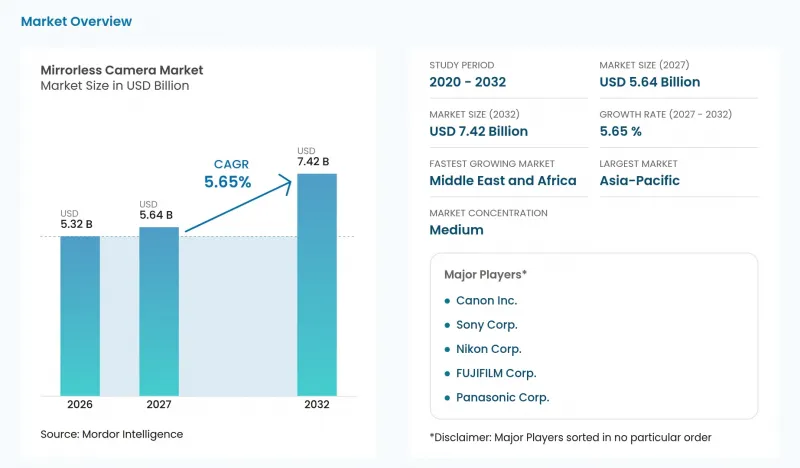
This report is segmented by Lens Type (Interchangeable Lens and more), End-User (Prosumer/Enthusiast and more), Video Resolution (Up to 4K and more), Price Point (Mid-Range and more), Distribution Channel (Offline Retail and more), and Geography (Asia-Pacific and more). The market forecasts are provided in terms of value (USD), based on availability.
Global Mirrorless Camera Market Trends and Insights
Booming Demand for 4K/6K Hybrid-shooting Models Among Content Creators
Creators seeking video-focused cameras give manufacturers a reason to compete on recording utility alongside still-image capabilities. Canon Inc. reported increased Q3 2025 sales of the EOS R50 V mirrorless camera and PowerShot V1 compact camera following favorable response from social-media and vlog video users. For 2025, Canon also reported expanded interchangeable-lens camera sales amid an increase in camera users, especially young people. A hybrid body can make a dedicated device relevant to more of a buyer's output by combining still-image and video utility. Video-led buyer recruitment therefore offers manufacturers a demand route beyond replacement purchases by established stills photographers.
Surging Adoption of Full-Frame Bodies by Wedding and Event Professionals in Europe
For wedding professionals, repeated paid coverage can improve the economics of a full-frame body over its service life. By February 2025, Nottinghamshire wedding photographer Ed Godden reported shooting more than 80 weddings with his first Sony a7 IV full-frame body, bought in summer 2022. Spreading acquisition cost across repeated assignments can make a higher-value body commercially viable without requiring every booking to recover a large equipment expense. In a January 2026 account, Godden referred to his a7 IV bodies and described a recent London wedding shot with 35mm, 20mm and 85mm lenses. His multi-body practice illustrates demand for additional bodies within an established system, so suppliers can sell another body to a working wedding photographer before a serviceable camera needs replacing.
Flagship-Smartphone Computational Photography Cannibalizing Entry-Level Sales
A first-time camera buyer needs an additional photographic benefit when a flagship smartphone already serves the intended output. The restraint is strongest when the buyer's existing phone can complete the task for which a separate camera is being considered. In that case, an entry-level body adds a purchase and another device to carry, so its advantages must justify that additional commitment. A dedicated camera can answer with capabilities suited to a particular shooting task, but those capabilities need to matter to the first-time user. The remaining commercial hurdle is the incremental value of a second device, which can delay entry into a camera system even when body prices do not rise.
Other drivers and restraints analyzed in the detailed report include:
- Corporate and Education Sector Shift to Mirrorless for Live-Streaming Set-ups (North America)
- Government Film-Incentive Programs Fueling High-End Purchases (Middle East)
- Supply-chain Volatility in CMOS and IBIS Components Affecting ASPs
For complete list of drivers and restraints, kindly check the Table Of Contents.
Segment Analysis
Interchangeable-lens cameras accounted for an 86.42% share of the mirrorless camera market size in 2026, making them the largest segment. The Camera & Imaging Products Association (CIPA) recorded 6.31 million mirrorless camera shipments worldwide in 2025, up 12.5% from 2024. A system that lets a buyer change lenses can serve changing capture requirements while the body remains part of the same equipment platform. That flexibility supports separate decisions about an optical upgrade and a body replacement, allowing each purchase to address a particular shooting task. For a manufacturer, the commercial value lies in keeping the body relevant as the buyer changes lenses for different shooting needs.
Built-in/static-lens cameras are forecast to be the fastest-growing segment, with a CAGR of 8.75% between 2027 and 2032. A fixed optical configuration makes the initial camera choice decisive, because later lens changes cannot broaden its shooting role. Buyers can evaluate a complete camera around a defined assignment, while suppliers can develop the body and permanent optics as one proposition. That integration can simplify the equipment decision, but it also makes a poor match between the lens and the intended task harder to correct. Targeted complete-camera offers whose fixed optics suit the buyer's main application carry this segment's growth.
Prosumers and enthusiasts represented a 47.1% mirrorless camera market share in 2026 and formed the largest segment. Canon reported sales growth for the EOS R6 Mark III in the first half of 2026. Canon released the full-frame mirrorless model in November 2025 for advanced amateur users. An advanced-amateur buyer can assess a full-frame body by its value to personal photography, without requiring paid assignments to recover the purchase price. That opens a separate route to revenue for manufacturers, since an individual's photographic ambitions can support a full-frame upgrade outside a commercial studio's equipment cycle.
Professional users, including commercial studios and media houses, are forecast to be the fastest-growing segment, with a CAGR of 5.92% between 2027 and 2032. The 2025 Professional Photographer Reader Study from the Professional Photographers of America (PPA) reported 78% mirrorless adoption and 64% DSLR use among respondents. It also reported 83% studio or photography-business ownership among PPA members. A photographer operating a studio can assign a new mirrorless body a working role alongside equipment already supporting the business. The commercial opening includes supplementary-body sales to established operators, giving manufacturers a route beyond the complete replacement of a professional's existing camera system.
Complete Report Scope:
- By Lens Type
- Built-in/Static Lens
- Interchangeable Lens
- By End-User
- Professional (Commercial Studios, Media Houses)
- Prosumer/Enthusiast
- Amateur/Hobbyist
- By Video Resolution
- Up to 4K
- 4K - 6K
- Above 6K/8K
- By Price Point
- Entry-Level (Less than USD 1000)
- Mid-Range (USD 1000 - USD 3000)
- High-End (Above USD 3000)
- By Distribution Channel
- Offline Retail (Brand and Specialty Stores)
- Online Retail
- By Geography
- North America
- United States
- Canada
- Mexico
- Europe
- Germany
- United Kingdom
- France
- Nordics
- Rest of Europe
- South America
- Brazil
- Rest of South America
- Asia-Pacific
- China
- Japan
- India
- South-East Asia
- Rest of Asia-Pacific
- Middle East and Africa
- Middle East
- Gulf Cooperation Council Countries
- Turkey
- Rest of Middle East
- Africa
- South Africa
- Rest of Africa
- Middle East
- North America
Geography Analysis
Asia-Pacific held a 35.95% mirrorless camera market share in 2026, making it the largest geography. CIPA member companies, including their overseas production, shipped 1.9 million mirrorless cameras to China in 2025, up 15.9% from 2024. Canon India announced its official consumer e-Shop on January 20, 2025, with products supplied by authorized partners, while Henry's Cameras opened a Cagayan de Oro City branch in the Philippines on April 7, 2025. In South Korea, Nikon Imaging Korea reported that teenagers and users in their 20s and 30s formed the majority of its website registrants for mirrorless and cinema line products as of November 2025. Regional expansion can therefore depend on organizing authorized distribution as well as supplying camera bodies, with partners connecting the manufacturer's offer to customers beyond an individual retailer's store footprint.
The Middle East and Africa region is forecast to be the fastest-growing geography, with a CAGR of 8.6% between 2027 and 2032. In 2025, Hot Cold Studio, a Dubai studio operator that rents cameras and production equipment, joined Grand Stores, a professional-imaging distributor and retailer in the United Arab Emirates. Hot Cold said the tie-up gave its clients access to a broader equipment range and expanded inventory backed by the distributor. A distributor-backed rental fleet gives production crews equipment access beyond direct retail sales, which is where suppliers find the opening in this region.
In Europe, EU radio-equipment rules have required USB-C ports since December 28, 2024, for digital photo and video cameras with removable or embedded rechargeable batteries and wired charging. The EU exception applies to digital cameras designed exclusively for the audiovisual sector or for security and surveillance. In North America, Camera West opened a San Francisco photographic-equipment flagship in March 2026. In South America, Brazil's GECEX rejected Canon do Brasil's 2025 request to reduce a 20% import duty to 0% for a specified professional APS-C interchangeable-lens camera configuration. These cases distinguish a design obligation for covered EU cameras from a local retail expansion and a rejected Brazilian tariff request, making their commercial relevance depend on product eligibility and location.
- Canon Inc.
- Sony Corp.
- Nikon Corp.
- FUJIFILM Corp.
- Panasonic Corp.
- OM Digital Solutions Corp.
- Leica Camera AG
- Ricoh Imaging Co. Ltd. (Pentax)
- Sigma Corp.
- Victor Hasselblad AB
- Blackmagic Design Pty Ltd.
- SZ DJI Technology Co. Ltd.
- GoPro Inc.
- Phase One A/S
- Sharp Corp. (8K Mirrorless)
- Z CAM Ltd.
- Eastman Kodak Co.
- Samsung Electronics Co. Ltd.
- Xiaomi Corp. (Concept APS-C)
- RED Digital Cinema Inc.
Additional Benefits:
- The market estimate (ME) sheet in Excel format
- 3 months of analyst support
TABLE OF CONTENTS
1 INTRODUCTION
- 1.1 Study Assumptions and Market Definition
- 1.2 Scope of the Study
2 RESEARCH METHODOLOGY
3 EXECUTIVE SUMMARY
4 MARKET LANDSCAPE
- 4.1 Market Overview
- 4.2 Market Drivers
- 4.2.1 Booming Demand for 4K/6K Hybrid-shooting Models Among Content Creators
- 4.2.2 Surging Adoption of Full-Frame Bodies by Wedding and Event Professionals in Europe
- 4.2.3 Corporate and Education Sector Shift to Mirrorless for Live-Streaming Set-ups (North America)
- 4.2.4 Government Film-Incentive Programs Fueling High-End Purchases (Middle East)
- 4.2.5 Rapid Lens-Road-Map Expansion by Japanese OEMs Accelerating Upgrade Cycles
- 4.2.6 Transition of Broadcasters from ENG Camcorders to Mirrorless Systems (Asia)
- 4.3 Market Restraints
- 4.3.1 Flagship-Smartphone Computational Photography Cannibalizing Entry-Level Sales
- 4.3.2 Supply-chain Volatility in CMOS and IBIS Components Affecting ASPs
- 4.3.3 Steep Learning-Curve Limiting Adoption by First-Time Hobbyists
- 4.3.4 Import Tariff Escalations on Optics in South America
- 4.4 Industry Value Chain Analysis
- 4.5 Regulatory Landscape
- 4.6 Technological Outlook
- 4.7 Porter's Five Forces Analysis
- 4.7.1 Threat of New Entrants
- 4.7.2 Bargaining Power of Suppliers
- 4.7.3 Bargaining Power of Buyers
- 4.7.4 Threat of Substitutes
- 4.7.5 Competitive Rivalry
- 4.8 Industry Ecosystem Analysis
- 4.9 Pricing Analysis
- 4.10 Investment Analysis
5 MARKET SIZE AND GROWTH FORECASTS (VALUE)
- 5.1 By Lens Type
- 5.1.1 Built-in/Static Lens
- 5.1.2 Interchangeable Lens
- 5.2 By End-User
- 5.2.1 Professional (Commercial Studios, Media Houses)
- 5.2.2 Prosumer/Enthusiast
- 5.2.3 Amateur/Hobbyist
- 5.3 By Video Resolution
- 5.3.1 Up to 4K
- 5.3.2 4K - 6K
- 5.3.3 Above 6K/8K
- 5.4 By Price Point
- 5.4.1 Entry-Level (Less than USD 1000)
- 5.4.2 Mid-Range (USD 1000 - USD 3000)
- 5.4.3 High-End (Above USD 3000)
- 5.5 By Distribution Channel
- 5.5.1 Offline Retail (Brand and Specialty Stores)
- 5.5.2 Online Retail
- 5.6 By Geography
- 5.6.1 North America
- 5.6.1.1 United States
- 5.6.1.2 Canada
- 5.6.1.3 Mexico
- 5.6.2 Europe
- 5.6.2.1 Germany
- 5.6.2.2 United Kingdom
- 5.6.2.3 France
- 5.6.2.4 Nordics
- 5.6.2.5 Rest of Europe
- 5.6.3 South America
- 5.6.3.1 Brazil
- 5.6.3.2 Rest of South America
- 5.6.4 Asia-Pacific
- 5.6.4.1 China
- 5.6.4.2 Japan
- 5.6.4.3 India
- 5.6.4.4 South-East Asia
- 5.6.4.5 Rest of Asia-Pacific
- 5.6.5 Middle East and Africa
- 5.6.5.1 Middle East
- 5.6.5.1.1 Gulf Cooperation Council Countries
- 5.6.5.1.2 Turkey
- 5.6.5.1.3 Rest of Middle East
- 5.6.5.2 Africa
- 5.6.5.2.1 South Africa
- 5.6.5.2.2 Rest of Africa
- 5.6.5.1 Middle East
- 5.6.1 North America
6 COMPETITIVE LANDSCAPE
- 6.1 Market Concentration
- 6.2 Strategic Moves
- 6.3 Market Share Analysis
- 6.4 Company Profiles (includes Global level Overview, Market level overview, Core Segments, Financials as available, Strategic Information, Market Rank/Share for key companies, Products and Services, and Recent Developments)
- 6.4.1 Canon Inc.
- 6.4.2 Sony Corp.
- 6.4.3 Nikon Corp.
- 6.4.4 FUJIFILM Corp.
- 6.4.5 Panasonic Corp.
- 6.4.6 OM Digital Solutions Corp.
- 6.4.7 Leica Camera AG
- 6.4.8 Ricoh Imaging Co. Ltd. (Pentax)
- 6.4.9 Sigma Corp.
- 6.4.10 Victor Hasselblad AB
- 6.4.11 Blackmagic Design Pty Ltd.
- 6.4.12 SZ DJI Technology Co. Ltd.
- 6.4.13 GoPro Inc.
- 6.4.14 Phase One A/S
- 6.4.15 Sharp Corp. (8K Mirrorless)
- 6.4.16 Z CAM Ltd.
- 6.4.17 Eastman Kodak Co.
- 6.4.18 Samsung Electronics Co. Ltd.
- 6.4.19 Xiaomi Corp. (Concept APS-C)
- 6.4.20 RED Digital Cinema Inc.
7 MARKET OPPORTUNITIES AND FUTURE OUTLOOK
- 7.1 White-Space and Unmet-Need Assessment

