PUBLISHER: Mordor Intelligence | PRODUCT CODE: 2187776

PUBLISHER: Mordor Intelligence | PRODUCT CODE: 2187776
GCC International Express Service - Market Share Analysis, Industry Trends & Statistics, Growth Forecasts (2027 - 2032)
According to Mordor Intelligence, the GCC international express service market size is valued at USD 0.72 billion in 2026 and is estimated to grow from USD 0.78 billion in 2027 to reach USD 1.13 billion by 2032, at a CAGR of 7.57% during the forecast period (2027-2032).
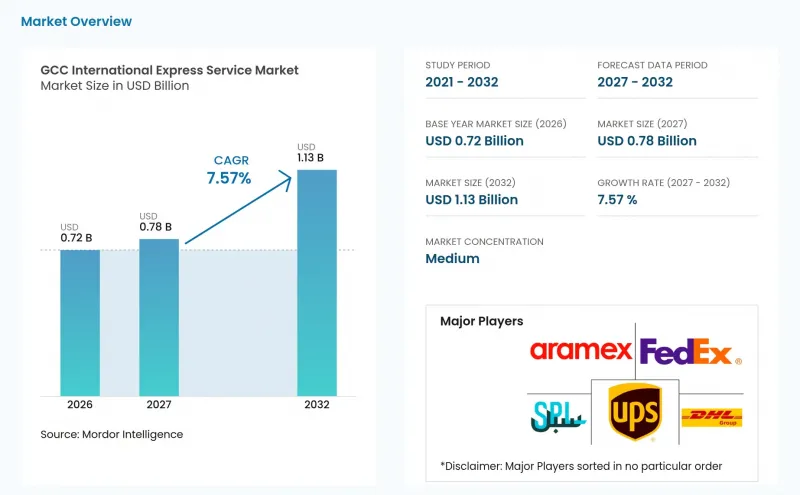
The GCC international express service market is shaped by cross-border online purchases, customs modernization, and the Gulf's role between Asian exporters and consumers in Africa and Europe. This report is Segmented by Shipment Weight (Light Weight Shipments, and More), by Route (Inter-Regional and Intra-Regional GCC Shipments), by Business Model (B2B, B2C, and C2C), by Mode of Transport (Air, Road, and Others), by End User Industry (E-Commerce, Healthcare, and More), and by Country (Qatar, Saudi Arabia, and More). The Market Forecasts are Provided in Terms of Value (USD).
GCC International Express Service Market Trends and Insights
Cross-Border E-Commerce Growth
Cross-border e-commerce remains an important source of parcel demand for the GCC international express service market because consumers increasingly order products not held in domestic inventories. DHL expects GCC e-commerce to grow at nearly 11% annually through 2027 and identifies cross-border logistics as a notable area of activity within the region. Delivery speed can affect a buyer's willingness to complete an order, especially for products with limited local availability or a short purchase cycle. This makes predictable delivery windows important to platforms, sellers, and consumers, rather than simply an added shipping feature. Express providers that can link shipment data, customs processing, and last-mile updates are better placed to support this demand. The GCC international express service market, therefore, depends on service consistency as well as parcel volume, since recurring online demand can move quickly toward providers with better delivery reliability.
GCC Customs-Duty Harmonization
The GCC Integrated Customs Tariff moved to a 12-digit classification structure across member states from January 2025, creating a common basis for product classification. A common structure gives operators a clearer foundation for preparing declarations across multiple GCC destinations. It also makes accurate product data more valuable, because the quality of submitted information affects whether a shipment can move through automated clearance. The GCC international express service market benefits when classification and declaration processes are less dependent on manual correction. Operators with integrated customs systems can use the change to reduce avoidable data errors and handoffs. The remaining advantage will depend on how consistently importers, marketplaces, and carriers apply the classification requirements in daily operations.
Limited Last-Mile Infrastructure Outside Tier-1 Cities
The GCC international express service market faces higher delivery costs when networks extend beyond the largest cities into lower-density areas. Routes outside major urban centers may involve fewer parcels per stop, longer travel distances, and greater uncertainty in final delivery locations. This makes it difficult to keep the cost per delivery aligned with customer expectations for express services. Cash-on-delivery orders can add further work because collections, failed deliveries, and return movements require extra handling. Address quality also remains important, since unclear locations can require drivers to call customers or carry out manual searches. National address initiatives can improve this over time, but providers still need enough route density to make expanded coverage financially sustainable.
Other drivers and restraints analyzed in the detailed report include:
- 24-Hour Clearance at Major Air Cargo Hubs
- Expansion of Bonded Logistics Zones
- Workforce Nationalization and Skilled-Labor Constraints
For complete list of drivers and restraints, kindly check the Table Of Contents.
Segment Analysis
Light weight shipments held 51.43% of the GCC international express service market share in 2026 and are forecast to expand at a 7.76% CAGR through 2032. This category fits the operating model of online retail parcels, documents, samples, small consumer electronics, and many healthcare consignments. Automated sortation systems are usually designed to process large volumes of parcels within a limited size and weight range. The GCC international express service market size for light shipments is supported by frequent orders rather than high revenue from individual consignments. Direct-to-consumer sellers also tend to ship beauty products, personal care items, accessories, and electronics in smaller parcels. These shipment profiles reward operators who can process high volumes with frequent scans and predictable routing.
Medium weight shipments serve customers who need faster delivery than economy freight but do not require the premium handling used for the smallest urgent parcels. Industrial components, medical devices, fashion goods, and business supplies can fall into this range. Heavy shipments represent a smaller share of parcel movements, but their value per shipment can be higher when they support production-critical activity. A delayed spare part can have consequences that outweigh the additional cost of express transport. Providers, therefore, need weight-based pricing and network design that recognize different service needs rather than applying a single delivery model.
Intra-regional GCC shipments held 74.13% of the GCC international express service market size in 2026. These flows benefit from shorter distances, strong trade links, and the movement of regional inventory between Gulf markets. The market share held by intra-regional routes reflects the importance of replenishment shipments between free zones, warehouses, retailers, and business customers. United Arab Emirates logistics facilities remain important starting points for regional movements because many firms stage goods there before distributing them across the Gulf. Predictable customs treatment and established road corridors can support next-business-day services on major routes. This makes regional flows important for carriers that need stable network utilization and recurring commercial demand.
Inter-regional shipments are forecast to expand at a 7.80% CAGR from 2027 to 2032. These flows connect GCC buyers and sellers with production centers and consumer markets outside the region. Goods entering free zones can be processed, consolidated, or redirected before being sent to Africa, South Asia, Europe, or East Asia. FedEx expanded its direct presence in Saudi Arabia in September 2025 and introduced a dedicated nonstop service connecting the Kingdom with the United States and Europe. Direct lanes can reduce the need for intermediate transfers and strengthen service choices for companies with international customers. The GCC international express service market may need these international connections as exporters and online sellers seek more dependable access to customers outside the Gulf.
Complete Report Scope:
- By Shipment Weight
- Light Weight Shipments
- Medium Weight Shipments
- Heavy Weight Shipments
- By Route
- Inter-Regional Shipments
- Intra-Regional GCC Shipments
- By Business Model
- Business-to-Business (B2B)
- Business-to-Consumer (B2C)
- Consumer-to-Consumer (C2C)
- By Mode of Transport
- Air
- Road
- Others
- By End User Industry
- E-Commerce
- Financial Services (BFSI)
- Healthcare
- Manufacturing
- Primary Industry
- Wholesale and Retail Trade (Offline)
- Others
- By Country
- Saudi Arabia
- United Arab Emirates
- Qatar
- Bahrain
- Kuwait
- Oman
List of Companies Covered in this Report:
- Aramex PJSC
- DHL Group
- FedEx Corporation
- United Parcel Service, Inc.
- Saudi Post- SPL (including Naqel Express)
- Emirates Post Group
- SMSA Express Transportation Company Ltd.
- Qatar Post
- Postaplus
- Agility Global PLC (Shipa)
- iMile Delivery Services LLC
- AJEX Logistics Services
- J&T Global Express Limited
- S.F. Holding Co., Ltd.
- Asyad Express
- Zajil Express Trading Company L.L.C.
- SkyNet Worldwide Express LLC
- First Flight Couriers (Middle East) L.L.C.
- Century Express Courier Services LLC
- Bahrain Post
- Sa'ee Logistic Services
Additional Benefits:
- The market estimate (ME) sheet in Excel format
- 3 months of analyst support
TABLE OF CONTENTS
1 Introduction
- 1.1 Study Assumptions and Market Definition
- 1.2 Scope of the Study
2 Research Methodology
3 Executive Summary
4 Market Landscape
- 4.1 Market Overview
- 4.2 GCC Macroeconomic and Trade Context
- 4.2.1 Demographics and Urbanization
- 4.2.2 GDP Distribution by Economic Activity
- 4.2.3 GDP Growth by Economic Activity
- 4.2.4 Inflation and Interest Rates
- 4.2.5 Economic Performance and Diversification
- 4.2.6 Transport and Storage Sector GDP
- 4.2.7 Export Trends
- 4.2.8 Import Trends
- 4.2.9 Fuel Price Trends
- 4.2.10 Logistics Performance
- 4.3 Infrastructure Analysis
- 4.4 Regulatory Landscape
- 4.5 Value Chain and Distribution Channel Analysis
- 4.6 Market Drivers
- 4.6.1 Cross-Border E-Commerce Growth
- 4.6.2 GCC Customs-Duty Harmonization
- 4.6.3 24-Hour Clearance at Major Air Cargo Hubs
- 4.6.4 Expansion of Bonded Logistics Zones
- 4.6.5 Pharmaceutical Cold-Chain-as-a-Service
- 4.6.6 Cross-Border Returns Consolidation and Duty Recovery
- 4.7 Market Restraints
- 4.7.1 Limited Last-Mile Infrastructure Outside Tier-1 Cities
- 4.7.2 Workforce Nationalization and Skilled-Labor Constraints
- 4.7.3 Geopolitical Choke Points and Airspace Disruption
- 4.7.4 Cargo Security Rules for Lithium-Battery Shipments
- 4.8 Technology Innovations in the Market
- 4.9 Porter's Five Forces Analysis
- 4.9.1 Threat of New Entrants
- 4.9.2 Bargaining Power of Buyers
- 4.9.3 Bargaining Power of Suppliers
- 4.9.4 Threat of Substitutes
- 4.9.5 Competitive Rivalry
- 4.10 Impact of Geopolitical Events on the Market
5 Market Size and Growth Forecasts (Value in USD)
- 5.1 By Shipment Weight
- 5.1.1 Light Weight Shipments
- 5.1.2 Medium Weight Shipments
- 5.1.3 Heavy Weight Shipments
- 5.2 By Route
- 5.2.1 Inter-Regional Shipments
- 5.2.2 Intra-Regional GCC Shipments
- 5.3 By Business Model
- 5.3.1 Business-to-Business (B2B)
- 5.3.2 Business-to-Consumer (B2C)
- 5.3.3 Consumer-to-Consumer (C2C)
- 5.4 By Mode of Transport
- 5.4.1 Air
- 5.4.2 Road
- 5.4.3 Others
- 5.5 By End User Industry
- 5.5.1 E-Commerce
- 5.5.2 Financial Services (BFSI)
- 5.5.3 Healthcare
- 5.5.4 Manufacturing
- 5.5.5 Primary Industry
- 5.5.6 Wholesale and Retail Trade (Offline)
- 5.5.7 Others
- 5.6 By Country
- 5.6.1 Saudi Arabia
- 5.6.2 United Arab Emirates
- 5.6.3 Qatar
- 5.6.4 Bahrain
- 5.6.5 Kuwait
- 5.6.6 Oman
6 Competitive Landscape
- 6.1 Market Concentration
- 6.2 Key Strategic Moves
- 6.3 Market Share Analysis
- 6.4 Company Profiles (includes Global Level Overview, Market Level Overview, Core Segments, Financials as available, Strategic Information, Geographic/Network Coverage, Products and Services, Recent Developments)
- 6.4.1 Aramex PJSC
- 6.4.2 DHL Group
- 6.4.3 FedEx Corporation
- 6.4.4 United Parcel Service, Inc.
- 6.4.5 Saudi Post- SPL (including Naqel Express)
- 6.4.6 Emirates Post Group
- 6.4.7 SMSA Express Transportation Company Ltd.
- 6.4.8 Qatar Post
- 6.4.9 Postaplus
- 6.4.10 Agility Global PLC (Shipa)
- 6.4.11 iMile Delivery Services LLC
- 6.4.12 AJEX Logistics Services
- 6.4.13 J&T Global Express Limited
- 6.4.14 S.F. Holding Co., Ltd.
- 6.4.15 Asyad Express
- 6.4.16 Zajil Express Trading Company L.L.C.
- 6.4.17 SkyNet Worldwide Express LLC
- 6.4.18 First Flight Couriers (Middle East) L.L.C.
- 6.4.19 Century Express Courier Services LLC
- 6.4.20 Bahrain Post
- 6.4.21 Sa'ee Logistic Services
7 Market Opportunities and Future Outlook
- 7.1 White-Space and Unmet-Need Assessment
- 7.2 Future Market Scenarios

